Gagrule.net

Gagrule.net News, Views, Interviews worldwide

  • Home
  • About
  • Contact
  • GagruleLive
  • Armenia profile

What Turkey’s halal ambitions mean for the average Turk

November 26, 2017 By administrator

A butcher holds pieces of beef at a meat shop in Istanbul, Turkey, July 27, 2017.

Pinar Tremblay,

Do you remember Lady Gaga’s meat dress from 2010? The famous singer appeared at an awards ceremony draped in flank steak to protest anti-gay policies in the United States. Intriguingly, the idea might have inspired, years later, smugglers trying to move meat from Georgia to Turkey.

On Nov. 15, several smugglers were caught crossing the border with 20 kilos (44 pounds) of raw meat wrapped around their chests, bellies and legs. In Georgia, if meat sells for $1.25 per kilo ($2.75 per pound), for example, the same amount costs $10 per kilo ($22 per pound) in Turkish markets. X-ray machines can’t detect meat, so no one knows how much meat has been smuggled into Turkey in the past.

After this event made headlines in Turkey, Customs and Trade Minister Bulent Tufenkci stated the obvious to the press, saying, “When the price of meat [in Turkey] goes down, smuggling will decrease.” Yet despite years of heated rhetoric about how to provide affordable meat, prices have persistently increased. From January 2003 until July 2017, meat prices rose 225%. Turks’ meat consumption decreased significantly. In desperation, the Turkish government started importing meat from cheaper — but also dubious — sources. For example, in December 2016, the Official Gazette announced Turkey was importing 500 tons of pork from Moldova. Although opposition newspapers, including Islamist publications, asked who would be consuming this much pork, the government offered no explanation. So now, Turks are asking: Are the products we are consuming actually halal (permissible under traditional Islamic law)?

Meat is the crux of all halal foods in Islam. Pork and all of its products (from skin to bone) are forbidden. Anything that comes into contact with a human body such as cosmetics, medicine or clothing should ideally comply with halal guidelines. In a world where processing most products involves ingredients from multiple sources, it becomes all the more difficult to know the purity of any goods. For example, gelatin, which is made from animal bones, skin and connective tissues, is used in a range of foods: yogurt, candy, cereals, cream cheese and sour cream, just to name a few.

So foods we may assume are vegetarian or vegan might very well contain meat in the form of gelatin. Pharmaceuticals and cosmetics need to meet halal guidelines, meaning they must not contain alcohol or impure animal byproducts. Even in the tourism industry, to receive halal accreditation, accommodations and facilities must conform to Islamic rules by having gender-segregated public facilities, including pools and beaches.

Al-Monitor contacted food and chemical engineers who work in the certification field and their main concern is the lack of a single, global halal standard. The Standards and Metrology Institute for Islamic Countries (SMIIC) was established in 2010 under the Organization of Islamic Cooperation (OIC). SMIIC has 36 members, including three observer states and is based in Istanbul. Yet not all 57 OIC members have ratified SMIIC’s statute.

In the meantime, Istanbul has heard a lot about the concept of halal recently. The World Halal Summit and OIC Halal Expo took place on Nov. 23-25, and then the city hosted SMIIC’s annual general assembly meeting Nov. 26. Also, parliament passed a law Nov. 1 establishing the Halal Accreditation Agency (HAK) and President Recep Tayyip Erdogan approved it Nov. 17.

HAK, with an initial setup staff of 50, is to operate under the Economy Ministry and is expected to be the sole entity to supervise private agencies that grant halal certification. Pro-government media presented the news briefly as an accomplishment and highlighted that the vast global halal market will be a lucrative one for Turkey.

One simple question the public posed was, “If the government just created this agency, were the halal goods we had before not actually permissible?” Economy Minister Nihat Zeybekci addressed this concern by saying, “There is no doubt that everything produced in Turkey is halal.”

He explained that the new agency was not established because of a domestic need, but rather to have a place in international markets, as 80% of the companies that seek halal certification are from non-Muslim countries. Turkey already has not one, but two existing agencies to provide oversight on all goods in Turkish markets. One is the Turkish Standards Institute, which started halal food certification in 2011 under SMIIC guidelines. In addition, the Turkish Accreditation Agency (TURKAK) provides accreditation services to institutions that assess halal conformity in Turkey.

Opposition party lawmakers — including those who are sometimes allied with the ruling party — were critical of the decision to create a new agency rather than expand TURKAK.

But the Ministry of Economy has argued that TURKAK can’t provide halal accreditation transactions because of concerns about European Union harmonization regulations. And although TURKAK is starting with a staff of just 50, the law allows for foreign offices to be opened, which could easily necessitate expanding the staff — and the budget. Given that government spending has risen to record-breaking levels, despite all the talk of belt-tightening, did Turkey really need this additional expenditure?

Since there are no universal halal guidelines, how would HAK serve Muslims in Turkey and abroad? For Turkish markets, in the past two decades, many nongovernmental organizations such as GIMDES and Dunya Helal Birligi have tried to provide information and certification for halal goods and services. For example, GIMDES head Huseyin Buyukozer was against importing anything but livestock. Yet Erdogan signed an agreement to import 5,000 tons of meat from Serbia in early October.

Now that HAK has been established, products that are exported from Turkey to all over the world have the opportunity to gain halal-certified seals. However, according to Zeybekci, seeking this certificate is not compulsory. So if you were to go into a store in New York to buy cookies from Turkey, and one package has a halal seal and one doesn’t, which one would you prefer?

Major food exporters take that question seriously. A senior industrial engineer who works for a big food company in Turkey told Al-Monitor on condition of anonymity, “This is another way to generate revenue for the government. Soon we fear you will see nationwide commercials advertising halal goods from bread to toothpaste, which means we will all have to fall in line and pay for halal certification. But then the price of all goods will have to increase. The government tried this with halal tourism, which failed due to [exorbitant] prices. But now, with food and other basic consumer goods, this is a huge market. What if the halal certificate is granted as a reward, or withheld as a punishment for dissent?”

Also, all taxpayers will have to foot the bill to support HAK, whether they use halal-certified food or not, similar to the way the Directorate of Religious Affairs’ budget is tax-supported, even though its services are exclusively for Sunnis.

So despite Erdogan’s supposed newfound love for the legacy of Mustafa Kemal Ataturk — the staunch secularist who founded modern Turkey — Erdogan’s struggle to please the Islamist base continues full speed ahead without any oversight.


Filed Under: Articles Tagged With: halal, meat, Turkey

Presstv Report: Saudi coalition should bomb Al Jazeera: UAE official

November 26, 2017 By administrator

Dubai security chief Dhahi Khalfan

Dubai security chief Dhahi Khalfan

A top security official in the United Arab Emirates (UAE) has called on the Saudi-led coalition attacking Yemen since 2015 to bomb the Qatari media network Al Jazeera. 

“The alliance must bomb the machine of terrorism … the channel of Daesh, al-Qaeda, and the al-Nusra front, Al Jazeera the terrorists,” Dubai security chief Dhahi Khalfan tweeted.

The UAE is a partner in the bombing campaign against Yemen. It is also part of a Saudi-led bloc that cut ties with Qatar and imposed a blockade over the country in June.

In his diatribe, Khalfan blamed Al Jazeera for the Friday terror attack in Egypt’s Sinai Peninsula that killed 305 people and injured 128 others.

“For how long will they [Al Jazeera] continue to tamper with the security of Egypt and the Arab world?” he asked, blaming Al Jazeera for the assault.

No group has claimed responsibility for the Sinai attack but Egyptian officials have said the attackers were a group of 25-30 men who carried Daesh flags.

Khalfan is known for making controversial remarks in the past, including calling on Arabs to unite with Israel, supporting US President Donald Trump’s travel ban against Muslim countries, and urging Doha to decide against hosting World Cup 2022.

The Saudi-led bloc has presented Qatar with a 13-point list of steep demands, including its closure of Al Jazeera, before the countries restore ties.

Qatar has rejected the demands, denouncing them as interference in its internal affairs.

Source: http://www.presstv.com/Detail/2017/11/26/543541/UAE-Al-Jazeera-Qatar-Saudi-Arabia-Khalfan


Filed Under: Articles Tagged With: Al-jazeera, Saudi coalition

Turkey is showing its belligerent face on the world stage

November 25, 2017 By administrator

By Ludér Tavit Sahagian,

The revealing of Turkey’s longstanding authoritarian and belligerent face is greatly appreciated ( “NATO is headed for a very messy break-up,” Stephen Kinzer, Ideas, Nov. 12).

Turkey has always been unworthy of allied relations with Western nations and merits no place in Euro-Atlantic organizations, where member states are under equal commitments and obligations and may not abandon common values. The country’s aggressive form of nationalism, dismal genocidal and human-rights record, meddling in European elections, violent attacks on peaceful American protesters, support for religious extremism, incursions into Syria and Iraq to target Christians and Kurds, and illegal occupation of Northern Cyprus and Western Armenia are central testaments to these facts.

The Soviet-led Warsaw Pact is history, and the Cold War should be long over. A world without the North Atlantic Treaty Organization would certainly reduce arms buildups and military flareups globally and ensure a more peaceful and prosperous world order — one in which multilateral international organizations like the United Nations are given the opportunity to function optimally.

Filed Under: Articles Tagged With: goodby, NATO, Turkey

OSCE PA president urges to redouble Karabakh conflict resolution efforts

November 25, 2017 By administrator

In his first address as OSCE Parliamentary Assembly (PA) President, Georgian parliamentarian George Tsereteli touched upon the conflict resolution issue among the others.

As the OSCE PA reported in a press release, a key focus of President Tsereteli’s remarks was on the need to redouble the efforts into resolving conflicts, including the Nagorno-Karabakh conflict.

“Whether we’re talking about the conflicts in Ukraine, about Nagorno-Karabakh, or about the conflict in Georgia and occupation of territories – all of these have tragic human consequences each and every day,” he said. “This must continue to be our focus.”

He noted one of his priorities as OSCE PA president is to ensure that the OSCE is fully prepared to address these issues.

“One of my priorities as President is to ensure that the OSCE is fully equipped to address these challenges, to uphold the founding principles of the Helsinki Final Act, promote common values, and lend the PA’s contribution to resolving conflicts,” the president said.

Filed Under: Articles Tagged With: Conflict, Karabakh, OSCE

If we lose Karabakh, we will turn the final page of the Armenian history “Monte Melkonian”

November 25, 2017 By administrator

Monte Melkonian

November 25 is the birthday anniversary of National Hero of Armenia and Artsakh, legendary commander, philosopher and warrior Monte Melkonian. He would have turned 60 today.

Monte Melkonian was born on November 25, 1957 at Visalia Municipal Hospital in Visalia, California to Charles and Zabel Melkonian. He was the third of four children born to a self-employed cabinetmaker and an elementary-school teacher. By all accounts, Melkonian was described as an all-American child who joined the Boy Scouts and was a pitcher in Little League baseball. Melkonian’s parents rarely talked about their Armenian heritage with their children, often referring to the place of their ancestors as the “Old Country.”

In the spring of that year, the family also traveled across Turkey to visit the town of Merzifon, where Melkonian’s maternal grandparents were from. Merzifon’s population at the time was 23,475 but was almost completely devoid of its once 17,000-strong Armenian population that was wiped out during the Armenian Genocide in 1915. They did find one Armenian family of the three that was living in the town, however, Melkonian soon learned that the only reason this was so, was because the head of the family in 1915 had exchanged the safety of his family in return for identifying all the Armenians in the town to Turkish authorities during the genocide. Monte would later confide to his wife that “he was never the same after that visit….He saw the place that had been lost.”

Upon his return to California Monte returned to his education. In high school, he was exceeding all standards and having a hard time finding new academic challenges. Instead of graduating high school early, as was suggested by his principal, Monte found an alternative thanks to his father: a study abroad program in East Asia. At the age of 15 Monte traveled to Japan for a new chapter in his young life. While there he began making money teaching English which helped finance his travels through several Southeast Asian countries. This introduced him to several new cultures, new philosophies, new languages, and in several cases, like his travels through Vietnam, new skills that would become immensely valuable in his later life as a soldier. Returning to the United States, he graduated from high school and entered the University of California, Berkeley, majoring in ancient Asian history and Archeology. In 1978 he helped to organize an exhibition of Armenian cultural artifacts at one of the university’s libraries. The section of the exhibit dealing with the 1915-23 genocide was removed by university authorities, at the request of the Turkish consul general in San Francisco. The display that was removed was eventually reinstalled following a campus protest movement. Monte eventually completed his undergrad work in under three years. Upon graduating, he was accepted into the archeology graduate program at the University of Oxford. However, Monte chose to forgo this opportunity, and instead chose to begin his lifelong struggle for the Armenian Cause.

On October 6, 1990, Monte arrived in what was then still Soviet Armenia. During the first 8 months in Armenia, Melkonian worked in the Armenian Academy of Sciences, where he prepared an archaeological research monograph on Urartian cave tombs, which was posthumously published. Seta and Monte were married at the monastery of Geghart in August 1991.

Finding himself on Armenian soil after many years, he wrote in a letter that he found a lot of confusion among his compatriots. Armenia faced enormous economic, political and environmental problems at every turn, problems that had festered for decades. New political forces bent on dismantling the Soviet Union were taking Armenia in a direction that Monte believed was bound to exacerbate the crisis and produce more problems.

Under these circumstances, it quickly became clear to Monte that, for better or for worse, the Soviet Union had no future and the coming years would be perilous ones for the Armenian people. He then focused his energy on Nagorno-Karabakh. “If we lose Karabakh,” the bulletin of the Karabakh Defense Forces quoted him as saying, “we turn the final page of the Armenian history.” He believed that, if Azeri forces succeeded in deporting Armenians from Karabakh, they would advance on Zangezur and other regions of Armenia. Thus, he saw the fate of Karabakh as crucial for the long-term security of the entire Armenian nation.

On September 12 (or 14) 1991 Monte travelled to Shahumian region (north of Nagorno-Karabakh), where he fought for three months in the fall of 1991. There he participated in the capture of Erkej, Manashid and Buzlukh villages.

On February 4, 1992 Melkonian arrived in Martuni as the regional commander. Upon his arrival the changes were immediately felt: civilians started feeling more secure and at peace as Azeri armies were pushed back and were finding it increasingly difficult to shell Martuni’s residential areas with GRAD missiles.

In April 1993, Melkonian was one of the chief military strategists who planned and led the operation to fight Azeri fighters and capture the region of Kalbajar of Azerbaijan which lies between the Republic of Armenia and former NKAO. Armenian forces captured the region in four days of heavy fighting, sustaining far fewer fatalities than the enemy.

Monte was killed in the abandoned Azerbaijani village of Merzili in the early afternoon of June 12, 1993 during the Battle of Aghdam. According to Markar Melkonian, Monte’s older brother and author of his biography, Monte died in the waning hours of the evening by enemy fire during an unexpected skirmish that broke out with several Azerbaijani soldiers who had gotten lost. Monte died in the arms of his closest and most trusted comrades.

Monte was buried with full military honors on June 19, 1993 at Yerablur military cemetery in Yerevan, Armenia. According to one estimate, some 25,000 people filed past his open casket as it lay in state at the Officer’s Hall in Yerevan.

Filed Under: Articles Tagged With: Karabakh, Monte Melkonian

Egypt’s Sinai Death toll in mosque attack rises to 305

November 25, 2017 By administrator

Death toll of a bomb and gun assault on a packed mosque in Egypt’s restive North Sinai province rose to 305 on Nov. 25, as the country mourned for its dead.

Warplanes struck militant hideouts in retaliation for the country’s deadliest attack in recent memory.

Special prayers were planned nationwide a day after gunmen detonated a bomb and mowed down worshippers fleeing the Rawda mosque in North Sinai, where security forces are battling the Islamic State of Iraq and the Levant (ISIL).

President Abdel Fattah al-Sisi declared three days of mourning and vowed to “respond with brutal force” to the attack, among the deadliest in the world since the September 11, 2001 attacks on the United States.

“The army and police will avenge our martyrs and return security and stability with force in the coming short period,” he said in a televised speech.

Hours later Egyptian air force jets destroyed vehicles used in the attack and “terrorist” locations where weapons and ammunition were stocked, an army spokesman said.

The state prosecutor’s office said in a statement that 235 people were killed and 109 wounded in the assault on the mosque roughly 40 kilometers west of the North Sinai capital of El-Arish.

Filed Under: Articles Tagged With: Death, Egypt, Sinai, toll

Armenian church union comes under stone attack in Turkey

November 25, 2017 By administrator

The Armenian representation of the “Union of Salvation Churches” came under a stone attack by unidentified people in Turkey’s Malatya province, Ermenihaber reported, citing Gazetekarinca.com Turkish news agency.

According to the source, there was no one inside the building during the attack, which only left the glass of windows broken.

The security cameras installed in the area fixed the incident, with the faces of some of the attackers clearly outlined in the footage.

The Turkish police have launched an investigation into the incident.

To remind, a few days ago red crosses with red paint were spotted marked on the outside walls and doors of several households belonging to Alevi people in the Cemal Gürsel neighbourhood of Malatya.


Filed Under: Articles Tagged With: Armenian Church, stone attack, Turkey

Erdogan wants Aleppo reconstruction Project, have not problem contacting with Assad

November 24, 2017 By administrator

“Authentic Turkish Crime “Your Friend today your enemy tomorrow”
Turkish President Recep Tayyip Erdogan has not ruled out possible contact with Bashar Assad, signaling a break with his long-held opposition to the Syrian president’s role in the Arab country’s future.   

“The political doors are always open until the last minute,” Erdogan said when asked about a possible contact or cooperation with Assad.

Erdogan’s comments were reported by Hurriyet newspaper and other Turkish media on Friday, made on board his plane returning from a trilateral meeting with Russia and Iran to promote a peaceful settlement in Syria.

Even though Russia and Iran have backed Assad’s government since the start of the Syrian conflict in March 2011 and Turkey has supported his foes, the three countries have teamed up to help mediate a peace settlement.

Ankara has toned down its anti-Assad rhetoric, and the climbdown was clear during the trilateral meeting with Russia and Iran in the Russian Black Sea resort of Sochi on Wednesday.

Turkey made clear its “reservations” about Assad having any future role in Syria, Mahir Unal, the spokesman of the Justice and Development Party, told reporters.

Filed Under: Articles Tagged With: assad, Erdogan

Egypt mosque bombing: killing 85 people in Sinai attack

November 24, 2017 By administrator

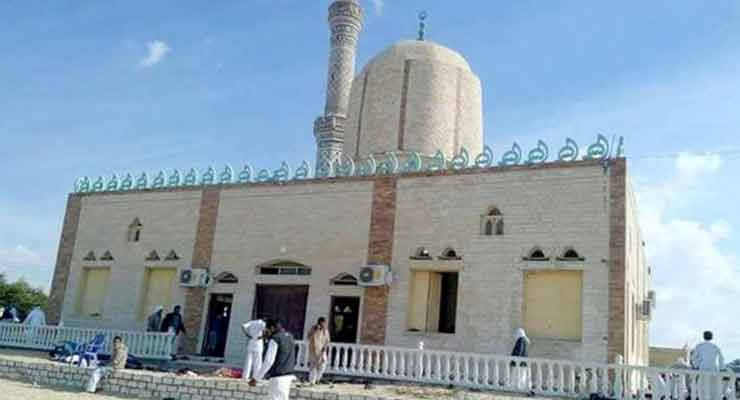
Suspected militants have targeted a mosque in the north of Egypt’s Sinai peninsula, with reports of gunfire and explosions. Scores have been killed, according to state media.

Militants were reported to have set off a bomb and opened fire at a mosque in Egypt’s restive northern Sinai on Friday, apparently targeting supporters of the security forces attending prayers there.

State media said at least 85 people were killed in the attack on the Al Rawdah mosque, some 40 kilometers (25 miles) west of the provincial capital, Arish city.

Eyewitnesses reported seeing men in four off-road vehicles arrive at the scene to carry out the attack. They were seen to plant explosives around the mosque which were detonated as worshippers left. The attackers were then said to have opened fire at those who fled.

State television said President Abdel Fattah el-Sissi had convened an emergency security meeting soon after the attack.

Some 80 people people were wounded, according to Egypt’s MENA state news agency. The Egyptian government declared three days of mourning in the wake of the attack.

Egyptian security forces are fighting an Islamic State (IS) insurgency in northern Sinai, with militants having killed hundreds of police and soldiers over the past three years as fighting there intensified.

Militants in the area have also targeted the followers of the mystical Sufi branch of Sunni Islam, as well as Coptic Christians.

Filed Under: Articles Tagged With: bombing, Egypt, mosque

Merkel: Russia’s key role in relations with Armenia, Azerbaijan is apparent to EU

November 24, 2017 By administrator

It is apparent for the European Union (EU) that Russia plays a central part in relations with the EU Eastern Partnership (EaP) countries with which we will sign an agreement today.

German Chancellor Angela Merkel on Friday stated about the aforementioned at the official opening of the EaP summit in Brussels, the capital city of Belgium.

“I’m very happy that we [already] have signed the [EU] Association Agreement with Georgia, Moldova and Ukraine,” added Merkel. “Now, we [the EU] will sign a partnership agreement similarly with Armenia and Azerbaijan. It will not be as intensive as the Association Agreement, but we will cooperate with them.

“It’s clear to us that the relations with Russia play a central role in the case of these countries. For that reason, I hope that we will realize, at today’s discourse, what the domestic political situation is in those countries.”

Filed Under: Articles Tagged With: Armenia, Azerbaijan, Merkel

  • « Previous Page
  • 1
  • …
  • 906
  • 907
  • 908
  • 909
  • 910
  • …
  • 2068
  • Next Page »

Support Gagrule.net

Subscribe Free News & Update

Search

GagruleLive with Harut Sassounian

Can activist run a Government?

Wally Sarkeesian Interview Onnik Dinkjian and son

https://youtu.be/BiI8_TJzHEM

Khachic Moradian

https://youtu.be/-NkIYpCAIII
https://youtu.be/9_Xi7FA3tGQ
https://youtu.be/Arg8gAhcIb0
https://youtu.be/zzh-WpjGltY


gagrulenet Twitter-Timeline

Tweets by @gagrulenet

Archives

Books

Recent Posts

  • Pashinyan Toys: Some of the weapons on display turned out not to be weapons at all
  • The Imperative of Preserving the Statehood of Artsakh:
  • If Pashinyan is re-elected, Armenia will become a “gubernia” of several countries
  • Mr. Karapetyan laid out the failures he inherited from the current government-and presented a clear, decisive plan
  • Anna Hakobyan Join Pashinyan, holding a motorcade rally sign of desperation…

Recent Comments

  • Tina on Anna Hakobyan prepared a heartbreaking text about the deprivations “Hraparak”
  • Baron Kisheranotz on Pashinyan’s Betrayal Dressed as Peace
  • Baron Kisheranotz on Trusting Turks or Azerbaijanis is itself a betrayal of the Armenian nation.
  • Stepan on A Nation in Peril: Anything Armenian pashinyan Dismantling
  • Stepan on Draft Letter to Armenian Legal Scholars / Armenian Bar Association

Copyright © 2026 · News Pro Theme on Genesis Framework · WordPress · Log in