Gagrule.net

Gagrule.net News, Views, Interviews worldwide

  • Home
  • About
  • Contact
  • GagruleLive
  • Armenia profile

Justice Ministry to address UN over Baku’s anti-Armenian propaganda

March 1, 2013 By administrator

March 1, 2013 – 17:53 AMT

PanARMENIAN.Net – Armenian Ministry of Justice will issue an address to the UN Committee on the Elimination of Racial Discrimination over Baku’s anti-Armenian propaganda and discrimination, deputy justice minister Yeghishe Kirakosyan said.
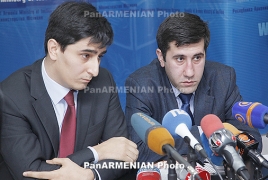
148162“The statement focuses on the extradition and pardon of Azerbaijani axe-killer Ramil Safarov, along with other facts of discrimination and hatred against Armenians,” he said.

The Committee on the Elimination of Racial Discrimination (CERD) is the body of independent experts that monitors implementation of the Convention on the Elimination of All Forms of Racial Discrimination by its State parties.

Armenian Justice Ministry’s statement will be submitted to the Committee under Article 11 of the Convention.

Ramil Safarov, the Azerbaijani army officer who was serving a life sentence in Hungary for axing to death Armenian Lt. Gurgen Margaryan, was extradited to Azerbaijan and pardoned by Azerbaijani President Ilham Aliyev.

Official Yerevan reacted by suspending diplomatic ties with Hungary. Hungary, however, states that it had sent Safarov back to Azerbaijan after receiving assurances from the Azerbaijani Justice Ministry that Safarov’s sentence, which included the possibility of parole after 25 years, would be enforced.

According to some reports, Safarov was extradited to Azerbaijan in exchange for Azeri purchase of Hungarian securities worth Euro 2-3 billion, an information official Budapest denies.

“Hungarian prime minister is “morally bankrupt” and should resign after admitting that he personally approved the transfer of the Azeri axe murderer while knowing the likely consequences,” the leader of the opposition Socialists said earlier.

Attila Mesterhazy said it was clear from Orban’s comments at a news conference on September 11 that he had been aware that Azerbaijan would release the life-sentenced Ramil Safarov after his repatriation.

– See more at: http://www.panarmenian.net/eng/news/148162/#sthash.dIajRhu2.dpuf
Filed Under: Articles

Sumgait massacres: On 25th anniversary of nightmare

February 28, 2013 By administrator

February 28, 2013 | 09:00

By Ivan Gharibyan

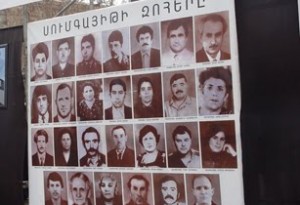
Burning buses and destroyed apartments, dead bodies, tortured and disabled people – these words come to mind when 141865speaking about industrial city of Sumgait, Azerbaijan. February 27 marks the 25th anniversary of the first ethnic pogroms in the Soviet Union’s history. On February 27-29, 1988, just a few days after the council of the people’s deputies of the Nagorno-Karabakh autonomous region decided to submit a request for the region to secede from the Azerbaijani SSR and form part of the Armenian SSR, unprecedented events in the multinational state’s history occurred in Sumgait.

The situation in the city, with lumpenproles constituting a major part of its population, was being exacerbated for several days. One more factor that complicated the situation was the absence of Jahangir Muslimzade, Head of the Sumgait Committee of the Communist Party — he was on holiday. A day before the pogroms first Secretary of the Central Committee of the Communist Party of Azerbaijan Kyamran Bagirov, and Chairman of the Council of Ministers Hasan Seyidov tried to “cool the passions.” But the passions were running high at the Chemical Industry Workers’ Club in Sumgait, and the two top-ranking officials had to leave through the back door.

On February 27, the wave of popular unrest swept over the streets. The Azeri poet Khydyr Alovlu, a staunch supporter of the “national leader” Heydar Aliyev, played a key provocative role in the events. He is the person that held high posts in the Sumgait city administration later, when the Aliyev clan came to power in independent Azerbaijan. According to Azeri sources, at a rally on February 27, Khydyr Alovlu, who considered himself a poet, cried out “Death to Armenians!”

Jahangir Muslimzade, who was attending the rally, lost control of the situation. The local authorities and law-enforcers did not act. The local Komsomol organization had to apply to Baku for help in preventing a riot and murders.

The Armenian pogroms in Baku proved to be cold shower for the Kremlin, which was completely confused by the events that were taking place for the first time in the multinational state. According to official information, 32 citizens of Sumgait were tortured to death, and hundreds of them were severely injured and disabled.

The Armenian massacre in Sumgait on February 27-29, 1988, which fact is being passed over in silence in Azerbaijan, proved to be the first sign of Azeri neo-fascism that was raising its head and later was rife and rampant resulting in Armenian massacres in Baku and Kirovadad, deportation of the Armenian population from the Shahumyan region, war unleashed in response to the Nagorno-Karabakh people’s demand for the right to self-determination.

Strangely enough, but even all the aforementioned facts are not the most terrible. Much more terrible and dangerous is the Azerbaijani leaders’ policy of sowing seeds of hatred toward the neighbors in their own people by distorting historical facts and misinterpreting the events of 1988-1994. The Aliyev clan’s style is far from being ingenious: they invented the “Khojaly genocide” to consign the Sumgait pogroms to oblivion. But the civilians killed in Khojaly were actually victims of a filthy domestic political struggle in Azerbaijan, which fact is never mentioned in Baku. And irrefutable evidence, including the statements by the then president of Azerbaijan Ayaz Mutalibov, is available. The same can be said of the Armenian pogroms in Baku on January 13-19. To hold back the truth, the Azeri leaders present the entry of troops to Baku to prevent the annihilation of non-Muslim population as Azerbaijan’s national tragedy.

It cannot be helped. The Azeri authorities continue their policy of turning their own people into a herd of cattle bereft of reason, without any knowledge of history. As the saying was in Nazi Germany “Our Fuehrer thinks for us.” This must be President Ilham Aliyev’s logic. By means of the mass media under his full control he is doing his best to develop the personality cult of his deceased father.

The only thing for us to do is to bow our heads before the innocent victims of the Sumgait pogroms organized by the Azeri cutthroats 25 years ago and thank the individual Azerbaijanis who, risking their own lives, saved their Armenian friends and neighbors.

– See more at: http://news.am/eng/news/141865.html#sthash.t7pd53ev.dpuf

Filed Under: Articles Tagged With: Sumgait massacres

We the People BY MARIA TITIZIAN

February 26, 2013 By administrator

BY MARIA TITIZIAN

Day Three
We are sitting at Café Vergnano on Northern Boulevard with a group of friends, drinking coffee watching the clock. It’s almost 5 p.m. and mariatitizian-300x284we know where we have to be. We pay the bill, gather up our belongings and begin making our way to Liberty Square. The sky is overcast and I check my bag to make sure my umbrella is there. It’s been three days since the presidential elections and every day there have been rallies. I am nervous and have difficulty catching my breath.

As we cross Tumanyan Street, we see that thousands have already gathered and even more are streaming into the square.  I begin to breathe again. As we walk into the crowd, we see familiar faces. There are artists, writers, environmentalists, ordinary men and women and lots of young people. There is a peculiar silence as everyone, standing shoulder to shoulder wait for the speeches to begin.

A group of men, holding sunflower seeds in little paper cones make their way to where we are and assemble near us. In front of me is a middle aged couple, quietly talking to one another. Their inaudible conversation is mesmerizing even though I don’t know what they are talking about, but assume it has something to do with hope. It’s almost reverent.

I turn to my right and see a well known environmental activist, a writer and my cousin standing together talking. My cousin, what can I say about him? He is the brother I never had. He is the spitting image of my grandfather, a Genocide survivor from Musa Dagh, my guardian angel in heaven who I never got a chance to meet but with whom I share an almost divine relationship. Ruben sees me and we hug each other tightly and look at each other, I can feel the tears welling up in my eyes. Every time I see him I am reminded of my family back in Canada and the crushing garod I feel for them. Ruben was born in Armenia, our fathers were first cousins. My four great uncles repatriated to Armenia in 1947 and I met Ruben for the first time when we moved to Armenia. We are not of the same political persuasion but today, in Liberty Square those lines are blurred and it doesn’t matter.

The speeches begin. There is complete silence. The air is getting colder and the crowd is swelling. I link arms with my friend Dzovig who has arrived with her family. My husband and daughter stand behind us; other friends and acquaintances surround us, and my people stand strong, resolute, hopeful. My son is here too, somewhere in the crowd, filming for Civilnet, which has been working around the clock covering the events unfolding in our lives. We are all here. Here in the square, we the people stand and wait. There is this crazy impossible love pouring out of my heart and I’m having difficulty breathing once again.

One after another, the speeches take place. Young political activists, environmentalists, representatives of civil society, presidential candidates, and representatives of other political parties take the podium and deliver their speeches. We can all feel a movement beginning to take shape, we’re not entirely sure how it will develop or how it will manifest itself but there is something taking place. In the middle of the roster of speakers, Raffi Hovhanessyan announces that the ARF has decided to join the movement and the crowd starts cheering. The group of men in front of us with the sunflower seeds turn to each other and say, “Ara, Dashnaknere miatsel en, ara es arten lurj e,” (Hey, the ARF has joined in. This is serious) and they start phoning their friends saying, “Ara, yegek, Dashnaknere miatsel en” (My cousin Ruben turns to me and says, finally. I start to breathe again.

As dusk falls on the square, no one has moved, everyone is waiting to hear what Raffi will say about his meeting with Serzh Sarkisian that had taken place a day before. There is an electric anticipation. I just keep hoping that a deal hasn’t been struck, that Raffi will make the right decision, that the people are going to keep the pressure up.

After standing in the cold for two hours, listening to one speech after another, Raffi finally steps up to the podium. He explains to the people in the square, to the people watching the rally being livestreamed throughout the country and around the world that all of his proposals for a solution to the impasse have been rejected by the president. He says that he will not back down, that he will take his message the following day to Ashtarak, Vanadzor and Gyumri. He says this is a movement for a new Armenia; he invites everyone to join the movement. This is the Barev Revolution, the Barevolution. The crowd goes wild, I think I might have whistled or jumped for joy or floated, I can’t remember. We go home, elated and wait to congregate to Liberty Square in two days.

Day Four
And indeed, the following day Raffi and his team of supporters begin their journey to the cities in the north of the country where he had been able to pull in incredible numbers, beating the incumbent in village after village, in city after city. Everywhere they go, they are greeted by thousands of people. In some places, the police have blocked roads from surrounding villages to ensure that people don’t take part. Unbroken and resolute, they leave their cars behind and walk, sometimes up to ten kilometers on foot to join their compatriots. It seems nothing will stop them from participating in what now appears to be a nationwide movement. We hear calls for a student strike. My husband and I start wondering aloud, if university students find the strength, the courage to boycott classes and join this movement, then this will be unstoppable.

Day Five
The next rally is set to take place on Sunday, February 24 at 3 p.m.. Once again we head toward Liberty Square. Hundreds of people are making their way, walking, talking, holding hands. We enter the square and make our way to our usual spot, it seems we have become regulars here. At first we notice that there aren’t as many people as two days ago, but still people are making their way into the square. Two young girls are walking through the crowd asking people to dial 180 (the number of the electric company) to demand that officials turn the electricity on, which has been turned off to prevent Raffi from addressing his supporters. I take my phone out to dial when all of a sudden I hear Raffi beginning his speech. Someone has turned the electricity on.

He speaks for about 45 minutes, he tells us about his trip to the north of the country, he informs us that the next two days he will be traveling to the south of the country, making his way to Goris and that on February 28, we will all gather once again in Liberty Square. No one else speaks, there is no vision articulated, no strategy, no game plan. A man standing behind me, who has driven here from Artashat says, I drove all this way to hear his schedule? Is this it? Raffi tells the crowd that he and his family and his supporters are going to walk to Yerablur and whoever wanted could join him. The crowd begins to disperse, Raffi, his family and supporters start walking toward Yerablur, where the martyrs from the Karabakh war are buried.

I walk away slightly stunned, slightly deflated. The euphoria we had felt two days ago begins to dissipate and I worry that without a clearly defined vision, this movement may die in its infancy. We meet up with friends, sit around and wonder what is happening. Does he have a team of strategists, does he know where he’s going to take this movement? Is he going to be able to keep up the pressure? What will his demands be? Is he going to demand Sarkisian’s resignation, call for new presidential or parliamentary elections? Is he going to give some context to the Barevolution? Is he forging alliances with other sectors of society, is he going to mobilize more people. It’s a great idea to go to the regions of the country, but what message is he taking?  Sometimes he looks like a deer caught in the headlights, surprised and unsure of how it is that he has come to be in this position.

We all want so desperately to believe that change will come. Many of us are not naïve, we realize that Serzh Sarkisian is not going to back down, we understand that this movement is not about Raffi Hovannisian or the presidency, it’s about ensuring fundamental change, about the will and rule of the people, it’s about transparency and accountability, it’s about the rule of law, about social cohesion and justice, equality, it’s about our future.

I hope that different political forces, civil society organizations, students and people will rally around this movement. I hope that our people will continue to stand strong and firm. I hope that we all understand what is at stake and I hope that Raffi can visualize and articulate a vision around which we will unite. Time will tell.

Filed Under: Articles, Opinion Tagged With: We the People

Serj Tankian sends open letter to Serzh Sargsyan: It is time for change

February 26, 2013 By administrator

Armenian American singer-songwriter, composer, lead vocalist of the rock band System of a Down Serj Tankian has sent an open letter to Serzh Sargsyan in connection with the February 18 presidential election.

Below is the full text:

“Dear Mr. President,

Serj TankianCongratulations on your victory.

Victory means getting the most votes, of course, in a democracy.

Based on the overwhelming reported fraud from many NGOs, irrespective of the OSCE report, it seems like it would be scientifically impossible for even you, Mr. President, to know whether you actually won the majority of votes.

That’s quite funny isn’t it? That you, the President of Armenia are not really sure, deep inside, whether you are the true chosen leader of your people or not.

That would really bother me personally. If I wanted to lead my people, I would really want them to make that decision for themselves, because I respect my people and that is their decision to make. Otherwise, I would take over Armenia and call myself the Governor General of Armenia or Dictator du jour or whatever moniker I felt like sporting that day. Maybe your party is out of control and the oligarchs are running out of caviar or something and they want to make sure that the flow of the good times doesn’t stop.

Whatever the case, it is time for change.

Whether you’ve won fairly or not, somehow you are now President, again.

What does that mean to you?

Yes, Artsakh is important to us all and we have to struggle together for our brothers there.

But what I mean is how are you going to progress the cause of Armenians, in Armenia and around the world?

How are you going to help pull the country out of its economic, social, and political dysfunction and turmoil?

Obama at least offers hope, even when he lets us down.

Years ago, I started a campaign asking President Obama to do the right thing and stick by his promise to recognize the Armenian Genocide.

You too took an oath, to the constitution of Armenia, to protect the country from enemies foreign and domestic. Those who steal elections from my people are domestic enemies that need to be punished.

It should be your duty to enforce that, even if some think it hypocritical. You should also consider dissolving Parliament and being the first Armenian reformist President who goes out of his way to make sure that future elections are fair and representational.

Serzh, everyone who knows me knows that I can’t stand injustice. And like most diasporan Armenians, I have always been reluctant to criticize your government directly and publicly. But the avalanche of people suffering under your rule due to corruption and injustice is tipping the scale for us all.

You need to know that.

Armenia is desperate for the rule of law more than anything else. And no one can be above the law. You can make that happen, now, by example and presidential decree.

Unite us Serzh. Inspire us.

Please take this challenge.

Thank you for your time.

Peace,

Serj Tankian.”

Filed Under: Articles, Opinion Tagged With: Serj Tankian sends open letter to Serzh Sargsyan

New documentary on Khojaly events gathers around 210,000 viewers (Video)

February 25, 2013 By administrator

February 25, 2013 | 16:31

“Between hunger and fire. Power at the expense of lives” is a new, two-series English-language documentary that tells about the blockade of Stepanakert – capital of Nagorno-Karabakh Republic – in between November 1991 and February 1992. The film uncovers a story of bombardments, country-wide destructions and atrocity crimes against local Armenian population, as well as maneuvers of Karabakh Self-Defense forces to calm down the heavy-artillery fire from around the surrounding hills of the ca141894pital, foremost stationed in Khojaly town.

The 90-minute, two-part documentary, released on YouTube, gathered around 210,000 viewers in around a week, and counting.

The documentary was originally released in Russian in February 2012, and attracted considerable attention and interest in Armenia and beyond. The “Moscow” cinema of Yerevan, various local universities hosted public screenings, discussions and lectures on the film. The documentary, part of larger endeavours, has been initiated by the Information and Public Relations Centre of the Administration of the President of Armenia.

A heavyweight against the anti-Armenian propaganda and policy of racism, sponsored by Azerbaijani government and affiliated funds, the documentary is available in English either – for the wider international community to have a wider perspective on the Khojaly events and the Karabakh liberation war at all.

It is noteworthy, that the European Court of Human Rights (ECHR) has ruled in Fatulayev v. Azerbaijan case (2010), that freedom of speech, pluralism and tolerance are essential values for an eventual democratic governance in Azerbaijan, which it aspires to have — to the contrary of human rights watchdog annual reports.

First-time ever published archival documents, testimonies, photographs, maps and interviews recollect the developments of those days of war in February 1992, offering new evidences and challenging facts against the anti-Armenian and racist propaganda of hatred and xenophobia, championed by Azerbaijan and its government affiliated funds, which had been presenting ‘Khojaly events’ in a carefully ‘doctored’ and ‘tailored’ way so far.

The film is considered for an audience of 18 and over only, as it contains detailed violence content and uncovered photographs that may cause mental unrest.

Filed Under: Articles Tagged With: 000 viewers, New documentary on Khojaly events gathers around 210

Stand presenting Azerbaijani version of Aghdam events taken place in 1992 was destroyed in Turkey

February 25, 2013 By administrator

In Turkey, a group of unknown men attacked the stand representing the Azerbaijani version of Aghdam events taken place in 1992 and known by the Azerbaijani side as “Khojalu”. According to “Haber7.com” seven people have been beaten as a result of the incident.

KhojaluTo the event of collecting signatures for pro-Azerbaijani petition, organized by the Hekberyu Tyurkchilyar Association a group of oppositionists rushed in, smashed the stand and attacked the persons responsible for the event beating them with stones, sticks and glass bottles.

On February 26, 1992, during the war in Karabakh, around 200 to 300 people (according to Human Right Watch, and 600 according to the version propagated by Azerbaijan) were killed in unknown circumstances near the city of Aghdam. They have been deliberately withheld by the Azerbaijani authorities in the midst of the military actions. Population of the village of Khojalu, which was a firing point shooting at the blockaded Stepanakert (among five others) was kept in the village for months by force and was not evacuated by the authorities of Azerbaijan deliberately, in order to use them as human shields later.

Residents of Khojalu coming out through the humanitarian corridor, that the self-defense forces of NKR had left open, freely passed more than 10 km and reached the Aghdam city controlled by the Azerbaijani troops. Later, not far from the positions of Azerbaijani troops dead bodies of the villagers were found. The exact death toll remains unknown as the official Baku publishes data contradicting each other. Parliamentary Commission investigating the tragic death of the civilians at Aghdam city was dissolved by the order of Heydar Aliyev, the investigative materials are kept secret.

Source: Panorama.am


Filed Under: Articles Tagged With: Khojalu

Armenia-Artsakh booth named best at LA Times Travel Show

February 25, 2013 By administrator

February 25, 2013 – 16:52 AMT

147393 The joint Armenia-Artsakh booth was named the best at the Los Angeles Times Travel Show held February 22-24.

The event co-sponsor, National Competitiveness Foundation of Armenia (NCFA) was awarded the prize.

The booth, which enjoyed wide public acclaim throughout the show, featured Armenia’s major travel companies, also offering information guides, films, video clips as well as dance performances and national dishes, NCFA press service reported.

Filed Under: Articles

BarCamp Yerevan 2012 Brings Together 1,000 Technologists, Activists, and Media Innovators

February 25, 2013 By administrator

Over 1,000 people converged on the American University of Armenia from June 9-10, 2012 for the 4th Annual BarCamp Yerevan. This year’s event was the largest ever, with more than 1,300 IT specialists, software developers, bloggers, civic activists, and curious newbies attending.

barcamp_2012-08-2The BarCamp format, pioneered in Silicon Valley in 2005, consists of a series of informal sessions focused on what’s new and interesting in the field of Internet and technology. The schedule is not announced in advance; participants who want to deliver presentations slot themselves into a timetable after they arrive at the event, with some sessions evolving spontaneously out of ideas sparked by on-site discussions. Popular topics include civic applications for social media, applied programming problems, and various online and mobile tools.

In addition to over 70 participant-led sessions, the camp also featured a job fair and workshops by respected trainers on guarding against DDoS attacks, protecting sensitive files on your computer, and safer internet browsing and social networking.

This year, BarCamp Yerevan organizers deviated from the typical unstructured format to invite several international guest speakers, which included media marketing consultant and trainer Mike Villers-Stuart on creating engaging online content and distribution methods, MN-RU editor-in-chief Aleksandr Bogomolov on covering the recent protests in Moscow, prominent Russian blogger and photographer Petr Lovigin on his latest creative projects, and Lana Pinayeva, head of marketing at the major Russian news agency RIA Novosti, on convergent media and the future of media consumption.

Funding for the event was provided by Internews’ “Alternative Resources in Media” project through USAID, as well as companies Orange, AtTask, BetConstruct, and Be2 and the Russian RIA Novosti news agency.

Filed Under: Articles

Unforgetting Iraq- CrossTalking Peter Lavelle RT (Video)

February 25, 2013 By administrator

Even after the US occupation, Iraq continues to witness external intervention on an enormous scale. Is this what is driving the country towards becoming a failed state? Is the Maliki government contributing to Iraq’s fragmentation?

And why is Iraq currently out of the media spotlight, despite all the things happening there? CrossTalking with Pepe Escobar, Sami Ramadani and Meir Javedanfar.

Filed Under: Articles, Videos Tagged With: Unforgetting Iraq- CrossTalking Peter Lavelle

Kurdish women in Syria create first female battalion

February 24, 2013 By administrator

For the first time in Syria, 150 Kurdish women have set up a female-only battalion in the northern province of Aleppo, which has seen some of the heaviest fighting since the start of the Syrian uprising in early 2011.

Kurdish Woman BattalionThe news comes from a statement by the Syrian Observatory for Human Rights on Saturday. While women have been known to fight alongside men in both pro and anti-regime forces – as well as the Kurdish militia, it is the first time they have formed their own fighting unit. An amateur photograph has been circulating on the internet, showing rows of women in military fatigues during training.

The announcement comes a month after the government set up paramilitary units called the National Defense Forces, which have actively been seeking to recruit women of all ages. This is testimony to the steady increase of women’s numbers in armed units. They are also becoming very useful in assisting male fighters, as they arouse less suspicion when transporting supplies and weapons.

“Women are fighting on all the fronts now, though it’s possible the Islamist rebel ranks have the fewest women taking part in them,” says Abdel Rahman of the Observatory.
The Kurdish question

The city where the battalion originated is Afrin, which in late 2012, was the last scene of fighting between Kurdish units and Arab militias fighting the regime of President Bashar Assad. While a number of Syrian Kurds remain neutral, they also exist on both sides of the current Syrian split, getting invariably involved in the violence.

The Kurds also happen to be the second largest ethnic group in Syria, comprising three out of the 23 million of its total population. They have been discriminated against in Syria by several Arab regimes, often being denied citizenship, similar to their plight in other states in the region. Their eventual goal seems to be autonomy within a united Syria.
In January, at least 56 were killed in a week’s fighting in north-east Syria between anti-Assad rebels and the long-oppressed Kurdish minority, in which tanks and mortars had been used against the Kurds. While the rebel-on-government violence was to the west and south, the Kurds used the opportunity to set up schools and cultural centers, as well as armed militias and police units. The rebels have been blaming them for seeking self-rule by using the civil war to their advantage.

And many Kurds do tread carefully, knowing that President Assad’s failure to crush the rebellion could spell doom for their own ethnic group as well. They fear that the rebels would not honor the autonomy of various regions – especially one that holds around 2.5 billion barrels of Syria’s crude oil reserves.

Living predominantly in the mountainous regions of the north, the Kurds are situated next to the Turkish border. Their political group, the Democratic Union Party (PYD) is closely allied to the marginalized Kurdish faction in Turkey – the PKK. President Assad, according to some, has chosen to seize the opportunity for friendship with the Kurds, many of whom never joined the uprising against him. This could also play into his hands in light of the Turkish government’s opposition to his regime.

However, the Syrian Jihadists have directed huge blame at the Kurds for not participating in the uprising. Clashes between rebels and Kurds have intensified as soon as government forces withdrew from Kurdish-held areas in the summer of 2012. Often very little incidents at checkpoints had started major firefights between the Kurds and the rebels.

This split is one among several ethnic fault lines that run parallel to the Syrian revolution of 2011. In its two years, it has grown into a fully-fledged civil war and took more than 70,000 lives, according to UN estimates. It has also made more than 650,000 flee their homes, while over a million are displaced

Filed Under: Articles Tagged With: Kurdish women in Syria create first female battalion

  • « Previous Page
  • 1
  • …
  • 2038
  • 2039
  • 2040
  • 2041
  • 2042
  • …
  • 2068
  • Next Page »

Support Gagrule.net

Subscribe Free News & Update

Search

GagruleLive with Harut Sassounian

Can activist run a Government?

Wally Sarkeesian Interview Onnik Dinkjian and son

https://youtu.be/BiI8_TJzHEM

Khachic Moradian

https://youtu.be/-NkIYpCAIII
https://youtu.be/9_Xi7FA3tGQ
https://youtu.be/Arg8gAhcIb0
https://youtu.be/zzh-WpjGltY


gagrulenet Twitter-Timeline

Tweets by @gagrulenet

Archives

Books

Recent Posts

  • Armenia’s Education Crisis: The PISA 2025 Results Should Concern Every Armenian
  • An Armenian Story Reaches the British Royal Family
  • Pashinyan & Company, greedy, evil, all-hating & all-powerful people clinging to their chairs…
  • Why Diaspora Armenian Must Begin Discussing a Government in Exile?
  • Israel recognized Armenian Genocide, Pashinyan in Panic

Recent Comments

  • Tina on Anna Hakobyan prepared a heartbreaking text about the deprivations “Hraparak”
  • Baron Kisheranotz on Pashinyan’s Betrayal Dressed as Peace
  • Baron Kisheranotz on Trusting Turks or Azerbaijanis is itself a betrayal of the Armenian nation.
  • Stepan on A Nation in Peril: Anything Armenian pashinyan Dismantling
  • Stepan on Draft Letter to Armenian Legal Scholars / Armenian Bar Association

Copyright © 2026 · News Pro Theme on Genesis Framework · WordPress · Log in