Gagrule.net

Gagrule.net News, Views, Interviews worldwide

  • Home
  • About
  • Contact
  • GagruleLive
  • Armenia profile

Ahead of Election in Cyprus, Gloom and Voter Apathy Tied to Financial Woes

February 24, 2013 By administrator

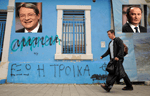
Graffiti that reads “Troika get out,” in Limassol, Cyprus.
By NICHOLAS KULISH
Published: February 23, 201
bull-cyprus1LIMASSOL, Cyprus — Evagoras Georgiou will go to the polling station at the Tsireio middle school in the St. John neighborhood here for Sunday’s presidential election. But he will leave his ballot blank, voting for neither of the two candidates in the runoff for Cyprus’s most powerful political office.

Both candidates have promised to abide by a deal with international lenders that promises to help the country service its debts but that will bring harsh austerity and recession with it.

Mr. Georgiou, 28, studied business management in Britain and returned almost a year ago to look for work. He has yet to find a job and says he believes that a deal with the European Commission, the European Central Bank and the International Monetary Fund — known collectively as the troika — will only make matters worse.

“They both have the same policies but find a way to make the public believe they disagree,” Mr. Georgiou said of the two candidates. “We see that any country with a troika agreement is ridden with debt and has high unemployment of youth.”

What many Cypriots find most frustrating is that their crisis, like those in Ireland and Iceland before them, was concentrated in the banks. There is no sovereign debt crisis and, before the banking collapse, their economy was relatively healthy. Why, they wonder, should they suffer for the misdeeds of a few bankers? Why cover losses that should be borne, at least in part, by private investors?

This small Mediterranean nation goes to the polls at a moment of rising uncertainty and apprehension. Nicos Anastasiades, the leader of the conservative party Democratic Rally, is expected to best Stavros Malas, who is backed by AKEL, the Communist party.

Mr. Anastasiades comes from the same conservative bloc in Europe, the European People’s Party, as Chancellor Angela Merkel of Germany. Ms. Merkel came here for a party conference in January and met with Mr. Anastasiades at that time.

But on the subject that preoccupies many Cypriots, the anticipated bailout, the difference between the two candidates may be slim. Mr. Malas has called for a softening of the harshest austerity measures but otherwise has promised to stay the course with the sort of budget-slashing measures advocated by Germany that have led to deep recessions in other European countries.

“Fundamentally, the average Cypriot and even the average politician realizes this model being imposed by Germany all over Europe is flawed,” said Bambos Papageorgiou, who is a member of the Cypriot Parliament’s finance committee from AKEL and who used to work in the London derivatives market. “But our situation is such that we can’t avoid negotiating.”

Cyprus has known its share of adversity. The island has been divided since the Turkish Army invaded the northern part of the island in 1974. United Nations peacekeepers still patrol the buffer zone, which runs through the center of the capital, Nicosia.

Graffiti written in black spray paint near one of the blue and white guard posts at the edge of the zone on the Greek side reads “Troika Go Home.”

Cyprus has been unable to raise money in international bond markets for a year and has been kept afloat only by a loan of $3.5 billion from the Russian government. That allowed it to put off the final reckoning, which is now coming due.

In absolute terms, the bailout of Cyprus under discussion is quite small compared with the cost of keeping Greece afloat, around $22 billion compared with roughly $327 billion. But German politicians have balked at what they see as a bailout for Russian oligarchs and money launderers, who they say keep their money in Cypriot banks.

Cyprus signed a memorandum of understanding with the troika in November, cutting salaries for government workers by up to 15 percent. Additionally, public pension payments were pared back by as much as 10 percent, and the value-added tax will rise. Both sides decided to wait until a new government was in place to complete the bailout.

In the meantime, Cyprus’s economy shrank by roughly 2.3 percent last year, according to preliminary estimates by the government statistics office, driving the unemployment rate up to 14.7 percent by the end of the year.

Though frustrated, European voters have tended to hold their noses and vote for pro-bailout candidates, as they did in Greece last year when Antonis Samaras eked out a victory over Alexis Tsipras’s radical-left Syriza. But political analysts wonder how long their patience will hold as austerity measures punish the most indebted countries and their pared-back spending pulls down even the Continent’s healthier economies.

And there is little hope for a rapid recovery. The European Commission said Friday that the economy of the euro zone would shrink 0.3 percent in 2013. The commission also forecast that Cyprus’s economy would shrink 3.5 percent this year and 1.3 percent in 2014.

Marios Mavrides, a member of Parliament with Democratic Rally and a professor of economics at the European University Cyprus, predicted that as the deep budget cuts mandated by the troika began to bite, recession would last all the way into 2015.

“We need to go through a deep recession. There’s no other way,” Mr. Mavrides said. “The banking system is virtually hanging from a single thread.”

The mood is especially pessimistic among young Cypriots. “I don’t see any future for the young generation,” said Marios Georgiou, 30, a sales representative in Nicosia, who said he was saving money to emigrate, possibly to Australia or Canada.

In the meantime, property developers have started placing their hopes on Asian investors. The highway between Limassol and the resort town of Paphos is lined with billboards advertising property in Chinese characters. Christos Charalambous said that his employer, Kleanthis Savva Developers, had several dozen clients from China.

“We hope that this year things will turn around. Last year was the worst that I can remember in the real estate business,” said Mr. Charalambous, who has worked in the industry for a decade. “If 2013 is worse than 2012, many businesses will default.”

There is hope on the horizon, in the form of substantial natural gas reserves discovered in the waters between Cyprus and Israel. Recalling the difficult period four decades ago after Turkey invaded, Andreas Christou, Limassol’s mayor, said he remained optimistic. “We shall find a way to survive,” he said.

Andreas Riris contributed reporting.

Filed Under: Articles Tagged With: Ahead of Election in Cyprus

Turkish Airline becoming gateway for Somalis Using Fake Passports to Europe.

February 23, 2013 By administrator

By ABDI GULED Associated Press
MOGADISHU, Somalia February 22, 2013 (AP)

Somalis aided by human traffickers are using fake passports to board the Mogadishu-to-Istanbul flight as a way to flee to Europe, a Somali official and Turkish Airlines said.

Turkish Airline last year became the first international airline to fly direct to Mogadishu after two decades of conflict isolated the East African nation. Somalia’s government said that Somali asylum seekers are using fake passports that belong to Somali-Europeans smuggling networks to get to Europe by flying out of the country on Turkish Airlines.

“After the city got some stability, human traffickers returned with scams,” said Gen. Abdullahi Gafow Mohamud, Somalia’s immigration and naturalization department chief. “The problem increased when Turkish Airlines started operating here. Somalis in Europe are increasingly using fake passports to smuggle people illegally into Europe.”

Mohamud said Somali officials caught three people using fake passports last week. He accused Somalis in Europe of being part of the scam. Residents in Somalia pay thousands of dollars for the use of the false passports.

“They look for people with similar features, so that they give their passports to them to assist the person to get to Europe unnoticed. We can’t ignore it anymore,” he said.

Mohamud showed reporters bundles of fake passports he said were used by human traffickers.

Turkish Airlines confirmed that such scams are happening. Merve Oruc, a spokesman for the airline, said in an email that the airline is experiencing “some problems” with fake passports.

“And because of it, (the) visa department of our subsidiary, Turkish Ground Services, goes to Mogadishu for each flight and works together there with Immigration Office,” Oruc wrote.

The Somali government is concerned the smuggling scams could lead to the stoppage of the Istanbul-Mogadishu flight. Oruc said the airline has no plans to discontinue the flight.

Since African Union forces ousted al-Shabab fighters from Mogadishu about 18 months ago, a relative peace has returned to the war-battered city, creating a new sense of hope and opportunity in the seaside city.

At the height of violence in Somalia thousands of Somalis fled across the Gulf of Aden into Yemen ever year and dozens perished at sea while trying to cross the Red Sea in rickety boats. Despite the new, relative peace, many Somalis are still trying to flee to Europe or North America.

Human traffickers are banking on the relatively weak Somali passport security to pass through the system unnoticed. World governments rarely grant visas to Somali passport holders, leading many Somalis to believe that an illegal human trafficking route is their only way to get to Europe.

Filed Under: Articles

Commemoration ceremonies scheduled in Ukraine on massacres of Armenians in Sumgait

February 23, 2013 By administrator

13:55, 23 February, 2013

709374YEREVAN, FEBRUARY 23, ARMENPRESS: All Armenian churches in Ukraine are scheduled to conduct requiem on mass massacres of Armenians in Sumgait. As Armenpress reports citing Analitika.at.ua web site Grigory Buniatyan, the head of Armenian Apostolic Diocese in Ukraine stated the commemoration events dedicated to the memory of innocent victims are due on February 24.

”Armenians all over the world are commemorating 25 th anniversary of Sumgait massacres. Armenian large communities from the corners of the world are going to host various events on this day. Documentary films about bloody events in Sumgait will be demonstrated then” the web site runs. Massacre perpetrated against Armenian population living  in Azerbaijani Sumgait city was the first boom of Soviet Union ethnic violence. Sumgait massacres last for three days, were accompanied by massive violence, plunder and murder.

Filed Under: Articles Tagged With: massacres of Armenians in Sumgait

Hovannisian Vows to Continue Popular Movement

February 23, 2013 By administrator

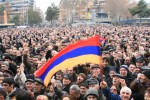
YEREVAN—“This popular struggle will not die down. We will achieve victory,” said opposition presidential candidate Raffi Hovannisian on Firday as he addressed thousands of supIMG_8627porters who had gathered at Liberty Square to hear a briefing on his meeting Thursday with Serzh Sarkisian at the Presidential Palace.

Hovannisian, who addressed the crowd that has been multiplying exponentially since Monday’s elections, reported that Sarkisian rejected all of his proposals, which aimed to satisfy the aspirations of Armenia’s citizens following the presidential polls.

Square at 3 p.m. Sunday to further the movement.

ARF Joins the Movement
The Armenian Revolutionary Federation joined the thousands upon thousands of Armenian citizens gathered at Freedom Square Friday, with the party’s Supreme Council of Armenia representative Armen Rustamian delivering a powerful message of solidarity with the people.

After a series of speeches by Raffi Hovannisian’s Heritage Party leaders, other opposition leaders, civil society activists, and artists, Hovannisian introduced Rustamian, saying: “Today we are joined by a political figure whose party, our party, the party of my ancestors, in the name of the fatherland, unity, our national interests, the rights of the citizen, and our  state’s sovereignty, wages a struggle wherever it is necessary, from Strasbourg to Ankara to Moscow to Washington…. Please welcome the representative of the Armenian Revolutionary Federation (ARF) Armen Rustamyan.”

Rustamian first spoke of the ARF decision to come to Freedom Square. “For a few days now, Freedom Square was waiting for—and wanted to see—the ARF. And we are now here! We have come here, to this rally, because as we announced earlier, the ARF stands with you, with the people,” he said.

Rustamian noted that the Armenian people proved on Feb. 18 that it’s impossible to kill justice and freedom. He said, “The people does not tolerate the rotten political, social, economic, and moral environment.”

Rustamian joined other opposition leaders at the rally in their criticism of the statements of international observers, who deemed the elections fair. “Regardless of what the international observers say, it is you who took part in the election, and you know all too well what really happened,” Rustamian said.

“This is an unstoppable movement to establish the rule of the people,” argued Rustamian.

Filed Under: Articles Tagged With: Hovannisian Vows to Continue Popular Movement

The Gulen Movement in Azerbaijan & a quid pro quo?

February 22, 2013 By administrator

By: Sharon Higgins,
It requires an ongoing effort to even minimally understand the Gulen movement, the secretive and controversial religious group which operates the largest charter school network in the United States. Details about this group’s structure, recruitment and control of members, were recently presented by Fuad Aliyev in “The Gulen Movement in Azerbaijan” (12/27/2012).Sharon HigginsHis article appeared in Current Trends in Islamist Ideology, a publication of the Hudson Institute’s Center on Islam, Democracy and the Future of the Muslim World. Aliyev is a Fulbright Scholar at the Central Asia-Caucasus Institute at the School of Advanced International Studies at Johns Hopkins University.

Azerbaijan is the largest country in the Caucasus, a geopolitical region at the border of Europe and Asia [see maps below]. It has enormous energy reserves, including one of the largest natural gas fields in the world, the Shah Deniz II. Only discovered in 1999, this field will be the origin point for the Nabucco gas pipeline, a project being planned that will bring the first gas ever from the Caspian Sea basin to Europe, via Turkey. Construction has not yet commenced, but if built, the Nabucco pipeline will be one of the largest engineering projects in the world. Some estimates say it will be operational by 2017. The Nabucco will join the Baku-Tbilisi-Ceyhan pipeline, an oil pipeline from Azerbaijan to a Turkish port on the Mediterranean, a project that was first proposed in 1992 and completed in 2005.
The Gulen movement opened its first school in Azerbaijan in 1992. This was first school it opened outside of Turkey (see this article about its 20th anniversary from a Gulenist news source). The movement had expanded into Azerbaijan immediately after independence was attained in 1991 as a result of the dissolution of the Soviet Union. As Aliyev wrote, “Since the arrival of the [Gulen movement] in Azerbaijan, it has made a targeted effort to recruit the children of the country’s elite into their education institutions.” It has been reported that the offspring of many influential Azerbaijani officials are attending these schools.
Given the timing and other indicators, something to ponder is if interests in these newish energy sources in which Turkey is an integral player might have some bearing on our government’s unique relationship with Fethullah Gulen and his increasingly powerful group of intensely business-oriented followers. Is this somehow tied to the generous funding continually being provided to the Gulen movement for its charter school expansion? Is it tied to the strange silence from US Secretary of Education Arne Duncan and other members of our government about the fact that a secretive and controversial religious group from a foreign country is operating so many charter schools (none in 1998, two in 1999, and now 135)? Is our government enabling the Gulen charter school expansion as some sort of quid pro quo? There is an enormous amount of information which should be presented to the American public so that this large subject can be opened up for a much wider level of discussion.
READ MORE >>>
Petitioning The President of the United States

Filed Under: Articles, Opinion Tagged With: The Gulen Movement in Azerbaijan & a quid pro quo?

Azerbaijan is responsible for events in Khojaly – Armenia’s first ombudswoman

February 22, 2013 By administrator

February 22, 2013 | 15:20

YEREVAN. – Azerbaijan is responsible for the events that occurred in Khojaly on February 25–26, 1992, Armenia’s first Human Rights Defender, “Against Legal 141557Arbitrariness” Foundation Executive Director Larisa Alaverdyan stated during a press conference on Friday.

“Azerbaijan has no ethical and political right to raise matters that are based on lies and distorted facts. Is it not true that, reflecting at the time on the events of Khojaly, first President of the Republic of Azerbaijan, Ayaz Mutalibov, had stressed that the pogrom [in Khojaly] was orchestrated and carried out by the opposition members of the Azerbaijani Popular Front [Party], whose objective was to overthrow the functioning government?” Alaverdyan stressed.

At the same time, she pointed to the mistakes the Armenian side had committed. As per Alaverdyan, the 1995-1996 initiative that was related to Karabakh appeared in Azerbaijani hands, and before that, however, Armenia was performing successfully with a variety of initiatives to settle the key issue.

Filed Under: Articles Tagged With: Azerbaijan is responsible for events in Khojaly

Canadian parliamentarian issues statement on 25th anniversary of Freedom Movement in Nagorno-Karabakh

February 22, 2013 By administrator

Canadian parlamentrianHonorable Jim Karygiannis, Member of Parliament for Scarborough-Agincourt, issued a statement on the 25th anniversary of the Freedom Movement in Nagorno-Karabakh (Artsakh), karygiannismp.com reported.

The statement, published on the official website of the parliamentarian, says that February 20, 2013, marks the 25th anniversary of the birth of the movement that led to the liberation of the people of Nagorno-Karabakh (Artsakh).

On that day in 1988, the legislature of Nagorno-Karabakh appealed to the administrations of the Armenian and Azerbaijan Soviet Socialist Republics for a peaceful transfer of Nagorno- Karabakh from Soviet Azerbaijan’s administrative rule to that of Armenia. A week later, a wave of anti-Armenian pogroms took place in Sumgayit, the second largest Azeri town. Dozens of people were tortured and murdered just for being Armenian. Such atrocities also occurred in Baku, Azerbaijan.

“As the Soviet Union collapsed, the newly-independent Azerbaijan launched a full-scale war against Nagorno-Karabakh. In May 1994, following the bloody conflict, Azerbaijan signed a cease-fire agreement with the Nagorno-Karabakh Republic,” says Karygiannis.

He emphasizes that today the Nagorno-Karabakh Republic is a de facto independent, democratic and fully functioning state, with a thriving market economy and a dynamic civil society, which is working toward entrenching its freedom and the formal recognition of its independence.

“In July 2012, I led a team of Canadian Election Observers for the Presidential Election in the Republic of Nagorno-Karabakh. It was a picture of perfect election from start to finish and witnessing the election process in a new democracy was a positive learning experience,” notes Karygiannis.

Filed Under: Articles

Armenian Genocide 98th Anniversary Commemoration to be held in Times Square on April 21

February 22, 2013 By administrator

Armenian genocide 98A large throng is expected to participate in the 98th Anniversary Commemoration of the Armenian Genocide to be held in Times Square (46th St. & Broadway) on Sunday, April 21 from 2-4 pm. The organizers invite people of all backgrounds to join together to commemorate the Armenian Genocide and subsequent genocides during Genocide Awareness Month and to speak out against this horrendous crime against humanity, ereleases.com reports.

The theme of the Armenian Genocide Commemoration is “Turkey is Guilty of Genocide: Denying the Undeniable is Criminal.” This historic event will pay tribute to the 1.5 million Armenians who were massacred by the Young Turk Government of the Ottoman Empire and to the millions of victims of subsequent genocides worldwide. Speakers will include civic, religious, humanitarian, educational, cultural leaders, and performing artists.

Dennis R. Papazian, PhD, immediate past National Grand Commander of Knights of Vartan and Founding Director of the Armenian Research Center at the University of Michigan-Dearborn, and Dr. Mary A. Papazian, President of Southern Connecticut State University, will preside over the ceremonies.

Dr. Dennis Papazian comments, “Recent momentous events encourage me to believe that the long vigil of the Armenian people waiting for recognition of their genocide by the Turkish government may be coming to a positive conclusion. An influential Kurdish leader in Turkey, a member of Parliament and vice-president of the pro-Kurdish Democratic Society Congress, Ahmet Turk, admitted that the Kurdish people played a significant role in the ‘torture and massacre of Armenians, Assyrians and Yezidis’ during the Armenian Genocide and apologized to the Armenian people. Turk stated, ‘Our grandfathers and fathers were used in the injustices perpetrated against Armenians, Assyrians and Yezidis. There is blood on their hands. With the blood of these peoples they bloodied their own hands. Thus, as their children and grandchildren, we apologize.’”

Dr. Papazian continues, “A second momentous event was the publication of a book in Turkey entitled ‘The Armenian Genocide’ by Hasan Cemal, the grandson of Cemal (Jamal) Pasha, one of the three main authors of the Armenian Genocide. Hasan Cemal, a member of the Turkish establishment and a newspaper columnist, began his inquiry into the Armenian Genocide following the killing of Turkish diplomats by a group of young Armenians who went by the name of ASAlA. At first, Hasan Cemal supported the official government point of view, and as he became more knowledgeable, finally concluded that indeed there was a genocide of the Armenians perpetrated by the Young Turk party which controlled the Ottoman government in 1915-1923. The book has inspired many members of the Turkish elites to reevaluate their denial of the Armenian Genocide.”

Papazian adds, “Itzak Alaton, the owner of one of the largest corporations in Turkey, urged the Turkish Socio-Economic Research Center to pursue the Turkish recognition of the Armenian Genocide.” ”April 24, 1915 is just around the corner,” stated Alaton, “let us change our denialist policies. I am tired of the fear to face our past. Let us raise our voices to our deputies in Ankara and those deputies should raise their voices to their political parties and leaders in order for us to open our skeleton-fill closets.”

Source: Panorama.am

Filed Under: Articles, Genocide Tagged With: Armenian genocide 98

Norm Naimark, Orhan Pamuk on Armenian genocide, Turkish denial

February 22, 2013 By administrator

Norm Naimark

“ThiOrhan Panukrty thousand Kurds have been killed here, and a million Armenians. And almost nobody dares to mention that. So I do.”

After Turkish author Orhan Pamuk made those remarks in 2005, rallies were held to burn his books and a hate campaign forced him to flee the country.  When he returned, the future Nobel laureate faced a criminal trial.

He stood his ground:  “What happened to the Ottoman Armenians in 1915 was a major thing that was hidden from the Turkish nation; it was a taboo. But we have to be able to talk about the past.”

Norm Naimark would agree:  “A healthy national consciousness cannot abide nasty secrets hidden away in a locked drawer.”

For Turkey, there are practical consequences to the government’s official denial of genocide – scholars have been intimidated into doing research, denied access to research, and governments held hostage.

Naimark has edited a new volume of essays, just released by Oxford University Press: A Question of Genocide: Armenians and Turks at the End of the Ottoman Empire. After reading this book, no one will be able to deny the Armenian genocide.  [Note:  If you want to see how bad it was, do an image search on google for “Armenian genocide” — I will not use those photos. They are dehumanizing.]

For Naimark, whose provocative Stalin’s Genocides was widely discussed and critically praised, a critical question is how, in fact, do these frenzies happen?

Context is everything.  “It is not too strong to state that war serves as a breeding ground for genocide,” he writes in his preface.  War provides justifications and possibilities.

“In the minds of Turkish nationalists, the Armenians’ traditional designation as gâvur (infidels) took on some of the elements of race prejudice and was reinforced by popular resentment of alleged Armenian wealth and treachery. That ‘Christians’ had driven the Ottomans out of southeastern Europe during the Balkan Wars of 1912–1913 and now threatened the integrity of the Anatolian lands of the Turks from outside and within made the Armenian threat even more dangerous from the Young Turk point of view.”  The Young Turk ideology claimed the racial superiority of Turks to Armenians.

Envy and greed also play a role.  A trigger is often rapid status reversals, “especially when class and ethnicity are both involved” as well as racial and religious prejudices.

Rarely does genocide fix itself exclusively on one set of victims – in this case, Anatolia’s Assyrians were also targets; so were Greeks.naimark-200x300

According to Naimark, “the whirlwind of killing pulls in more and more victims and implicates an increasing number of assailants.”

Here’s what I find interesting:  Genocide happens at a number of levels of government, each with their own methods of implementation and decision-making.   “Every case of genocide is in some measure local,” he writes.

“Recent research on mass killing indicates that the crime of genocide needs to be thought of as occurring at various levels of society: at the very top, where decisions are taken that lead to mass murder; at the ‘meso-level,’ where regional officials and their accomplices, the police and military, implement orders or interpret signals from the political leadership that lead to genocide; and at the most basic local level of society, where individuals participate in the killing, steal from the victims, move into their houses, or witness the depredations. Sometimes, locals try to save individuals and families, or protest against the deportation or murder of their neighbors, usually in vain.”

Genocide is not an “event” but a process – one that follows “unwritten rules of historical behavior.”  The deportation and killing of Ottoman Armenians began in the spring of 1915 and accelerated over the next six months – but it wasn’t truly finished until the early 1920s, in the face of outside stabilizing political events.

The end product was the destruction of the Armenian community in Anatolia – as in most cases of genocide, the events took place in full view of the international community,” writes Naimark. In this case, the great powers were at war, and Realpolitik trumped humanitarian considerations.

As a result is a haunting betrayal of responsibility: “The conscience of contemporary world society is haunted by images of doomed Armenian women and children, wandering aimlessly in the Anatolian plateau, mad with hunger and grief, and by photographs of rows of corpses of murdered Armenian men and boys, guarded casually by Turkish soldiers.”

And the perps? W.H.  Auden put it best:

All if challenged would reply
– ‘It was a monster with one red eye,
A crowd that saw him die, not I. —


Filed Under: Articles, Books Tagged With: Orhan Pamuk on Armenian genocide, Turkish denial

British Magazine: Azerbaijan Election-rigging, torture of opponents, corruption marked family rule of both Heydar and his son

February 21, 2013 By administrator

The Aliyev family has been having its way with the Azerbaijanis for decades. Heydar Aliyev, the family patriarch, was a Communist Party boss in the best of Stalinist traditions from the 1960s, and president of Azerbaijan from 1993 to 2003. His son, Ilham Aliyev came out of the security apparatus, which left him well positioned to New Intenationaltake over from his father, the New Internationalist says.

“Good contacts in the security apparatus have proved more important than democratic credentials in much of former Soviet Asia. The countries of the Caucasus, where Azerbaijan is perched on the western shores of the Caspian Sea, must walk a thin line between Russia in the north and the Islamic world further south, while at the same time making nice with a Europe hungry for oil and gas, and a US empire obsessed with geo-political positioning. Little wonder the desires and needs of ordinary Azerbaijanis get lost in the shuffle,” the paper says.

“Election-rigging, torture of opponents, widespread corruption and ostentatious displays of power and wealth have marked the family rule of both Heydar (who died in 2003) and his son,” the magazine writes. Ilham keeps on top of things today with a slight democratic veneer for foreign consumption but the name of the game remains the same – autocratic self-enrichment by a narrow ruling circle. Transparency International rates Azerbaijan as the sixth most corrupt country in the world.

“The name of the beneficent Aliyevs is everywhere. If you are lucky enough to fly to the country’s capital, Baku (a fine old city made prosperous by petro-dollars), you get to land at Heydar Aliyev International Airport. While in town you can attend a seminar at the Heydar Aliyev Heritage Research Center. Then perhaps a visit to the beautiful $250-million Heydar Aliyev Cultural Center. You get the idea,” the author says.

According to the author there is no need to go all the way to Baku to pay homage to the dead dictator. The statues that are popping up in capitals all over the world – Cairo, Belgrade, Mexico City – have locals scratching their heads. “Who is this guy, anyway?” wonders the author.

“Like so many oil-rich places, Azerbaijanis find oil a mixed blessing. It means a high per-capita income and great potential, if equitable development policies were in place. But in practice it has meant a petro-state with all the trimmings: kleptocracy, inequality, boss-type politics and environmental degradation,” the article says.

According to the article At just over $5,000, the per-capita income is high for the region, but there is much rural poverty beyond the glitz of Baku and a large refugee problem (set officially at over 600,000) – mostly as a result of the war with neighboring Armenia over the disputed territory of Nagorno-Karabakh.

Ilham’s rule, despite going through the motions of democracy, has been marked by the absolute repression of anyone calling for the real thing. Opposition parties have consistently failed to gain any representation at all running against Aliyev’s New Azerbaijan Party and his 85-per-cent-plus votes in presidential elections are typical dictator-style numbers. When the Arab Spring spilled over into Azerbaijan there were no concessions from Ilham’s government: just a major clampdown, with some 400 protesters still languishing in prison. Freedom of the press and internet are now severely restricted and independent journalists are subject to beatings, imprisonment and blackmail.

The article also notes that the Aliyevs have always been cunning players of the nationalist card. In September 2012 Ilham officially pardoned Lieutenant Ramil Safarov, who had been convicted of murdering a sleeping Armenian soldier on a 2004 NATO-sponsored language course in Hungary. “Ilham got the Hungarians to send him home to serve out the rest of his sentence and promptly granted him not only his freedom but a promotion to Army Major, back pay and a new flat. Azerbaijani nationalists were ecstatic, Armenians outraged and the Hungarian government embarrassed over rumours of a large loan of Azerbaijani oil money,” New Internationalist says.

Source: Panorama.am


Filed Under: Articles Tagged With: Azerbaijan Election-rigging

  • « Previous Page
  • 1
  • …
  • 2039
  • 2040
  • 2041
  • 2042
  • 2043
  • …
  • 2068
  • Next Page »

Support Gagrule.net

Subscribe Free News & Update

Search

GagruleLive with Harut Sassounian

Can activist run a Government?

Wally Sarkeesian Interview Onnik Dinkjian and son

https://youtu.be/BiI8_TJzHEM

Khachic Moradian

https://youtu.be/-NkIYpCAIII
https://youtu.be/9_Xi7FA3tGQ
https://youtu.be/Arg8gAhcIb0
https://youtu.be/zzh-WpjGltY


gagrulenet Twitter-Timeline

Tweets by @gagrulenet

Archives

Books

Recent Posts

  • Armenia’s Education Crisis: The PISA 2025 Results Should Concern Every Armenian
  • An Armenian Story Reaches the British Royal Family
  • Pashinyan & Company, greedy, evil, all-hating & all-powerful people clinging to their chairs…
  • Why Diaspora Armenian Must Begin Discussing a Government in Exile?
  • Israel recognized Armenian Genocide, Pashinyan in Panic

Recent Comments

  • Tina on Anna Hakobyan prepared a heartbreaking text about the deprivations “Hraparak”
  • Baron Kisheranotz on Pashinyan’s Betrayal Dressed as Peace
  • Baron Kisheranotz on Trusting Turks or Azerbaijanis is itself a betrayal of the Armenian nation.
  • Stepan on A Nation in Peril: Anything Armenian pashinyan Dismantling
  • Stepan on Draft Letter to Armenian Legal Scholars / Armenian Bar Association

Copyright © 2026 · News Pro Theme on Genesis Framework · WordPress · Log in