Gagrule.net

Gagrule.net News, Views, Interviews worldwide

  • Home
  • About
  • Contact
  • GagruleLive
  • Armenia profile

Armenian Genocide movie ‘The Cut’ to screen at 2015 Fresno Film Festival

October 29, 2015 By administrator

The-Cut-5-620x300Asbarez – A historical epic seven years in the making about the Armenian Genocide will make its Central Valley debut at the 2015 Fresno Film Festival.

“The Cut” will screen at 3:00pm on Saturday, November 14 at the historic Tower Theatre, as part of the November 13-15 Festival, which celebrates independent voices in cinema.

Beginning in Armenia in 1915, “The Cut” follows one man’s journey through the Ottoman Empire after surviving the Genocide. Nazaret (Tahar Rahim), a young blacksmith from Mardin, Turkey, is ripped from his family and is forced to work as a slave laborer. Years later, he begins a continent-crossing quest to reunite with his twin daughters.

Turkish-German filmmaker Fatih Akin directed and co-wrote the film with Armenian-American screenwriter Mardik Martin. Martin—best known for writing the Martin Scorsese films “Raging Bull,” “New York, New York” and “Mean Streets”—will make a special appearance to discuss the film, presented by Fresno Filmworks and co-sponsored by the Armenian Studies Program at Fresno State.

With few films touching on the genocide, let alone depicting it, Martin said in a news release: “A story about survivors of the Armenian Genocide is a sensitive subject to tackle. I never imagined anyone would have the courage to do it. Fatih has that courage. …I can only hope that the audience is able to delve into the feel of the era and its turbulence and upheaval. For me as an Armenian, this is an incredible adventure movie.”

With a large Armenian community in the Central Valley, Fresno Filmworks president Jefferson Beavers reiterated the importance of the screening.

“In this 100th anniversary year of the Genocide, I cannot think of a more culturally relevant or historically important film we could possibly show,” Beavers said. “It’s an honor and our duty, not just to our Armenian brothers and sisters, but to our entire community, to show this movie in Fresno.”

“It is wonderful that such an important film is being screened in Fresno. The Armenian Studies Program is pleased to be a co-sponsor. The film is especially timely and I think it will be well received in the community,” said Armenian Studies Program Coordinator Barlow Der Mugrdechian.

Dr. Sergio La Porta, Berberian Professor of Armenian Studies at Fresno State, said it can also be seen as a reflection of positive change within the Turkish community of artists and intellectuals.

“The idea that you have Armenian and Turkish people working together on this film—I think is a wonderful way in which art can bring two communities that have this historic injustice standing between them to bring them closer together to a point of mutual understanding,” La Porta said. “It’s especially great to have a Turkish director to be involved in this.”

Filed Under: Articles, Events Tagged With: Armenian, Film, Fresno, Genocide, the cut

Fresno: Festival brings Armenian culture, food

September 28, 2015 By administrator

Centerpiece-copy9-620x330by: Myles Barker

The Armenian Food Festival held its 9th annual celebration Saturday at the Fresno Armenian Home.

The festival, which went from 10 a.m. to midnight, started out as a family gathering among Armenians in the Fresno community but has grown to a one-day festival open to the public. report http://collegian.csufresno.edu

Bedros Khederian, the organizer of the festival, said it is not just for Armenians but open to anyone who wants a taste of the Armenian culture.

“We invite everyone so they can come and enjoy themselves and have fun,” Khederian said.

Khederian said the purpose of the event is not only to get the public involved but to also continue the tradition of their country and to pass it on to the new generation and to educate them on what it represents.

“We are continuing it for as long as we can,” Khederian said. “I don’t know how long I will live so I like to do it as much as I can and if I can pass it on to the younger generation so that they continue it, I will be able to rest in peace.”

Khederian said he loves the atmosphere of the festival, the people that come from all over the world to participate and the molasses, also known as Prpoor.

The bubbling grape molasses, Prpoor, which brews from grapes on the last day of harvest, is made during an 800-year-old traditional Armenian harvest festival similar to Thanksgiving.

“My favorite thing is to make the molasses because I remember when I was five or six- years-old that we used to do that,” Khederian said. “We would start on Monday morning and finish it maybe Friday or Saturday. We used to wait for that and even though we started over in Armenia, we want to continue it here.”

The festival attracted nearly 1,000 people, many of which came on buses from all over such as Los Angeles, Sacramento, San Francisco and Canada.

They gathered together to enjoy authentic Armenian food, which consisted of grape leaves, baklava, shish kabob and sandwiches.

Richard Hagopian, along with his band and Armenian sensation Andrey Hovnanian, also known as André, delivered the musical performances. An open area was also designated for dancing and bounce houses on the grass for kids.

Meher Chekerdemian, a former Fresno State professor who also helped manage the funds at the festival, said he encourages everyone, especially those in the Fresno community, to come out and get to know a little bit about the Armenian way of life.

“If you like Armenian food and Armenian people then you should come and hear the music and enjoy the good Armenian food,” Chekerdemian said.

Chekerdemian, who has been to all nine of the festivals, said he is glad that the event is becoming more popular and hopes that it continues to grow each year.

“We appreciate the help and the recognition and we are very proud of it and we want to keep it going,” Chekerdemian said. “We will continue doing this as long as the young kids take over.”

Sarkis Barbarian, a former Fresno State student who now owns a mechanic shop in Fresno, works at the event every year as a bartender and loves meeting new people and reconnecting with old friends.

“I like how it brings all the Armenians together,” Barbarian said. “It’s a good environment with good food, good music and nice weather.”

Sevag Sanikian, a freshman biology major, who works at one of the food booths at the festival said he enjoys seeing everyone happy and having a good time.

“I like that you get to see a bunch of family and friends come together from all around the Armenian community,” Sanikian said. “I would recommend this to the public and to anyone that has Armenian heritage in them or who wants to come learn and be a part of the culture.”

Rosie Terpogosyian, a pre-nursing student, has attended the festivals ever since she can remember and always looks forward to it every year.

“I am Armenian and I’ve been coming here since I was little so it is like a tradition,” Terpogosyian said.

Grigor Kyutunyan, a Fresno State alumnus, said the festival is a great place to have fun, meet new people and have a good time with family.

“I’ve always been here, we have been here every year to enjoy the food, music and just chatting and having a good time,” Kyutunyan said.

Kyutunyan said the festival is a tradition and it is up to young Armenians like him to keep it alive.

“You feel it is a part of you,” Kyutunyan said. “The culture, the people, the history, it keeps you alive.”

Filed Under: Articles, Events Tagged With: Armenian, festival, Fresno

Fresno, Grapes blessing, ‘queen of fruits,’ to reign Sunday at Armenian festival

August 8, 2015 By administrator

GrapsGrape blessing and festival in Fresno to include traditional Armenian food, music and dancing
Prayers are for all crops, not just grapes
In the drought, ‘There are a lot more prayers for the farmers’
The blessing of the grapes is an annual Armenian service and event that offers the first crops of the new harvest to God. The 2015 blessing of the grapes will be held at the California Armenian Home on Sunday. Video: Craig Kohlruss/ckohlruss@fresnobee.com

BY CARMEN GEORGE
cgeorge@fresnobee.com
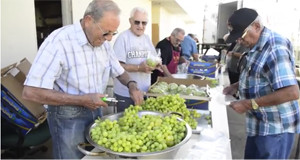
While cutting and bagging bunches of large green grapes Saturday morning, 89-year-old Bob Tusan grins as he shares a star quality of his favorite fruit.
“When you eat grapes, they make you younger,” says the third-generation grape farmer as he works alongside 20 others behind Holy Trinity Armenian Apostolic Church in downtown Fresno.

The group is preparing for Sunday’s 102nd annual Armenian Grape Blessing at the California Armenian Home in southeast Fresno, where grapes will be the centerpiece of the popular festival that includes traditional Armenian food, music and dancing.

After the blessing, 1,200 pounds of grapes filling 60 boxes will be for sale.

“A lot people, they don’t eat any grapes until they’ve been blessed,” Tusan says. Has he been waiting?

A man beside him quips a warning, “Don’t lie, don’t lie.”

“I got to taste them,” Tusan follows, smiling, “to see if they are ripe.…When they’re ripe, then we bless them.”
The origins of the grape blessing go back to ancient Armenia, Rev. Vahan Gosdanian says, where priests held solemn ceremonies in vineyards around harvest time.

“During the prayer, we bless all the crops, but they chose the grape because the grape is considered the queen of all the fruits,” Gosdanian says.

This royal designation is linked to Jesus Christ giving wine to his disciples during the Last Supper, he says, and statements that Christ made like, “I am the vine, you are the branches.”

Levon Baladjanian, the festival’s chairman, says he sees grapes as the symbol of Armenia, “the homeland,” along with being the staple of Armenian-American farmers in the central San Joaquin Valley.

Of the grape blessing, he says, “I think it gives people the feeling that the harvest is like the springing of a new life for the year, and that’s why you always hope the harvest is successful and on time.”

As California’s drought drags on, Baladjanian says the grape blessing is only growing in importance.

“There are a lot more prayers for the farmers.”

Tusan and his Sanger neighbor for the past 76 years, Jack Bedoian, are among those whose grapes are suffering. Tusan had to drill deeper wells and now only waters every other row of grapes.

“So, we’ve got problems,” he says. “It’s all bad.”

Of the grape blessing, he adds, “As you get older, it has more meaning to you.”

Though around a quarter of his age, 23-year-old Andrew Esguerra also finds deep meaning in grape blessing.

“Like the vine replenishes the grapes, it’s kind of like God feeding us through our faith,” Esguerra says.

The root of the festivities for Gosdanian lies in giving thanks to God for his many blessings.

“We enjoy God’s blessing every day. We just have to count them,” he says. “Like they say, ‘Just count your blessings.’ You just have to see them. They are all around us, every minute, blessings and miracles.”

For Gosdanian, one of those joys is living in the Valley.

“It’s the world capital of grapes,” he says, “so we are blessed.”

Carmen George: 559-441-6386, @CarmenGeorge

Source: Read more here: http://www.fresnobee.com/living/religion/article30518925.html#storylink=cpy


Filed Under: Events, News Tagged With: Armenian, Blessing, Fresno, Grapes

Fresno Armenian Evangelical Churches Raise $35,000 for Syrian-Armenians

July 31, 2015 By administrator

Armenian-Presbyterian-ChurchFRESNO — On Saturday, June 13, 2015 Pilgrim Armenian Congregational Church and First Armenian Presbyterian Church joined efforts to host a relief benefit banquet for Armenians in Syria. The theme for the evening was “Hearts for Syria”.

The Co-Chair and Mistress of Ceremonies, Roseann Emerzian Saliba welcomed over 200 attendees and introduced the distinguished guests: Rev. Vahan and Yeritzgin Sossi Gosdanian; Rev. Nerses and Mrs. Sevan Balabanian, Honorary Consul to Armenia, Mr. Berj & Mrs. Arpi Apkarian; Appellate Court Justice Charles Poochigian and his wife, Fresno County Supervisor Chairwoman, Deborah Poochigian; and Fresno County Superior Court Judge, Edward and Mrs. Jacqueline Sarkissian.

The invocation was offered by Rev. Gregory Haroutunian; and the national anthems were performed by Miss Vera Darakjian in Armenian and Mrs. Jane Bedrosian in English, accompanied by Mrs. Faye DeLong. Mr. Oscar Luna provided two musical selections for the evening.

Mrs. Saliba opened the evening’s program with remarks, stating “for most of us, these past few months have been filled with a range of heart-felt emotions, beginning with the commemoration of the 100th Anniversary of the Armenian Genocide on the one hand; and on the other hand, the devastating news of the increasing violence against Christians in Syria, where once again Armenians fall victim to persecution.”

Saliba remarked, “We know that Armenians have had a long history in Syria .having arrived there during the Armenian Genocide; and Syria did not hesitate to open its borders and support the persecuted Armenians.” She went on to say that her parents migrated to America through Syria during the Genocide; however, many remained, where they rebuilt their lives and thrived; and their culture was embraced. Most migrated to Aleppo, while others lived in smaller communities like Qamishli, Damascus, and Kessab. The Armenians established residences, opened businesses, built churches, hospitals, schools and libraries.

Over a period of time, they went from being penniless refugees to middle and upper class citizens – involved in all sorts of trade, education, medicine and traditional Armenian professions, such as carpets and jewelry-making.

Saliba said, “It is heartbreaking that today many of the descendants of those who found sanctuary in Syria, find themselves experiencing the same trauma as their forefathers; a rich history but an uncertain future. Syria, once a symbol of peace and security for our people, has now turned into a land without peace.”

She thanked the attendees for attending the banquet, and for their love and compassion for their sisters and brothers in Syria.

Following a delicious dinner catered by the Pilgrim Church Men’s Forum, Banquet Co-Chair, Edward Saliba, shared his heartfelt comments, relating his experience during the Lebanese Civil War to the situation in Syria, which he stated appeared much more severe.

The evening’s guest speaker was Mrs. Sevan Balabanian from San Francisco. Mrs. Balabanian had just returned from Lebanon where she and her husband, Rev. Nerses Balabanian, ministered to the Syrian-Armenians who had sought refuge there. She presented video clips from the President of the Armenian Evangelical Churches in Syria, Rev. Haroutiun Selimian and the Pastor of the Kessab Armenian Evangelical Church, Rev. Jirayr Ghazarian. Mrs. Balabanian then presented a powerful slide presentation depicting Armenian life before the conflict began, and the current situation. She brought many to tears, as they learned of the trauma and pain being inflicted on the Armenians.

Rev. Ara Guekguezian, Senior Pastor of the Pilgrim Armenian Congregational Church ended the evening with an inspiring plea for prayer and support, and concluded the evening with the benediction.

Filed Under: Articles, Events Tagged With: Armeni, Church, evangelical, Fresno, Syrian-Armenian

Armenian Genocide monument at Fresno State vandalized

July 27, 2015 By administrator

195308Three months after the unveiling of the Armenian Genocide monument at Fresno State, the structure has been vandalized, Fresno Bee reports.

“The souls of the victims are disturbed,” said Berj Apkarian, Honorary Consul of the Republic of Armenia in Fresno.

Someone yanked one of the panel from the monument last week, Apkarian said.

Fresno State said they’re investigating the tampering of the plaque. It was unbolted but not taken, and they said it will be re-installed this week.

“The panel had a lot of history,” Apkarian said. “It’s very heartbreaking and I’m so disappointed.”

“I am saddened by the recent vandalism attempt at our beautiful Armenian Genocide Memorial Monument,” said Joseph Castro, President of Fresno State. “I ask the campus and community to join together in protecting our historic monument.”

Apkarian plans to work with Castro and police to find out who vandalized the monument. The panel is made of Spanish steel, he said.

“This is a hate crime,” Apkarian said. “It must be taken very seriously, and it can’t be tolerated.”

The monument was unveiled in April to commemorate the 100th anniversary of the start of the Armenian Genocide.

“The monument has a symbolic and historic importance for the community,” Apkarian said. “The community must take steps to not tolerate such acts.”

Related links:

Tert.am: Ֆրեզնոյում պղծել են Հայոց ցեղասպանության 100-ամյակին նվիրված հուշարձանը
The Fresno Bee. Armenian genocide monument at Fresno State vandalized

Filed Under: Articles, Genocide Tagged With: Fresno, Genocide, monument, vandalized

ANCA Central California and City of Fresno Mark Genocide Centennial

April 28, 2015 By administrator

fresno-100

Armen K. Hovannisian, Chairman of the Armenian Bar Association, speaks in Fresno.

FRESNO, Calif.—Again this April 24th the Armenian National Committee of America Central California with the support of the City of Fresno raised both the United States and Armenian flags in front of City Hall to commemorate the Armenian Genocide. This year, prompted by the Centennial, a march was organized that lead hundreds of demonstrators from the Holy Trinity Armenian Apostolic church, a distance of approximately 1.5 miles, to Fresno City Hall.

Long time ANCA CC member Paul Jamushian welcomed the crowd of 650 then noted the theme this year was “Never Forget”. The Master of Ceremonies, Debbie Poochigian, known for her strong view on the subject of “չմոռանալ” (“to not forget”) was then introduced. Immediately thereafter, Poochigian, also the Chairman of the Fresno County Board of Supervisors invited local Armenian church priests to start by paying tribute to our martyrs with the Lord’s Prayer in Armenian.

The Armenian flag was raised by the Fresno Sassoon Chapter of the Homenetmen Scouts. The United States flag was raised by the Design Science High School of Fresno Unified. Both national anthems were sang by Hygo Ohannessian with background music performed by the AUSA Sounds of Freedom Band. A seemingly made to order, perfectly timed wind made the flags waive as soon as they were raised.

Fresno Mayor Ashely Swearengin, a longtime supporter of Armenian-American issues said in her speech “We honor you and join you in remembering the events of 100 years ago.” The Mayor attended multiple ceremonies in commemoration of the centennial of the Genocide. “When I think back over just the last twenty four hours and I consider the emotion and the beauty of the commemoration ceremonies that we have seen this year, I am truly overwhelmed and I am not Armenian,” said the Mayor who was visibly touched by the community’s efforts.

MaryAlice Kaloostian, District Director of Senator Tom Berryhill relayed her grandmother’s and great grandmother’s story of survival. “They would steal what was ours and made it theirs,” said Kaloostian referring to the Ottoman Turks. Her family came from Kharpert and her grandmother had a scar on her head and ear. The scar on the ear was from a Turkish girl trying to pull her earring off because she wanted it for herself. “I shouldn’t be here today, if the Turks had been successful, none of us would be here today,” she said.

Congressman Jim Costa, a staunch supporter, also spoke at the commemoration. For many years he has been an advocate for the recognition of the Armenian Genocide in the United States. Costa, who has many childhood Armenian-American friends, is a part of the Armenian caucus in Washington D.C. and has heard many personal stories of the genocide from his friends. He closed by saying “silence is genocide’s best ally.”

A soon to be observer of the election in Artsakh, County Supervisor Andreas Borgeas was the next speaker. His presentation included the critical future of Artsakh as well as his wife’s grandmother’s personal experience as a survivor.

The keynote speaker for the morning was Armen K. Hovannisian, Chairman of the Armenian Bar Association. In a stirring speech to an audience who interrupted him with repeated applause, Hovannisian began by asking “Is the destruction of an entire national quantifiable? Is the decimation of nearly all of its people measurable? Is what was lost and what was taken recoverable by any stretch of imagination?” His questions immediately got the audience’s attention.

Toward the end of his speech, Hovannisian looked passionately at the crowd and stated, “We must wake up tomorrow with a consciousness that is both rooted in the Armenian Genocide and which raises up above it as well that insists that we Armenians forever more define our identity not by what was done to us but what we do from this day forward.”

Also part of the program was a selection of songs performaned by the Charlie Keyan Armenian Community School of Fresno.

Filed Under: Articles, Genocide Tagged With: centennial, Fresno, Genocide, mark, Simon Zavarian Centennial Marked in Lori

GENOCIDE MONUMENT AT FRESNO STATE TO BE UNVEILED ON APRIL 23

March 28, 2015 By administrator

Armenian Genocide monument under construction

Armenian Genocide monument under construction

Fresno—Thursday April 23 will mark a historic occasion for Central San Joaquin Valley Armenians when a monument dedicated to the victims and survivors of the Armenian Genocide will be unveiled at Fresno State.  The program begins at 7:30pm in the Maple Mall, located just south of the university’s Satellite Student Union.

The monument has been made possible by the generosity of numerous patrons as well as the cooperation of Fresno State President Dr. Joseph Castro, whose public initiative and commitment to diversity paved the way for constructing the memorial on the university campus.  The unveiling ceremony is organized by the Armenian Genocide Centennial—Fresno Committee, an association of local organizations that is undertaking and promoting a series of events and activities in the Central Valley.

“We are fortunate as a generation to witness the centennial of the Armenian Genocide.  It is our responsibility to pass the torch to the future generation to never forget man’s inhumanity to man.” said Berj K. Apkarian, Chairman of the Monument Committee of AGC—Fresno and Fresno’s Honorary Consul of the Republic of Armenia

Designed by Fresno architect Paul Halajian, the monument will embody symbols of cultural meaning to the Armenian people. Its principal components, a series of pillars, will be arranged in a circular pattern and angled inwards, reminiscent of the Armenian Martyrs Monument (Tzitzernagapert) in Armenia. Built from béton brut and Tufa stones, the nine pillars represent the six provinces of historic Western Armenia—Van, Bitlis, Dikranagerd, Kharpert, Sepastia, and Erzerum—Cilicia, the Diaspora, and the Republic of Armenia. They will gradually descend in height around the circle, with the first measuring 19 feet high and the last 15 feet to underscore the significance of the year 1915. An incomplete halo will be set above on top of the pillars, symbolizing both the fracture left by the Genocide and the unity of the Armenian people.

“The monument will serve not only as a symbol of the terrible tragedy of the Armenian Genocide, but also as a tool to educate future generations of Fresno and California residents, regardless of ethnic background,” said Dr. Sergio La Porta, President of the AGC—Fresno and Professor of Armenian Studies at Fresno State.  “The lessons of the Armenian Genocide strike at the heart of who we are as a species; they alert us to the perils of modernity which we often ignore, confident in our scientific and technological progress; and they remind us of the importance of being human, first and foremost.”

Along with the monument, the AGC—Fresno has organized and promoted numerous centennial events, including 1915-2015: Tradition/Legacy/Culture, a commemorative art exhibit at the Fresno Art Museum and a Town Hall Meeting at Saroyan Theater discussing topics related to the Armenian Genocide as well as numerous educational lectures and programs. 

Free parking will be available for the unveiling ceremony in Lots P5 and P6 near the Peters Business Building. Handicapped parking is available as well in the same lots. Free overflow parking will also be available in the Save Mart Center parking lot.

The AGC—Fresno comprises representatives from various social, educational, and political organizations of the Central Valley that are working together to commemorate the 100th anniversary of the Armenian Genocide. For more information about centennial events, visit the AGC—Fresno website at www.agcfresno.org and on Facebook at www.facebook.com/agcfresno.

The Armenian Genocide Centennial-Fresno Committee

cordially invites you to attend the

Dedication and Opening of the Armenian Genocide Monument at Fresno State

Thursday, April 23, 2015 • 7:30PM

Maple Mall, Fresno State (near the East End of the Rose Garden)

The Public is welcome. Free admission.

Free parking in Lots P5 and P6

(near the Peter Business Building).

Free overflow parking is available in the

Save Mart Center parking lot.

100th Anniversary of the Armenian Genocide

1915-2015

agcfresno.org or facebook.com/agcfresno

Filed Under: Articles, Genocide Tagged With: Fresno, Genocide, monument

wherever Armenian Live they Build “Three Sisters Grapes”

March 3, 2015 By administrator

Natalie Soghomonian, Three Sisters Grapes

Natalie Soghomonian, Three Sisters Grapes

No Vine Before Its Time

One Degree grains have a natural sweetness that isn’t entirely the result of their sunny dispositions.

The grains we use to make our breads, cereals and flour are sprouted, and that means nature has added its own spoonfuls of sweetness. When a grain begins to sprout, the plant releases natural sugars to sustain it during this period of active growth. At the same time, the plant is also releasing enzymes that simplify compounds (making the grain more easily digestible), along with a burst of nutrients and natural flavor.

Sometimes, though, the recipe calls for an extra dash of sweetness, and that’s how we found Natalie Soghomonian, manager of an organic vineyard just south of Fresno, California. Natalie is a third generation farmer and, as the middle daughter of owners Joe and Johnni Soghomonian, is part inspiration for the farm’s famous Three Sisters label.

The Soghomonian farm grows a wide range of flavorful grapes. The family also reserves a portion of its acreage for the production of raisins, made from plump fresh grapes grown veganically. Based on the safe growing practices on the farm, the integrity of the family, and the nearly unimaginable flavor of the raisins, One Degree has chosen this select ingredient to sweeten a variety of our products.

No Vine Before Its Time

One Degree grains have a natural sweetness that isn’t entirely the result of their sunny dispositions.

The grains we use to make our breads, cereals and flour are sprouted, and that means nature has added its own spoonfuls of sweetness. When a grain begins to sprout, the plant releases natural sugars to sustain it during this period of active growth. At the same time, the plant is also releasing enzymes that simplify compounds (making the grain more easily digestible), along with a burst of nutrients and natural flavor.

Three Sisters Grapes

Three Sisters Grapes

Sometimes, though, the recipe calls for an extra dash of sweetness, and that’s how we found Natalie Soghomonian, manager of an organic vineyard just south of Fresno, California. Natalie is a third generation farmer and, as the middle daughter of owners Joe and Johnni Soghomonian, is part inspiration for the farm’s famous Three Sisters label.

The Soghomonian farm grows a wide range of flavorful grapes. The family also reserves a portion of its acreage for the production of raisins, made from plump fresh grapes grown veganically. Based on the safe growing practices on the farm, the integrity of the family, and the nearly unimaginable flavor of the raisins, One Degree has chosen this select ingredient to sweeten a variety of our products.

When he was in his early 20s, Joe Soghomonian took over the farm from his father, an immigrant from Armenia who had seen promise in this open land, a place to cultivate prosperity and happiness for his family. Concern for the family was a prime reason Joe decided 30 years ago to become one of the first farmers in this corner of the Central Valley to become organic.

“Once you go through there and spray, you can hear a pin drop,” Joe remembers. He knew that kind of silent spring was not healthy for his daughters, who loved to play in the fields.

For Natalie, working in the fields was at least as much fun as playing there. As a child, she never missed a chance to wake up early and help her father tend the vineyards and groves. She has always wanted to be a farmer. In college, classmates gave her the nickname “farm chick,” a moniker that’s made its way onto the license plate of her pickup truck. Every day she tours the fields, often riding an old bike past rows of purple-dappled vines.

The vineyard is an idyllic place. That’s especially true in the spring when bright red poppies bloom amid the vines and the fields are adorned with the vivid stripes of cover crops— flowers, clover and other plants which build nutrients in the soil. The cover crops are key to the success of veganic cultivation of grapes, and flowers play an important role in attracting beneficial types of insects that keep destructive bugs on vine-tasting tours at bay.

Looking out on this beautiful landscape, with its gracefully tangled vines, stately walnut trees and elegantly designed buildings, it’s obvious why Natalie is so devoted to this land and why she takes so much pride in the fruit of her family’s labors. “My organic raisins have better quality than the other raisins that you get in the store because of the integrity and the patience that goes into growing that product,” she says.

The grapes destined to become raisins are hand-picked, because machinery can “juice up the grape” and increase the likelihood of mold, she adds. It’s important to control moisture later, too, as the grapes make the flavorful transition to raisins. “You need to move the trays around to make sure they’re getting air and heat in there. I’m out there every hour checking.”

Natalie doesn’t believe in shortcuts, whether it’s the allure of mass-production or the false promise of genetically modified plant varieties. Quality over quantity is a core principle. And when it comes to planting new vines, taste is paramount. “There’s no flavor in a lot of the new varieties,” she says. “The quality’s not there.” And there’s often an absence of the full range of nutrients, she believes.

As part of her commitment to quality, Natalie has made it a priority to sell raisins directly to consumers and organic food companies, rather than to packers. “Packers mix it a lot, you don’t know where it goes. They will often mix it with lower quality raisins. You don’t know where your raisins go, the buyers don’t know where the raisin is coming from.”

Her perspective on quality and transparency is a natural fit for One Degree. “When you purchase my raisins I know exactly which block they came from,” she says. Natalie is excited about the fact that consumers can scan the QR code on a One Degree package and see a video about her farm, featuring her own description of how, when and where the crop was grown. “That’s really great; I think that’s beautiful,” she told us. “I wish everything had that. That’s what I’m about too.”

We’re confident that our customers are going to enjoy getting to know Natalie and her irresistible raisins. And we’re gratified to know that the truth, transparency and sweetness of our veganic loaves are on the vine, in rows tapering through a rich organic landscape, somewhere south of Fresno.

http://www.threesistersorganic.com/

— Charlie Dodge

Filed Under: Articles Tagged With: Armenian, farm, Fresno, Three-Sisters-Grapes

Fresno CA. A History Lesson at Ararat Cemetery

February 24, 2015 By administrator

By Stefani Booroojian,

A History Lesson at Ararat Cemetery

A History Lesson at Ararat Cemetery

April 24th marks the 100th commemoration of the Armenian Genocide, when 1 1/2 million Armenians died at the hands of Ottoman Turks. It’s important in the central valley because thousands of Armenians immigrated to Fresno in the years before and after the genocide.  Several generations of Armenians now call the valley home and their history can be traced in one unique place in south-west Fresno:  the Ararat Armenian Cemetery– the only Armenian cemetery in America. report your central valley.
Ararat Cemetery is 130 years old and many of the thousands interred here reflect that.   Cemetery tour guides Frank Balekian and Meher Checkerdemian walked the plots and looked at names with us.  Each special to a local family and some important to the community and the world.  Like the Seropian brothers, the very first Armenians to come to Fresno in 1881.   According to Balekian,  “So, Jacob came first and then his brothers Garabed and Simon also arrived.”
Also interred is pilot Joe Sahakian who flew the “Sacred Cow,” the presidential aircraft for President Harry Truman in World II, and Pulitzer prize winning author and playwright William Saroyan.   According to Balekian, “H
e was cremated and half were interred here in Fresno and the other half went to Yerevan, Armenia.”
There are also remembrances of Armenia’s tragic past.  There’s a monument erected in 1968 by the Manoogian family for those who died in the Armenian Genocide 100 years ago.  Balekian says, “S
o here is buried the remains of unknown Armenians martyred by the Turks in 1915 to 1918.”  It is the only place in the western world where actual remains are contained.
This 10 acre plot of history is a stop for school tours and history buffs.   According to Executive Director Sheri Manning-Cartwright, one stone cross gets a lot of attention.  It’s a memorial to Visalia born Monte Melkonian.  According to Manning-Cartwright, “H
e was your average American boy who got interested in his Armenian heritage and joined the secret army for the liberation of Nagorno-Karabakh.”  Melkonian died on the battlefield in 1993 and was buried in Armenia.  But he is not forgotten here.
Nor was another war hero, Soghomon Tehlirian.  He survived the genocide and got vengeance by assassinating one of the Ottoman Turkish Empire’s top leaders, Talaat Pasha in 1921.  Tehlirian was tried for the killing and acquitted.  According to Chekerdemian,  “T
his reminds you of that.  It reminds you of the million and a half that were massacred.  It was genocide, everybody knows that and this reminds you of the one that really avenged those people.”
There are 13 decades of history at the Ararat Cemetery on more than 10 acres of land.  Documenting a culture that came here, made an impact here, and now rests here for eternity.

Stefani Booroojian

Stefani Booroojian feels fortunate to be part of a rich broadcasting tradition in her hometown. Stefani currently anchors KSEE 24 News at 5, 6, 6:30, & 11 pm. She brings award winning experience with three Emmys, a number of Associated Press awards, and distinguished alumni honors from Fresno City College and Fresno State.

Filed Under: Articles, Genocide Tagged With: Ararat-Cemetery, armenian genocide, Fresno, History, lesson

Fresno City Hall Flag Raising to commemorate the Armenian Genocide of 1915

February 21, 2015 By administrator

Flag Raising ceremony to commemorate the Armenian Genocide 2015

Flag Raising ceremony to commemorate the Armenian Genocide 2015

This year the annual Flag Raising ceremony to commemorate the Armenian Genocide of 1915 will occur at Fresno’s City Hall – 2600 Fresno Street, Fresno, CA 93721 on Friday, April 24th at 9 am.  Both the flags of the United States of America and Armenia will be raised to show solidarity between the two countries.  Parking will be relaxed around the facility.  We look forward to seeing you there! More information to follow..

#armeniangenocide

Filed Under: Articles, Genocide Tagged With: armenian genocide, Flag-Raising- ceremony, Fresno

  • « Previous Page
  • 1
  • 2
  • 3
  • 4
  • Next Page »

Support Gagrule.net

Subscribe Free News & Update

Search

GagruleLive with Harut Sassounian

Can activist run a Government?

Wally Sarkeesian Interview Onnik Dinkjian and son

https://youtu.be/BiI8_TJzHEM

Khachic Moradian

https://youtu.be/-NkIYpCAIII
https://youtu.be/9_Xi7FA3tGQ
https://youtu.be/Arg8gAhcIb0
https://youtu.be/zzh-WpjGltY


gagrulenet Twitter-Timeline

Tweets by @gagrulenet

Archives

Books

Recent Posts

  • Pashinyan Toys: Some of the weapons on display turned out not to be weapons at all
  • The Imperative of Preserving the Statehood of Artsakh:
  • If Pashinyan is re-elected, Armenia will become a “gubernia” of several countries
  • Mr. Karapetyan laid out the failures he inherited from the current government-and presented a clear, decisive plan
  • Anna Hakobyan Join Pashinyan, holding a motorcade rally sign of desperation…

Recent Comments

  • Tina on Anna Hakobyan prepared a heartbreaking text about the deprivations “Hraparak”
  • Baron Kisheranotz on Pashinyan’s Betrayal Dressed as Peace
  • Baron Kisheranotz on Trusting Turks or Azerbaijanis is itself a betrayal of the Armenian nation.
  • Stepan on A Nation in Peril: Anything Armenian pashinyan Dismantling
  • Stepan on Draft Letter to Armenian Legal Scholars / Armenian Bar Association

Copyright © 2026 · News Pro Theme on Genesis Framework · WordPress · Log in