Gagrule.net

Gagrule.net News, Views, Interviews worldwide

  • Home
  • About
  • Contact
  • GagruleLive
  • Armenia profile

Tunisia: Same weapon in both politicians’ killings

July 26, 2013 By administrator

The Islamist extremist cell behind an earlier political assassination also killed a leftist Tunisian politician using the same weapon, a top security official announced Friday, according to AP.

Mohammed Brahmi was shot 14 times in front of his home within sight of his family on Thursday, plunging the country into a political crisis and unleashing g_image-Same Weapondemonstrations around the country blaming the government for the assassination.

Interior Minister Loutfi Ben Jeddou told reporters that ballistics tests on the 9mm bullets used in the attack showed it came from the same weapon used to kill opposition leader Chokri Belaid in February. The minister said a jihadi cell of 14 was behind that attack, four of whom were in custody.

The press conference came as thousands across Tunisia called for the government to resign.

Demonstrations raged around the country the night before, holding the ruling Islamist Ennahda Party responsible for the assassination and attacking local party headquarters. Police used tear gas in central Tunis and in the provinces to disperse the protests.

The slaying of Brahmi of the leftist Popular Current party raised fears of new chaos in the country that unleashed the Arab Spring. Tunisia is working toward enshrining a new constitution meant to lead the way to lasting democracy and so far has avoided the widespread violence and unrest as in Egypt and Libya.

Brahmi was a respected leftist politician and a strong critic of the Ennahda Party, which rules in a coalition with two other secular parties. There were no immediate claims of responsibility for his killing.

His party told The Associated Press it is postponing his funeral, initially planned for Friday, fearing it could inflame supporters on an already tense day. He will be buried Saturday in the same cemetery in Tunis as Belaid.

The main trade union called for a general strike Friday, closing down the airport, public transportation and most government offices as a new coalition of civil society and opposition parties called for the dissolution of the government and the national assembly.

In a statement published by Mosaique FM, several left wing and liberal parties announced the formation of a National Salvation Front calling for civil disobedience and a sit-in outside the national assembly until it and the government are dissolved.

There have also been reports of resignations by some members of the assembly, which was elected in October 2011 and charged with writing a new constitution and running the country. The constitution was expected to be completed and new elections held by the end of the year.

The new opposition front is calling for the formation of a national unity government charged with finishing the constitution and holding new elections.

In a statement late Thursday, Ennahda condemned the assassination as a “cowardly” act “targeting the revolution and national unity, and obstructing the democratic transition process.”

Much of the opposition, however, is holding Ennahda responsible for Brahmi’s assassination, much as it did Belaid’s, either because the Islamists have been unable to ensure security in the country or because they are actively collaborating with extremist elements to target their opponents.

The Interior Ministry has accused Islamist extremists of being behind the attack on Belaid and said it would announce the names of suspects shortly.

The U.S. State Department, the United Nations and Amnesty International called for an impartial investigation into the killings and for Tunisians to avoid reacting with violence.

 

Filed Under: Articles Tagged With: Tunisia: Same weapon in both politicians' killings

Uprisings from Wall Street to Gezi Park: An Interview with David Barsamian

July 26, 2013 By administrator

For more than a quarter of a century, journalist and author David Barsamian has been a tireless voice for social justice, broadcasting programs from India, to Syria, to the United States. Barsamian, whom Howard Zinn called “the Studs Terkel of our time,” is the founder and director of Alternative Radio, based in Boulder, Colo. g_image-DAvid Barsamian(www.alternativeradio.org). His interviews and articles appear regularly in “The Progressive” and “Z Magazine.” He is the co-author of a number of books with Noam Chomsky, Arundhati Roy, Edward Said, Tariq Ali, Howard Zinn, and Eqbal Ahmed, including, most recently, Power Systems with Noam Chomsky.

In this interview with The Armenian Weekly, Barsamian talks about the root causes and particularities of the global uprisings and protests. The conversation mines the connections between capitalism, climate change, poverty, and points to the need to “save pessimism for better times.”

Khatchig Mouradian—How do you read the massive demonstrations and social upheavals across the world in recent years?

David Barsamian—There has been a surge in resistance and oppositional politics in the last decade, as a direct result of the failures of neo-liberal economic policies, which has enriched a handful of elites and pauperized large numbers of people. So there is a general economic crisis of capitalism and we have to locate these different resistance movements in that context. Of course, the nature of the movements varied by location because of historic circumstances, ethnic makeup, religion, and other factors.

This backlash is against channeling wealth to a handful of people who are well connected to the government while the rest of the population has been left behind. The train has left the station, and in the locomotive are the rich and the plutocrats and the CEOs, while the other passenger cars are left behind. The power brokers have seceded from their own countries, in a way. They are so dedicated to accumulating wealth and capital that they are anti-national, they want to be part of the world economic elite, because capital knows no borders.

Today, with the press of a button millions of dollars can be moved across borders in a way that avoids taxation and accountability. According to one estimate, around $30 trillion have been sequestered away in different accounts and tax havens that states cannot tax. This is important, because as part of the neo-liberal agenda, social services have been reduced and what were once national properties have been sold off to private corporations. For example, every time I hear the term “public-private partnerships,” I cringe. It sounds wonderful. But what does it mean? I am the public, you take everything from me, you benefit, and I finance that! That’s the partnership! In a sense we’re looting these countries of resources, robbing them of their futures and destroying the environment. That’s the background to these uprisings.

K.M.—The frustration and rage have been mounting for some time.

D.B.—In the Middle East, the rage was building up over years. And finally, the spark came: A fruit vendor, [Tarek al-Tayeb Mohamed] Bouazizi in Tunisia, set himself on fire because he was being harassed and humiliated by bureaucrats. That led to the protest movements in Tunisia, which led to Egypt, which led to Libya and Syria. So far the monarchies have been successful in crushing any opposition.

People are feeling an enormous amount of pressure. It’s harder and harder to provide enough food for families to live with dignity, to have decent lives. Capitalism has taken on a very rapacious and predatory strain. Marx talked about capitalism with its “werewolf hunger” for profits. Corporations have accrued tremendous economic and political power. They have been enabled by the traditional political parties who work closely with the guys in the suites at the expense of the people in the streets. We can see that right here in the U.S., where the two parties are not very different on fundamental issues. For example, there is no disagreement on capitalism itself. In fact there is no discussion of capitalism. The word is barely mentioned. The capitalism taught in economics departments at top universities has little relation to the actual existing capitalism, which depends heavily on state protection and subsidies.

So there’s this rage worldwide, particularly in rural areas. Syria and India are good examples. In Syria, there’s been severe draught in the countryside, many people have had to abandon their farms and go to big cities like Aleppo and Damascus. Cut off from their land, the connection with families and neighbors, now they’re “unanchored and stranded”—as one Indian writer, Pankaj Mishra, calls them. So they’re trying to make their way now in cities doing odd jobs, whatever they can find. This is a huge problem in India as well, where a quarter of a million farmers have committed suicide because of insurmountable debts. They take loans at very prohibitive rates, they can’t pay them back, and they kill themselves.

During the Occupy Movement, the slogan “We are the 99 percent, they are the 1 percent,” captures reality. It’s not that far off. The reason the Occupy Movement had some traction in this country, is because people can see. You don’t need a Ph.D. in economics to see your paycheck not increasing for five to six years, food prices of going up. How are you going to pay for your children’s education? How are you going to send them to college?

K.M.—These movements were contagious because they reminded the oppressed of their collective power. On the other hand, the “one percent” seems to have ignored a crucial matter: that they have to keep throwing crumbs at those whom they are oppressing.

D.B.—It’s necessary for the capitalists to keep the people they’re victimizing alive. Otherwise who’s going to buy their products? You can’t kill the patient; he must be kept alive to keep on paying off his debts. This turn now in early-21st century capitalism has been very acute and historically without parallel. In the U.S., tens of millions of people have lost their homes, don’t have jobs, or have taken part-time jobs to make ends meet. In turn, Greece and Spain now have 25 percent unemployment! Capitalism is in crisis.

All of those factors are aboil, and a spark ignites the anger. Some of the anger can be coherent and focused, other types of anger can be incoherent, so there can be violence, racism, sectarianism, and ethnic rivalries. It’s important to keep the focus on trying to generate social change. Can you have a social democratic revolution non-violently? Everyone likes to point to Gandhi in India, Mandela in South Africa, or to Martin Luther King in the U.S. But states that do not allow room for non-violent resistance are privileging violence, and that’s what Mubarak and Assad did. They are privileging violence because the state has a monopoly on violence, or at least has tremendous amount of firepower. I think that non-violence and civil disobedience scare leaders. They want to be confronted with violence, because that’s where they have a distinct advantage. In Taksim Square, for example, creative and artistic ways of protest have put the state at a disadvantage.

What’s significant about the demonstrations in Turkey is that it has broken a sense of fear and intimidation that people had not to speak out against Erdogan. He is seen by many as arrogant and autocratic. People have crossed that threshold of fear; they are no longer afraid of the state. There’s a powerful moment in Michael Moore’s film “Sicko.” He is talking to a group of Americans in Paris, and they’re explaining to him what I consider to be a profound truth: In France the government is afraid of the people, and in America, the people are afraid of the government. That is also true in Turkey for historical reasons—internal repression, military dictatorships, and a faux democracy whereby so many people in the country are disenfranchised and are not full citizens.

We will see more so-called stable regimes in crisis toppling. Even within the EU, it’s not clear what’s going to happen in Greece, Spain, Portugal, or even Italy. These are revolutionary times, and if anyone tells you they know how things will evolve, don’t believe them. In a time of flux and enormous planetary instability, we are likely to see huge upheavals.

K.M.—Let’s talk about the Occupy Movement, what it accomplished, and why it lost steam.

D.B.—Occupy Wall Street injected into the political discourse the notion of inequality: the 1 percent versus the 99 percent, the sense that there’s something seriously skewed in the U.S. economy. No one was expecting it when it started in New York on Sept. 17, 2011. A Canadian magazine, Adbusters, suggested the idea. And soon it mushroomed: I visited Occupy encampments in Bellingham, Seattle, Tacoma, Boulder, Denver, Santa Fe, and other places. It petered out not just from within; there was state violence that razed most of these encampments, threatened arrest. By the spring of 2012, it had largely dissipated. The name was still there, but the energy seemed to have diminished. It’s not clear why that happened. Perhaps part of it is because people need to go on with their lives. You just can’t take three or four months off and not generate any kind of income if you’re supporting a family. As a tactic it was successful but it was unrealistic to expect that people would spend months living in tents.

Is Occupy going to come back? That’s difficult to say. It will take new shapes and forms. They did in the New York area after Super Storm Sandy, providing service to elderly people in apartment blocks in Brooklyn and Queens, delivering supplies to those who did not have power. So they did do important work that I don’t think was acknowledged sufficiently in the media. But we do need an opposition in this country. And it’s not going to come from the Republican Party or Democratic Party. They are hand-in-glove part of the establishment and part of the structural problems of the U.S. We need a force from outside these parties that is pushing the envelope toward more economic justice—an important concept injected into the discourse by Occupy. Immigrants or people of color are working for 40-50 hours and get paid virtually nothing. I did an interview with a woman about workers who live on tips. The hourly wage for a worker living on tips is $2.13. It hasn’t increased since 1996. These kinds of inequalities are in urgent need of redress.

K.M.—Are we also where we are because the mainstream media—here and elsewhere—does not address root causes?

D.B.—If your diagnosis is not correct, all the proposals you are putting forth will fail. And of course the function of the media and, to a large part, education, is to deflect attention from root causes. Let’s talk about Wall Street financier Bernie Madoff. He cheated grandmothers, he stole pension funds, he was an awful, awful man and we all feel virtuous in denouncing him. There’s the illusion of reform in this culture: We need more scrutiny and regulation on these people so that they don’t do these bad things. No one looks at the barrel that produces these apples. The rotten apples are then purged from the barrel, the barrel stays intact, and the cycle continues. People have forgotten the bank scandals of the late 80s and the Enron and other corporate disasters of the early 2000s.

K.M.—Talk about the impact of greed on the environment. It’s not just the people who are rebelling; the planet itself is in revolt.

D.B.—That’s literally true. The earth itself is under assault from this kind of rapacious capitalism, which is extracting all of the resources, and not renewable resources. It’s in the DNA of capitalism—it cannot limit itself, because of its drive for profit. We cannot pretend about a kinder, gentler capitalism, or a recycled, eco-capitalism. The earth is hemorrhaging. In 1992, 1,700 scientists issued a warning to humanity about global warming and the future of the planet. What has happened since then? There’s been conference after conference: Durbin, Rio, Copenhagen, Doha… All they do is get together, sip their Chardonnay, and issue wonderful declarations: We’re all green, we’re all for the environment. Then it’s business as usual.

You have that stress now on our home. The Earth is our home, and we are not good caretakers and stewards. In cities like Cairo, Delhi, Calcutta, Dhaka, and Karachi, the level of pollution is unbelievable. We need a radical change. And we have to rethink what we understand by sovereignty, because the environmental crisis can only be addressed collectively. In the small Himalayan state of Bhutan, they’re having a human happiness index, they’re going all green, eliminating plastic, etc. But this is a tiny country with 700,000 people. It’s not going to address the larger problem. It has to be done globally.

Crucially, water is disappearing. It will be the major issue of the 21st century. Historically there were wars over silver or gold, oil in the current period. Water will be the dominant issue in the coming years. If you look at maps of West Asia, South Asia, they’re hugely water-stressed. Part of the Israeli occupation has been to take water from the Palestinians’ aquifer. That’s where the colonies have been built on the West Bank—on the water reserves of that area.

K.M.—You’ve been involved in activism and alternative media for a long time. What keeps you going?

D.B.—I like to quote the great Uruguayan writer Eduardo Galeano, who said, “Let’s save pessimism for better times.” A lot of people today are cynical. Justifiably so. Just look at and see what’s going on. But cynicism shouldn’t lead to passivity. You have to be proactive. And that’s one of the reasons I started Alternative Radio as a kind of serum to counteract the toxicity produced by the corporate media. But I get a lot of energy from people much less privileged than I am. I was just in Manitoba and there’s a very active indigenous movement there—made up of people who don’t have the privilege or the advantages that someone like me may have, yet are organizing and doing significant work. There are examples of very uplifting resistances around the world that inspire me, and it’s much more fun swimming against the current. When you’re swimming against the current, you’re not only building up strength, fortitude, and character, but you’re meeting very interesting people. People who are providing alternatives.

My friend Arundhati Roy says “responsibility” is a boring word. But I do feel a kind of responsibility because of my Armenian family’s background, because of the advantages and opportunities I have had. I think it is good to leave leaving the world a little bit better than you found it.

Source: Panorama.am

Filed Under: Articles

Number of visitors to Artsakh definitely grows: Culture Minister

July 26, 2013 By administrator

July 26, 2013 – 15:34 AMT

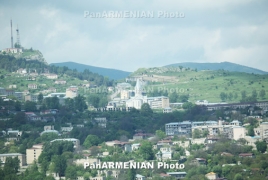
PanARMENIAN.Net – Although the tourist season has just begun, the number of visitors to Nagorno Karabakh has definitely grown, NKR Culture Minister said.

166743“Over 100 people per day were visiting the museums of Shuhsi during the past months and majority of them were tourists,” Narine Aghabalyan told PanARMENIAN.Net

She also emphasized that representatives of 13 countries were in Artsakh recently to take part in an international music festival. “They spent 10 here and saw lots of interested sights. Now, they will tell the truth about our land in their countries,” Ms. Aghabalyan said.

Filed Under: Articles

Egypt braces for Friday rival protests

July 25, 2013 By administrator

Military official says Brotherhood has 48 hours to join political reconciliation after army rally call, Reuters reports

Supporters of Egypt’s deposed president and his opponents predicted blood on the streets ahead of what could be a violent day of mass protests, summoned by the Rival protestMuslim Brotherhood and the army in a struggle for the country’s future.

Army chief General Abdel Fattah al-Sisi, who overthrew President Mohamed Morsi on July 3, has called on Egyptians to take to the streets on Friday to show their support for action against “violence and terrorism”.

Some pro-Morsi supporters are stocking up with bandages and syringes ahead of the mass rallies and those holding tent vigils fear violence and military crackdown, the Reuters news agency reported.

Al Jazeera’s Nadim Baba, reporting from Nasr City, said that there were a large number of people camped out and that the demonstrations have been peaceful, with both sides claiming that only a minority have been involved in clashes.

Ultimatum

The army has also given the Muslim Brotherhood until Saturday afternoon to sign up to political reconciliation, a military official said, after the army issued a statement saying it might use tougher tactics against the group.


“We will not initiate any move, but will definitely react harshly against any calls for violence or black terrorism from Brotherhood leaders or their supporters. We pledge to protect peaceful protesters regardless of their affiliation,” the official told the Reuters news agency, saying they had 48-hours to comply.

The army deposed President Mohamed Morsi on July 3 and installed an interim administration that has set out a roadmap for a new political transition leading to parliamentary elections in about six months.

Earlier, the army signalled it would change its strategy for dealing with “violence and terrorism” after protests it has called on Friday.

In a statement posted on a Facebook page affiliated to the army command, the military said it was ready to turn its guns on anyone involved in either.

Al Jazeera’s Nicole Johnston, reporting from Cairo, said that the military rally call has the backing of most of the liberal and secular groups in Egypt. But our correspondent said that these groups are accusing the Brotherhood of inciting violence.

Prime Minister Hazem el-Beblawi, head of the interim cabinet, said there was escalating violence by increasingly well-armed protesters, citing a bomb attack on a police station.

“The presence of weapons, intimidation, fear – this causes concern, especially when there are calls for many to come out tomorrow from different sides,” he told a news conference.

Meanwhile, in a recorded statement, the deposed prime minister Hesham Qandil has laid out his plan to restore order. He called for the release of all detaineed arrested since June 30 and for a delegation to visit and ensure the well-being of Morsi.

The White House has urged the Egyptian army to exercise restraint and caution and has said it is concerned about rhetoric that inflames the tensions.

Filed Under: Articles Tagged With: Egypt braces for Friday rival protests

Foreign Fighters Flocking to Syria Stirs Terror Concerns

July 25, 2013 By administrator

By Terry Atlas

The U.S. and European Union are seeing an increasing number of radicalized young Muslims going to Syria to fight, a development that raises the danger that they will return to conduct terrorist attacks at home.

i3r0mj15zmBAThe war is providing both a rallying point and a training ground for radical Islamists from other nations, according to Matthew Olsen, director of the U.S. government’s National Counterterrorism Center. Their numbers are increasing and the radicals, such as those joining the al-Nusra Front, an offshoot of the terrorist group al-Qaeda in Iraq, are now “the most capable fighting force within the opposition” to Syrian President Bashar al-Assad, he said.

“Syria has become really the predominant jihadist battlefield in the world,” Olsen said at the Aspen Security Forum in Aspen, Colorado. “We see foreign fighters going from Western Europe and, in a small number of cases, from the United States to Syria to fight for the opposition.”

Olsen and other forum speakers highlighted terrorism as part of the growing stakes in the Syrian civil war, which threatens to destabilize the region. Efforts by the U.S. and European countries to promote peace talks have stumbled, and President Barack Obama has balked at deeper American involvement, citing concerns that some rebel groups may have terrorist links.

About 600 fighters have gone to Syria from Europe, according to Gilles de Kerchove, the European Union’s counter-terrorism coordinator. That number grows to the thousands if fighters from the Balkans and North Africa are counted, he said.

Different Scale

“The scale of this is completely different from what we’ve experienced in the past with Afghanistan, Pakistan, with Yemen and Somalia,” de Kerchove said at the forum yesterday.

Most of those from Europe are self-radicalized and traveling on their own initiative, as opposed to being recruited by a radical network, de Kerchove said.

He called it “at bit surprising” that they are going to Syria, to fight other Muslims, rather than going the Mali, where France has intervened militarily to push back advances by Islamic radicals. That may be the case because travel is easier to Syria, through Turkey, and because many of the young radicals are more attuned to fighting in urban conditions rather than in Mali’s vast desert territory, he said.

Those men may pose a threat in their home nations if they survive and return home, he said. European governments lack the capabilities to monitor all of them around the clock, he said.

Olsen declined to disclose U.S. estimates of the numbers, though he said the pace has been increasing recently.

‘Jihadist Movement’

“The concern going forward from a threat perspective is there are individuals traveling to Syria, becoming further radicalized, becoming trained and then returning as part of really a global jihadist movement to Western Europe and, potentially, to the United States,” Olsen said during a panel discussion July 18.

Richard Barrett, former coordinator of the United Nations’ al-Qaeda Taliban Monitoring Team, said the risks are real. At the same time, he said it is important to recognize that not all who return home will be inclined to conduct terrorism.

The UN estimates that more than 93,000 people have died in Syria’s civil war, which began with peaceful protests in March 2011. The fighting has sent hundreds of thousands of refugees fleeing into neighboring countries such as Jordan.

In recent weeks, fighting has broken out between radical and mainstream elements of the Sunni-dominated opposition as they compete for power in a country increasingly splintered among warring factions. Meanwhile, Assad holds on to Damascus and has gained momentum in the fighting.

‘Break Up’

“It wouldn’t surprise me if Syria were to break up as a result of what is going on there now,” said John McLaughlin, former deputy director of the Central Intelligence Agency.

The turmoil in Syria is destabilizing an already volatile region swept up in the Arab Spring movement. Tensions have spilled into Lebanon, the Sunni insurgency in Iraq has revived, and Jordan faces a flood of refugees straining its ability to handle them.

At the same time, Shiite Iran and its Lebanese ally Hezbollah, which the U.S. and Israel regard as a terrorist group, have sent fighters to aid Assad, who is an Alawite, an offshoot of Shiite Islam. Persian Gulf Arab nations, which are Sunni, as well as the U.S., U.K. and France are supporting the mainstream opposition.

“We have a perfect witches’ brew evolving in Syria which, I think, is going to explode out and affect the entire Levant in ways that are detrimental to U.S. interests,” said Charles Allen, a 40-year CIA veteran who is now at the Chertoff Group, a Washington-based global security advisory firm.

Terrorist Dream

Al-Qaeda’s leader, Ayman al-Zawahiri, has long sought to gain control of territory as the terror group had in Afghanistan before the U.S. invasion, said McLaughlin. One of al-Qaeda’s stated goals is the re-establishment of a caliphate across the Mideast and North Africa as there was in the early days of Islam.

“Wherever he’s hiding right now, he’s probably looking at Syria and saying ‘this is my dream come true,’ because probably one part of Syria is going to end up in the hands of people like that,” McLaughlin said, referring to Zawahiri.

Touring a Syrian refugee camp in Jordan on July 18, Secretary of State John Kerry said that the U.S. was concerned by the involvement of Hezbollah and Iran and that the administration was considering a buffer zone and a no-fly zone. The Obama administration has so far resisted such deeper involvement.

“A lot of different options are under consideration,” Kerry said. “I wish it was very simple.’‘

Stalled Talks

Obama has authorized providing small arms to the Syrian opposition. U.S. plans in conjunction with Russia for peace talks have stalled for months as Assad’s regime and opposition leaders jockey for stronger positions.

Allen and Olsen also expressed concern that Assad’s stockpile of chemical weapons poses a threat, with Allen wondering who would gain control of those arms if Syria breaks up. U.K. Foreign Secretary William Hague announced this week that his government will send the opposition’s Supreme Military Council some defensive chemical weapons equipment following evidence that Assad’s forces have used chemical agents against the opposition.

To contact the reporter on this story: Terry Atlas in Washington at tatlas@bloomberg.net

To contact the editor responsible for this story: John Walcott at jwalcott9@bloomberg.net


Filed Under: Articles Tagged With: Foreign Fighters Flocking to Syria Stirs Terror Concerns

Global Power Project- Part 7: Banking on Influence with Citigroup

July 25, 2013 By administrator

Citigroup- A Bank with a sordid history of predatory profiteering & criminal activity

By: Andrew Gavin Marshall, BFP Partner Producer

In the second quarter of 2013, the third-largest U.S. bank by assets, Citigroup, posted a 42% increase in profits which CEO Michael Corbat praised as a “well 0724_citibankbalanced” result of “cost cutting” programs, including the firing of 11,000 workers.

This big bank has a sordid history of predatory profiteering and criminal activity, not unlike all the other large banks. In the early 20th century, what was then National City Bank was the main bank for the Rockefeller Standard Oil interests. Over ensuing decades and mergers it eventually came to be Citibank, and in the late 1990s, Citigroup. At that time, the bank was dealing with accusations that it had aided in the laundering of roughly $100 million in payoffs by Mexican drug cartels.

In 2000, the mega-bank was accused of abusing borrowers and clients through predatory lending practices. The bank aroused further controversy by helping Enron evade financial rules which allowed the company to hide its real financial reporting from government regulators. In 2005, Citigroup paid a $2 billion settlement to Enron investors who had filed a class-action lawsuit against the bank for helping Enron hide billions of dollars in debt.

A 2005 report by Citigroup created the term ‘plutonomy’ to describe the modern state capitalist system in which there is only the rich “and everyone else”; an economy in which the rich increasingly become the consuming class, driven to a significant degree by “disruptive technology-driven productivity gains, creative financial innovation, [and] capitalist friendly cooperative governments.”

Referencing the United States, the U.K., Australia and Canada as modern plutonomies, Citigroup global strategist Ajay Kapur noted, “The Plutonomy is here, is going to get stronger, its membership is swelling,” and while the

“risks” of plutonomies include “war, inflation, financial crises, the end of the technological revolution and populist political pressure,” Kapur noted that “the rich are likely to keep getting even richer, and enjoy an even greater share of the wealth pie over the coming years.” Indeed, Citigroup would ensure that this was the case.

In the 1990s, Bill Clinton’s Treasury Secretary Robert Rubin helped to deregulate Wall Street and allow for massive mergers and the proliferation of dangerous financial instruments in the derivatives market, which helped create the future housing crisis. After leaving the White House, Rubin became an adviser to Citigroup, and ultimately the bank’s chairman, where he helped push the mega-bank further down the path taken by Morgan Stanley and Goldman Sachs to build up an unprecedented housing bubble. When the inevitable happened, Citigroup owned tens of billions of dollars in bad debts. Meanwhile, Robert Rubin was appointed as an economic adviser to the transition team for President Obama.

Citigroup was subsequently bailed out by the federal government, that is, the U.S. taxpayer, and became the largest single recipient of bailout funds totaling some $476.2 billion in cash and guarantees. Citigroup was essentially put into receivership by the government, which decided to reward the bank after its highly effective and efficient participation in the destruction of the economy. The U.S. Treasury eventually sold the last of its shares in Citigroup in 2010.

Since that time, the bank has been quietly settling civil complaints and lawsuits, further proving that criminal activity by major financial institutions comes down to a cost-benefit analysis: if the cost of committing massive crimes is less than the benefit of engaging in such criminal activity, there is little incentive to obey the law rather than pay comparably lower fines after breaking it.

Between 2003 and 2011, the Securities and Exchange Commission (SEC) accused Citigroup of securities fraud five separate times, with the bank agreeing to pay settlements in each case, amounting to a slap on the wrist from the SEC. As a Bloomberg report stated bluntly, for Citigroup “obeying the law is too damn hard.” Or rather, simply, it is unnecessary.

In 2011, Citigroup paid a $285 million settlement with the SEC for defrauding investors. In 2012, the bank paid another settlement of $590 million for defrauding investors, though it made sure not to admit guilt as the payment was “solely to eliminate the uncertainties, burden and expense of further protracted litigation.” In 2013, Citigroup agreed to pay a further $968 million to

Fannie Mae over the bad mortgage loans it sold to the company in the run-up to the financial crisis.

But before you assume that Citigroup simply defrauded investors and other institutions, know this: the bank also undertook foreclosures on hundreds of U.S. military members during the financial crisis, often while the military personnel were in Iraq or Afghanistan. After illegally foreclosing on military personnel while they were overseas fighting wars for the America’s imperialists and profiteers, Citigroup made a later appearance in Iraq, announcing in 2013 that it would be the first U.S. bank to open a branch in Bagdad “as major international oil groups as well as industrial and construction companies are looking to invest in Iraq.”

Iraq is just the latest hub of overseas criminal financial activities for Citigroup, which has meanwhile been struggling to “comply” with anti-money laundering laws after also participating in the largest financial scam in history: the Libor rate-rigging scandal. At the same time, the bank has been dooming the European Union’s crisis countries (namely Greece) to a faster decline, issuing self-fulfilling reports that suggest the region is headed for further crisis, thus reducing investor confidence and pushing the crisis-hit economies into even deeper crisis.

In sum, Citigroup’s fraudulent lifestyle – with its increased quarterly profits – is one more example of how the institutions of the financial system function as criminal conglomerates on a scale far surpassing any Mafia on record. And of course, for such criminal activity to go unpunished, the institution cannot exist in isolation. In fact, like all other big banks, Citigroup is heavily integrated in the national – and increasingly international – structure of elite institutions, with cross-membership between major corporations, think tanks, governmental positions, media and educational institutions.

Thirty-seven individuals on the executive committee and board of directors of Citigroup were examined for the Global Power Project. The most represented institution was the Council on Foreign Relations, with six individual affiliations, followed by Morgan Stanley, Banco Nacional de Mexico (Banamex), American Express, the Foreign Policy Association, IBM, the Brookings Institution, the Metropolitan Museum of Art, Yale University, and Stanford University, among many others.

Meet the Elites

On the board of directors of Citigroup is Franz B. Humer, the chairman of Roche Holding, a major pharmaceutical conglomerate. Humer also sits on the International Advisory Council of JPMorgan Chase, and is chairman of INSEAD, chairman of Diageo Plc, a member of the international advisory board of Allianz SE, a member of the board of Jacobs Holdings, and a member of the European Round Table of Industrialists (which advises EU leaders on promoting policies beneficial to large corporate and financial interests). Humer also serves, comfortingly, as chairman of the International Centre for Missing and Exploited Children.

Judith Rodin, the president of the Rockefeller Foundation, is on the board of Citigroup. Rodin also served as the President of the University of Pennsylvania from 1994-2004, after which she remained as President Emerita. A former Provost of Yale University, Rodin also serves as a director of Comcast Corporation, AMR Corporation, the World Trade Memorial Foundation and Carnegie Hall. She is a member of the Council on Foreign Relations and a former honorary director of the Brookings Institution. Additionally, Rodin is a member of the board of the Alliance for a Green Revolution in Africa (AGRA) – a joint venture between the Rockefeller Foundation and the Bill & Melinda Gates Foundation to promote the advancement of GMOs in Africa – and she served as a member of the High Level Panel of the African Development Bank. Rodin currently serves as a member of the international advisory council of the Mary Robinson Foundation, a member of the American Academy of Arts and Sciences, the American Philosophical Society, and the Institute of Medicine of the National Academy of Sciences. She is also a participant in the World Economic Forum, the Global Humanitarian Forum, the Clinton Global Initiative’s “poverty alleviation track,” and she is a board member of Obama’s White House Council for Community Solutions.

Another member of the Citigroup board is Ernesto Zedillo, the former President of Mexico from 1994 to 2000, who was pivotal in implementing the North American Free Trade Agreement (NAFTA), much to the benefit of big banks and corporations, and to the detriment of poor and working people. Zedillo had previously served a number of positions in the Mexican government, including deputy director of the Bank of Mexico. Currently, Zedillo is the director of the Center for the Study of Globalization and an International Economics and Politics professor at Yale University. He is a member of the Group of Thirty, on the board of directors of Alcoa and Procter & Gamble, and on the international advisory boards of both BP, Rolls-Royce and ACE Ltd.. He is additionally an adviser to the Credit Suisse Research

Institute, a member of the Foundation Board of the World Economic Forum, a former member of the Trilateral Commission, the former chairman of the Global Development Network, a former chair of the High Level Commission on Modernization of the World Bank Group Governance, a former member of the international advisory board of the Council on Foreign Relations and the Coca-Cola Company, a former member of the Global Development Program Advisory Panel of the Bill & Melinda Gates Foundation, and he is currently a member of the board of the Peterson Institute for International Economics.

William R. Rhodes, another Citigroup board member, serves as a senior advise to Citi and is president and CEO of William R. Rhodes Global Advisors. A director of the Private Export Funding Corporation, Rhodes is a senior adviser to the World Economic Forum, the global management firm Oliver Wyman, vice chairman of the National Committee on U.S.-China Relations, a director of the Korea Society and the U.S.-China Business Council, a member of Korean President Lee’s Council of Global Advisors, a member of the international advisory board of the National Bank of Kuwait, a senior adviser to the Dalian Government in China, a member of the private sector advisory board of the Inter-American Development Bank, a member of the international policy committee of the U.S. Chamber of Commerce, a member of the board of the Foreign Policy Association, and a trustee of the Asia Society and the Economic Club of New York. Rhodes is also a member of the Council on Foreign Relations, the Group of Thirty, the Lincoln Center Consolidated Corporate Fund Leadership Committee, the Metropolitan Museum of Art Business Committee, and he sits on the advisory council of the Brazilian American Chamber of Commerce. He is a former vice chairman of the Institute of International Finance, a chairman emeritus of the Americas Society and the Council of the Americas, a director of the U.S.-Russia Business Council and the U.S.-Hong Kong Business Council, a chairman of the U.S.-Korea Business Council, a trustee and member of the board of governors of the New York Presbyterian Hospital, a chairman of the board of trustees of the Northfield Mount Hermon School, and a member of the board of overseers of the Watson Institute for International Studies at Brown University.

Like all the big banks, Citigroup is heavily integrated with other dominant institutions in American and international society, which helps explain why the bank can break so many laws and get away with it. It’s not simply financial weight that makes this bank “too big to fail” and “too big to jail.” It’s the institutional affiliations that also help make it that way.

Andrew Gavin Marshall, BFP Partner Producer, Contributing Author & Analyst Andrew Gavin Marshall is an independent researcher and writer based in Montreal, Canada, with a focus on studying the ideas, institutions, and individuals of power and resistance across a wide spectrum of social, political, economic, and historical spheres. He has been published in AlterNet, CounterPunch, Occupy.com, Truth-Out, RoarMag, and a number of other alternative media groups, and regularly does radio, Internet, and television interviews with both alternative and mainstream news outlets. He is Project Manager of The People’s Book Project and has a weekly podcast show with BoilingFrogsPost

Filed Under: Articles Tagged With: Global Power Project- Part 7: Banking on Influence with Citigroup

Insight: ‘Crude for blood’ – return of sectarian war hits Iraq’s oil exports

July 25, 2013 By administrator

(Reuters) – Iraq’s Sunni insurgents are targeting its main northern oil pipeline, undoing plans for a massive increase in exports as violence reaches levels unseen since the darkest days of civil war.

Policemen inspect the wreckage of a vehicle after a car bomb attack in KirkukIraq’s ambitious plans to ramp up its oil output have been held back by poor maintenance and technical problems. Violence is making the situation worse, and, if it continues to escalate, could have a measurable impact on global supply.

Death tolls for the past three months in Iraq have been the highest for five years, since the days when rival Sunni and Shi’ite militias fought for control of neighborhoods and battled 170,000 U.S. troops.

Today, the Americans are long since gone, but sectarian animosity has re-emerged, fuelled by resentment among Sunni Muslims at what they perceive as domination by Prime Minister Nouri al-Maliki’s Shi’ite majority.

This week insurgents staged possibly their boldest attack in years, freeing hundreds of prisoners in coordinated strikes on two jails that killed dozens of troops.

That tactical sophistication is also being turned against Iraq’s oil exports, hurting plans to turn the country into the world’s biggest new source of traded oil and raise the money to rebuild after decades of sanctions and war.

“It is government crude for Sunni blood,” said Abu Ammar, a Sunni tribal leader in southern Nineveh province, where a stretch of the main Kirkuk oil pipeline has repeatedly come under insurgent attack.

“The Baghdad government should understand this message: stop spilling our blood and we’ll stop attacking the oil pipeline,” he told Reuters.

“The Shi’ite government is killing and persecuting Sunnis in all parts of Iraq. As revenge we have to make the government suffer, and the best way is to keep blowing up the oil pipeline.”

According to oil shipping figures tracked by Reuters, Iraq’s oil exports have fallen this month to just 2.27 million barrels a day, a fifth below the government’s target of 2.9 million bpd this year.

Iraq has ambitious plans to increase oil exports as high as 6 million bpd after decades when production was held back by sanctions and war. Its exports reached 2.62 million bpd last November, the highest level in decades, but progress has since been reversed.

BETTER FOR WATERING GARDENS THAN CARRYING OIL

The total has been kept down in part by technical problems that have little to do with security, especially in Basra, the southern port where few Sunnis live.

An official at the South Oil Company said on Thursday Iraq will have to cut its exports in Basra by 400,000-500,000 barrels per day in September for maintenance.

But one of the main reasons for the fall is the damage inflicted by insurgents to the Kirkuk pipeline, constructed in the 1970s to bring 1.6 million barrels of oil per day to the Turkish Mediterranean port of Ceyhan.

A bomb attack on June 21 kept the pipeline closed for much of July. A repair crew sent to fix the damage was ambushed by gunmen who killed two engineers and two police.

In the end, Kirkuk oil shipments for this month averaged just 150,000 bpd, less than a tenth of official capacity.

“Bomb attacks and leakages due to corrosion have made the pipeline unfit to handle steady shipments from northern oilfields,” a senior official with Iraq’s state-run North Oil Company told Reuters.

“The deterioration of security in areas where the line stretches has made it impossible for our crews to repair damage in time as we used to. Now it takes ages,” said the official.

“In recent meetings we told the oil ministry that Kirkuk’s major export pipeline is now suitable for watering gardens and not for carrying oil.”

BACK TO 2007

A former official in Iraq’s oil industry said the incidents were familiar from the dark days of Iraq’s sectarian civil war.

“It seems like we are going back to the 2006-2007 environment where the pipeline was halted for months on end,” the former official said. “The attacks are deliberate: the aim is to stop Kirkuk from flowing.”

Although sources differ on the precise numbers of casualties, at least 2,500 people have been killed in Iraq in the past three months, mostly by bombings that target security forces, worshippers in mosques and ordinary people.

According to U.N. figures, the death toll for the month of May surged above 1,000 for the first time since mid-2008, when U.S. and Iraqi troops launched an offensive to recapture swathes of territory still in the grip of warring sectarian militias.

The last five years saw a gradual decline in violence in Iraq. U.S. forces pulled out at the end of 2011. Iraq touted plans to ramp up its oil production and earn funds for reconstruction. Last year its output surged.

But Maliki’s Shi’ite-led government never managed to win over the support of Sunnis, the minority that ruled under Saddam. A fragile political system has come close to unraveling this year, with Sunnis staging mass demonstrations against the government, accusing it of marginalizing them.

Civil war in neighboring Syria along the same sectarian lines as in Iraq has emboldened Sunni militants, including Iraq’s branch of al Qaeda, which merged with a powerful Syrian rebel force. The combined group claimed responsibility for this week’s Iraq prison attack.

“The prospects of a descent into civil war along the lines of the violence that dominated Iraq in 2006-07 are very real,” wrote security consultancy Eurasia Group in a research note two weeks ago.

That note still said the deployment of government forces in Sunni provinces would probably be sufficient to prevent Sunni insurgents from developing “forces that can engage government units directly”. But Monday’s subsequent attack on the prisons suggests the assessment may be optimistic.

Suicide bombers drove cars packed with explosives to the gates of Abu Ghraib prison on the outskirts of Baghdad on Sunday night and blasted their way in, while gunmen attacked guards with mortars and rocket-propelled grenades. Other militants took up positions on a highway and fought off troop reinforcements.

A similar attack was staged simultaneously at another prison north of the capital. The two attacks killed at least 26 soldiers. Some 500 prisoners, mainly Sunni militants, escaped.

“The situation is definitely deteriorating and we’re seeing attacks on a scale we haven’t seen since late 2007,” said John Drake, an Iraq analyst at AKE, a consultancy that advises oil companies and other firms with exposure to Iraq.

“If they can successfully attack a prison, it’s going to be important to keep other essential facilities – including oil facilities – safe.”

(Additional reporting by Peg Mackey, Alex Lawler, Peter Apps and Peter Graff; Writing by Peter Graff; editing by Janet McBride)

Filed Under: Articles Tagged With: Insight: 'Crude for blood' - return of sectarian war hits Iraq's oil exports

Thousands protest in Tunis after secular politician slain

July 25, 2013 By administrator

By Tarek Amara

TUNIS | Thu Jul 25, 2013 12:56pm EDT

(Reuters) – Tunisian opposition politician Mohamed Brahmi was shot dead outside his home in Tunis on Thursday in the second such assassination this year, setting off violent protests against the Islamist-led government in the capital and elsewhere.

Tunisian opposition politician Brahmi smiles in Tunis“This criminal gang has killed the free voice of Brahmi,” his widow Mbarka Brahmi told Reuters, without specifying who she thought was behind the shooting.

Brahmi’s sister later accused the main Islamist Ennahda party of being behind the killing. “Ennahda killed my brother,” Souhiba Brahmi said. Ennahda has condemned the murder.

The politician’s wife said Brahmi had left the house after receiving a telephone call. She heard shots and found his body lying on the ground outside as two men fled on a motorcycle.

Brahmi belonged to the secular, Arab nationalist Popular Front party, whose then-leader, Chokri Belaid, was killed in a similar way on February 6. His death ignited the worst violence in Tunisia since President Zine al-Abidine Ben Ali fell in 2011.

Divisions between Islamists and their secular opponents have deepened since the popular uprising against Ben Ali, which unleashed unrest across the Arab world, unseating rulers in Egypt, Libya and Yemen, and leading to a civil war in Syria.

Brahmi, 58, was a critic of the Ennahda-led ruling coalition and a member of the Constituent Assembly that has drafted a new constitution for the North African nation of 11 million.

The chairman of the Constituent Assembly said Friday would be a day of mourning for Brahmi.

Thousands of people protested outside the Interior Ministry in the capital, Tunis, and a hospital in the Ariana district where Brahmi’s body had been taken after the killing.

“Down with the rule of the Islamists,” they chanted, and demanded that the government resign.

Big crowds accompanied Brahmi’s body when it was taken later for autopsy at another Tunis hospital. Despite the presence of hundreds of soldiers and police, protesters smashed cars and broke the windows of the hospital in Ariana, witnesses said.

ENNAHDA OFFICES SET ALIGHT

Similar demonstrations erupted in the southern town of Sidi Bouzid, the cradle of the Tunisian revolution, where protesters set fire to two local Ennahda party offices, witnesses said.

“Thousands have taken to the streets. People have blocked roads and set tires alight,” said Mehdi Horchani, a resident of Sidi Bouzid. “People are very angry.”

Tunisia’s biggest labor organization, UGTT, called for a general strike on Friday in protest at Brahmi’s killing. Its secretary-general, Hussein Abbasi, earlier predicted that the assassination would lead the country into a “bloodbath”.

The government met to discuss the crisis and Prime Minister Ali Larayedh was expected to address the nation later.

Rached Ghannouchi, leader of the Ennahda party, said Brahmi’s assassination was aimed at “halting Tunisia’s democratic process and killing the only successful model in the region, especially after the violence in Egypt, Syria and Libya”.

Tunisia’s political transition since the revolt that toppled Ben Ali has been relatively peaceful, with the moderate Islamist Ennahda party sharing power with smaller secular parties.

But the government has struggled to revive a stuttering economy and has come under fire from secularists who accuse it of failing to curb the activities of radical Salafi Islamists.

The government blamed Belaid’s assassination, also carried out by assailants on a motorcycle, on an unidentified group of Salafi militants, saying six of them are still on the run.

The Egyptian army’s overthrow of Islamist President Mohamed Mursi on July 3 following mass protests against him has further energized the anti-Islamist opposition in Tunisia.

A protest movement known as Tamarod, modeled on the Egyptian group of the same name that orchestrated the anti-Mursi demonstrations, has called for rallies to topple the government.

But Ghannouchi dismissed the plan. “Tunisia will not follow the Egyptian scenario,” he told Reuters. “We will hold on.”

After the killing of Brahmi, who had applauded the Egyptian army’s removal of Mursi, the leader of his Popular Front called for non-violent action to oust the Tunisian government.

“We call on the Tunisian people to pursue peaceful civil disobedience in all the cities of the republic to bring down the government and the Constituent Assembly and form a national salvation government,” Hamma Hammami said.

Ennahda’s secretary-general, Hamadi Jebali, who was forced to resign as prime minister following Belaid’s death in February, condemned Brahmi’s killing as “the second installment in a conspiracy against the revolution and the country”.

The latest assassination occurred on Tunisia’s Republic Day as the country prepares to vote in the next few weeks on a new constitution before a presidential election later in the year.

(Additional reporting by Fatma Matoussi; Writing by Alistair Lyon; Editing by Alison Williams)

Filed Under: Articles

Snowden asylum still under review, stays in airport for now

July 25, 2013 By administrator

Published time: July 24, 2013 11:42

NSA whistleblower Edward Snowden will have to stay at a Moscow airport for a little longer as his asylum plea is still being reviewed by Russian immigration authorities, according to his lawyer.

BP8HYqGCEAIND5yAnatoly Kucherena said that the NSA-leaker plans to settle down in Russia. But for now, Snowden still cannot leave Moscow Sheremetyevo Airport.

As they met today, the lawyer handed Snowden the certificate proving that Russia’s Federal Migration Service is now reviewing his political asylum request.

Kucherena, who arrived at the airport at about 4pm Moscow time (12:00 GMT), had a large paper bag with him. Speculation immediately arose that he was carrying a document that would allow Snowden out of the transit zone.

“The certificate is not a document, political asylum request maybe reviewed within three months,”
the lawyer dispelled the rumor.

Kucherena did not give any specific date when documents should be issued. Asked about reasons for that, he explained that the delay in issuing all necessary documents to Snowden is due to the uniqueness of the situation.

Filed Under: Articles Tagged With: Snowden asylum still under review, stays in airport for now

Iraqi Kurdistan to host pan-Kurd conference

July 25, 2013 By administrator

BAGHDAD (AFP) –  Iraq’s autonomous Kurdish region is preparing to host a conference that will bring together Kurdish parties from Iraq, Syria, Iran and Turkey, an official said on Wednesday.

photo_1374701263734-1-HD“The general conference will be held within a month from now,” Adnan al-Mufti, a senior member of Iraqi President Jalal Talabani’s Patriotic Union of Kurdistan party, told AFP.

A preparatory meeting was held in Arbil, the capital of Iraqi Kurdistan, on Monday, and was attended by 39 Kurdish parties.

“We want a complete agreement and a just and peaceful solution for the Kurdish issue,” Kurdistan region president Massud Barzani told the meeting.

Major Kurdish populations are spread across four countries — Syria, Turkey, Iraq and Iran.

One of the most pressing issues is that of the Kurds in war-torn Syria, where they make up about 15 percent of the population and are mostly concentrated in the north.

Kurdish regions of Syria have been run by local Kurdish councils since President Bashar al-Assad’s forces withdrew from the areas in mid-2012.

The Kurds have walked a fine line, trying to avoid antagonising either the Assad regime or the rebels seeking its overthrow, but fierce fighting has recently broken out between Kurdish forces and jihadists opposed to Assad.

And Syrian Kurdish officials said last week that they are planning to create a temporary autonomous government to administer Kurdish regions in the north of country.

Filed Under: Articles Tagged With: Iraqi Kurdistan to host pan-Kurd conference

  • « Previous Page
  • 1
  • …
  • 1971
  • 1972
  • 1973
  • 1974
  • 1975
  • …
  • 2068
  • Next Page »

Support Gagrule.net

Subscribe Free News & Update

Search

GagruleLive with Harut Sassounian

Can activist run a Government?

Wally Sarkeesian Interview Onnik Dinkjian and son

https://youtu.be/BiI8_TJzHEM

Khachic Moradian

https://youtu.be/-NkIYpCAIII
https://youtu.be/9_Xi7FA3tGQ
https://youtu.be/Arg8gAhcIb0
https://youtu.be/zzh-WpjGltY


gagrulenet Twitter-Timeline

Tweets by @gagrulenet

Archives

Books

Recent Posts

  • An Armenian Story Reaches the British Royal Family
  • Pashinyan & Company, greedy, evil, all-hating & all-powerful people clinging to their chairs…
  • Why Diaspora Armenian Must Begin Discussing a Government in Exile?
  • Israel recognized Armenian Genocide, Pashinyan in Panic
  • Pashinyan Toys: Some of the weapons on display turned out not to be weapons at all

Recent Comments

  • Tina on Anna Hakobyan prepared a heartbreaking text about the deprivations “Hraparak”
  • Baron Kisheranotz on Pashinyan’s Betrayal Dressed as Peace
  • Baron Kisheranotz on Trusting Turks or Azerbaijanis is itself a betrayal of the Armenian nation.
  • Stepan on A Nation in Peril: Anything Armenian pashinyan Dismantling
  • Stepan on Draft Letter to Armenian Legal Scholars / Armenian Bar Association

Copyright © 2026 · News Pro Theme on Genesis Framework · WordPress · Log in