Gagrule.net

Gagrule.net News, Views, Interviews worldwide

  • Home
  • About
  • Contact
  • GagruleLive
  • Armenia profile

Greece not tough enough on rich tax evaders, IMF says

May 9, 2013 By administrator

Jill Treanor
The Guardian, Monday 6 May 2013 14.37 EDT

Tax evasion by the wealthy and self-employed is leaving those on salaries and pensions to bear brunt of austerity measures.

Anti-austerity protesters hold Greek flags in front of parliament in Athens last yearAnti-austerity protesters hold Greek flags in front of parliament in Athens last year. Photograph: Louisa Gouliamaki/AFP/Getty Images

Greece has not done enough to clamp down on “notorious tax evasion” by the rich and self-employed, leaving those on salaries and pensions to take most of the pain from the austerity measures imposed as part of the country’s €240bn (£202bn) bailout, according to a much-anticipated verdict on its economic measures published on Monday.

The International Monetary Fund, one of the contributors to the Greek bailout, also said – at the conclusion of its mission to the debt-laden, recession-hit country – that a “taboo against dismissals” in the overstaffed public sector had led to a surge in unemployment in the private sector.

Greece has pledged to cut about 20% of the public sector – or 150,000 jobs – between 2010 and 2015 to help reduce spending, but progress has been slow, while unemployment has topped 27%. A bill has been passed recently to allow 15,000 public-sector posts to be axed.

However, the IMF said Greece had made progress in a socially painful recession. It had made “exceptional” improvements on its fiscal position, its competitiveness and preserving stability in the financial sector. “The achievements to date are evidence of a very strong and persistent determination on the part of Greece and its European partners to do whatever it takes to restore Greece to a sustainable situation inside the euro area,” the IMF said.

The debt-to-GDP ratio for Greece is around 160%, but the IMF has called for this to be cut to 120% by 2020, resulting in the imposition of tough conditions.

But restoring growth to the country is “the overarching precondition of whether Greece succeeds”, according to the IMF. In the face of criticism that some of the problems were caused by austerity measures, the Washington-based fund said that the deeper-than-expected recession was caused by a loss of confidence, concerns about a euro exit and political uncertainty.

The IMF is concerned about the lack of structural reforms, which has left the rich relatively untouched in an economy where 70% of the income is declared by wage earners and pensioners. “Very little progress has been made in tackling Greece’s notorious tax evasion. The rich and self-employed are simply not paying their fair share, which has forced an excessive reliance on across-the-board expenditure cuts and higher taxes on those earning a salary or a pension,” the IMF said.

The government’s medium-term reform programme assumes an improvement in tax collection of 1.5% of GDP, but the IMF regards this as “very ambitious”, given progress so far. It said that, as well as improving tax collection, reform of the labour market was needed to open up competition, and more should be done to pare back the public sector. “Decisive corrective actions are needed in each of these areas to promote an early supply response and achieve a more balanced distribution of the burden of adjustment,” the IMF said. “The mission welcomes that the government is refocusing its programme in recognition of these problems.”

Filed Under: Articles

Shoushi Stands Tall – Nagorno-Karabakh Republic (Artsakh)

May 9, 2013 By administrator

The anticipation that had been building on May 8 turned into jubilant pandemonium on May 9. SHOUSHI WAS TRIUMPHANTLY LIBERATED.

The people of the Nagorno-Karabakh Republic (Artsakh) in and around Stepanakert had endured grueling daily barrage of fire from Azeri forces, which pic_2_1336562439had taken their positions in Shoushi and were relentlessly bombing the civilian population. The operation, whose military precision had delivered an exacting blow to Azeri forces, irreversibly stifled their attacks and paved the way for the eventual liberation of Lachin (Kashatagh) and the establishment of the vital land corridor to Armenia—a lifeline. It also was the spark that ensured victory in the Karabakh Liberation Struggle.

It would be an understatement to say that the events of and leading up to May 9, 1992 had a far greater importance for the soldiers of the Nagorno-Karabakh Republic Liberation Army and the general population of Karabakh. The liberation of Shoushi not only had crucial strategic significance, it also brought back the ancient Armenian capital that for so long had served as a center for cultural reawakening and intellectual renaissance.

The significance of Shoushi’s liberation still resonates as loudly as it did 21 years ago, as it is not merely a symbol but a constant reminder of the people’s expression of self-determination and courage, will and resilience.

Today, the Azeri Army, which 21 year ago retreated in disgrace and embarrassment, is regularly provoking military skirmishes around the border and threatening the fragile peace that has been safeguarded. The Azeri leadership is not only threatening war to reclaim Karabakh but has amplified its racist posturing toward Armenians, calling all Armenians enemies of the state. The international mediators refuse to properly assess the situation and, through convoluted statements, are attempting to remain neutral. And, Karabakh is still not at the negotiating table as a party to the conflict.

What is clear to the people of Karabakh, and the entire Armenian nation, is that the liberation of Shoushi embedded an irreversible course for our national liberation movement that is immune to threats and compromises. The people who conceived and carried out the remarkably unthinkable operation to liberate Shoushi will protect it to death.

The Azeris believe that by spending millions of filthy petro-dollars into a propaganda machine that perpetuates their lies, will temper and fray the resilience and determination of the Armenian people, when, in reality, Shoushi was just the beginning of the realization of the Armenian Liberation Struggle toward JUSTICE.

Filed Under: News Tagged With: Shoushi Stands Tall - Nagorno-Karabakh Republic (Artsakh)

Suicide bombers target Kurdish security forces in Iraq

May 9, 2013 By administrator

May 8, 2013 – 18:16 AMT

Three suicide bombers struck at Kurdish security forces and the local headquarters of a Kurdish political party in the disputed area of Iraq on Wednesday, May 8, killing three people, police and medics said, according to Reuters.

144104Tensions between Iraq’s Sunni, Shi’ite and ethnic Kurdish communities have increased since the withdrawal of U.S. troops in December 2011.

Wednesday’s attacks took place in a band of oil-rich territory over which both the central government in Baghdad and the Kurds, who run their own administration in the north, claim jurisdiction.

At the heart of the dispute is the ethnically mixed city of Kirkuk, 250 km (155 miles) north of Baghdad.

A suicide bomber in a car targeted the offices of the Patriotic Union of Kurdistan (PUK) in Kirkuk on Wednesday, killing one guard, police and hospital sources said.

Another bomber in Kirkuk targeted Kurdish security forces known as peshmerga, killing one, police and medics said. In the town of Tuz Khurmato, about 67 km south of Kirkuk, a suicide bomber in a car killed one peshmerga, security sources said.

No group immediately claimed responsibility for the attacks. Iraq is home to a number of Sunni Islamist insurgent groups.

The Iraqi army and peshmerga forces reinforced positions along their contested internal boundary last year, raising the temperature in a long-running feud over land and oil rights.

More Kurdish troops deployed beyond the formal boundary of their autonomous region last month, a move they said was to protect civilians after clashes broke out between Sunni protesters and Iraqi security forces in the town of Hawija, near Kirkuk.

Filed Under: Articles

NKR Defense Minister: Armenian army essential in provision of regional peace

May 9, 2013 By administrator

May 9, 2013 – 13:21 AMT

PanARMENIAN.Net – On May 9, Armenians celebrate a triple holiday: the Victory Day, the NKR Defense Army Day and Liberation of Shushi. According 157692to the Nagorno Karabakh Republic Defense Minister, Artsakh people are the ones to give the fairest assessment of the achievements and shortcomings of defense army.

“However, the fragile but lasting peace that the defense army has been upholding for 20 years in Karabakh is the best achievement of the army,” Movses Hakobyan told PanARMENIAN.Net

“Armenian army has always been one of the most important factors for provision of peace and safety in the region,” the military official stressed.

Filed Under: Articles

Serzh Sargsyan demands palpable results from Government

May 8, 2013 By administrator

11:42, 8 May, 2013

YEREVAN, MAY 8, ARMENPRESS. The activity of the new Government of the Republic of Armenia will be assessed only based upon the results. As reports “Armenpress” the President of the Republic of Armenia Serzh Sargsyan stated this during the first session of the new Government of the Republic of Armenia. Armenia’s President congratulated the members of the government on the occasion of their appointment and underscored: “Last 718153year’s objective was to provide 7 percent of minimum economic growth and that objective was completed. This year we have the same objective, but from now on we shall expect qualitative rates from your activity. Precise indicators of growth of the efficiency of the Government’s activity and settlement of social issues. We shall not ask you what has been done, but what the results of the work you carried out are. And those results must be palpable and visible.”

The Prime Minister of the Republic of Armenia Tigran Sargsyan expressed his gratitude to the President of the Republic of Armenia for the confidence and assured that the Government has a clear understanding about the great expectations of the citizens. Among other things the Prime Minister of the Republic of Armenia noted: “We shall spare no effort to justify that confidence, and to make the results of our activity palpable and visible for all the citizens.”

The President of the Republic of Armenia Serzh Sargsyan signed decrees on appointment of the Ministers. In accordance with the decree of the President of the Republic of Armenia Airmen Georgian was appointed the Minister of Territorial Administration and Deputy Prime Minister of the Republic of Armenia.

Filed Under: News

3 Men Sought In Safe Theft From Armenian Church In Santa Ana

May 8, 2013 By administrator

14:41, 8 May, 2013

Santa Ana, CA. Police are asking for the public’s help in identifying three suspects wanted for stealing a safe from an Orange County Armenian church. The three men are suspected of forcefully breaking into Forty Martyrs Armenian Church, 5315 W. McFadden Avenue, just before 5 a.m. on May 1, Armenpress 718184reports referring to CBS Los Angeles. According to officials, the suspects, who were caught on surveillance, pried “open a side door and stole a safe containing approximately $15,000.”
The three men were seen fleeing the church in a gray newer model sedan, police said. The first suspect was described as a white male, between 30 and 35 years old, clean shaven, with short brown hair and a thin build. The second suspect is described as a white man, 40 to 45 years old, with a thin build, bald head and mustache. And the final suspect is described as a man between 35 and 40 years old, possibly Hispanic.
Santa Ana detectives believe the suspects may also be involved in four additional burglaries in the area where safes were taken.

Filed Under: Articles

Armenia doubled export volumes of cement to Georgia

May 8, 2013 By administrator

15:15, 8 May, 2013

YEREVAN, MAY 8, ARMENPRESS: In the first three months of 2013 the volumes of export of cement to Georgia from the Republic of Armenia have doubled in comparison with the same period of 2012. According to Armenpress, in the first three months of 2013 36 thousand 56.8 tons of cement was 709419exported to Georgia with the total customs value of 2 million 385 thousand 800 USD. According to the data provided by the State Revenue Committee at the Government of the Republic of Armenia, in the same period in 2012 18 thousand 67.6 tons of cement was exported to Georgia. By the information given by the State Revenue Committee, in the first three months of 2013 cement was exported from Armenia only to Georgia.

In 2012, in comparison with the year of 2011, the export volumes of cement from Armenia to Georgia increased by about 39%. In 2012 about 136 thousand 175 tons of cement was exported to Georgia, with the total customs value of 9 million 408 thousand 800 USD.

In 2012 the total volumes of export from Armenia to Georgia made 71 million 398 thousand USD. In 2012 the total volumes of export from the Republic of Armenia made 1 billion 428 million USD. In export field the Armenia’s main European partner-countries are Germany (153 million 111 thousand USD), Bulgaria (129 million 302 thousand USD), Belgium (127 million 176 thousand), Netherlands (79 million 717 thousand), etc.

Viewed 125 times

Filed Under: Articles Tagged With: Armenia doubled export volumes of cement to Georgia

Aram Hamparian: It’s time for new American approach to Armenian Genocide

May 8, 2013 By administrator

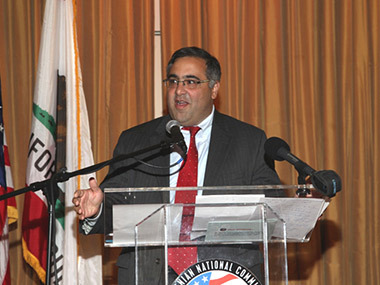
Aram Hamparian, the ANCA Executive Director, has published an article in Asbarez.com, where he spoke about the position of the United States on the Armenian Genocide. The article says, in part:

“It’s time for a new American approach to the Armenian Genocide, one that is as simple as it is sound: Progress and peace based upon truth and justice.

g_image.php66American policy on the Armenian Genocide can be both principled and practical.

Years of futile U.S. efforts to appease Turkey have failed to end Ankara’s blockade of Armenia and only hardened Ankara’s denial of truth and obstruction of justice for this crime.

This denial poisons Armenian-Turkish relations, fosters wave after wave of anti-Armenian intolerance within Turkey, threatens Armenia’s and Artsakh’s security, and, of course, fuels regional tensions.

The future of this region – it’s sustainable stability over the long-term – cannot be built upon a foundation of lies. Justice is good geopolitics.

It’s time for the Obama-Biden Administration to reject Ankara’s gag-rule and proudly reaffirm our government’s record of having recognized the Armenian Genocide. Sadly, under foreign pressure, President Obama has failed to reflect, much less reinforce, America’s standing acknowledgment of the Armenian Genocide as a crime of genocide.

After years of failed efforts to appease Ankara, it’s time for President Obama to honor his words, and for our government to live up to America’s promise of truth and justice.

It’s time to stop outsourcing our nation’s Armenian Genocide policy to Turkey, and – in the interest of both regional stability and our core values as a nation – to reclaim American leadership in support of a truthful and just resolution of this crime.”

Filed Under: Articles, Genocide

The Armenian Mirror-Spectator: Armenian orphans became a source of enriching genetic pool for Turkish nation

May 8, 2013 By administrator

Below, we present an article by Raffi Bedrosyan published in The Armenian Mirror-Spectator.

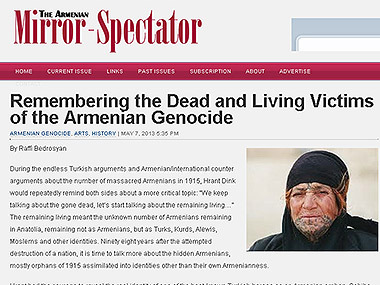
During the endless Turkish arguments and Armenian/international counter arguments about the number of massacred Armenians in 1915, Hrant Dink would repeatedly remind both sides about a more critical topic: “We keep talking about the gone dead, let’s start talking about the remaining living…” g_image.php55The remaining living meant the unknown number of Armenians remaining in Anatolia, remaining not as Armenians, but as Turks, Kurds, Alewis, Moslems and other identities. Ninety eight years after the attempted destruction of a nation, it is time to talk more about the hidden Armenians, mostly orphans of 1915 assimilated into identities other than their own Armenianness.

Hrant had the courage to reveal the real identity of one of the best-known Turkish heroes as an Armenian orphan. Sabiha Gokçen, the first female military pilot and Ataturk’s adopted daughter, was in reality Hatun Sebilciyan, an Armenian girl orphaned in Bursa in 1915. This revelation was the beginning of the end for Hrant, triggering a massive hate and threat campaign against him by the government, the military and the media, resulting in his assassination three years later. But Sebilciyan/Gokçen was only one of tens of thousands of Armenian girls and boys torn away from their parents during the 1915 events. What happened to these orphans? How many were there? This article will cite some examples from different parts of Anatolia.

It is a well-documented fact that during the deportation of the Armenian population from all corners of Anatolia to the Syrian desert, as the convoys approached their towns or villages, local Turks and Kurds snatched Armenian children from their parents to take them home as servants or wives. Many children were sold as slaves by them or the gendarmes escorting the convoys. There were also a few children entrusted by their parents to Kurdish and Turkish neighbors before starting on the deportation route. There were some children initially rescued by European/American missionaries or Pontian Greek religious leaders, but inevitably they were also later seized and sent away or murdered. We can cite one of many documented tragic incidents in Trabzon, where 600 Armenian orphan children were taken to the Greek monastery with the government’s permission after their parents were massacred by drowning in the Black Sea. But after three months, by the order of the Trabzon governor Djemal Azmi, the police forcefully removed the orphans from the monastery and handed them over to a Turkish boat captain, Rahman Bayraktaroglu, who placed each child in a flour sack, securely tied the top and dropped each into the Black Sea. It is documented that Governor Jemal later joked, “The harvest of smelt (hamsi) will be plentiful this season with all the drowned as fish feed.”

Trabzon Governor Djemal Azmi selected about 450 of the best-looking girls from the Armenian community of Trabzon and converted the local Red Crescent Hospital to a whorehouse for the Turkish elite and visiting dignitaries, even sending some of the girls as treats to his superiors in Istanbul. The supply of the orphans got replenished as needed. He kept a supply of 15 Armenian girls for himself but also gave one to his 14-year-old son, Ekmel, as a present. Most of the girls were forcefully Islamicized; a few eventually escaped or committed suicide. These experiences came to light from witnesses during the trials of the Ittihat ve Terakki leaders after the war, but also were told in 1921 by Djemal Azmi’s son himself to his close friend, known to him as Mehmet Ali. The friend, however, happened to be an Armenian named Hratch Papazian, disguised and even circumcised as a Moslem, who had succeeded infiltrating the Ittihad ve Terakki circles hiding in Berlin, in preparation for assassinating the Turkish leaders as part of Operation Nemesis (Djemal Azmi and Bahattin Shakir, head of the Special Organization [Teskilat-i Mahsusa] who was the chief organizer of the deportation massacres, were both assassinated in Berlin on April 17, 1922, right in front of the bewildered widow of Talat Pasha, a year after Talat himself was brought to justice).

The Ittihat ve Terakki government had special plans for the surviving orphans. In an organized operation, while there was a world war going on, most of the surviving orphans were rounded up and sent to orphanages set up in multiple locations, with the objective of converting them to Islam and to be assimilated as Turks. One of these special Turkification orphanages was in Ayn Tura, near Zouk, an hour’s drive from Beirut, where 1,000 Armenian orphans were kept, between the ages of 3 to 15. By the orders of Djemal Pasha, governor of Syria and Lebanon, and under the supervision of Turkish intellectuals and teachers, including the newly-appointed principal, Turkish novelist Halide Edip Adivar, these orphans were converted to Islam and Turkified. The boys were circumcised, and were given Turkish names, but preserving the initials of their Armenian names and surnames, so that Haroutiun Najarian became Hamid Nazim, Boghos Merdanian became Bekim Muhammed, Sarkis Sarafian became Saffet Suleyman. The orphanage was converted from a Christian school after expelling the Lazarist Catholic priests. While famine prevailed everywhere in Lebanon and Syria during the war, abundant food was provided to the orphanage, with the objective of raising well-fed and healthy newly Turkified children. Based on the memoirs of one of the orphans, Harutiun Alboyajian, the children were expected to speak Turkish only; if the supervisors heard any Armenian spoken, the boys would be beaten severely. They were dressed as Turkish children and were taught Islam. It was Djemal Pasha’s firm belief that the Armenians had superior intellect and capabilities, which would help the Turkish nation immensely. Despite efforts to keep the orphanage sanitary, about 300 Armenian orphans died from leprosy and other diseases until 1918. Some of the orphans were placed with families in towns where there were no Armenians left, and some were distributed to other orphanages. At the end of the war, when Near East Relief took over the orphanage, there were 670 orphans, 470 boys and 200 girls, who still remembered their Armenian names.

Another example of Turkification experiment was in Eastern Anatolia, successfully implemented by Eastern Front commander Kazim Karabekir. He estimated that there were about 50,000 desperate orphans after the war in his regional area of operations. It is documented that about 30,000 of them were circumcised and Turkified. He rounded up about 6,000 Armenian children in Erzurum, 2,000 girls and 4,000 boys, and placed them in an army camp. Some were given training similar to a military school; others were taught trades essential for army supplies such as sewing and boot-making. These orphans had become completely Turkified and named “The Healthy Children Army.” The talented ones among these boys were later sent to higher military academies in Bursa and Istanbul. Without going into the psychology of the assimilations and conversions, it is alleged that these converted military officers became the most fanatical ultranationalists in the Turkish army, with some of them participating in the May 1960 military coup which toppled the civilian government of Adnan Menderes.

Apart from the orphanages, tens of thousands of young girls and boys became slaves after 1915, bought and sold in bazaars and markets. Although slavery was officially abolished in the Ottoman Empire in 1909, slavery markets re-opened after 1915 in order to trade Armenian women and children. Kidnapping Armenian children from the deportation convoys not only supplied the Turks and Kurds with servants, free labor or sex objects in their own homes, but also a marketable commodity that could be sold for profit in these markets. The markets were set up in Aleppo, Diyarbakir, Cizre, Urfa and Mardin. It is reported that the Mardin market had the lowest prices. After being branded and tattooed as a slave, Armenian children aged 5-7 found buyers for 20 cents, similar to the price of a lamb. Girls or boys aged 14-15 went for 50 cents, whereas an adult Christian woman was worth about one Turkish lira. But if the slave came from a well-known wealthy family, the price went up significantly, as owning the slave could also bring the future potential of claiming the wealth of the slave’s family. There are several documented cases from the later Turkish Republic era when Kurdish and Turkish families attempted to legalize the ownership of many real estate properties, previously owned by their “wives” or “daughters.”

There are also documented cases when kind-hearted Assyrian priests or European/American missionaries purchased several Armenian children from these markets, with the objective of rescuing them. Assyrian Archbishop Tappuni of Mardin purchased and saved nearly 2,000 Armenian children in 1916. While some Moslems treated the Armenian slaves humanely, most owners savagely beat them, as they believed “Christians only deserve beatings.” The women and girls ended up being second wives for the Moslem owners, who received harsh treatment not only from their husbands but also from the other wives of their husbands. But eventually, they all got absorbed into the Moslem households, bearing children, learning the Quran, praying piously as Moslem women.

According to a post-war report of the League of Nations Rescue Commission for Armenian Women and Children, at least 30,000 Armenian girls were sold in the markets to be placed in harems, or to be used as slave labor. Documented histories of some 2,000 Armenian girls, boys and young women rescued from Turkish and Kurdish households after the war are archived in the League of Nations offices in Geneva. Rescuing the Armenian orphans became one of the first tasks of the League of Nations after the armistice in 1918. Following the pleas of the Istanbul Armenian Patriarchate, the Allied Forces and the League of Nations representatives organized the transfer of most Armenian orphans from Anatolia and Syria to Istanbul, and started searches of Armenian orphans in Moslem homes. As there was no room to place all the orphans in existing orphanages in Istanbul, several schools were used to house the Armenian children, including the French Notre Dame de Sion, St. Joseph, the Italian school, the Russian monastery, and Turkish Kuleli Military Academy.

As some of the orphans already had Turkish names, there started heated discussions between the Armenian Patriarchate and the government authorities as to the real identity of the children. In fact, some of the orphans were already transferred to Turkish homes in Istanbul as maids and servants; among them, 50 orphans sent to the farm of Ittihad ve Terakki leader Enver Pasha. The children were conditioned and intimidated not to speak Armenian, nor to reveal their Armenian identities during the war years.

Documents show that between 1920 and 1922, there were about 3,800 Armenian children brought to Istanbul, 3,000 sent to Cyprus, 15,600 taken to Greece, and 12,000 transferred to Syria from Marash, Urfa, Antep, Malatya and Harput. Significantly, the Istanbul Patriarchate records indicated that there were still at least 63,000 Armenian orphans documented as “Not Rescued” in Turkish and Kurdish households.

In recent years, genocide scholars have stated that the perpetrators not only aim at the “destruction” of the oppressed group but also the “construction” of the oppressor group. The 1915 events and the consequences clearly show that the Armenian orphans became a source of pro-creation for the Turkish nation by enriching their genetic pool. There are now tens of thousands of Turkish and Kurdish families, with a hidden Armenian grandmother. It is remarkable that, even ninety eight years after attempts of forced Turkification, assimilation and conversion, there are signs of hidden Armenian identity in various places in Anatolia starting to emerge. There is a somewhat graphic term defining these people in Turkey, “remnants of the sword” (kilic artigi).

Hrant Dink’s lawyer, Fethiye Cetin, in her book My Grandmother, and the follow-up, The Grandchildren, co-written with Aysegul Altinay, and many other books, documentaries and movies have come out in recent years, describing the existence and emergence of the hidden Armenians in Turkey, carried from one generation to the next, all originating from the 1915 Armenian orphans.

It is of course very difficult to estimate the number of hidden Armenians in Turkey today. One can assume that perhaps up to 100,000 Armenian orphans survived but got Turkified, converted and assimilated. Scholars estimate another 200,000 adult Armenians avoided deportation in various Anatolian villages by converting to Islam. It is therefore conceivable that 300,000 Armenian souls survived the 1915 events. The population of Turkey increased seven fold since then. Using the same multiple, one can extrapolate that there may exist 2 million people with Armenian roots in Turkey today.

I would like to share one of my own personal experiences with a hidden Armenian, albeit indirectly. When I was in Armenia in 1995 as a voluntary engineer inspecting Hayastan All Armenian Fund-financed construction projects, I also visited Spitak where the church destroyed in the 1989 earthquake was being rebuilt. I was informed that the financing came from Turkey from a still confidential donor, as specified in the will of a grandmother of a very wealthy Turkish family, who had only revealed her Armenian roots at her deathbed. In recent years and especially after the reconstruction of the Surp Giragos Armenian Church in Diyarbakir, there has been a resurgence of the hidden Armenians in revealing their identities. It is hoped that the Turkish government sees this as a positive consequence of the recent steps of liberalization and not as a threat, and eventually finds the courage to face its past.

Filed Under: Articles, Genocide

Voice of America: U.S. ambassador to UN is concerned about human rights situation in Azerbaijan

May 8, 2013 By administrator

Eileen Chamberlain Donahoe, U.S. Ambassador to the Human Rights Council commented on Universal Periodic Review of UPR and expressed her concern about the human rights situation in Azerbaijan, the Voice of America reports.

g_image.php44The author reminds that Azerbaijan was one of fourteen countries examined during the session held in Geneva, on April 30.

“We are concerned by the continued incarceration of some journalists and democracy activists. These raise concerns about the authorities’ use of the judicial system to limit the rights of individuals to express themselves freely,” the ambassador said.

She also voiced concern over “undue restrictions on freedom of peaceful assembly” in Azerbaijan and over “recently enacted legal government restrictions on funding for civil society and continuing difficulties for NGO’s seeking to register,” as well as reports of harassment of human rights lawyers.

According to the article in its latest annual human rights report on Azerbaijan, the U.S. Department of State noted similar problems, including “restrictions on freedom of expression, including intimidation, arrest and use of force against journalists and human rights and democracy activists.”

Among other violations of freedom of expression, including imprisonment of journalists, the State Department report cited the case of investigative journalist Khadija Ismayilova who works at Radio Free Europe/Radio Liberty. Thus Ms. Ismayilova, who has exposed official corruption in Azerbaijan, was the victim of attempted blackmail. Although the Azerbaijani Presidential Administration criticized the invasion of her privacy, an official investigation has not led to any arrests.

Ambassador Donahoe called on the Azerbaijani authorities to release individuals incarcerated for publicly expressing their opinions and ensure due process for other detainees, permit peaceful protest to be held in Baku city center, and work with domestic and international organizations, to amend legislation in order to promote a flourishing civil society.

U.S. State Department strongly criticized Azerbaijan in the report for violation of human rights, including freedom of speech and the press. According to international human rights organization “Committee to Protect Journalists” (CPJ), there are at least 6 imprisoned journalists in Azerbaijan, thus this republic is now among the top ten countries in the world by the number of press workers’ arrests.

Source: Panorama.am

Filed Under: Articles

  • « Previous Page
  • 1
  • …
  • 2657
  • 2658
  • 2659
  • 2660
  • 2661
  • …
  • 2746
  • Next Page »

Support Gagrule.net

Subscribe Free News & Update

Search

GagruleLive with Harut Sassounian

Can activist run a Government?

Wally Sarkeesian Interview Onnik Dinkjian and son

https://youtu.be/BiI8_TJzHEM

Khachic Moradian

https://youtu.be/-NkIYpCAIII
https://youtu.be/9_Xi7FA3tGQ
https://youtu.be/Arg8gAhcIb0
https://youtu.be/zzh-WpjGltY


gagrulenet Twitter-Timeline

Tweets by @gagrulenet

Archives

Books

Recent Posts

  • Pashinyan Toys: Some of the weapons on display turned out not to be weapons at all
  • The Imperative of Preserving the Statehood of Artsakh:
  • If Pashinyan is re-elected, Armenia will become a “gubernia” of several countries
  • Mr. Karapetyan laid out the failures he inherited from the current government-and presented a clear, decisive plan
  • Anna Hakobyan Join Pashinyan, holding a motorcade rally sign of desperation…

Recent Comments

  • Tina on Anna Hakobyan prepared a heartbreaking text about the deprivations “Hraparak”
  • Baron Kisheranotz on Pashinyan’s Betrayal Dressed as Peace
  • Baron Kisheranotz on Trusting Turks or Azerbaijanis is itself a betrayal of the Armenian nation.
  • Stepan on A Nation in Peril: Anything Armenian pashinyan Dismantling
  • Stepan on Draft Letter to Armenian Legal Scholars / Armenian Bar Association

Copyright © 2026 · News Pro Theme on Genesis Framework · WordPress · Log in