Gagrule.net

Gagrule.net News, Views, Interviews worldwide

  • Home
  • About
  • Contact
  • GagruleLive
  • Armenia profile

Artsakh president congratulates on the 26th anniversary of NKR Defense Army and Liberation of Shushi

May 9, 2018 By administrator

Artsakh President Bako Sahakyan sent today a congratulatory address in connection with the Victory Holiday, the 26th anniversary of the Nagorno Karabakh Republic Defense Army and the Liberation of Shushi.

“May 9 has long been the symbol of victories of our heroic people. History has proven more than once that in different periods, during ordeals our Motherland underwent we have managed to unite and protect our national interests, homes and hearths, families and children. Our people managed to do that due to their courage and brevity, the infinite love and devotion to the Motherland, their unity and unshakable will,” read the statement in part, released by the information department at the President’s Office.

“We always remember the feat of our heroic fathers and grandfathers in the Great Patriotic War, we have been brought up by their example, and inspired also by this very example we have liberated Shushi, ancient Armenian settlements and built a free and independent statehood.

The independence generation today continues our people’s heroic traditions; continues with dignity and confidence enriching the victorious pages of our history,” the statement read, adding “Let the May cherished victories be a landmark for our people and lead to new achievements and accomplishments. I wish all of us peace, welfare and all the best.”

Filed Under: Articles Tagged With: liberation, Shushi

Armenia: May triple holiday celebrated with grandeur in Artsakh

May 9, 2017 By administrator

Festive events marking the Victory Holiday, the 25th anniversary of the Nagorno Karabakh Republic Defense Army and the Liberation of Shushi have started in Shushi and Stepanakert from early morning on Tuesday.

The celebrations dedicated to May holidays started with a military march at the Revival Square in Stepanakert. Events are planned in all regions of the country to be crowned with a final festive concert and a firework display in the capital city.

Filed Under: News Tagged With: day, liberation, Shushi

Karabakh marks 25th anniversary of Shushi liberation

May 8, 2017 By administrator

Nagorno Karabakh (Artsakh) is marking the 25th anniversary of Shushi liberation on Monday, May 8.
Shushi was liberated on May 9, 1992. Liberation of Shushi was crucial because of its major strategic significance and had its decisive say in the further development of the National Liberation Movement. Constant bombings left the capital of Nagorno Karabakh in ruins, killing hundreds.

From November 1991 up to the first half of 1992 over 4740 shells were fired at Stepanakert from Shushi, Djangasan, Kesalar, Gaibalu. As a result, 111 people were killed and 332 injured, 370 houses were left in ruins. Moreover, there was no connection with Armenia through the Lacin corridor. The blockade resulted in a lack of electricity, gas and dirking water, greatly damaging the economy of the whole republic.

After a number of successful operations in late 1991 and early 1992, the liberation of Khojalu on February 25-26, 1992 and the opening of the airport created economic, military and physiological preconditions for liberation of Shushi. The self-defense of the village Karintak on 25-26 January of 1992 was of great significance, when the small detachment of the Armenian volunteers was able to resist the counterattack organized by the huge army of the enemy from Shushi. By April 27, 1992 in Shushi, from where the population was replaced, a huge number of military equipment was deployed.

To liberate Shushi, the Armenian side took a number of diplomatic and decisive actions. The military operation was carried out on May 8 – 9. It was one of the greatest ones in the history of Armenia, bringing a radical turn in the course of military operations of the Karabakh Liberation Movement.

The plan of actions was developed under the supervision of A. Ter-Tadevosyan right after Khodjalu was liberated. The plan was drawn in the moths of March and April, after the position, and the number of the enemy troops was clarified. The enemy forces were much larger in number. By April 28 the operation directions, the commanding officers and the availability of forces were already clarified.

The attack was supposed to launch on May 4, but for a number of reasons (lack of ammunition, bad weather etc.) it was postponed. On the night of May 8, 4 attacking and 1 backup group of 1200 fighters launched the attack.

The outcome of the military actions was already predetermined on May 8, when the subdivisions seized very favorable positions, with the enemy allowed to leave the city through the corridor.

At noon, the enemy’s first military plane and helicopters launched the attack. A number of Armenian units, as well as Shushi and Stepanakert were fiercely bombarded. Later it turned out that the aim of the air attack was liquidating of the few military ammunition depots left in Shushi, as well as the whole city; however, they failed. The Khazanchetsots Church, where the Azeris kept their ammunition depots, also survived. The operation was almost completed by the evening. On May 9 the ancient Armenian city was liberated.

Filed Under: Articles Tagged With: Karabakh, liberation, Shushi

Mosul to be totally freed from Daesh grip in May: Cmdr.

April 30, 2017 By administrator

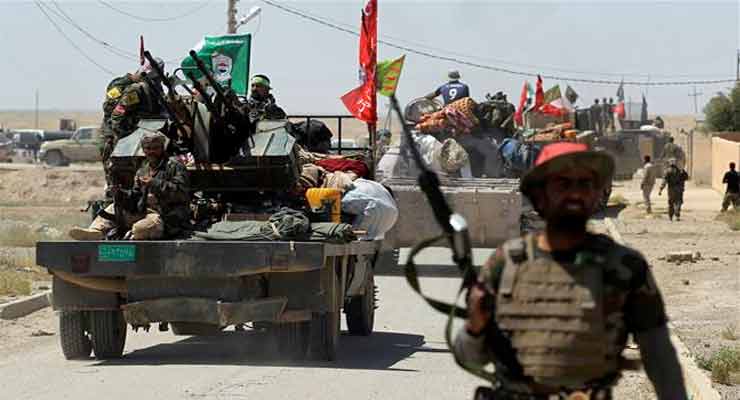
A high-ranking Iraqi military commander has expressed hope that government forces, backed by volunteer fighters from Popular Mobilization Units, will drive the Daesh Takfiri terrorists out of their last urban stronghold in the country in less than a month despite the stiff resistance that the extremists are putting up in the densely-populated Old City district of western Mosul.

The official al-Sabaah (The Morning) daily newspaper, quoting Army Chief of Staff Lieutenant General Othman al-Ghanimi, reported on Sunday that the battle should be completed “in a maximum of three weeks.”

The report came on the same day that the commander of Nineveh Liberation Operation, Lieutenant General Abdul Amir Yarallah, said fighters from Popular Mobilization Units, commonly known by their Arabic name, Hashd al-Sha’abi, had reclaimed control of the villages of Tomit, Bont al- Mosheirfeh and Umm al-Shatan west of Tel Abtah, and raised the national Iraqi flags over several buildings in the liberated areas.

Yarallah added that pro-government Iraqi forces had inflicted heavy losses on Daesh ranks and their military hardware during the operations.

Separately, two Iraqi soldiers were killed and eight others injured when Daesh militants launched an ambush attack against an army outpost in the troubled western province of Anbar.

Captain Ahmed al-Dulaimi of the provincial police said the attack targeted government forces west of the town of Ar-Rutbah, situated about 428 kilometers (265 miles) west of the capital, Baghdad, on Sunday.

He said five of the assailants were shot dead, adding that fierce exchanges of gunfire broke out between both sides after the ambush.

The United Nations says nearly half a million civilians have fled fighting since the offensive to retake Mosul from the Daesh terrorists started on October 17, 2016.

The UN Office for the Coordination of Humanitarian Affairs said on April 17 that 493,000 people had been displaced from the city, located some 400 kilometers north of the capital Baghdad.

As many as 500,000 civilians are still trapped in Daesh-controlled neighborhoods of western Mosul.

Iraqi army soldiers and Hashd al-Sha’abi fighters have made sweeping gains against the Takfiri elements since launching the operation to retake Mosul.

The Iraqi forces took control of eastern Mosul in January after 100 days of fighting, and launched the battle in the west on February 19.

Filed Under: Articles Tagged With: 3 weeks, liberation, Mosul

Breaking News: Battle for Mosul: Operation to retake Iraqi city from IS ‘begins’

October 16, 2016 By administrator

mosul-libA military operation to recapture the Iraqi city of Mosul from so-called Islamic State (IS) has begun, Prime Minister Haider al-Abadi says.

The long-awaited assault from Kurdish Peshmerga, Iraqi government and allied forces is backed by the US-led coalition fighting IS in Iraq.

Mosul, Iraq’s second largest city, has been under IS control since June 2014.

The UN has warned that the humanitarian impact could be “enormous”, and affect up to 1.2 million people.

Mosul is the group’s last major stronghold in Iraq. The loss of the city, officials say, would mark the effective defeat of IS in the country.

In an address broadcast on state television in the early hours of Monday, Mr Abadi said: “The hour has come and the moment of great victory is near.”

“Today I declare the start of these victorious operations to free you from the violence and terrorism of Daesh,” he added, using another name for IS.

Dressed in military uniform and surrounded by Iraqi officers, he vowed that only government forces would enter Mosul, a Sunni-majority city.

It was from there that IS leader Abu Bakr al-Baghdadi declared a caliphate – a state governed in accordance with Islamic law – in territory controlled by the group in Iraq and Syria.

An operation to retake the city, capital of the northern Nineveh governorate, has been planned for months.

Filed Under: News Tagged With: begian, liberation, Mosul

How Antep become Gaziantep A beautiful mosque and the dark period of the Armenian genocide

October 15, 2016 By administrator

church-to-mosque

from Church to mosque The ‘Liberation’ mosque as it is today Nelofer Pazira

The city of Gaziantep and the ‘Liberation’ mosque is a milestone on the journey between one great crime of the 20th century, and another seen during the Second World War.

By Robert Fisk,

The ‘Liberation’ Mosque is a fine, neo-classical, almost Gothic construction with striped black-and-white stone banding, unusual for a Muslim holy place but a jewel in the Tepebasi district of the old town of Gaziantep. Its stone carvings and mock Grecian columns beside the window frames are a credit to another, gentler age. The minarets perch delicately – and I had never seen this before – on square towers that might have been church towers had there been Christians in this ancient city.

But of course, there were. What no-one will tell you in Gaziantep, what no guidebook mentions, what no tourist guide will refer to, is that this very building – whose 19th century builders were none other than the nephews of the official architect of Sultan Abdulhamid II – was the Holy Mother of God cathedral for at least 20,000 Christian Armenians who were victims of the greatest war crime of the 1914-18 war: the Armenian genocide. They were deported by the Ottoman Turks from this lovely city, which had been their families’ home for hundreds of years, to be executed into common graves. The murderers were both Turks and Kurds.

Altogether, up to 32,000 Armenians – almost the entire Christian population of 36,000 of what was then called Antep – were deported towards the Syrian cities of Hama, Homs, Selimiyeh, to the Hauran and to Deir Ezzor in 1915. The Muslim citizens of Aintep then apparently plundered the empty homes of those they had dispossessed, seizing not only their property but the treasures of the cathedral church itself. Indeed, the church, ‘Surp Asdvazdadzin Kilisesi’ in Armenian, was turned into a warehouse – as were many Jewish synagogues in Nazi Germany and in Nazi-occupied eastern Europe during the Second World War – and then into a prison. 

Prowling around the church-mosque enclosure, I found some of the prison bars still attached to the window frames, although the building has been functioning as a mosque since 1986. The main gate was closed but I pushed it open and found not only that the structure of the magnificent building is still intact but that scaffolding has been placed against the walls for a renovation. Behind the church – and separate from the building – was an ancient stone cave whose interior was blackened with what must have been the smoke of candle flames from another era, perhaps a worshipping place because the cave appears to have been a tomb in antiquity. The caretaker came fussing up to us to tell us that the mosque was shut, that we must leave, that this was a closed place. But he was a friendly soul and let us take pictures of the great façade of the church and of the minarets.

The only sign of its origin is the date “1892” carved in stone on the east façade of the original church, marking the final completion of the work of the great Armenian architect Sarkis Balian – he was the official architect of the 19th century Sultan Abdulhamid II, a terrible irony since Abdulhamid himself began the first round of Armenian massacres of 80,000 Christians (the figure might be 300,000) in Ottoman Turkey just two years after the Armenian stonemason Sarkis Tascian carved the date on the façade. In the later 1915 Armenian Holocaust – even Israelis use this word for the Armenian genocide – a million and a half Armenians were slaughtered by the Turks. It is a shock to realize that Aintep’s vast toll of dead were only a small fraction of this terrifying war crime.

Outside the church, I found an elderly Syrian refugee sitting on the pavement by the closed gate. He greeted us in Arabic and said that, yes, he knew this was once a church. Just over a century ago, the Arabs of northern Syria – the land now occupied by Isis – were among the only friends the Armenians found in the vast deserts into which they were sent to die. Some took Armenian children into their homes. Others married Armenian women – the degree of coercion involved in this ‘charitable’ act depends on the teller — although more than twenty years ago I met a Syrian man and his ‘converted’ Armenian wife near Deir Ezzor, both around a hundred years old and both of whom has lost count of their great-great-grandchildren.

A Turkish man in a shop below the cathedral was less generous. Yes, it had been a church, he said. But when I asked him if it had been an Armenian church, he chuckled – dare I call it a smirk? — and looked at me, and said nothing. I suppose a kind of guilt hangs over a place like this. So it is a happy thought that some Armenian families have in recent years – as tourists, of course – visited the city that was once Antep and have spoken with warmth to members of Turkey’s leftist parties and celebrated the work of American missionaries who cared for both the Armenian and Turkish Muslim population here before 1915. One Armenian identified his old family home and the Turkish family who lived there invited him in and insisted that he should stay with them and not in a hotel. For this was also his home, they said.

But tears of compassion do not dry up the truth. For when the First World War ended, Allied troops marched into Antep. First came the British, led by the execrable Sir Mark Sykes – of Sykes-Picot infamy – and then the French in October 1919, who brought with them, alas, elements of the Armenian volunteers who had joined their ‘Legion d’Orient’ in Port Said. The Muslim elites who had taken over the town – and the Armenian homes and properties – feared the newcomers would demand restitution. Fighting broke out between Muslims and the French and their Armenian allies and the Muslims discovered a new-found enthusiasm for the independence struggle of Mustafa Kemal Ataturk. Thus began the false history of the city.

Perhaps the greatest font of knowledge on this period is a young Harvard scholar, Umit Kurt, of Kurdish-Arab origin, who was born in modern-day Gaziantep. Mr Kurt is now an academic at Harvard’s Center for Middle East Studies and wrote his doctoral dissertation on the Armenians of Antep from the 1890s with a special focus – this is the important bit for readers – on property transfers, confiscation, deportation and massacres. Mr Kurt’s conclusion is bleak.

“The famous battle of Aintab [sic] against the French,” he says, “…seems to have been as much the organised struggle of a group of genocide profiteers seeking to hold onto their loot as it was a fight against an occupying force. The resistance…sought to make it impossible for the Armenian repatriates to remain in their native towns, terrorising them [again] in order to make them flee. In short, not only did the local…landowners, industrialists and civil-military bureaucratic elites lead to the resistance movement, but they also financed it in order to cleanse Aintab of Armenians.”

They were successful. The French abandoned Antep in December 1919 and the Armenian volunteers fled with them. The new Turkish state awarded the Muslim fighters of the city with the honourific Turkish prefix ‘Gazi’ – “veterans” – and thus Antep became Gaziantep and the great church of old Sarkis Balian would eventually be renamed the ‘Liberation Mosque’ – “Kurtulus Cami” – to mark the same dubious victory over the French and Armenians, the latter being defamed as killers by those who had sent the Armenians of the city to their doom in 1915.

Not much justice there. Nor in the official Turkish version of that terrible history of the Armenian Holocaust in which – this is the least the Turkish government will concede – Armenians died ‘tragically’ in the chaos of the First World War, as did Muslims themselves. German military advisers witnessed the genocide. Hitler was later to ask his generals, before the invasion of Poland and the destruction of its Jews, who now, in 1939, remembered the Armenians. The official Turkish account of the fate of Gaziantep’s original Armenians refers to their “relocation” – a word used by the Nazis when they sent the Jews to their extermination in eastern Europe.

No, we shouldn’t contaminate the Turks of modern Turkey with the crimes of their grandfathers. Umir Kurt wrote his dissertation for the brilliant and brave Turkish historian Taner Akcam, whose work on the Armenian genocide has revolutionised historical scholarship in Turkey. Last year, President Recep Tayyip Erdogan deliberately moved the date of the 1915 Gallipoli commemorations to the very day of the anniversary of the start of the Armenian genocide in an attempt to smother any memory of the crime – but the government allowed Armenians to parade through Istanbul in honour of their 1915 dead. Yet if the historical narrative from the 20th century’s first holocaust to its second holocaust is valid, then the path upon which the first doomed Armenians of Antep set out in their convoy of deportation on 1st August 1915 led all the way to Auschwitz. The ‘Liberation’ Mosque is a milestone on the journey.

Source: http://www.independent.co.uk/voices/turkey-gaziantep-armenian-genocide-a7362771.html

Filed Under: Genocide, News Tagged With: armenian genocide, Gaziantep, liberation, milestone, mosque

Karabakh: May 8 marks Shoushi liberation operation

May 8, 2016 By administrator

f572ef26b2d4c8_572ef26b2d4fe.thumbA Shoushi liberation operation 24 years ago proved a landmark in liberation of Nagorno-Karabakh.

The battle of Shoushi took place on May 8, 1992, and the town was liberated on May 9. Azerbaijani troops had until that time shelled the capital of Nagorno-Karabakh, Stepanakert.

The operation was launched in four directions. The Armenian forces established control over the Qirs positions and Lachin-Shoushi highway.

The operation plan was worked out under the command of Arkadi Ter-Tadevosyan, during March-April, 1992, and was based on the intelligence data.

The Armenian forces launched an offensive along a 25-km-long line, and reached the Armenian border on May 18.

Filed Under: News Tagged With: Karabakh, liberation, marks, May 8, operation, Shoushi

Karabakh: Khojalu liberation and Azerbaijan’s propaganda

February 25, 2016 By administrator

Khojaly-Map English (1)This day, 24 years ago, the Arstakh Defense Army launched a military operation to neutralize the Khojalu-based Azerbaijani nests that shelled Stepanakert, liberate the Khojalu airport to ensure food and medicine supplies to Artsakh, liberate the Stepanakert-Askeran highway, which ran near Khojalu and was under the Azerbaijani forces’ control.

During the operation, a humanitarian corridor was opened for civilians, and most of the civilians safely left the town.

A group of people, however, were killed near Aghdam, and Azerbaijan began using the tragedy in its anti-Armenian propaganda, branding it “a massacre committed by Armenians.”

It should noted that Azerbaijani propaganda has no explanations for how the Khojalu residents safely left the town, passed by the Armenians positions deployed near Askeran, but were killed in a territory that the Artakh Defense Army reached a year later in 1993.

Khojalu liberation was major landmark to curb Azerbaijani aggression, says Armenian analyst

n an interview with Tert.am, political scientist Hrant Melik-Shanazaryan said that the liberation of Khojalu was the first major victory in countering Azerbaijan’s aggression against Artsakh. According to him, the more active is Azerbaijan’s propaganda the stronger is the international community’s desire to know the details. This is Azerbaijan’s problem.

Mr Melik-Shahnazaryan, this day, 24 years ago, Artsakh warriors liberated Khojalu. What impact did that action have on developments in the Nagorno-Karabakh conflict?

Liberation of Khojalu and destruction of the Azerbaijani military alignments deployed there proved to be the first major victory which can be considered a turning point in countering Azerbaijan’s armed aggression against Artsakh. True, before February 1992, the Artsakh Defense Army had achieved notable military success in Togh and Sarnshen, and later in Lesnoy, Salibeki, Ashagh, Ghushchular, Gharabahgly and Krkzhan – the settlement neighboring Stepanakert – it can be stated with confidence that Khojalu proved to be the landmark that radically changed the balance of forces in our favor in the Azerbaijani-Artsakh conflict.

That was a glorious victory that can hardly be overestimated. Khojalu was of strategic importance for both Armenians and Azerbaijanis. Artakh’s only airport is located there, and it was the only hub that connected Artsakh with the Motherland. Besides, by tripling the Khojalu population within two years, Azerbaijan’s authorities turned it into concentrated force that would shell and bomb Stepanakert, Askeran and the neighboring Armenian villages. And in Aghdam (present-day Akna), which is located at a distance of 12 kilometers of Khojalu, Azerbaijan had deployed large forces that had a task of taking over Stepanakert.

The Artsakh Armenians had nothing else to do but to neutralize the threat to the entire population of the country.  Destruction of the nests and military forces deployed in Khojalu was the only option to break the blockade of Stepanakert, re-establish the connection between the south and north of Artsakh and put an end to round-the-clock shelling of Artsakh settlements, creating conditions for air communication with Armenia and accomplishing a number of other important tasks. To the credit of our freedom-fighters, the liberation of Khojalu was a brilliant action.

Azerbaijan launched information warfare. Every year, they raise the Khojalu issue at different levels. What task is their propaganda seeking to accomplish?

Yes, over the past years, Azerbaijan has followed a “tradition” of bringing different accusations against the Armenian side at the end of February. By means of their press and propaganda they begin yelling in the true sense of the word. However, it should be noted that this tactics has in recent years boomeranged. Did the Aliyev administration believe that the world would readily accept their made-up stories? Was not it crystal clear the disinformation would be exposed and all the facts would be revealed, which caused tragic death of many residents of Khojalu.

During the last three or four years, the Armenian a side has carried out serious research to reveal and present to the international community the real causes of the death of the Khojalu residents in  question. I do not think anyone doubts now that, before taking over the Azerbaijani settlement, the Armenian side had repeatedly warned the local residents, urging them to leave the battlefield. The Armenian side opened a humanitarian corridor for the Khojalu residents for them to safely leave the town and reach their fellow-citizens near Aghdam. So that more than 700 residents could safely be transported to Stepanakert, stayed there for a few days and handed over to Azerbaijan without any pre-conditions. All the facts have been confirmed, even by Azerbaijani sources.

So what is the matter in dispute? How does Azerbaijan prove the Armenian side’s responsibility for the Khojalu tragedy?

There is no dispute as such. Nor is there any evidence – only accusations against the Armenian side. The ‘Khojalu tragedy” has something in common with that settlement -only in the context of local residents’ death there. In fact, however, it was a tragedy of Aghdam, not of Khojalu. The events unfolded in Aghdam, where, as I have mentioned, Azerbaijan had deployed large forces. At that time, Azerbaijan was in full control of the area where the Khojalu residents were killed. Azerbaijani troops opened fire at them. It may have been because of confusion. However, other causes are being discussed in Azerbaijan as well, particularly ones related to the National Front’s intention to force President Ayaz Mutalibov into resigning. Much has been talked about it, with relevant documents published. I would advise readers to visit the xocali.net (http://xocali.net/) website,  (http://www.armenianhouse.org/mshakhnazaryan/docs-ru/khojaly_f/contents.html) and https://www.youtube.com/watch?v=kvzfp9nb-VU . The readers will find answers to all the questions about the liberation of Khojalu and later tragedy in Aghdam.

But what the facts say runs counter to the Azerbaijani propaganda machine. How does the Aliyev administration manage to raise such a theory built on lie and disinformation. An open-minded outlook would reveal that the Azerbaijani propaganda has developed a certain influence on the international perception of the conflict.

The only possible way to bring it to attention is its unlimited replication and the same international community’s unawareness of the events in Artsakh at the last century’s end. No person with common sense can be indifferent to the horrendous scenes video-taped by Chingi Mustafaev. I mean the episodes featuring the tragedy of Aghdam. Those episodes strongly influenced the Azerbaijani society then, causing [President Ayaz] Mutalibov to abandon the presidential residence. Seeing that those episodes stirred up sentiments in the Azerbaijani society, the Aliyev administration decided to use them for also cheating the international community.   If there were such episodes after the liberation of Shushi, for example, they would now be speaking of the “Shushi tragedy”. But the Azerbaijani propaganda went even farther beyond that.

Thinking, probably, that those episodes are not enough to move humanity, they search for photos on the internet featuring brutal scenes from the Kosovo war or the earthquake in Turkey in an attempt to misrepresent them as evidence of the “Khojalu tragedy”

But the stronger the Azerbaijani propaganda and their call upon the international community to criticize Armenia for Khojalu, the stronger international experts’ desire for more detailed information on those events. This is where Azerbaijan is facing a problem. And this is why the country rejects any proposal for conducting an investigation.

Azerbaijan’s disinformation propaganda has assumed such increased scales that tremendous resources are now necessary  to identify and deny all that. If we speak in this context of the Khojalu liberation and the developments that followed, do you think Armenia’s efforts would be enough to reveal the whole truth?

As regards Khojalu, in particular, everything has been done; or almost everything. The only problem we have is perhaps the fact that the probe into the events of the Nagorno-Karabakh war bears an episodic character. To put it more plainly, let us consider the Khojalu liberation operations. That town, which was of such a great significance for the Armenians, had to liberated. And it was. But considering the same issue from the perspective of the local population’s tragic death, we have to look back – spatially and temporarily – to remember the Azerbaijani Mi-8 helicopter, which was downed on November 21, 1991. Ayaz Mutalibov lost his political team that day as the helicopter carried the entire political elite of Azerbaijan. The only person who refused to get on the helicopter was Tamerlan Gharaev who was than an outstanding representative of the opposition National Front. In Azerbaijan, it has been almost proven beyond reasonable doubt that the National Front representatives themselves downed the helicopter to oust Mutalibov from office. But the problem remained unresolved in [19] 91.  To get rid of Mutaloibov, they needed more victims. And the Aghdam tragedy followed those event. It was, by the way, Tamerlan Gharaev himself, that didn’t allow the troops in Aghdam to undertake operations in support to Khojalu.

Other records suggest that Gharaev maintained intimate relations with Heydar Aliev who, after acceding to power in 1993, appointed him Azerbaijan’s ambassador to India. And he remained in that post for 17 years and is now on a diplomatic mission in other countries in the East. I believe that Tamerlan’s activity can help resolve other interesting facts too. So the matter needs a proper consideration.

As we see, everything was interrelated. Yes, the Azerbaijani disinformation propaganda has assumed such extensive scales that one may even write a research thesis on that. But the key landmark events regarding the Azerbaijani-Karabakh conflict have been considerably studied. Fortunately, all this is very successfully continuing also today.


Filed Under: News Tagged With: Karabakh, Khojalu, liberation, propaganda

May 18 marks 23rd anniversary of Berdzor liberation

May 18, 2015 By administrator

19226922 years ago, on May 18, 1992, the defense army of Artsakh liberated Lachin (now Berdzor), with the move becoming a military, political and psychological victory.

After liberation of Shushi, Armenian forces had a new goal – to cleave the Road of Life at the shortest section between Nagorno Karabakh and Armenia, since Karabakh was under conditions of severe economic blockade.

Electricity and gas supplies were halted. Ammunition, food and medicine were delivered from Armenia by civil aviation, the flight becoming possible after liberation of Khojalu, where the only airport in Karabakh was located.

On May 13, 1992, Armenian forces continued concentrating near Zarasly settlement located between Shushi and Lachin. The communication with Lachin was cut off, while its hospital, school and building of local administration were destructed.

On May 15, Armenian detachments attacked upland Gulablu settlement of Aghdam region. Azerbaijani troops, which had numerical and positional advantages, repelled the attack. The enemy’s army fired at civilians of Stepanakert and other Armenian settlements from high levels of Gulablu.

On May 17, Armenian forces rebuffed the Azerbaijani army’s attack on Shushi. According to the NKR defense army, fire exchange took place in Lachin between the Azerbaijani armed detachments and local Kurds. However, as soon as traffic through a bypass road from Berdzor to Goris region was resumed, the Azerbaijani detachments started urgently leaving Lachin.

On May 18, Armenian Defense Minister Vazgen Sargsyan told the parliament of Armenia that the road linking Nagorno Karabakh with Armenia is open. A representative of the Azerbaijani defense ministry admitted the fall of Lachin later on May 18.

Berdzor, the center of Kashatagh region with a population of 9800, continues to serve as the Road of Life connecting Armenia and Nagorno Karabakh.

Filed Under: Articles Tagged With: anniversary, Berdzor, Karabakh, liberation

Karabakh marks 23rd anniversary of Shushi liberation

May 8, 2015 By administrator

191838Karabakh will mark the 23rd anniversary of Shushi liberation with series of events on May 8 and 9.

Shushi was liberated on May 9, 1992. Liberation of Shushi was crucial because of its major strategic significance. Shushi’s liberation had its decisive say in the further development of the National Liberation Movement. Constant bombings left the capital of Nagorno Karabakh in ruins, killing hundreds. report panarmenian

From November 1991 up to the first half of 1992 over 4740 shells were fired at Stepanakert from Shushi, Djangasan, Kesalar, Gaibalu. As a result, 111 people were killed and 332 injured, 370 houses were left in ruins. Moreover, there was no connection with Armenia through the Lacin corridor. The blockade resulted in a lack of electricity, gas and dirking water, greatly damaging the economy of the whole republic.

After a number of successful operations in late 1991 and early 1992, the liberation of Khojalu on February 25-26, 1992 and the opening of the airport created economic, military and physiological preconditions for liberation of Shushi. The self-defense of the village Karintak on 25-26 January of 1992 was of great significance, when the small detachment of the Armenian volunteers was able to resist the counterattack organized by the huge army of the enemy from Shushi. By April 27, 1992 in Shushi, from where the population was replaced, a huge number of military equipment was deployed.

To liberate Shushi, the Armenian side took a number of diplomatic and decisive actions. The military operation was carried out on May 8 – 9. It was one of the greatest ones in the history of Armenia, bringing a radical turn in the course of military operations of the Karabakh Liberation Movement.

The plan of actions was developed under the supervision of A. Ter-Tadevosyan right after Khodjalu was liberated. The plan was drawn in the moths of March and April, after the position, and the number of the enemy troops was clarified. The enemy forces were much larger in number. By April 28 the operation directions, the commanding officers and the availability of forces were already clarified.

The attack was supposed to launch on May 4, but for a number of reasons (lack of ammunition, bad weather etc.) it was postponed. On the night of May 8, 4 attacking and 1 backup group of 1200 fighters launched the attack.

The outcome of the military actions was already predetermined on May 8, when the subdivisions seized very favorable positions, with the enemy allowed to leave the city through the corridor.

At noon, the enemy’s first military plane and helicopters launched the attack. A number of Armenian units, as well as Shushi and Stepanakert were fiercely bombarded. Later it turned out that the aim of the air attack was liquidating of the few military ammunition depots left in Shushi, as well as the whole city; however, they failed. The Khazanchetsots Church, where the Azeris kept their ammunition depots, also survived. The operation was almost completed by the evening. On May 9 the ancient Armenian city was liberated.

Filed Under: Articles Tagged With: Karabakh, liberation, Shushi

  • 1
  • 2
  • Next Page »

Support Gagrule.net

Subscribe Free News & Update

Search

GagruleLive with Harut Sassounian

Can activist run a Government?

Wally Sarkeesian Interview Onnik Dinkjian and son

https://youtu.be/BiI8_TJzHEM

Khachic Moradian

https://youtu.be/-NkIYpCAIII
https://youtu.be/9_Xi7FA3tGQ
https://youtu.be/Arg8gAhcIb0
https://youtu.be/zzh-WpjGltY


gagrulenet Twitter-Timeline

Tweets by @gagrulenet

Archives

Books

Recent Posts

  • Pashinyan Government Pays U.S. Public Relations Firm To Attack the Armenian Apostolic Church
  • Breaking News: Armenian Former Defense Minister Arshak Karapetyan Pashinyan is agent
  • November 9: The Black Day of Armenia — How Artsakh Was Signed Away
  • @MorenoOcampo1, former Chief Prosecutor of the International Criminal Court, issued a Call to Action for Armenians worldwide.
  • Medieval Software. Modern Hardware. Our Politics Is Stuck in the Past.

Recent Comments

  • Baron Kisheranotz on Pashinyan’s Betrayal Dressed as Peace
  • Baron Kisheranotz on Trusting Turks or Azerbaijanis is itself a betrayal of the Armenian nation.
  • Stepan on A Nation in Peril: Anything Armenian pashinyan Dismantling
  • Stepan on Draft Letter to Armenian Legal Scholars / Armenian Bar Association
  • administrator on Turkish Agent Pashinyan will not attend the meeting of the CIS Council of Heads of State

Copyright © 2025 · News Pro Theme on Genesis Framework · WordPress · Log in