Gagrule.net

Gagrule.net News, Views, Interviews worldwide

  • Home
  • About
  • Contact
  • GagruleLive
  • Armenia profile

NASA, MIT bring Zero Robotics to Armenia

June 16, 2018 By administrator

The two-week high school programming competition Zero Robotics organized by the Massachusetts Institute of Technology (MIT) and NASA is currently underway in Armenia’s Shirak province and is set to run through June 22.

The prestigious competition is held annually among high school and middle school students and is coordinated in Shirak by YES Armenia and the World Vision Armenia.

In a conversation with PanARMENIAN.Net Narek Tutkhalyan, coordinator of youth programs in Shirak province, revealed that teens aged 14-16 will write a code as part of the program, which, in the event of advancing to the next round, will be sent to NASA and the International Space Station to be tested on a space robot.

“The participants will have the opportunity to follow the process live, communicate with talented astronomers and see how the ISS works,” Tutkhalyan said.

“To make the competition even more interesting, speakers offer lectures on IT, robotics and related topics every day.”

Those involved on the contest will visit the Byurakan observatory in Aragatsotn province, as well as the Tumo Center for Creative Technologies and the SMART center in Tavush province.

Filed Under: Articles Tagged With: bring Zero, MIT, NASA, robotics

PKK releases Turkish agents’ ‘confessions’ about Paris murders of three female members

January 11, 2018 By administrator

ERBIL, Kurdistan Region – The murders of three female members of the PKK in Paris five years ago were planned by Turkey’s intelligence service and would have received “high ranking” approval, according to statements attributed to two Turkish agents being held by the PKK in the Kurdistan Region.

Sakine Cansiz, Fidan Dogan, and Leyla Soylemez were killed in Paris in January 2013. The PKK has accused Turkey of being behind their deaths.

The only suspect, a Turkish citizen named Omer Guney, died in custody in December 2016, just a month before going to trial. He had denied involvement in the killings.

On Wednesday, the Group of Communities in Kurdistan (KCK), the PKK umbrella body, released statements from two Turkish intelligence (MIT) agents in their custody saying that the murders were committed by the MIT and received high level approval.

Approval would have to come from the director of the agency, captured MIT agent Erhan Pekcetin said, according to a statement published by ANF, a PKK-linked media outlet.

“I don’t think that he will decide himself, he will ask the president. Because these actions can create international problems,” he said, noting that peace talks between Ankara and the PKK were ongoing at the time of the murders.

Pekcetin also stated that Guney was involved.

Pekcetin and Aydin Gunel, “senior officials” from MIT were seized by the PKK in the Kurdistan Region last summer. The PKK released their photographs and details last week.

Thousands of Kurds held a march in Paris on Saturday demanding “truth and justice” for the deaths of the three women. Some also changed slogans against Turkish President Recep Tayyip Erdogan who had met French President Emmanuel Macron in the city the day before.

Source: http://www.rudaw.net/english/middleeast/turkey/10012018

Filed Under: Articles Tagged With: assassination, MIT, PKK, Turkish

Details Of Paris Killings Of 3 Kurdish Women By Turkey’s MİT Exposed

January 5, 2018 By administrator

(Left to right) Leyla Söylemez, Sakine Cansız, Fidan Doğan.

Pro-Kurdish Fırat news agency (ANF), which is affiliated with the outlawed Kurdistan Workers’ Party (PKK), has released alleged new details about Paris killings on Friday and claimed that the execution order had been given by four administrators of the Turkey’s National Intelligence Organization (MİT).

On January 9, 2013, the outlawed PKK’s founding member Sakine Cansız, Kurdistan Information Bureau (KNK) Paris representative Fidan Doğan and Leyla Söylemez, who was a member of Kurdish youth movement, were assassinated in their Paris bureau. Suspect Ömer Güney died in prison on Dec. 17, 2016, just a few weeks before the trial.

The trial was planned to start on Jan. 23, 2017 in Paris High Criminal Court. However, the case was closed over Güney’s demise under suspicious circumstances. The probe into the murder of three Kurdish women in Paris has reopened later upon the appeal of lawyers.

“The massacre had reportedly come just a few days after an initiative to launch a new process of peace between Turkish government and the PKK. The process that was later dubbed the Imralı talks was just beginning. Before them, there had been the Oslo talks,” wrote the ANF.

“On January 3, 2013, a civilian committee had visited the Imralı island for the first time. Six days later, the bloody massacre in Paris occurred. The assassin was working for the MİT. He was a hitman, and was the only suspect under arrest. All signs he left behind were pointing to Ankara. The National Intelligence Agency, MİT, to be exact,” added it.

According to the report by ANF, “The MİT was there in the address he gave in code as he was planning his escape from prison. During the investigation, many other pieces of information were leaked. From a document that was leaked to the press on January 14, 2014, it could be understood that the execution order had been given by 4 administrators in the Turkish intelligence agency. Turkish intelligence claimed this document wasn’t genuine, but the document did have a wet-ink signature, and was included as evidence in the investigation file. Turkish officials refused to cooperate.”

“The document dated November 18, 2012 was signed by MİT officials Yüret, U.K. Ayık, S. Asal and H. Özcan. A document signed by MİT administrators showed that murder suspect Ömer Güney had been sent 6,000 Euros for ‘possible expenses’ and ordered to assassinate Sakine Cansız,” wrote ANF.

The document was saying: “In his last visit to our country to meet with us, the source was ordered to make preparations for people determined in the context of attacks/sabotages/assassinations against the organization targets in Europe and other such operative possibilities/capabilities, to acquire necessary equipment for his efforts, and to take maximum care in all communication with us, and has been paid 6.000 Euros for possible expenses.”

ANF’s report has continued to give details of assassination plan as follow:

“In a voice recording leaked to the press around the same time, Ömer Güney was speaking with unidentified MİT members to plan the murders. The date was January 12, 2014. The voice that was determined to belong to Ömer Güney was talking about assassination plans against Kurdish administrators. The two other voices in the recording were determined to be MİT members.

“The ‘final meeting’ that assassination plans were made according to documents and voice recordings was by early October, coinciding with Ömer Güney’s visit to Turkey. After Güney infiltrated Kurdish associations, he made many secret visits to İstanbul and Ankara. In the indictment, these visits were listed one by one with dates and times.

“The suspect had Sakine Cansız and many other Kurdish representatives in his crosshairs. The time when documents and voice recordings were leaked was also when Güney was planning his escape from prison. The murder suspect was planning to procure guns through his cohorts on the outside, and escape during his stay in the Salpêtrière Hospital in Paris.

“Years later, on December 17, 2016, the news of his death came from the same hospital. The case was expected to start that same month, but for some not fully explained reason, it got postponed to January 23.

“Later allegations were made that the massacre was planned during the Oslo and Imralı meetings, even that the members of the state committee in the talks were among the plotters. Kurdish journalist Amed Dicle’s book titled “2005-2015 Turkey-PKK Talks: ‘Resolution process operation’ against the Kurdish question’s resolution” pointed out that the order of execution was given during the Oslo meetings.

“The book also pointed out that the MİT members in the voice recording leaked on January 2014 were in the state committee that went to Oslo to meet with the PKK. The man mentioned in the book is code named Ozan, whose true identity hasn’t been confirmed, but is posed as a MİT administrator and was present in all meetings, from the first meeting in Geneva on July 5, 2008 to the last one in Oslo on July 5, 2011.

“According to Dicle, many people present in the Oslo meetings believe it was this MİT administrator code named Ozan in the voice recordings. The man in question was next to MİT Undersecretary Hakan Fidan in the Oslo meetings.

“New information that has surfaced months later confirm the previous. On the fifth anniversary of the massacre, On January 3, The outlawed Kurdistan Communities Union (KCK), an umbrella organization that encompasses the outlawed PKK, issued a statement on the massacre, which also coincided with the fifth anniversary of the first committee visiting Imralı in 2013.

“With the information the KCK shared regarding the two high ranking MİT officials captured in August 2017, they exposed the name of the man who planned the Paris massacre: Sabahattin Asal. According to the KCK statement, he participated in the Imrali meetings in the name of the state along with Muhammed Dervişoğlu.”

The ANF report has stated that Asal is a MİT administrator. One of the four signatures on the confidential document dated November 18, 2012 leaked in January 2014 belonged to  S. Asal. This name announced by the KCK matching the name on the document and the same man participating in the Imralı meetings show that the Turkish government’s role in the Paris killings.

Filed Under: Event Schedule Tagged With: Kurdish, MIT, Turkish, woman

Agency: in cooperation with the ‘the Turkish National Intelligence (MIT) leaders of the ISIS with its funds are in Turkey

October 19, 2017 By administrator

A number of the ISIS Terrorist leaders managed to escape from Syria, after repeated defeats by the Syrian Democratic forces in Raqqa and Rural area of Deir al-Zour, arrived in Turkey after taking their money with them, and the suspicions about the role of Turkish intelligence “MIT” in this process.
According to informed sources, the leaders fleeing the fighting have entered the Turkish territory, through the crossings controlled by terrorists “Euphrates shield” in the countryside of Aleppo eastern and north-east, backed by the Turkish occupation state.
For his part, the Syrian Observatory for Human Rights confirmed the health of this information and the director of the Observatory, Rami Abdulrahman said that the fugitives were able to enter Turkey by paying bribes to the leaders of the mercenaries of the so-called “Euphrates Shield”, ranging from 20-30 thousand US dollars per person , And the mercenaries entrusted coordination between them and the Turkish intelligence to cross the border.
The Syrian Observatory for Human Rights documented during the past months the escape of hundreds of “Supporters” elements of the ISIS organization, including local leaders to the province of Hasaka-Syria, and then disappeared there and some of them were seen inside Turkish territory. The Syrian Observatory also documented the escape of elements and leaders of the terrorist organization from the eastern Homs To the control areas of the mercenaries operating in the process of “shield Euphrates” forces backed by the Turkey in the countryside of Aleppo north-east, and then move to Turkish territory by coordination between the Turkish dead and smugglers.
Arabic Sources
وكالة : بالتعاون مع “الميت التركي” قيادات من داعش تصل الى تركيا مع أموالها
http://xeber24.org/archives/47332


Filed Under: Articles Tagged With: Fund, ISIS, MIT, Turkish

Noubar Afeyan elected to MIT Board of Trustees

June 10, 2016 By administrator

214376Armenian General Benevolent Union (AGBU) Central Board Member Noubar Afeyan was elected to the Board of Trustees of the Massachusetts Institute of Technology (MIT), AGBU said in a press release.
Afeyan, along with the nine other term members elected this year, will serve for five years, effective July 1. Afeyan will add his expertise to the 76 distinguished leaders in education, science, engineering, and industry already serving the MIT Board of Trustees.

Afeyan, who was elected to the AGBU Central Board of Directors in 2012, earned his Ph.D. in biochemical engineering from MIT, and has authored numerous scientific publications and patents. He is the founder and CEO of Flagship Ventures, a leading early-stage, life-science venture firm managing funds exceeding $1.4 billion. In his 30-year career, Afeyan has co-founded more than 38 life-science and technology startups, and is currently director or chair of several private and public company boards. Additionally, he co-founded the National Competitiveness Foundation of Armenia, the UWC Dilijan International School, the Noubar and Anna Afeyan Foundation, and the Aurora Prize for Awakening Humanity. He also served as chair of the World Economic Forum’s Global Agenda Council on Chemicals and Biotechnology and its Emerging Technologies Council. Since 2000, Afeyan has been a senior lecturer at the MIT Sloan School of Management.

Established in 1906, the AGBU is the world’s largest non-profit Armenian organization. Headquartered in New York City, the AGBU preserves and promotes the Armenian identity and heritage through educational, cultural and humanitarian programs, annually touching the lives of some 500,000 Armenians around the world.


Filed Under: Articles Tagged With: Board of Trustees, elected, MIT, Noubar Afeyan

Armenia President visits Massachusetts Institute of Technology

March 30, 2016 By administrator

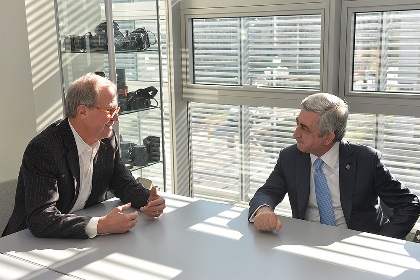
defaultPresident of Armenia Serzh Sargsyan, who is on a working visit to the United States (US), on Tuesday visited—in the State of Massachusetts—Moderna Therapeutics biotechnology company, which develops a new generation of medical drugs.

The President met with company founder, American Armenian entrepreneur Noubar Afeyan, and CEO Stéphane Bancel. Subsequently, he toured Moderna Therapeutics.

On the same day, the President of Armenia paid a visit to the Massachusetts Institute of Technology (MIT).

First, he met with MIT President Leo Rafael Reif, and then toured the media laboratory of this private research university.

Afterward, Sargsyan visited the MIT Samberg Conference Center, where he attended and addressed at a reception and meeting with the fellows and alumni of Luys fund scholarships.

MIT-Visit


Filed Under: News Tagged With: Armenian President, MIT

For Sale: Iraqi Kurdistan, a Nation and Its Values must read to understand Barzani

January 28, 2016 By administrator

Photo by gagrulenet

Photo by gagrulenet

Sheri Laizer in France,

(Ekurd) Iraqi Kurdistan has turned into a chaotic frontier land where the black economy and corruption flourish. Major international players and internal political forces secretly put aside their weapons to agree on how to divide the spoils.

Turkey, Iran, the USA, the Barzanis and other key tribal leaders cut shares in high profits from the revenues of Kurdistan while the peshmerga have not received their wages for the past seven months but are still expected to carry on the battle against ISIS.

Last August (2015), Nechirvan Barzani, Massoud Barzani’s nephew and Prime Minister claimed, “oil exports from Kurdish-controlled fields had reached 600,000 barrels per day (bpd) and could give Kurdistan the much needed $800 million per month to offset the deficit and pay salaries of civil servants in the region.” Despite this, nearly six months on wages are still not being paid and energy supplies depend on family status.1

Nechirvan Barzani this week blamed the economic downturn on the decrease in the price of oil, the battle against ISIS and the costs of hosting ‘close to two million refugees and displaced persons…”2

The official KRG website announced that in a meeting held on Monday 25 January 2016 between the US Ambassador to Iraq, Stewart Jones, other members of the US administration and Kurdish cabinet members, “Prime Minister Barzani presented a summary of the financial crisis and explained that it was caused by withholding by Baghdad of Kurdistan Region’s share in the national budget since February 2014” (and the other factors specified above).

“Both Prime Minister Barzani and Deputy Prime Minister Talabani provided detailed information on the depth and complexity of the financial crisis.”3

But those factors were the same last August and oil exports have continued. Although the general economic situation is considered to be grave and this doesn’t appear to impact on the key players in the leading families that have become enormously wealthy through Mafia-style deals done at the expense of Kurdistan and its old values of warrior’s honour.

Barzani autocracy

Derek Monroe, an American commentator who had spent time in the Kurdistan region of Iraq astutely observed in June 2013: “The KDP and its historical rival, the Patriotic Union of Kurdistan (PUK), have created interlocking mechanisms of power distribution and execution that put both of them in the driver’s seat at the same time. The balance is often altered slightly in favor of one or the other party, depending on the individual at the helm. In the Barzani clan’s case, the money trail reinforces ancient tribal allegiances and connections, making a de-facto “democratic” Barzani dynasty possible…”4

While the Kurdish fighters, police and other state employees are left without their salaries, many members of the Barzani family are still able to invest in building projects, as well as buying up restaurants, houses and land – and this is both inside and outside Kurdistan.

According to Arian Mufid, writing in the Kurdistan Tribune last October (2015), Kurdistan is facing previously unknown levels of hardships firstly owing to the war with ISIS along a 1100 stretch of border “halting all political and economic development for the time being. Secondly, the corruption of the Barzani party and family which controls the backbone of the government, and as a result is crippling prospects for political independence in the south of Kurdistan. Thirdly, the incompetence of the current government has damaged the relationship between Baghdad and Erbil and consequently the Iraqi budget is not reaching the KRG on time and there is a backlog in the payment of public employees’ wages …”5

Numerous Barzani family members have amassed huge wealth from keeping control of the economy as also of would-be rival entrepreneurs and small businessmen. Kurdish people resent this. They see that the politicians and heads of the powerful tribes have become enormously rich and believe they are stealing the money of Kurdistan to invest in private enterprises such as building projects in Kurdistan and buying up property abroad.

Members of the Barzani family also control import licenses and take large cuts from any entrepreneur that aims to launch projects that can be useful to the Kurdistan region such as wind farms for electricity and importing products from European countries. In the private sector, Massoud Barzani’s female relative, Aklima Barzani, reputedly demands an exorbitant cut of any project permit and any proposed contract to the point where the Kurdish businessmen whose project it is will receive the lesser share. Naturally, they are not happy about this. Sometimes the demand is said to involve an up-front fee and later, if the project is agreed, an on-going cut of the profits that can amount to millions of US dollars. Even the initial permit may cost up to a million US dollars.

Massoud Barzani’s son, Masrour, now head of security, allegedly relies on silencing through terror to maintain the family status quo. According to well-known US commentator, Michael Rubin “both the Barzanis (and Talabanis) confuse personal, party, and public funds. That said, while Nechirvan Barzani may be corrupt, it is in the Tammany Hall sense: his machine may be shady at times, but it delivers not only to his immediate inner circle but to the public at large…. Nechirvan also knows that it is far better to co-opt or ignore opponents than use force to imprison or kill them. Masrour is not so nuanced. Most of the crises which soiled the Barzani name over the past decade—the imprisonment of political critics, the attacks on critics in Virginia and Vienna, and the murder of journalists seem to rest at Masrour’s feet…”6

One Kurdish journalist, Sardasht Osman, known for his satire of the Barzani ‘royalty’ penned an allegory about how marrying the daughter of the president would transform the lives of all their relatives – an allusion to the nepotism afoot:

“…I would make my father become the Minister of Peshmerga [the Kurdish militia]. He had been Peshmerga in September revolution, but he now has no pension because he is no longer a member of Kurdistan Democratic Party.   

I would make my unlucky baby brother, who recently finished university but is now unemployed and looking to leave Kurdistan, chief of my special forces.

My sister who has been too embarrassed to go to the bazaar to shop, could drive all the expensive cars just as Barzani’s daughters do.

For my mother, who is diabetic and has high blood pressure and heart problems but who is not able to afford treatment outside Kurdistan, I would hire a couple Italian doctors to treat her in the comfort of her own house.

For my uncles, I would open few offices and departments and they, along with all my nieces and nephews would become high generals, officers, and commanders…”

Sardasht Osman did not marry a Barzani. Instead, he was kidnapped and killed.7

Turkey, Iran and the US push the buttons of the Kurdish leaders

The Barzani family and the KDP enjoy very good relations with Turkey along with having interests in the Turkish companies that enjoy most of the construction contracts in Kurdistan. The Turkish intelligence agency, MIT, also has agents active throughout the region and appears to operate with complete freedom.

The Turkish army continues to stage attacks on PKK positions inside Kurdistan, sometimes striking local Kurds “in error” as happened frequently and with tragic consequences in the 1990s. These forces have also established new positions up in the north of Kurdistan near the Turkish border.

These locations are well known to the local Kurdish villagers that live there. Some were surprised when recently the PKK’s forces were able to pass right through the middle of the Turkish army positions but neither side fired at the other. They asked themselves what secret deal might had been done whereas following the re-run of elections in Turkey on 1 November 2015, the Turkish army at once launched fresh attacks on the PKK and Kurdish targets after the AKP secured the parliamentary majority it sought.

Relations between the AKP government and the Kurdish movement have seriously declined. Violence increased and a return to the dark days of the 1990s is widely feared.

ISIS-driven oil tanker convoys move freely

Oil tanker transport oil sold by Islamic State to Kurdish businessmen in Iraqi Kurdistan, July 12, 2014. Photo: AFP

Oil tanker transport oil sold by Islamic State to Kurdish businessmen in Iraqi Kurdistan, July 12, 2014. Photo: AFP

Meanwhile, the illicit oil trade is flourishing across the border. In just one 24-hour period, Kurdish peshmerga fighters witnessed some 300-400 petrol tankers south of Sinjar, driven by non-bearded ISIS operatives, making their way unmolested from Qayara, south of Mosul, where they control the refinery, towards the Syrian border and to Turkey, bound for Gaziantep. “They don’t fly their flags when they are doing this”, one commentator observed.

At the same time, the US forces seem to stand back. When ISIS’s men are moving the petrol convoys, for example, there are no attacks. The rules of war no longer seem to apply.

There are also locations they appear not to wish for the peshmerga to attack despite the targets being within easy reach. They direct the peshmergas to stop their operation when the enemy is in range. The international forces will use their helicopters to assist when peshmerga are wounded as also to move them to the battlefield quickly but the peshmerga have no access to the satellite imaging used by the Allies and no right to question the directives given to them. Despite the limitations the peshmerga have executed significant attacks against ISIS targets and killed several ISIS leaders in recent months. But they are not in control of the battle itself.

Secret deals cut with ISIS

South of Tel Afar between Sinjar and Mosul lies an old airport once used by Saddam’s forces. In the afternoon of 22 October 2015 sources say a secret meeting was held with the headman of ISIS – the acting Wali of Mosul, Ayoub Ahmed Muslah, at al-Shura, along with two US officials, five Kurdish officials, and a Saudi businessman. US aircraft – two drones, a Blackhawk helicopter and a Chinook helicopter were seen by witnesses and assumed to have been protecting the meeting. These ‘negotiations’ took place without any fighting. Insiders assume the meeting was about oil.

A Kurdish flag and a Islamic State flag flutter on each end of the Mullah Abdullah bridge in southern Kirkuk. Photo: Reuters

A Kurdish flag and a Islamic State flag flutter on each end of the Mullah Abdullah bridge in southern Kirkuk. Photo: Reuters

This meeting ostensibly coincided with another event. Sirwan Barzani, Massoud Barzani’s nephew, is a millionaire businessman and managing director of Korek Telecom, a mobile phone company reported to be worth around 2 billion dollars.

“He could have supported the Peshmerga …through his giant companies, but everyone knows Sirwan Barzani has become a billionaire by using KRG [Kurdistan Regional Government] institutions,” said Kamal Chomani, a well-known local critic of the KRG.” 8

Some four months ago it was claimed that he had disappeared in the Sultan Abdullah area around Mosul. He was not heard of for around a month. Then he reappeared and claimed he had been captured by the Islamic State group but had escaped.

“We knew from our informants he had made a secret deal with ISIS near Qayara” said one peshmerga who wished not to be named for reasons of security.

After his brief absence from view, the KDP set up a special force for Sirwan Barzani and appointed him its leader. The Black Tiger base, on the frontline between Kurdish forces and the area controlled by ISIS was named after his nickname, the Black Tiger. Sirwan Barzani states that he possesses the necessary background having been a peshmerga with the KDP for more than 12 years and that he had also “received an education in the military academy in Zakho, and established the Barzani brigade in 1994…”9

The Ministry of Peshmerga claimed on Kurdistan TV that they had staged an operation near Makhmur and had managed to liberate 64 prisoners from ISIS at that same time that the secret meeting had taken place with the Wali of Mosul, ISIS’s leader raising doubts as to the veracity of the media report.

Many sources claimed to have seen Chinooks going to that same area outside Mosul, passing weapons to ISIS and Humvees arriving by land to supply them with canons. It is said by the people on the ground that some five to six months ago US forces passed ISIS smaller arms around the village of Rambusi by parachute drops. There were no peshmerga there at the time, as the US well knew and not until the peshmerga retook Sinjar over a month ago.

The PKK also had forces there and took unilateral action on the basis that civilians had been left unprotected. However, when the peshmerga attacked Sinjar, the ISIS forces had just melted away and they saw none at all. The PKK forces called the peshmerga when they got inside Sinjar city that in turn asked the International air forces to hold off bombing. They replied that they’d refrain if they saw the Kurdish flag hoisted as a signal. After just ten minutes the peshmerga took Sinjar back. ISIS had retreated during the night to areas they hold around Rambusi and Ba’aj.

ISIS uses these same locations and hostages have been detained there including the Yezidi women and girls kidnapped from Sinjar, raped by ISIS militants and abused as sex slaves. Details were also officially reported on the Syrian state’s media website10.

Mass disillusion, loss of faith and the economic downturn

One long-serving peshmerga in the fight against ISIS, Sarkawt (nom de guerre), claimed that ISIS has turned numerous ordinary Muslims against Islam. He himself felt such huge repugnance that he was no longer able to call himself a Muslim. He had stopped praying and going to the mosque altogether. He emphasised that many others felt the same. Not only had they lost faith in religion but they had also lost faith in the Kurdish officials governing the country and believed them to be looting Kurdistan at the expense of the Kurdish people. These Kurds no longer know what their future holds and what tomorrow might bring. 11

“There are many different Kurdish forces now and they don’t coordinate with one another,” he complained. “Kurds have no idea who is going to attack next, whether Iran, Turkey or Daesh. Meanwhile, the Kurdish people are getting poorer. Numerous Kurdish families are still living in conditions like those after the 1991 uprising, forced to use generators for electricity and wondering when and if their wages will come in.”

Internal reckonings

Alan, a Kurdish agricultural engineer, argued darkly, “If you open your mouth to complain, someone might stage an accident to silence you and everyone will just say, ‘Oh what a shame, he died!’

“Several weeks ago we lost three KDP officials that had begun speaking out. One was shot with a silencer near Makhmur, another was shot while he was driving near Erbil but it was claimed his car just ran into a wall, and a third man was killed in suspicious circumstances near Sulaimaniyah.”

A senior peshmerga commander, who asked to remain anonymous, claims that “Around six months ago a number of Iranian officials met with Massoud Barzani and asked him to open a route for their forces to enter Syria through the territory under the KDP’s control so they could better support Bashar al-Assad and Hezbollah. “If you do, we’ll protect you,” they promised. However, when this news reached the ears of US forces running missions in Iraq, US officials warned “If you cut any deal with Iran we’ll give ISIS the green light to reach Zakho and cut the border between Dohuk and Syria!

“When Iran heard this, they turned up the pressure on Nawshirwan Mustafa, Gorran’s leader, to argue that Massoud Barzani’s term of presidency should expire because Iran wanted him removed in order to replace him with someone that would help them implement their strategies.

Perhaps, in retaliation, President Massoud Barzani expelled the Minister of Peshmerga, a Gorran member as well as preventing Dr Yousef Mohamed, the Gorran official responsible for the Kurdish Parliament, from entering Erbil, effectively disabling the parliament but claiming it was because Gorran was inciting violence against the KDP.

Glaring socio-economic inequalities in ‘free’ Kurdistan

Many Iraqi Kurds will tell you Kurdistan’s wealth and resources are going to the highest bidders and that foreign forces control its defence strategies and the oil traffic, imposing constraints and ensuring that their orders are carried out.

And then there is the talk of the missing $4 billion from the budget and the private wealth of the key players…12

“While Massoud Barzani’s personal wealth is estimated to be in the range of $2 billion, the exact amount of the family’s involvement is unknown due to Kurdistan’s murky legal environment and a web of offshore cross-ownership entities.” 13

In 2010, Rozhnama newspaper accused the Barzanis of “benefiting from illegal oil smuggling … Official and unofficial oil revenues streaming into governmental and party coffers compound a growing resentment over widespread corruption and mismanagement. Signs of extreme poverty compete with these images of imported luxury goods.” 14 According to one source, “Hozan Fareed, who runs a luxury watch shop in Erbil’s fashionable Family Mall, said he had clients who would pay $150,000 for a watch.”15

The socio-economic divide is as visible and startling – from the Kurdish tycoons with their huge new houses flashing their Rolexes in speeding high-end cars, to Kurdish women in raggedy clothes whose small children sell trinkets and “chewing gum to passersby in order to retain what remains of their dignity.”16

Of course, the business of statehood is not the same as mounting rebellions against central government.  Back in the old days, the peshmerga fought wearing traditional shal u shapik costume and hand-woven klash shoes, the better to grip the slippery mountain slopes. The battles they fought then were inspired by Kurdish songs with heroic messages. Today’s Kurdish autocracy has replaced the Ba’athist elite of Saddam Hussein and its tyranny but the old songs have not been updated.

The century-old dream of a country the Kurds could call ‘free’ Kurdistan that millions once dreamed of is not the divided homeland that now surrounds them.

Many Iraqi Kurds are asking one another “just what has replaced Saddam Hussein and till when will this endure?”

1 http://rudaw.net/english/business/08082015
2 http://cabinet.gov.krd/a/d.aspx?s=010000&l=12&a=54141
3 http://cabinet.gov.krd/a/d.aspx?s=040000&l=12&a=54157
4 http://fpif.org/kurdistan_the_next_autocracy/
5 http://kurdistantribune.com/2015/barzanis-terrible-miscalculation/
6 http://www.kurdistanpost.nu/?mod=news&id=79198&rp=0&act=print&rf=1
7 http://ekurd.net/mismas/articles/misc2010/5/state3816.htm
8 http://ekurd.net/barzani-millionaire-protects-kurdistan-2016-01-19
9 Op. Cit.
10 https://syrianfreepress.wordpress.com/tag/rambusi/
11 http://ekurd.net/mismas/articles/misc2011/3/state4909.htm
12 http://ekurd.net/mismas/articles/misc2012/4/state6130.htm
13 http://ekurd.net/mismas/articles/misc2012/4/state6070.htm
14 http://fpif.org/kurdistan_the_next_autocracy/
15 http://rudaw.net/english/business/08082015
16 http://fpif.org/kurdistan_the_next_autocracy/

Sheri Laizer, a Middle East and North African expert specialist and well known commentator on the Kurdish issue. She is a contributing writer for Ekurd.net. More about Sheri Laizer see below.

Read more about Corruption in Iraqi Kurdistan
Read more about The Monarchy of Iraqi Kurdistan


Barzani ISIS.jpg

Filed Under: News Tagged With: iraqi kurdistan, ISI, MIT, Turkey

Official claims MİT ‘warned’ Dink Armenian journalist upon request of General Staff

January 4, 2016 By administrator

237326An official from the National Intelligence Organization (MİT) claimed during his 2014 testimony that Turkish-Armenian journalist Hrant Dink, who was assassinated in 2007, was invited to the İstanbul Governor’s Office in 2004 to be “warned” over some of his controversial reports upon a request from the General Staff, the media has revealed.

The meeting was attended by Dink, former İstanbul Vice Governor Ergun Güngör and two MİT officials.

The details of the testimony given by Özel Yılmaz — one of the two MİT officials who attended the meeting — on Dec. 22, 2014 to İstanbul Chief Public Prosecutor Gökalp Kürkçü, who is overseeing an ongoing investigation into the killing of Dink, was recently revealed to media outlets.

According to a report in the Radikal daily on Monday, Yılmaz claimed in his testimony the meeting was held on the orders of the General Staff. Yılmaz reportedly told the prosecutor an official from the General Staff had called former MİT Undersecretary Şenkal Atasagun and requested that MİT “warn” Dink over his reports about the ethnic origin of Sabiha Gökçen, the adopted daughter of the founder of the Turkish Republic.

Yılmaz also reportedly claimed Atasagun appointed former MİT İstanbul Regional President Hüseyin Kubilay Günay to coordinate the meeting to warn Dink. Yılmaz also claimed during his testimony the MİT officials accidentally bumped into Dink when they were at the İstanbul Governor’s Office to collect some documents that Dink had provided to the governor’s office. Yılmaz also claimed he spoke to Dink about a prison sentence given to Dink over his reports, in which Dink alleged that Gökçen was of Armenian origin.

This testimony by Yılmaz has been questioned because it has some contradictions. Dink had not yet been handed down any prison sentence at that time when the meeting was held in 2014, contrary to what Yılmaz told the prosecutor.

In 2005, Dink was given a six-month suspended prison sentence after he was accused of denigrating “Turkishness” in writings about the identity of Turkish citizens of Armenian origin.

The MİT official said they did not go to the governor’s office to meet with Dink, but to collect the abovementioned documents. “When we were sitting in Güngör’s office, Dink came into the room. When we attempted to leave, Dink told us: ‘Please don’t bother. I can leave.’ Güngör presented us as his relatives and Dink told him our presence [in the room] would not be a problem for him. Later, we could not say we were actually MİT officials so as not to create any problems for Güngör.”

The details of the testimony given by Güngör on Dec. 9, 2014 were also revealed in the Radikal daily on Monday. According to the report, Güngör’s testimony also refutes some parts of Yılmaz’s testimony. Güngör said the meeting was held on a request by MİT, adding the governor’s office had no active role in the meeting except hosting it. Güngör also said the meeting was organized by Yılmaz and another MİT official, refuting Yılmaz’s claim that they accidentally bumped into Dink at the governor’s office.

Güngör also said Dink was invited to the meeting to be warned of “possible danger if he continues to make controversial statements.” He also said he introduced the two MİT officials as his relatives because MİT had requested in advance that he not reveal the identities of its officials.

A report published on news portal internethaber.com on Monday also claimed new footage has recently emerged on the assassination of Dink. According to the report, the footage shows six gendarmerie intelligence officers also in front of the Agos newspaper’s building at the time of the murder.

The report also pointed out the İstanbul Chief Public Prosecutor’s Office had already detected that signals were received from telephones belonging to six gendarmerie intelligence officers around the scene where Dink was shot at the time of the incident.

The news portal also says if the prosecutor’s office confirms that those six individuals detected in the footage were actually gendarmerie intelligence officers, this proves Dink’s murder was committed under the supervision of the gendarmerie.

Dink was shot and killed by ultranationalist hitman Ogün Samast in broad daylight outside the office of the Agos newspaper, where he worked, on Jan. 17, 2007. Samast was given a 22-year prison sentence, while a key suspect in the case, Yasin Hayal, was given a life sentence for inciting Samast to commit murder.

A retrial started in September 2014 when the İstanbul 5th High Criminal Court complied with a ruling from the Supreme Court of Appeals in May 2013 overturning a lower court’s ruling that acquitted the suspects in the Dink murder case of charges of forming a terrorist organization. This decision paved the way for the trial of some public officials on charges of voluntary manslaughter.

Filed Under: Articles, Genocide Tagged With: dink, MIT, murder, Turkey

Why: KRG leader Barzani visits Turkish most notorious Military Intelligence MİT headquarters in Ankara??

December 9, 2015 By administrator

(Photo: Reuters)

(Photo: Reuters)

Is Barzani part of Turkish spy network?

Kurdistan Regional Government (KRG) President Massoud Barzani visited Turkey this week to hold talks with Turkish officials amid tensions between Turkey and Iraq over the deployment of Turkish troops in northern Iraq.

Barzani arrived in Ankara on Wednesday afternoon for a two-day official visit. Although it wasn’t stated on the official schedule, the KRG leader paid his first visit to the National Intelligence Organization’s (MİT) headquarters, Turkish media reported. He is expected to meet with MİT Undersecretary Hakan Fidan.

KRG president’s visit to Turkey came amid the escalating tension between Ankara and Baghdad over the deployment of Turkish troops in Iraqi city of Mosul.

Turkey deployed about 150 troops, along with 25 tanks, to a camp in the Bashiqa region of northern Iraq on Thursday, calling it a routine rotation to train Iraqis to retake Mosul from ISIL, which captured Iraq’s second-largest city in 2014.

Ankara says its troops are in Iraq to train Iraqi forces against ISIL. The foreign ministry said Turkey had stopped the deployment two days ago due to the “sensitivities” of the Iraqi authorities but added that it will not withdraw those already there. The Iraqi government says it never invited such a force.

Filed Under: Articles Tagged With: Barzani, MIT, Turkey, visit

Espionage trial involving Turks in Germany reveals alleged money transfers

September 18, 2015 By administrator

Muhammed Taha Gergerlioğlu sits in front of the regional appeal court in Koblenz, Germany on Sept. 9. (Photo: Reuters)

Muhammed Taha Gergerlioğlu sits in front of the regional appeal court in Koblenz, Germany on Sept. 9. (Photo: Reuters)

Three suspects of Turkish origin have been charged with espionage in an indictment prepared by the German attorney-general that includes wiretapped phone conversations revealing transfers of huge sums of money and claims of Germany being the true enemy of Turkey.

In the third hearing of the suspects’ trial, provincial Police Chief Steffan Blasius testified that a suspect and former aide of Turkish President Recep Tayyip Erdoğan, Muhammed Taha Gergerlioğlu, 59, frequently communicated with German national Göksel Güler, also a suspect in the case, and many others, some of whom remain unidentified.

Blasius said the police prepared 3,300 pages of transcripts from more than 20,000 wiretapped phone and Internet communications. Police only mentioned the headings of the transcripts in court, without going into detail. Blasius read headings such as “Ismail al-Buti, 500 million USD,” “Swiss Bank, power of attorney, 500 million USD” and “To be given to RTE [Erdoğan]” in the Koblenz High Court.

Last year, the leader of the Turkish main opposition Republican People’s Party (CHP), Kemal Kılıçdaroğlu, claimed Erdoğan has eight Swiss bank accounts. He called on the president to prove otherwise, but Erdoğan has never responded.

During the trial of the suspects, the third of whom is Turkish national Ahmet Duran Y. and all of whom were arrested in Germany in December on suspicion of espionage, the court rejected the defense’s attempt to have the indictment thrown out because of ongoing cooperation over terrorism between the two countries.

In May, the attorney-general filed charges against the trio, accusing them of spying on behalf of Turkey’s National Intelligence Organization (MİT).

Blasius stated that Güler had acted as a sort of personal secretary for Gergerlioğlu, organizing his itinerary and picking him up from the airport when he came to Germany. He said the two originally spoke over the phone, but later switched to written communication, often using messaging software, including Skype, Viber, Tango and WhatsApp.

Among the headings of transcribed messages were “Recep Tayyip Erdoğan will reach [out to] 7 billion people and bring justice to the world” and “Arab media launched a campaign against TR [Turkey], all except Al Jazeera.”

‘Germany real enemy of Turkey’

A message Gergerlioğlu sent to an unidentified person on Aug. 18, 2014, stated, “Germans are our real enemies,” “These [Germans] are true enemies of Islam” and “Germans did not take it well that THY [Turkish Airlines] outperformed Lufthansa.”

Blasius said many messages included comments about Fethullah Gülen, who lives in self-imposed exile in the US and who has inspired a civil society movement in his name. One message even noted that the Israeli ambassador had attended an event organized by the Gülen movement.

Gülen, who is internationally acclaimed for his promotion of interfaith dialogue, tolerance and education, served as a spiritual leader and imam before moving to the US in 1999. He became a target of Erdoğan and the Justice and Development Party (AK Party) government following the eruption of a graft scandal that implicated Erdoğan’s inner circle in late 2013.

Erdoğan has accused the Gülen movement of operating a “parallel structure” of supporters in the judiciary and the police force who initiated the graft probes, while the movement denies the charge.

Turkish spies are said to have been ordered to spy on Erdoğan’s opponents in Germany, including members of the Kurdish minority, the faith-based Gülen movement and other Turkish nationals critical of the Turkish leadership.

According to court documents, the three were charged with tracking and spying on Turkish and Kurdish dissidents who would be detained upon returning to Turkey. Blasius said police had recovered many photographs from the communications, including some of demonstrations by the Kurdistan Workers’ Party (PKK) in Bielefeld and Mannheim.

The suspects allegedly profiled Alevi groups in particular. One message was titled “Regarding a PKK and Alevi rally in Koln: German intelligence is supporting atheist Alevis and secular Kurds against Turkey with lots of money. They are swimming in a pool of money. German anarchists are supporting this rally as well.”

Gergerlioğlu also organized a social group, called the “New İstanbul Civilization (YİM),” on WhatsApp, with more than 50 participants, who exchanged information and photos. In his messages, Gergerlioğlu talked about setting up a wide intelligence network, stressing that all information exchanged within the group would be assessed by MİT. He said: “MİT infiltrated the Islamic State in Iraq and the Levant [ISIL]. Foreign intelligence exposed that. The PKK is arming. Don’t worry; they will use it against ISIL.”

Gergerlioğlu was reportedly sent by MİT head Hakan Fidan with a fund of 25,000 euros to launch a consulting firm for German-Turkish companies in the city of Bad Dürkheim with Güler in 2011.

The indictment states that the suspects were engaged in acts of espionage for MİT. Ahmet Duran Y. and Güler were charged with collecting information about dissidents opposing Erdoğan in Germany under the leadership of Gergerlioğlu. They face a prison sentence of up to five years, according to German law.

The second witness to testify on Thursday was Police Chief Martin Müller of the Mainz Criminal Bureau. He said he examined the iPhone seized from Gergerlioğlu and found more than 300 documents in the phone’s memory. Among them were passport photographs belonging to British, Syrian, Iranian and Kazakhstani citizens, a list of names from various groups, including al-Qaeda, documents of arms trades between Israel and İstanbul, as well as various official letters and notifications addressed to and from Turkish prosecutors’ offices, governors, and members of the police force and gendarmerie.

Source: ZAMAN

Filed Under: Articles Tagged With: Erdogan, espionage, Germany, Gulen, MIT, money transfer, Muhammed Taha Gergerlioğlu, Turkey, Turks

  • 1
  • 2
  • 3
  • Next Page »

Support Gagrule.net

Subscribe Free News & Update

Search

GagruleLive with Harut Sassounian

Can activist run a Government?

Wally Sarkeesian Interview Onnik Dinkjian and son

https://youtu.be/BiI8_TJzHEM

Khachic Moradian

https://youtu.be/-NkIYpCAIII
https://youtu.be/9_Xi7FA3tGQ
https://youtu.be/Arg8gAhcIb0
https://youtu.be/zzh-WpjGltY


gagrulenet Twitter-Timeline

Tweets by @gagrulenet

Archives

Books

Recent Posts

  • Pashinyan Government Pays U.S. Public Relations Firm To Attack the Armenian Apostolic Church
  • Breaking News: Armenian Former Defense Minister Arshak Karapetyan Pashinyan is agent
  • November 9: The Black Day of Armenia — How Artsakh Was Signed Away
  • @MorenoOcampo1, former Chief Prosecutor of the International Criminal Court, issued a Call to Action for Armenians worldwide.
  • Medieval Software. Modern Hardware. Our Politics Is Stuck in the Past.

Recent Comments

  • Baron Kisheranotz on Pashinyan’s Betrayal Dressed as Peace
  • Baron Kisheranotz on Trusting Turks or Azerbaijanis is itself a betrayal of the Armenian nation.
  • Stepan on A Nation in Peril: Anything Armenian pashinyan Dismantling
  • Stepan on Draft Letter to Armenian Legal Scholars / Armenian Bar Association
  • administrator on Turkish Agent Pashinyan will not attend the meeting of the CIS Council of Heads of State

Copyright © 2025 · News Pro Theme on Genesis Framework · WordPress · Log in