Gagrule.net

Gagrule.net News, Views, Interviews worldwide

  • Home
  • About
  • Contact
  • GagruleLive
  • Armenia profile

Armenian Americans in L.A. donate over 3 million meals to COVID-19 impacted families to mark 105th anniversary of Armenian Genocide

April 23, 2020 By administrator

by: Sareen Habeshian, Ellina Abovian,

In honor of Friday marking the 105th anniversary of the Armenian Genocide, the Armenian American community is raising funds to donate more than 1.5 million meals to those in need amid the coronavirus pandemic, in honor of 1.5 million Armenians who were killed by the Ottoman Turks.

For the past 55 years, the Armenian community of Los Angeles has marched the streets of Hollywood to commemorate the memory of — and demand recognition for — the Armenian Genocide of 1915. This year, amid the COVID-19 pandemic, they’re switching gears to help American families affected by the crisis.

“In honor of the 1.5 million lives, we are committing to donate enough funds to support 1.5 million meals for Americans in need,” Alex Galitsky of the Armenian National Committee of America said.

In less than a week, that goal was surpassed, with 3,300,000 meals donated through Feeding America, the nation’s largest network of food banks, pantries and meal programs. The We Thank You America campaign was organized by the Armenian Genocide Committee, the United Armenian Council and the Unified Young Armenians. 

The initiative gives thanks to a humanitarian mission called Near East Foundation, formed by the U.S. a century ago, which helped save 132,000 Armenian orphans displaced by the genocide and established hospitals and refugee camps.

n December, both the U.S. House of Representatives and the Senate passed resolutions formally recognizing the Armenian Genocide, prompting denunciations by Turkey, which accused the U.S. of undermining its relations with a key NATO ally.

Every year, on April 24, the community and allies rally in front of the Turkish Consulate in L.A. to demand that the perpetrators of the genocide recognize the atrocity. More than 100,000 Angelenos participated in the March for Justice in the 100th year commemoration in 2015.

“Next year, hopefully when all is better, we will be back to the streets to demand justice for the wrongs that were done to the Armenian people during the first genocide of the 20th century,” Glendale City Councilmember Ardy Kassakhian said.

This year, in lieu of marches, events are all virtual.

“My great-grandfather was murdered but my grandfather was a survivor. … I never forget that,” mayor of Montebello Jack Hadjinian said. “Growing up I knew that this was the day that I had to spend my day commemorating, attending a protest… and now it’s like I’m going to do that from my living room.”

In a message to the diaspora community, L.A. Mayor Eric Garcetti said, “We will never stop fighting,” repeating the same message in Armenian for the 150,000 Armenians living in L.A. County.

To donate, visit 1915neveragain.org. Every $1 pays for 10 meals.

Filed Under: Genocide, News

Due to the coronavirus pandemic, Armenian Genocide commemoration will switch to humanitarian effort

April 21, 2020 By administrator

By Mark Kellam,

The 105th anniversary of the Armenian Genocide will be commemorated on Friday. However, because of the coronavirus pandemic, the annual March for Justice in downtown Los Angeles and performance featuring speakers, musical and dance groups at the Alex Theatre in Glendale won’t take place.

Instead, the Armenian community is organizing a humanitarian fundraiser to support Feeding America, a hunger relief organization with a nationwide network of food banks feeding the hungry.

The effort is in honor of the Near East Relief, which was a large-scale humanitarian operation formed by the United States in the 1920s to help Armenian Genocide survivors, including saving 132,000 Armenian orphans, and establishing more than 400 refugee centers, hospitals, vocational schools and orphanages, according to officials with the Armenian National Committee of America, Western Region, or ANCA-WR, in Glendale.

“In times of crisis, it is important we remind ourselves how great acts of human generosity can carry our communities through tremendous adversity,” Armen Sahakyan, executive director of ANCA-WR, said in a statement.

“The Armenian people witnessed that firsthand during the darkest days of our history — the still-unpunished Armenian Genocide of 1915-1923 — when the American people banded together to form the Near East Relief,” he added.

During the annual March for Justice, tens of thousands of Armenians take to the streets in L.A., calling on Turkey to recognize the Armenian Genocide. The Ottoman Empire, now modern-day Turkey, led the genocide.

“As the descendants of those survivors, to express our collective gratitude to the American people for their generosity as well as honor the courage and selflessness of the humanitarians and frontline workers who have come to our aid both then and today, the Armenian American community has come together to assist fellow citizens affected by COVID-19,” Sahakyan said.

Filed Under: Genocide, News

Fresno will quietly mark anniversary of Armenian Genocide due to COVID-19, but not forget

April 19, 2020 By administrator

I stood there that afternoon staring at the nearly 20-foot monument located inside the Masis Ararat Cemetery off Belmont and Hughes. What I was looking at was an eagle swopping down and grabbing a snake.

The monument, located near the middle of the cemetery, is dedicated to Soghomon Tehlirian. Tehlirian avenged the murder of his father, mother, three sisters, two brothers and a niece by shooting Talaat Pasha, one of the principal architects of the Armenian Genocide. A Berlin jury found Tehlirian not guilty by reason of temporary insanity. Most experts agree that Talaat had an active role in developing the plans to eliminate the Armenians.

My grandparents talked about Tehlirian. They also despised Talaat, a member of the Young Turks regime. Ironic that now, in their final resting place, they are steps away from this monument.

Like many others, commemorating the Genocide was important to my grandparents. I am certain they thought daily of those atrocities committed against the innocent civilian population. The truth is that for Armenians in America and around the world there is this heaviness that we feel when it comes to the Genocide, and this idea that so much was taken from us. For Tehlirian it was personal. His immediate family members were part of the 1.5 million killed.

Quantifying the loss is nearly impossible. My family, both sides, were landowners and wealthy. All of that was taken from them at the order of the Ottoman Turkish government. The part that bothers me the most is the spin by the present-day Turkish government that it was the Armenians fault. This is “victim blaming” at its highest degree.

This year as April 24th approaches, there will be no massive commemorations. No large protests in front of the Turkish embassies. No flags raised in front of Fresno’s City Hall and the cemetery. No noontime or evening gatherings at Fresno State.

Instead, families are left to commemorate in private, sheltering in place. Even though the coronavirus has erased the ability for public gatherings, I bet families will still commemorate. I ask those reading this to join my family in lighting a candle on the evening of April 24th and remembering those innocent lives that were lost. Since you are home, find a movie about the Genocide (“The Promise,” “Architects of Denial,” as well as others) to learn more. Although this occurred more than 100 years ago, it is still real and painful today.

As I began to drive off from the cemetery, I had many thoughts. I remembered a poem by Fresno’s own William Saroyan. His poem reads in part, “… Go ahead, destroy Armenia . See if you can do it. Send them into the desert without bread or water. Burn their homes and churches. Then see if they will not laugh, sing and pray again. For when two of them meet anywhere in the world, see if they will not create a New Armenia.”

This year, just as commemorations will be different, there is a silver lining. The U.S. House and Senate passed resolutions recognizing the Genocide. It’s one more reason to celebrate and be proud of our country, the U.S.A. Armenian Americans have done really well in Fresno and the United States. They’ve led companies, been successful in business, construction, law, recycling, politics, food, health care, entertainment and much more.

As far as that pesky coronavirus that is shaking up the world, an Armenian American is the co-founder and chairman of one of the companies leading to create a much needed vaccine. As Saroyan so eloquently put it, “…see if they will not create a New Armenia.” Sevag Tateosian is an analyst with the Fresno County Department of Public Health. He hosts and produces The Central Valley Ledger on CMAC Comcast 93 and Att 99.
Read more here: https://www.fresnobee.com/opinion/readers-opinion/article242091886.html#storylink=cpy

Filed Under: Articles, Genocide

ANI Exhibit on U.S. Military Intervention in the First Republic of Armenia featured in Hay Zinvor Magazine

April 16, 2020 By administrator

ARMENIAN NATIONAL INSTITUTE EXHIBITON U.S. MILITARY INTERVENTION IN THE FIRST REPUBLIC OF ARMENIAFEATURED IN HAY ZINVOR MAGAZINE
Washington, D.C. – The Armenian version of the 27-panel ANI exhibit “The United States Military in the Republic of Armenia 1919-1920,” which is based on documentary and photographic records created by the American Military Mission sent to Armenia by President Woodrow Wilson, is presently being serialized in the publication Hay Zinvor, Armenian Soldier. Hay Zinvor is a publication at the Defense Ministry of the Republic of Armenia, where the exhibit was recently displayed.
Four installments of the exhibit have appeared to date, and will continue to be serialized.  The exhibit may be viewed in the 2020 issues 11 (pages 20-21), 12 (pages 12-13), 14 (pages 26-27), 15 (pages 26-27) of Hay Zinvor:

“It was a very special privilege to see the ANI exhibit go on display at the Armenian defense ministry and to have Defense Minister Davit Tonoyan, US Ambassador Lynn Tracy, and Major General Lee Tafanelli of the Kansas National Guard do the opening,” stated ANI Chairman Van Z. Krikorian. “It is an equally great privilege to see this very special ANI exhibit become accessible in the Armenian language and to the Armenian-speaking public as one more example of the long and deep connections between Armenia and America,” added Krikorian.

The exhibit profiles several important American military figures, who rose to prominence as members of the American Expeditionary Forces (AEF) that were sent overseas to France to join the fight against Germany during World War I. Many of these officers later joined the American Relief Administration (ARA), created to respond to the postwar situation in Europe where food shortages threatened famine. The ARA was also tasked with relieving the plight of vulnerable people in Armenia. Herbert Hoover, who at the time headed the ARA, tapped former U.S. Ambassador to the Ottoman Turkey Henry Morgenthau and General John J. Pershing, the commanding general of the AEF, for recommendations on the personnel to be assigned to Armenia. Many of the U.S. officers sent to Armenia were close associates of General Pershing and some were highly decorated veterans of battles in France where they turned the tide of the war in favor of the Allies.

President Woodrow Wilson dispatched two missions to Armenia, a military mission headed by General James G. Harbord, which investigated the political situation in the region, and a humanitarian mission headed by Colonel Willian N. Haskell, which was also tasked with overseeing the undertakings of the Near East Relief organization that the United States Congress formally incorporated as part of the humanitarian relief effort in response to the dire situation in Armenia.

“I want to thank the editors of Hay Zinvor who proposed publishing the Armenian version of the ANI exhibit and who are overseeing its serialization,” stated ANI Director Dr. Adalian. “We also appreciate their close coordination with the Armenian Assembly’s Yerevan office staff, who have been supporting this undertaking with the translation effort. It is no small undertaking to explain this significant and complicated chapter in American history to an Armenian audience and they have done a superb job. Considering the challenges of continuing to forge ahead under conditions created by the dangers of the COVID-19 pandemic, I want to extend special appreciation to the Hay Zinvor and Assembly Yerevan staffs for dedicating their energies to properly commemorate the 105th anniversary of the Armenian Genocide.”

Those who want to read future issues of Hay Zinvor can subscribe online.  The publication is available for free to the public and contains past and current information about the Armenian military.

The United States Military in the First Republic of Armenia digital exhibit is the sixth exhibit developed by ANI. It follows upon other educational material developed for the centennial of the Armenian Genocide, including five large exhibits displaying hundreds of historic photographs. These exhibits include:

  • American Relief in the First Republic of Armenian 1918-1920 (about the role of the YMCA)
  • Iconic Images of the Armenian Genocide (also available as a slideshow)
  • The First Deportation: The German Railroad, The American Hospital, and the Armenian Genocide
  • The First Refuge and the Last Defense: The Armenian Church, Etchmiadzin, and the Armenian Genocide
  • Witness to the Armenian Genocide: Photographs by the Perpetrators’ German and Austro-Hungarian Allies 
  • Survivors of the Armenian Genocide

All exhibits can be freely downloaded.

Founded in 1997, the Armenian National Institute (ANI) is a 501(c)(3) educational charity based in Washington, D.C., and is dedicated to the study, research, and affirmation of the Armenian Genocide.

Filed Under: Articles, Genocide

APRIL 24 ARMENIAN GENOCIDE COMMEMORATIONS IN LOS ANGELES SUSPENDED DUE TO THE CORONAVIRUS PANDEMIC

April 8, 2020 By administrator

UACLA – UYA – AGC, Joint Press Release

Los Angeles, CA — After careful consideration of the Coronavirus pandemic, the United Armenian Council of Los Angeles (UACLA), the Unified Young Armenians (UYA) and the Armenian Genocide Committee (AGC) have decided to suspend all of their April 24 commemoration related activities. 

The coalition of these three community organizations are in charge of a) the Requiem service at the Armenian Genocide Martyrs Monument in Montebello, b) the March in Little Armenia, Hollywood and c) the Protest demonstration in front of the Los Angeles Turkish Consulate.

The Coalition made this decision not only as a moral responsibility to stand with the people of Los Angeles and the world, but to also comply with the health directives imposed by the local authorities, which are meant to mitigate the spread of the Coronavirus and to save lives.

We remain committed to the Armenian Cause and working towards a just resolution for the Crime of Genocide, demanding from the government of Turkey the recognition of the Genocide, and rightful restitution and reparations. Although this year we will not be able to gather and demand justice on April 24, we recognize that our collective efforts are and must be made year-round. Our work will continue. We will stand united, and we will make our voices heard for the 1.5 million martyrs of the first genocide of the 20th century.  In the coming days, we will announce our alternative commemorative plans in lieu of our traditional public gatherings.  

We acknowledge and thank the United States Senate and House of Representatives for setting the record straight and standing up for truth and justice by recognizing the Armenian Genocide. We thank them for their tireless work during these uncertain and challenging times.

We hope and pray that this global epidemic will end soon, and that all our communities will rise from it stronger than ever.

The coalition wishes you all the best. May you always remain healthy and safe.  

Filed Under: Genocide, News

Turkey Ignores its Highest Court’s Verdict on Armenian Patriarch’s Election

March 30, 2020 By administrator

By Harut Sassounian,

Forum 18 News Service of Oslo, Norway, published a lengthy article by Dr. Mine Yildirim on March 25, 2020, explaining the Turkish government’s interference in the election of the Armenian Patriarch of Turkey, despite the ruling of the Constitutional Court that the government’s interference “was not prescribed by law and not necessary in a democratic society.”

Two Armenians of Istanbul, Levon Berj Kuzukoglu and Ohannes Garbis Balmumciyan, had initially filed a lawsuit with the Administrative Court on March 27, 2012. The Court rejected the lawsuit, stating that the Patriarchal election can only take place after the death or resignation of the Patriarch who was in a coma, even though the 1863 Ottoman-era regulations stated that the Armenian Patriarch’s election can take place in the case of “the death of the Patriarch, resignation and other.” The applicants appealed this decision, but the Court of Cassation rejected it on November 23, 2015.

The two Armenians then appealed to the Constitutional Court claiming that the state’s refusal of their request for the election of a new Patriarch violated their right to freedom of religion. The Court made its judgment in favor of the Armenians five years later in May 2019. However, the Turkish leaders ignored the Court’s decision. “While the judgment includes important findings related to the state’s unjustified interference in the internal affairs of the Armenian community, it also raises questions about whether the Constitutional Court is an effective domestic remedy or an actor that conveniently blocks applications to the European Court of Human Rights in Strasbourg, thus closing the door to international supervision,” Dr. Yildirim wrote. “The state had prevented the Armenian community from electing its religious leader between 2009, when the then Patriarch Mesrob Mutafyan could no longer perform his duties due to illness, and 2019, when the community finally elected Bishop Sahak Mashalyan as the new Patriarch.”

It is more than a coincidence that the Constitutional Court gave its verdict on May 22, 2019, following the state’s approval of the Patriarchal election after the March 8, 2019, passing away of Patriarch Mutafyan. The timing of the decision was intended to give the impression that the state was not interfering in the election of a new Patriarch and the Court was not telling the government what to do.

In its ruling, the Constitutional Court referred “to the 1863 Regulation for the Armenian Millet (ethno-religious community) and international legal provisions, including the European Court on Human Rights (ECHR) and the 1923 Lausanne Peace Treaty’s provisions on the protection of non-Muslims in Turkey,” according to Dr. Yildirim.

Throughout the existence of the Republic of Turkey, the government made some arbitrary changes during the 1950, 1961, 1990, 1998 and 2019 Patriarchal elections. “The election Directives were based on the Cabinet Decree of 18 September 1961 which had been issued only for that year’s Patriarchal election and which included no provisions for future elections. Despite this, the Interior Ministry has continued to use this Decree,” Dr. Yildirim wrote. The Interior Ministry’s submission to the Constitutional Court stated that the measures taken by the authorities derive from “the state’s positive obligation to organize the religious field.”

The Constitutional Court countered that argument by ruling that its verdict is based on Article 24 of the Turkish Constitution which protected religious freedom, Article 38 of the Lausanne Treaty which referred to the practice of religion, as well as the various rulings of the European Court of Human Rights. Furthermore, the Constitutional Court ruled that “the appointment of a Patriarchal Vicar-General (in 2010) occurred not as a result of a process that took place within the competing civilian and spiritual initiatives in the Armenian community, but as a result of ‘state pressure that was unconstitutional,’” according to Dr. Yildirim. “In conclusion, the Constitutional Court found that the state has not been able to demonstrate a pressing social need that overrides the ‘spirit of Armenian traditions’ and the ‘Armenian community’s will.’ Therefore the interference in the applicants’ right to freedom of religion or belief by way of refusing the request to hold Patriarchal elections cannot be considered compatible with the requirements of a democratic society, and Article 24 of the Constitution had thus been violated.”

However, even after the ruling of the Constitutional court, the state continued to interfere in the Patriarchal election. The Turkish Interior Ministry came up with a new restriction, ruling that only those Turkish Armenian bishops who were serving in Turkey at the time could be candidates for the Patriarchal election, thus reducing the number of eligible candidates to two. “This is 100% in contradiction to the Constitutional Court’s judgment,” said Sebu Aslangil, the lawyer in the case. Nevertheless, the Armenian Steering Committee for the Patriarchal election decided not to contest the Interior Ministry’s ruling in order not to further delay the election of a new Patriarch.

Dr. Yildirim concluded: “The judgment raised the profile of the Constitutional Court as a high court delivering a judgment in line with ECHR jurisprudence. Yet, due to its timing, the judgment had no impact on rectifying the injustice that the Armenian community experienced. It also closed the door for an application to be made to the ECHR in Strasbourg, thus blocking international supervision of the implementation of the judgment.”

In effect, as the legal axiom states, “Justice delayed is justice denied.”

Filed Under: Articles, Genocide

Fethullah Gülen-linked Multicultural Mosaic Foundation recognizes Armenian Genocide

March 11, 2020 By administrator

The Multicultural Mosaic Foundation (MMF), a Colorado-based nonprofit organization which derives its inspiration from the Turkish Muslim religious leader Fethullah Gulen, voted to recognize the Armenian Genocide on March 7, The Armenian Mirror-Spectator reported. 

MMF issued a statement on March 8 explaining the context, as follows: “MMF established a committee three years ago tasked with learning what happened in 1915 to the Armenian citizens of the Ottoman Empire. For the last three years members of this committee have been attending lectures and dialog sessions with scholars of Ottoman history, Armenian history and genocides. Further, committee members engaged in meetings with family members who survived the Armenian Genocide. The study of academic articles, watching documentaries, panel discussions, private discussions were also part of the three-year journey.

“At the end of the three years the committee decided to vote on the recognition of the Armenian Genocide. The committee of about 20 members voted unanimously in favor of recognizing the Armenian Genocide. This vote was presented to the board as a recommendation to recognize the Armenian Genocide. Mosaic’s board followed the recommendation of the committee and recognized the Armenian Genocide on March 7, 2020.”

MMF was careful to note in its statement that the decision was made by MMF alone and only reflects its own position, as no other affiliated organization or platform participated in its decision-making process. MMF also defined itself as an organization “dedicated to the promotion of understanding, dialog and peace among all cultures and faith traditions.”

Filed Under: Articles, Genocide

Why it took Congress 40 years to pass a bill acknowledging the #ArmenianGenocide

March 6, 2020 By administrator

Eldad Ben Aharon, Lecturer, Leiden University

Between 1914 and 1921, the Ottoman Empire carried out an extended campaign to expel or kill the Armenians living in Turkey and its border regions. From massacres to death marches, 1.5 million of Turkey’s historic Armenian population was murdered.

Since 1923, Turkey has denied perpetrating what came to be called the Armenian genocide. It has pressured its allies to refrain from officially declaring the events a “genocide,” which the United Nations defines as acts committed with the “intent to destroy, in whole or in part, a national, ethnical, racial or religious group.”

But in a milestone vote in late 2019, both the U.S. House and Senate defied that pressure and the weight of over 40 years of precedent.

They passed a bill declaring that the killing of 1.5 million Armenians by the Ottoman Turks was, in fact, a genocide.

Since 1975, numerous efforts were made to pass an Armenian genocide bill. The decades-long struggle involving Turkey, Israel, Armenian-Americans, the American Jewish community and the U.S. government over the commemoration of the Armenian genocide resulted in failure to pass a bill every time – until 2019.

Setting the table

I am a historian of international relations. I am currently writing a book that focuses on Israeli-Turkish-American relations and the contested memories of the Armenian genocide.

The political struggle over U.S. recognition of the Armenian genocide was set in motion during the presidency of Jimmy Carter in 1976. Carter came to the job with a commitment to protecting human rights. That commitment was soon tested by the longstanding strategic relationship between the U.S. and Iran, which was ruled by the Shah with an iron fist. By late 1977, U.S.-Iranian relations were deteriorating after Carter sent mixed signals about the Shah’s dictatorship and his abuse of Iranians’ human rights.

In 1978, Carter’s fraught relations with the Shah weakened the Iranian leader’s hold on power. Popular protest movements mounted, culminating in the Shah’s overthrow in 1979, the Iranian fundamentalist revolution and the American hostage crisis.

The criticism at home about the Carter-Shah relationship and American Jews’ reluctance to support Carter’s administration convinced the president and his staff members to re-promote human rights through American foreign policy.

Their strategy: Use the Holocaust as a universal lesson for genocide prevention to help reinforce ties with Jewish voters.

Holocaust remembrance

While the Iran crisis was playing out, on Nov. 1, 1978, Carter launched the President’s Commission on the Holocaust. Carter requested that the commission submit a report addressing the “establishment and maintenance of an appropriate memorial to those who perished in the Holocaust.”

<span class="caption">Elie Wiesel, chairman of the President’s Commission on the Holocaust, spoke about the Holocaust and presented President Carter with the panel’s final report. Carter vowed that a U.S. memorial would be built.</span> <span class="attribution"><a class=

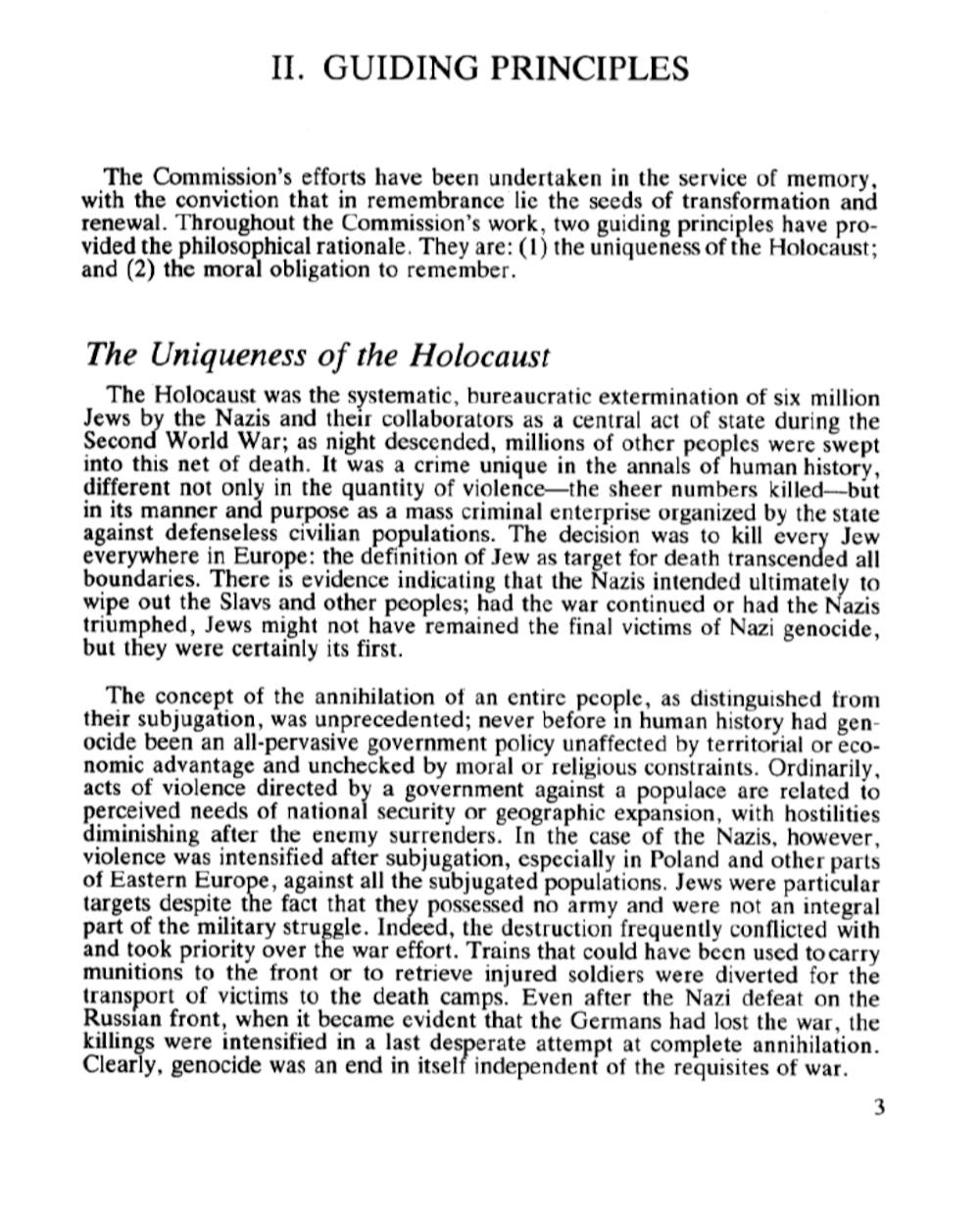
The commission included American Holocaust survivors like Elie Wiesel and Benjamin Meed. The commission’s September 1979 report recommended special days of remembrance for the Jewish victims of the Holocaust, a dedicated education program, and the establishment of the United States Holocaust Memorial Museum as a national memorial.

The museum, the report said, should be focused on one specific aspect of the Nazis’ many crimes: the “unique” and unprecedented nature of the murder of the Jews – even over other Nazi victims.

“Millions of innocent civilians were tragically killed by the Nazis. They must be remembered. However, there exists a moral imperative for special emphasis on the six million Jews. While not all victims were Jews, all Jews were victims, disdained for annihilation solely because they were born Jewish,” wrote the commission.

This approach clashed with Carter’s views on the universal lessons of the Holocaust. It also aroused the opposition of representatives of other victims of the Nazis, such as the Roma and the gay community, who pressed for inclusion in the Holocaust museum.

A ‘campaign to remember’

Another heated debate was taking place about who should pay for the museum, which was estimated to cost US$100 million.

https://images.theconversation.com/files/318487/original/file-20200304-66089-fsift2.jpg?ixlib=rb-1.1.0&q=45&auto=format&w=1000&fit=clip

The land allocated on the National Mall in Washington, D.C., was a contribution by the federal government. But the remaining funds to build the museum were to be donated mainly by the American public through a “Campaign to Remember.”

This was the moment – the convergence of Carter’s vision of human rights protection and the “Campaign to Remember” – that the organized American-Armenian community believed could bring the almost-forgotten memory of the Armenian genocide back to public consciousness.

California Gov. George Deukmejian, an Armenian-American, pressured museum leaders to appoint Set Momjian as its American-Armenian community representative. The Armenian community in the U.S. made a donation of $1 million, aiming to be able to include the Armenian genocide in the museum’s focus.

In August 1983, the Armenian expectations became reality when the museum commission reached a decision to include the Armenian genocide in the exhibition narrative. Although the decision about the 1915 genocide was informal, it was still a commitment that later would be difficult to reverse.

Turkey looks to Israel

The Turkish government was extremely anxious about the museum. It turned for help to its regional and Cold War ally, Israel. Turkey pressured Israel to influence the concept of the museum and to make sure the Armenians were left out of the memorial.

As part of an oral history project, I interviewed Gabi Levy, who served as Israeli ambassador to Turkey from 2007 to 2011. Levy told me that throughout the history of Israeli-Turkish relations, whenever Turkey had an urgent concern in the U.S., “the Turks carried assumptions regarding the ‘magical power’ of Israel’s foreign policy,” especially their purported ability to use the American Jewish lobby for influence the U.S. political arena.

Israel capitalized on presumptions about the Israeli/Jewish “magic power” to convince Turkey that they were taking all “possible measures.” Israeli diplomats tried to persuade the relevant American players to prevent the Armenian experience from being incorporated into the museum, requesting influential Jewish congressmen such as Tom Lantos and Stephen Solarz to convince the museum commission to exclude the Armenian genocide. Lantos and Solarz believed this would serve U.S. interests in the Middle East that included Israel and Turkey maintaining good relations.

Ultimately, as a key U.S. NATO ally, it was Turkey’s own pressure on the U.S. Congress and the Reagan administration’s Cold War fears that forestalled any presence of the Armenian genocide in the museum as well as resulted in the failure to pass the Armenian genocide bill.

When the memorial finally opened its doors in 1991, its focus was the Holocaust and Jewish victims.

What changed in 2019?

Internationally, a number of developments supported the dramatic changes in U.S.-Turkish relations in 2019. They include Turkey’s July purchase of a Russian-made air defense system, which angered the Americans, and the October military offensive by Turkey in Northern Syria against the Kurds, who were U.S. allies.

In the U.S., the unprecedented condemnation by both Democrats and Republicans of Turkish President Recep Tayyip Erdoğan for his attack on Kurds in Syria, as well as the impeachment process against Erdogan ally Donald Trump, weakened Congress’ adherence to the longtime official position favoring Turkey.

Congress passed powerful sanctions against Turkey. The Armenian genocide bill was part of the package.

Importantly, the bill passed by the U.S. Congress states the U.S. will “commemorate the Armenian Genocide through official recognition and remembrance.”

The U.S. is thus committed to allocate federal resources to build a U.S. memorial to commemorate the 1915 genocide – just as with the the 1978 President’s Commission on the Holocaust. Practically speaking, building U.S. Armenian genocide museum or memorial will have further negative implications for U.S.-Turkish relations, which might take another 40 years to rebuild.

This article is republished from The Conversation, a nonprofit news site dedicated to sharing ideas from academic experts.

Filed Under: Genocide, News

Ruins of a 3000-year-old Armenian castle found in Lake Van – Turkey

March 4, 2020 By administrator

The 3,000-year-old remains of an ancient fortification have been discovered at the bottom of Turkey’s largest lake. The underwater excavations were led by Van Yüzüncü Yıl University and the governorship of Turkey’s eastern Bitlis Province.

The castle is said to belong to the Iron Age Armenian civilization also known as the Kingdom of Van, Urartu, Ararat and Armenia. The lake itself is believed to have been formed by a crater caused by a volcanic eruption of Mount Nemrut near the province of Van. The current water level of the reservoir is about 150 meters higher than it was during the Iron Age.

Divers exploring Lake Van discovered the incredibly well-preserved wall of a castle, thought to have been built by the Urartu civilization. Experts had been studying the body of water for a decade before it revealed the fortress lost deep below its surface.

The 3,000-year-old remains of an ancient fortification have been discovered at the bottom of Turkey’s largest lake. Divers exploring Lake Van discovered the incredibly well-preserved wall of a castle, thought to have been built by the Urartu civilization

The discovery was made by a team of researchers, including Tahsin Ceylan, an underwater photographer and videographer, diver Cumali Birol, and Mustafa Akkuş, an academic from Van Yüzüncü Yıl University. 

Legends among the area’s population spoke of ancient ruins hidden in the water, and the Van team decided to investigate. Over the course of ten years, they captured images of pearl mullets, microbialites, corals and even a sunken Russian ship, but their prize remained elusive.

Their search has now paid off, uncovering castle stonework that has been protected from the ravages of time by the lake’s highly alkaline waters. It is thought the stone structure was built by the Urartians, as the rocks used were favoured by civilization. 

The castle, as well as a number of villages and settlements in the area, were built at a time when water levels were much lower than they are today.

Speaking to Hurriyet Daily News, Mr. Ceylan said: ‘Many civilizations and people had settled around Lake Van.

‘They named the lake the “upper sea” and believed it hid many mysterious things.

‘With this belief in mind, we are working to reveal the lake’s secrets.

‘It is a miracle to find this castle underwater.’

The Kingdom of Urartu was an ancient country in the mountainous region southeast of the Black Sea and southwest of the Caspian Sea.  Today the region is divided among Armenia, eastern Turkey, and northwestern Iran.

Mentioned in Assyrian sources from the early 13th century BC, Urartu enjoyed considerable political power in the Middle East in the 9th and 8th centuries BC.

The Urartians were succeeded in the area in the 6th century BC by the Armenians. Urartu is an Assyrian name and the people called Urartians called their country Biainili. Their capital Tushpa was located at what is now known as Lake Van.

Source: https://www.archaeology-world.com/ruins-of-a-3000-year-old-armenian-castle-found-in-lake-van-turkey/?fbclid=IwAR0JqNHk8DW4ExMwXmiH56UZxVU399jdR0HMISIlwBn1rIlF65miDE9nBhE

Filed Under: Genocide, News

Stanoz: Remnants of an Old Armenian Village in Ankara

March 2, 2020 By administrator

By Harut Sassounian,

Argun Konuk, a 24-year-old Turkish travel and history enthusiast, published a recent article about the Armenian village of Stanoz located near Ankara. 

Konuk reported that Stanoz was “once a prosperous Armenian village in the Ottoman era, now, nothing but ruins and tombstones…. Old Armenian manuscripts reveal that the first inhabitants of the village of Stanoz came from Cilicia in the 15th century. As records show, the population of Stanoz before World War I was 3142 people (668 families) and consisted of Armenians only. Up until its abandonment, Stanoz remained an Armenian-speaking settlement.”

The residents of the village of Stanoz were skilled in carpet weaving, embroidery and leather processing. Furthermore, they produced fabric from goat hair which was in high demand in Europe. The villagers were also knowledgeable about agriculture, cattle-breeding and construction.

Konuk also reported that unfortunately the only things that remain in Stanoz now are the graveyard, a stone bridge, and ruins of an Armenian Church. The damage was mostly caused by Turkish gravediggers or treasure hunters. The size of the graveyard keeps shrinking as the Turkish neighbors have been encroaching on the property.

Stanoz was mentioned in the journals of many travelers for centuries. An 18th Century British military officer, Frederick Burnaby, reported that during his visit to Stanoz, one of the Armenian priests told him that Armenians of Stanoz live in peace with people who practice Islam and Judaism.

Armenian women washing clothes near Zir River, 1929
 Maynerd Owen Williams, National Geographic Archive

Konuk also reported that “the well-known Turkish traveler Evliya Celebi shared remarkable anecdotes in his journal about this village after his visit in 1643. He spoke of Stanoz as a wealthy town with impressive productivity. Furthermore, he shared that Stanoz had a thousand dwellings, a big bazaar, a fully functioning Turkish bath and even a laundromat.”

There were three religious buildings in Stanoz: Sourp Prgich Church, Karasoun Manoug Church, and a Protestant Church. There were two Armenian schools: Sourp Ghevontyan School with 140 male and 40 female students and Lusignan School with 50 male and 35 female students.

Due to the Genocide and deportation of Armenians by Ottoman Turkey, many Stanoz residents were either killed or fled the area leaving the village as a ghost town.

The writer found that currently only three Armenians live in Stanoz. Kevork Balabian, who was born in Stanoz, told Konuk: “Stanoz had 1200 households and a population of 7-8 thousand. Ottomans valued Stanoz a lot. At the time, the Armenian population of Stanoz migrated to modern cities such as Istanbul, Marseille and Beirut. Only my wife and I, who came from Hatay, and our daughter live in the region. I go there often as I have a farm and a vineyard. Some treasure hunters come there in hopes of pillaging and finding some valuable artifacts but they are afraid of me so they mostly leave. We have graves there and I still look after them”

An old Turk told Kunuk: “We all grew up with Armenians, went to the same schools. Back then if you were hungry, you could easily knock on an Armenian’s door and ask for food and it was the same for them. We did many things together. There was an Armenian doctor whose name was Mihran Kiremitchi. Every single child who was born in this region owes him so much as he cared for everyone and cured everyone’s child regardless of ethnicity and social class. We never saw him asking for money from anyone. And again, weddings, funerals, everything else, we did together with the Armenians. We even celebrated religious holidays together. They used to paint eggs and we used to sacrifice animals. We miss them.”

An Armenian by the name of M. Suryan wrote in Aravod newspaper on April 28, 1919: “Some of the houses of Armenian residents who were exiled during World War I were looted and robbed. A considerable part of Albanians and Bosnians resettled in these abandoned homes. The new residents demolished many of the structures and provided firewood by removing wooden pillars, floor-ceiling boards of many homes. Moreover, instead of acquiring wood from the forest, they cut the fruit trees in the gardens to warm up. The aftermath was appalling as this notable village became dilapidated ruins. Gradz Kar, a small Armenian village, which consisted of twenty houses, located an hour away from Stanoz, also suffered the same fate.”

Konuk is highly offended that Turkish gravediggers have violated the sanctity of the Armenian graves: “The graveyard is particularly in such an abject condition that human bones are scattered around the graves that are pillaged by the treasure hunters and many of the tombstones are damaged. The tombstones are priceless. Each of them represent historical importance, however, their current state is heartbreaking. Even now after devastating centuries, there are still many artifacts and historical objects lying around. For me the most appalling thing was to see some human bones scattered around the graves. In hopes of finding gold or other valuable goods, treasure hunters dig the graves illegally and throw around the bones of the Armenians who are resting there eternally. Undeniably, this is an extreme case of disrespect.”

Konuk concluded his report with the following heart-warming words: “We Turks lived with Armenians in peace for centuries and I believe this place should carry the same importance as other Turkish cemeteries. Regardless of ethnicity and religion, the Turkish state should have taken measures to protect the memory of this village. Unfortunately, the future of Stanoz seems bleak. It is quite sad to see that this old and notable settlement completely vanished…. After five months of my first visit, I decided to go there again and it shocked me to see that many tombstones were missing! The Armenians of Stanoz were our kin. Who knows what stories and secrets this settlement has to tell us. Unfortunately we will never learn them.”

Filed Under: Articles, Genocide

  • « Previous Page
  • 1
  • …
  • 44
  • 45
  • 46
  • 47
  • 48
  • …
  • 373
  • Next Page »

Support Gagrule.net

Subscribe Free News & Update

Search

GagruleLive with Harut Sassounian

Can activist run a Government?

Wally Sarkeesian Interview Onnik Dinkjian and son

https://youtu.be/BiI8_TJzHEM

Khachic Moradian

https://youtu.be/-NkIYpCAIII
https://youtu.be/9_Xi7FA3tGQ
https://youtu.be/Arg8gAhcIb0
https://youtu.be/zzh-WpjGltY


gagrulenet Twitter-Timeline

Tweets by @gagrulenet

Archives

Books

Recent Posts

  • A letter from Leading businessman of the United Arab Emirates. Khalaf Hamad Al Habtour, sent to Donald Trump
  • Anna Hakobyan prepared a heartbreaking text about the deprivations “Hraparak”
  • Endless Wars & Concentration of power in one man’s hand:
  • Secret 1920 Document Reveals Turkey’s Plans — Just as Today, to Eliminate Armenia
  • “Corruption, looting, and cronyism appear widespread within the Pashinyan government.

Recent Comments

  • Tina on Anna Hakobyan prepared a heartbreaking text about the deprivations “Hraparak”
  • Baron Kisheranotz on Pashinyan’s Betrayal Dressed as Peace
  • Baron Kisheranotz on Trusting Turks or Azerbaijanis is itself a betrayal of the Armenian nation.
  • Stepan on A Nation in Peril: Anything Armenian pashinyan Dismantling
  • Stepan on Draft Letter to Armenian Legal Scholars / Armenian Bar Association

Copyright © 2026 · News Pro Theme on Genesis Framework · WordPress · Log in