Gagrule.net

Gagrule.net News, Views, Interviews worldwide

  • Home
  • About
  • Contact
  • GagruleLive
  • Armenia profile

Turkey refuses to sign ILO convention regarding safety and health in mines

May 15, 2014 By administrator

Questions have been raised over the mine accident in Soma that left at least 282 people dead, arguing that the country’s poor workplace safety standards stem partly from its failure to ratify the Safety and Health Mine saftyin Mines Convention of the International Labour Organization (ILO), the Hurriyet Daily News reports.
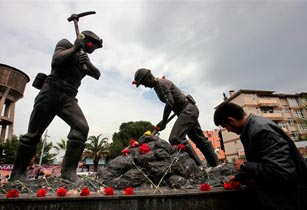
Convention No. 176 was established in 1995 in order to prevent any fatalities, injuries or ill health affecting workers or members of the public, or damage to the environment arising from mining operations.

The convention has been ratified by 28 countries, including the United States, Brazil, Russia, Armenia, Germany and Zimbabwe, but Turkey has refused to recognize the document.

The convention delegates responsibility to governments and the owners of mines with regard to safety and health.

An expert from ILO, Martin Hahn, said the convention consisted of specific measures in mines to solve work safety problems in the sector.

Turkey has signed separate two conventions, No. 155 regarding labor health and safety in 2005 and No. 187 to develop labor health and safety in 2014, Hahn said, adding that the two central agreements establish guidelines on labor health and safety across the country, stressing the importance of recognizing Convention No. 176 for Turkey regarding the active mining sector in the country.

An education specialist from the Confederation of Turkish Trade Unions (Türk-İş), Özan Karabulut, said they had failed in their attempts to have Ankara ratify the convention, highlighting that employers always consider work safety as a costly element.

Meanwhile, an online petition campaign has been launched to make Turkey sign the convention following the Soma disaster, with over 70,000 signatures having been collected so far.

Filed Under: Articles Tagged With: ILO, mines safety, Turkey

Bulgarian Defense Minister: Border Fence to be Finished in June

May 14, 2014 By administrator

Photo by BGNES

photo_verybig_160538The 30km border fence between Bulgaria and Turkey will be completed by June, assured Bulgaria’s Defense Minister Angel Naydenov.

The fence aimed at redirecting refugees only towards the official border checkpoints has sparked much controversy over the past months. In March, it was revealed that the Ministry of Defense had miscalculated the cost of the fence, writing up the sum by BGN 4 M, raising the overall price to BGN 9 M.

A number of international human rights organizations also criticized Bulgaria for its plans to build the border fence, calling it an anti-humanitarian measure to keep refugees away. The Ministry of Interior argued that it is only designed to make the process of receiving asylum seekers official, and to deter potential terrorists from entering the country unchecked.

Minister Naydenov admitted that the construction work on the fence had been slowed down as a result of the financial miscalculations as well as the poor weather conditions, but promised it will be ready in the time envisioned.

Be a reporter: Write and send your article

Filed Under: Articles Tagged With: Border Fence, Bulgarian, Defense Minis, Turkey

Turkey: Riot police fire water cannon at students protesting Soma mine blast

May 14, 2014 By administrator

Riot police fired water cannon in Ankara on Wednesday afternoon to disperse a group of students from Middle East Technical University (ODTÜ) who wanted to march towards the Energy Ministry to protest 184965_newsdetailthe heavy loss of life in Tuesday’s mine blast in Manisa’s Soma district.

Turks took to the streets across the country on Wednesday to protest the Soma coal mine blast in which over 200 people have been killed and hundreds of others remain trapped.

Many people lay down on the ground at İstanbul’s Taksim metro station to protest the mine blast. Similar protests also took place at İstanbul’s Kadıköy and Şişli districts.

n the capital city of Ankara, demonstrators gathered at Güven Park for a sit-in protest.

In the Aegean city of İzmir, electronic boards at metro stations read, “Hearts with Soma.”

Furthermore, many students in university campuses and members of several trade unions held protests in various provinces in which they smeared coal dust on their faces.

Rescuers pulled more dead and injured from the coal mine in western Turkey on Wednesday, more than 12 hours after the explosion, bringing the death toll to 205 in the nation’s worst mining disaster in decades.

Hundreds more were still believed to be trapped in the mine in Soma, around 120 kilometers northeast of the Aegean coastal city of İzmir. The explosion, which triggered a fire, occurred shortly after 3:00 p.m. (1200 GMT) on Tuesday.

Filed Under: Articles Tagged With: protesting Soma mine blast, Riot police, Turkey

Turkey Must Recognize Genocide, French President Says in Yerevan

May 14, 2014 By administrator

YEREVAN (ArmRadio)—“Turkey must recognize the Armenian Genocide,” French President Francoise Hollande said at a joint press conference with Armenian President Serzh Sarkisian on Tuesday in Yerevan.

hollande-yerevanThe French President reaffirmed that he will visit Armenia on the 100th anniversary of the Armenian Genocide.

“This is a call to the world to prevent the recurrence of such tragedies in the future,” he said.

“With this visit, France will once again reiterate its position that all genocides should be condemned,” Hollande said.

Speaking about the Karabakh issue, President Hollande said: “As a Minsk Group co-chairing country, France is ready to do its best to find a solution to the issue. Although there is a ceasefire agreement, it’s not enough. A thorough resolution is needed,” he said.

Francois Hollande added that France is ready to host a meeting of the Presidents of Armenia and Azerbaijan to help find confidence-building measures.

There have been fears in the recent period that the confrontation between Russia and the West could negatively affect the cooperation between the Minsk Group Co-Chairs and their shared stance on the issue, which would, in turn, result in the reconsideration and change of their positions.

Commenting on this, Armenian President Serzh Sarkisian said: “The Co-Chairs have said on many occasions that they have a united stance, which implies that the status of Nagorno Karabakh conflict should be determined through a legally binding free expression of will of the people. There is no alternative to the realization of the principle of self-determination,” President Sarkisian said.

He added that the approach was recently reiterated by US Co-Chair James Warlick. “He didn’t say anything new. He reconfirmed what his President had said on many occasions.” Sarkisian said. “The same approach was reflected in the statement of the Co-Chairs on the 20th anniversary of the ceasefire agreement,” he said, adding that “Azerbaijan’s attempts to interpret the approaches in a different way are doomed to fail.”

France ‘Understands’ Armenia’s Pro-Russian Stance
French President Francois Hollande pointedly declined to criticize Armenia for backing Russia’s intervention in Ukraine and voiced support for an Association Agreement with the European Union sought by the Armenian government during the press conference on Tuesday, RFE/RL’s Armenian service (Azatutyun.am) reported.

Hollande, whose country has imposed economic sanctions on Moscow together with other Western powers, said he understands the motives behind Armenia’s de facto recognition of the Russian annexation of Crimea. President Serzh Sarkisian opted for it “in a certain political and geographic context” reflecting the traditionally close Russian-Armenian relations, he said.

“I don’t want to judge. I want to understand, which is what I have done during this visit,” Hollande told a joint news conference with Sarkisian held at the end of his two-day trip.

Filed Under: Genocide, News Tagged With: armenian genocide, French president, Turkey

Turkey will ignore ECHR ruling to pay compensation to Greek Cyprus

May 13, 2014 By administrator

Sevil Erkuş ANKARA

Turkey will not pay a fine imposed on the country by the European Court of Human Rights (ECHR) for the Turkish military’s 1974 intervention in Cyprus, officials in Ankara n_66356_5have announced.

“In terms of the grounds for this ruling, its method and the fact that it is considering a country that Turkey does not recognize as a counterpart, we see no necessity to make this payment,” Foreign Minister Ahmet Davutoğlu said at a press conference on May 13.

The ECHR’s ruling consists of some “legal contradictions” and therefore Turkey does not see it at as binding in terms of payment, he said.

No court can force Turkey to pay a penalty to a state – Greek Cyprus – that it does not recognize, the minister said. “The court has exceeded its authority in intervening into a state-to-state problem.”

Turkey previously refused to pay similar penalties on the ECHR’s Cyprus rulings over individual applications by Greek Cypriots, Turkish diplomatic sources said, also referring to a separate ECHR ruling that Russia did not carry out.

In this case, the Council of Europe Ministers Committee could issue a condemnation against Turkey for implementing the ECHR order.

Ankara will inform ECHR about its decision to not pay the fine, outlining its reasons, according to sources.

In its ruling on a lawsuit filed by Greek Cyprus in 1994, the ECHR found Turkey guilty on May 12 of violating European human rights agreements, stating that the whereabouts of 1,491 Greek Cypriots was still unknown and that 211,000 Greek Cypriots were forced from their homes after Turkey’s intervention in Cyprus in 1974. The ECHR ordered Turkey to pay 30 million euros to be distributed to the living relatives of the missing people, while it said 60 million euros in damages should be paid for “the enclaved Greek-Cypriot residents of the Karpas peninsula.”

Davutoğlu described the timing of the ruling as “not well-intentioned.”

“The ECHR should rule on all the missing people cases, including the Turks in Turkish Cyprus,” he said.

Filed Under: Articles Tagged With: ECHR, Greek Cyprus, Turkey

Kurdish Mother and Infant Twins to Begin Prison Term in Turkey

May 12, 2014 By administrator

Kilinc with her infant twins: ‘I can take care of them more easily if they can walk.’ Photo: AA

46259image1COPENHAGEN, Denmark – A Kurdish mother, convicted for selling books related to the outlawed Kurdistan Workers’ Party (PKK), begins her jail sentence in Turkey later this month, along with her twin infants.

Mulkiye Demir Kılınc was convicted for selling books related to the PKK at the Mesopotamian Culture Center. After one of her clients, who was sending the books to the PKK, was arrested, Kilinc also was charged with “aiding a terror organization.”

The new mother, whose jail term starts on May 19, has asked for the sentence to be postponed for a year, so that her six-month-old twins are a little older and can walk.

“If the sentence is postponed for a year, they will be one-and-a-half years old, so they will be able to walk. They will not spend their infancy, when they only can crawl, at prison. I can take care of them more easily if they can walk,” Kılınc recently told Turkey’s Hurriyet newspaper.

On Sunday, Mother’s Day in Turkey, the Human Rights Association (IHD) has arranged a demonstration in Istanbul to protest the sentence.

A board member of the IHD in Istanbul, Seza Mis Horoz, told Rudaw that the prison sentence is a great injustice.

“To get such a big punishment for selling books and even come to prison with children is unbelievable. How should a mother go to jail with her children under such circumstances?” Horoz asked.

Over a year ago, the PKK and Turkey’s government started a peace process to end a bloody war that killed more than 40,000 people in a 30-year conflict. In return for the pullout of PKK guerrillas from Turkey, it was expected that the Turkish government would give the Kurds greater cultural and linguistic rights, even though details of the agreement between the two sides remain unknown.

According to Horoz, there is an inexplicable contrast between negotiating with the PKK, and imprisoning a woman for selling books to the same organization.

“What kind of peace does the Turkish state want with the PKK, when they at the same time imprison people with accusations of ‘selling books to the PKK?’”

She feared that such actions could damage the peace process between Turkey and the PKK.

“It creates frustration among people who thus lose faith in the government’s desire for peace,” she said.

Hejar Dashti, an expert on Kurds at Copenhagen University, told Rudaw that despite the peace process the PKK is still a banned organization in Turkey, according to the country’s terror laws.

“PKK is officially still the enemy number one in Turkey, therefore any connection to the organization is forbidden and is charged with terror paragraphs,” he explained.

He further added that both parties in the peace process are accusing each other of not living up to the process, and therefore the process is somehow put on standby.

Hurriyet newspaper.

Filed Under: Articles Tagged With: Infant Twins, Kurdish Mother, Prison, Turkey

Algerian Jihadist explains how Syrian Islamists operate from Turkish base in Reyhanli

May 12, 2014 By administrator

By Seyit Ervan – ANFMay 10, 2014

AFRIN, Syrian Kurdistan,— Muhammed Beshir, an Algerian jihadist who was captured by Efrin public Kurdish security members (Asayish) as he attempted to travel to Bab in the syriakurd1179area of Idlib, has revealed startling information about the role of Turkey is continuing to play in aiding foreign jihadists entry into Syria.

Muhammed Beshir was born in 1982 in the Algerian city of Vaharan. He migrated to Europe in 2005. After four years in Germany, France, and Spain he was deported back to Algeria. In 2013 in the wake of the uprisings in Syria Beshir met a Syrian in Vaharan who was working as a confectioner.

A short time after meeting this Syrian, Beshir explains that he was convinced to take part in the revolution in Syria with the promise of heaven, saying “after returning from Europe I went to my home town to live. After the events began in Syria people began to migrate there. One of them was a Syrian named Ebu Behcet who was working in confections. At first he got close to a lot of people. He would give me sweets without taking any money. After I went a number of times he began to speak about how ‘there is a jihad and it is necessary to go.’ Within two months he had convinced many to take part in the jihad. I also decided to go to Syria for the jihad. Within two days the bought my ticket and sent me off.”

Beshir narrates how after Ebu Behcet bought his ticket he flew from Hawari Bomedyan airport in the Algerian capital to Atatürk Airport in Istanbul. When he arrived in Istanbul he called a telephone number that had been given to him earlier, saying “after the plane landed I knew that I was in Istanbul.

But I had no idea who the telephone number they gave me belonged to. After I got out of the airport I called the number that had been given to me. A man speaking with a rich voice in broken Arabic answered the phone and began to explain what I needed to do next. He explained that ‘there is a place called Antakya, and you will come here and after you arrive you will call me again.’ Following his directions I went from the airport to the bus station. There I bought a ticket to Antakya. I left the day. I arrived in Antakya the next morning and called the same number. When he asked me where I was I said that I was still in the bus station. He wanted me to buy a ticket for Reyhanlı without leaving the station. I bought a ticket in the station and after a short journey I arrived in Reyhanlı. When I got there I called the man again. He wanted me to describe myself and after I did he hung up. Almost immediately someone approached and asked ‘are you Muhammed Beshir’? When I said ‘yes’ he said ‘ok, lets go.’ We stopped in front of currency exchange counter in the Reyhanlı market district. He said ‘my name is Abdulmecit Cevher.’ He showed me a place to sit and after offering me tea he said ‘ok, lets go home.’ We left and went to his house. There was no one at home. He was obvious that it was being used for those going to the war in Syria. There was everything in the house. He said ‘if you are tired have something to eat and get some rest. I will be back in the evening’ and then he left.

Crossing To Syria

Beshir explains how Adbulmecit Cevher, who works as a money changer at the local military induction center, came back later that night but said he could not cross then because there was fighting on the border. Because the fighting intensified he waited five more days in Cevher’s house. Then, Beshir says, “on the evening of the fifth day Abdulmecit came to his house with someone else and asked if I were ready to go. I said I was ready and he said I could pass with no problem because he spoke with the soldiers at the border. He said that because I would cross under the supervision of the commanders there would be no problem. Within a short time we left the house and got in a car. Within a few minutes we were next to a wire fence. We went straight to the place where there were soldiers. Abdulmecit and the man with him went and spoke with the soldiers and were joking around. Then Abdulmecit came over to me and said that the man with him would bring me from this point. He waited with soldiers and we walked on a little further, lifted up some of the fire fencing and went under. As we passed under the wires those soldiers were talking and laughing. It was clear that these were not ordinary soldiers from they spoke and joked around. They were high-ranking.”

After Crossing The Border

After they crossed the border Beshir says they got into a car that had been waiting for them, where he learned that he was in the area of Hibeyt. Beshir explains that as soon as he got out of the car they wanted him to make a choice, saying “those bringing me wanted me join al-Nusra but because I smoke cigarettes they wouldn’t accept me so they wanted me to choose the group I wanted to join. Because I didn’t know any of the groups I said whatever group you want to put me with is fine. They put me in with a group called the Liva Cephet El Hak. Of course after I joined this group I released that this group was a subsidiary of El-Nusra. Those who smoked cigarettes or who had used drugs or alcohol before were joining this group. Of course after spending some time with them I witnessed how they were preparing and taking people for the al-Nusra Front.”

Beshar – who knows French, German, Spanish and Arabic – tells of how he spent a couple of months with this group and witnessed first hand the truth of how these groups mislead youth in the name of the Syrian Revolution and the jihad, saying “in the two months that I stayed with them I saw how all they did was send people to die in the name of the revolution. I saw how those who call themselves commanders of the revolution only looted the areas we entered and how they sent the objects they looted to be sold in Turkey. I saw up-close how this blind violence had nothing to do with the revolution or with jihad. Perhaps some youth are really coming because they believe in the jihad. But I believe now that these youth are going nowhere but to their deaths. For that reason I am calling on those youth in Europe and Islamic countries who are being organized and sent off in the name of jihad, do not believe them and go where you go but do not come to Syria. Because in Syria there is no revolution or jihad.”

Despite realizing these truths, Beshir explains how he was unable to find a way to return. He also narrates how in the training camps they attempt to turn the recruits against Kurds, saying “in the training they gave us they often said that Kurds were not Muslims. With this they were preparing us to fighting against the Kurds. However I was surprised when I heard the call to prayer the first time after I was captured by the public security members (asayiş). Later when I said that I wanted to pray they showed me the utmost respect and after explaining my experiences over those two months I asked for help from them to return to my country.”

The Afrin Public Security helped with Muhammed’s request by bringing to the border with Kilis where they sent him with a fellow Algerian who took him to the Algerian consulate.

By Seyit Ervan – ANF

Filed Under: Articles Tagged With: Algerian Jihadist, Syria, Turkey

Court Orders Turkey to Pay Cyprus Over Invasion

May 12, 2014 By administrator

ISTANBUL May 12, 2014 (AP)
By DESMOND BUTLER Associated Press

AP_logo_update_20130709 Europe’s top human rights court in its largest ever judgment ordered Turkey on Monday to pay 90 million euros ($123 million) to Cyprus for its 1974 invasion and the island’s subsequent division.

The decision from the European Court of Human Rights said the passage of time did not erase Turkey’s responsibility in the case, ruling that Turkey must pay 30 million euros in damages to relatives of those missing in the operations and 60 million euros for “the enclaved Greek-Cypriot residents of the Karpas peninsula.”

Hundreds of Greek Cypriots still live in the Karpas peninsula in the northernmost tip of the breakaway Turkish Cypriot part of the island.

Cyprus has been divided since Turkey invaded in 1974 after a coup by supporters of union with Greece. Only Turkey recognizes the breakaway Turkish Cypriot state that was proclaimed in the north of the island.

The judgment comes as the Turkish and Greek Cypriot communities are making a new effort to reunite the island.

Speaking ahead of the ruling on Monday, Turkish Foreign Minister Ahmet Davutoglu warned that a judgment against Turkey would come at a delicate time and said that he viewed it as “neither binding nor of any value.”

“Not only is it legally problematic, its timing is wrong,” Davutoglu said.

Turkey’s Foreign Ministry said in a statement that the decision would not detract from Turkey’s “determination” to reach a settlement.

Cyprus’ government spokesman Nikos Christodoulides hailed the court’s decision and called on Turkey to comply immediately.

“Despite the fact that the persecution and hardship that they have endured cannot be measured in money, the Cyprus government welcomes the fact that the court again condemns in this way Turkey’s policy of violating the human rights of the enclaved,” he said.

The court said it would be up to the government of Cyprus to determine how to award the damages. Turkey has not always complied with the court’s rulings.

In a 1998 ruling, the Strasbourg court ordered Turkey to pay Titina Loizidou compensation for depriving her of property in the seaside city of Kyrenia. It was the first case in which a Greek Cypriot successfully sued Turkey over the invasion and earned the right to compensation.

Turkey paid the money in 2003, but has yet to comply with an earlier European Court decision ordering Ankara to allow Loizidou to reclaim her property.

Analysts noted that the current case was notable not only because of its size, but also because it took Turkey to task for the invasion and awarded the money to Cyprus on behalf of individuals, a sensitive point that could affect current reunification talks.

“The big question is how the decision will affect the negotiations that are the most promising ever,” said Cengiz Aktar, an analyst on Turkey-EU affairs at the Istanbul Policy Center. “It could put the talks into difficulty.”

Achilleas Demetriades, a prominent human rights lawyer in Cyprus, who has won several cases in the European Court involving Turkey, said that the judgment also pertains to Turkey’s failure to carry out an effective investigation of the whereabouts of Greek Cypriots who disappeared during and after the invasion of the island, and to provide that information to relatives of the missing.

Nicos Sergides, president of the Greek Cypriot organization of relatives of missing persons, said the ruling could offer fresh hope for relatives to find out what happened to their loved ones.

———

Angela Charlton and Lori Hinnant in Paris, Suzan Fraser in Ankara and Menelaos Hadjicostis in Nicosia contributed to this report.

Filed Under: News Tagged With: Court Orders, Cyprus, Invasion, Pay, Turkey

Turkey: Report: Dec. 17 graft probe linked with trafficking of drugs, arms (as much as $19.6 billion)

May 9, 2014 By administrator

May 08, 2014, Thursday/ 19:33:22/ TODAY’S ZAMAN/ ANKARA

The discovery by customs police of a large amount of heroin stashed in a truck back in 2007 clued police into a trail of money earned from drug and arms sales in an investigation that eventually branched out 184667_newsdetailinto the Dec. 17 graft operation, a Turkish daily said on Thursday.
 
According to the report in the Taraf daily, all the details of the corruption probe, which the government claimed was a coup plot, are present in the “Happani Group Assessment Report,” a report dated June 3, 2011, and prepared by a unit of the Bureau of Anti-Smuggling and Organized Crime (KOM) of the National Police Department.   

Taraf reported that thanks to wiretaps conducted after the seizure of heroin in the truck, it was determined that a gang composed of both individuals and corporations laundered money illegally earned in Iran and Iraq in Turkey. 

The daily said the seizure of 202 kilograms of heroin on Feb 12, 2007, from a truck at the Kapıkule border gate in Edirne province laid the foundation for the graft probe that went public on Dec. 17.

Taraf, summarizing the Happani report, said: “That is, it was determined that money earned through the smuggling of arms and drugs in Iran and Iraq was laundered at some exchange offices in the Grand Bazaar [in İstanbul]. Durak Exchange Office and a person called Abdullah were identified as being among the first who were involved such transfers [of money].”   

According to Taraf, the sweeping purges in the police force that followed the Dec. 17 operation prevented police from going after heroin and weapons smuggles who were implicated in the probe.
“In the second and third phases of the [graft] operation, ‘drug and arms barons’ were also supposed to be arrested. But the operation ‘against the judiciary’ caused the part of the file dealing with drugs to remain incomplete,” Taraf daily said.

After the heroin was seized, İstanbul Public Prosecutor’s Office launched investigation number 2007/1258 into the heroin seized. As part of the investigation, a court order was obtained to wiretap the phones suspects in the case. “Wiretaps were carried out by the Edirne Department of Anti-Smuggling and Organized Crime,” the daily said.   

The RotaHaber news portal published photographs of the operation in which police discovered the heroin on Thursday. Packages tightly sealed with scotch tape are seen lying in coffins taken from the truck.

In the search, conducted by customs police, Rotahaber said, out of 40 coffins on the truck, 29 had false bottoms. When the false bottoms were removed, 202 kilograms and 970 grams of heroin in 400 packages was discovered, the report said. The operation was conducted under the direction of Hanefi Avcı, then police chief of Edirne province, who was close to the ruling Justice and Development Party (AK Party) at the time.    

According to the Taraf report, that investigation led the police to Reza Zarrab, whom the government has described as a philanthropist, and to the Happani family, which works for Zarrab. Zarrab is an İstanbul-based Azeri businessman of Iranian origin who was a major suspect in the Dec. 17 corruption probe.

In 2009 and 2010, the National Police Department reportedly received many letters informing about the issue. “For example, in a letter dated May 7, 2010, it was claimed that Reza Zarrab had laundered billions of dollars through exchange offices in [İstanbul’s] Beyazıt [neighborhood]. Based on this information, the number of people whose phones were wiretapped increased,” the daily said.

Main opposition Republican People’s Party (CHP) leader Kemal Kılıçdaroğlu said at the party’s parliamentary group meeting on Tuesday that the Dec. 17 probe got started after police discovered heroin inside the truck at Turkey’s Kapıkule border gate, adding that the police had traced the heroin to a currency exchange office in İstanbul’s Grand Bazaar owned by an Iranian businessman.

That’s how the investigation started, the CHP leader had said. According to Kılıçdaroğlu, the National Intelligence Organization (MİT) became aware that the allegations could harm the government and warned Prime Minister Recep Tayyip Erdoğan in a report it submitted to the prime minister on April 18, 2013.

According to the report, as suspects — in which four former Cabinet ministers are also implicated — got wind of the investigation, the launch date of the operation was pushed forward, which also harmed the investigation into drugs and arms traffickers.

Wiretaps of the Durak Exchange Office at the Grand Bazaar, which the daily said is owned by Zarrab, opened the way for the police to uncover the corruption that was central to the Dec. 17 probe.

The daily said: “The connection with Zarrab was not discovered at the beginning. But, based on further investigation, police got on the track of Reza Zarrab and his driver Turgut Happani. That is, it is through the Durak Exchange Office that [police became aware that] Reza Zarrab and Turgut Happani were involved. Based on this information, [the phones of] Turgut Happani, Abdullah Happani, Serdal Happani, Şenel Happani and Reza Zarrab were wiretapped. The wiretaps led the police to Cabinet ministers in Ankara.”

The Hürriyet daily first reported on Dec. 21, 2013, shortly after the graft probe went public, that the Durak Exchange Office had led the police to launch the graft probe of Dec. 17, Taraf said. The Hürriyet story, which focused on Zarrab’s exchange office, said that the exchange office was used to launder as much as $19.6 billion.   

According to the report in the Taraf daily, following an investigation conducted by the Finance Ministry’s Financial Crimes Investigation Board (MASAK), it was said that Durak Döviz A.Ş., Tural Ltd., and Pırlanta Ltd., which are auxiliary firms of Royal Holding A.Ş., engaged in money laundering by exporting gold bars to Iran and Dubai. “That is, trade in gold was meant to launder money obtained by illegal means,” the daily said.

Filed Under: Articles Tagged With: corruption investigation, reza zarrab, Turkey

Turkish court indicts 13 soldiers who had intercepted a convoy to Syria

May 8, 2014 By administrator

AFP – Turkish court has charged 13 soldiers who had stopped in January trucks Turkish secret services en route to Syria, calling for each of them to life in prison, said on Thursday the Turkish media.

The 13 men will soon be tried in Adana (south), where the incident occurred, to an as yet undetermined date and the indictment which aims requires life in prison, said the Dogan news agency. The suspects are accused of including “leaking state information for political or espionage,” the agency said.

Teams gendarmerie corps in Turkey, were stopped and searched in Adana, a city near the Syrian border, seven trucks on the basis of information received that they were carrying weapons and ammunition. The authorities stated that the personnel on board consisted of members of the national intelligence agency (MIT), on official mission.

Trucks are left after excavation and the government, very angry, announced they were carrying aid to the Turkmen minority in northern Syria and denied any supply of arms. The soldiers who had intercepted the trucks subsequently relieved of their duties.

The incident intervened in full corruption scandal that has tainted the Islamic-conservative government of Prime Minister Recep Tayyip Erdogan after revelations in mid-December and for which the prime minister accused the Brotherhood preacher Fethullah Gülen have manufactured evidence.

Erdogan has conducted an extensive purge from the judiciary and the police, manipulated, according to him, by the Gülen movement to overthrow him. The power was also passed in Parliament in March a controversial law that gives increased powers at MIT. The new legislation grants including judicial impunity for members of the MIT in the exercise of their functions.

The government in Ankara is a fierce opponent of the regime of Syrian President Bashar al-Assad and hosts the exiled opposition, but has repeatedly denied having supplied weapons to the insurgents. However, in December, the Turkish media, citing UN documents and the government, said that the country had sent 47 tons of weapons to the rebels since June 2013.

Filed Under: Articles Tagged With: Adana, Syria, Turkey

  • « Previous Page
  • 1
  • …
  • 253
  • 254
  • 255
  • 256
  • 257
  • …
  • 271
  • Next Page »

Support Gagrule.net

Subscribe Free News & Update

Search

GagruleLive with Harut Sassounian

Can activist run a Government?

Wally Sarkeesian Interview Onnik Dinkjian and son

https://youtu.be/BiI8_TJzHEM

Khachic Moradian

https://youtu.be/-NkIYpCAIII
https://youtu.be/9_Xi7FA3tGQ
https://youtu.be/Arg8gAhcIb0
https://youtu.be/zzh-WpjGltY


gagrulenet Twitter-Timeline

Tweets by @gagrulenet

Archives

Books

Recent Posts

  • Pashinyan Government Pays U.S. Public Relations Firm To Attack the Armenian Apostolic Church
  • Breaking News: Armenian Former Defense Minister Arshak Karapetyan Pashinyan is agent
  • November 9: The Black Day of Armenia — How Artsakh Was Signed Away
  • @MorenoOcampo1, former Chief Prosecutor of the International Criminal Court, issued a Call to Action for Armenians worldwide.
  • Medieval Software. Modern Hardware. Our Politics Is Stuck in the Past.

Recent Comments

  • Baron Kisheranotz on Pashinyan’s Betrayal Dressed as Peace
  • Baron Kisheranotz on Trusting Turks or Azerbaijanis is itself a betrayal of the Armenian nation.
  • Stepan on A Nation in Peril: Anything Armenian pashinyan Dismantling
  • Stepan on Draft Letter to Armenian Legal Scholars / Armenian Bar Association
  • administrator on Turkish Agent Pashinyan will not attend the meeting of the CIS Council of Heads of State

Copyright © 2025 · News Pro Theme on Genesis Framework · WordPress · Log in