Gagrule.net

Gagrule.net News, Views, Interviews worldwide

  • Home
  • About
  • Contact
  • GagruleLive
  • Armenia profile

Four Turkish soldiers killed, seven wounded in PKK attacks, curfew imposed

October 1, 2015 By administrator

229903Two soldiers were gunned down by Kurdistan Workers’ Party (PKK)  as they left for work on Thursday in the southeastern province of Diyarbakır, while two others died in clashes between Turkish security forces and PKK terrorists in Mardin’s Nusaybin and Şırnak‘s Beytüşşebap districts on Thursday. Report Zaman

As the PKK-related tension in southeastern Turkey continues to grow with every passing day, Turkey witnessed another series of clashes between the terrorist group and Turkish security forces during which four soldiers were martyred.

In Mardin’s Nusaybin district, one soldier was killed and six others were injured on Thursday morning when members of the PKK opened fire on troops guarding fellow soldiers who were checking a road in the southeastern province of Hakkari. The wounded soldiers were reportedly taken to a military hospital in Mardin by helicopter.

The Mardin Governor’s Office declared a curfew, as of 5 p.m., in the district where the first attack took place in the early hours of the morning. The wounded personnel are not in life-threatening condition, the office added.

According to several media outlets, a group of terrorists fired long-barreled weapons against troops who were guarding other soldiers checking the Mardin-Kızıltepe highway and the troops returned fire.

Two F-16 fighter jets were reportedly dispatched to the area and an operation, supported by drones, an attack helicopter and a reinforcement unit, was launched to find PKK members in the area.

According to the Cihan news agency, one terrorist was “rendered ineffective” in coordinated operations that followed the attack, and the PKK casualties were expected to increase as security operations, backed by Turkish Air Force warplanes, helicopters and drones were still ongoing.

In yet another attack in the city in the afternoon, one soldier was killed and another was wounded injured in Şırnak’s Beytüşşebap district, after PKK terrorists detonated a bomb while a military vehicle was passing late on Thursday. The injured soldier was taken to a nearby hospital and an air operation has been launched in the area to find the assailants.

In addition, two other soldiers were killed by PKK militants in Diyarbakır early on Thursday.

After a suicide bomber carried out an attack in the Suruç district of Şanlıurfa on July 20, killing 33 activists and injuring more than 100 people, PKK-related tension in southeastern Turkey has grown over the past month. Two police officers were shot in the head by PKK members in retaliation for the Suruç terrorist attack on July 22. The violence and PKK-led attacks further escalated when Turkey carried out air strikes against PKK bases in neighboring Iraq.

More than 100 security personnel and hundreds of PKK members have been killed since the collapse of a cease-fire with the PKK in July. The renewed hostilities have left efforts to establish long-term peace in ruins, and have sparked some of the worst recent clashes in a three-decades-long conflict.

President Recep Tayyip Erdoğan said this week that up to 2,000 militants from the PKK have been killed in recent military operations inside Turkey and in northern Iraq.

Filed Under: Articles Tagged With: Killed, Kurd, PKK, soldiers, Turkey

Moscow supplies Kurds fighting ISIS with weapons via Iraqi govt – Lavrov

October 1, 2015 By administrator

Moscow is providing Kurds who are fighting Islamic State (IS, formerly ISIS/ISIL) with weapons via the Iraqi government, Russian Foreign Minister Sergey Lavrov said on Thursday. The Kurds’ representatives are taking part in the work of the information center in Baghdad, RIA Novosti quoted him as saying. The center staff includes military from Iraq, Syria, Iran and Russia.

Filed Under: Articles Tagged With: Kurd, Moscow, supplies, weapons

Three Turkish police forces, civilian killed in PKK attacks

September 30, 2015 By administrator

Villagers search for the bodies of Turkish soldiers inside a destroyed armored vehicle near Dağlıca district, southeastern Turkey, on September 7, 2015. (AFP)

Villagers search for the bodies of Turkish soldiers inside a destroyed armored vehicle near Dağlıca district, southeastern Turkey, on September 7, 2015. (AFP)

Three Turkish police forces and a civilian have been killed in two roadside bomb attacks blamed on Kurdistan Workers’ Party (PKK) militants in the country’s southeast.

The explosive, planted under a bridge on Şemdinli-Yüksekova highway in the Şemdinli district of Hakkâri province, detonated on Tuesday afternoon while an army vehicle was passing, Turkey’s English-language news website Bugun cited a statement released by the General Staff of Turkey.

Three more soldiers also sustained injuries in the incident and were taken to a hospital, the statement further said.

Elsewhere in the province of Batman, a similar attack claimed the lives of a police officer and a truck driver and wounded three other policemen.

Turkish President Recep Tayyip Erdoğan said on Tuesday that over 30 PKK militants had been killed in an overnight cross-border offensive by the country’s army.

Ankara launched an operation against PKK militants in the country and in neighboring Iraq in July. A shaky ceasefire between Ankara and the PKK that had stood since 2013 was declared as null and void following the Turkish military campaign.

Erdogan has vowed to eliminate the outlawed PKK, which has been fighting for an autonomous Kurdish region inside Turkey since the 1980s The conflict has left tens of thousands of people dead.​

Filed Under: Articles Tagged With: Kurd, PKK, police, Turkey

Aziz Baran: Open letter to NATO secretary general over Turkey’s policy against Kurds

September 29, 2015 By administrator

A Turkish police officer arrests an old Kurdish protester during a demonstration near Turkish-Syrian Kurdistan border Sanliurfa, Turkish Kurdistan. Photo credit: EPA

A Turkish police officer arrests an old Kurdish protester during a demonstration near Turkish-Syrian Kurdistan border Sanliurfa, Turkish Kurdistan. Photo credit: EPA

Aziz Baran | Special to Ekurd.net

Mr Jens Stoltenberg
Secretary General, NATO HQ
Bd Leopold III, B-1110 Brussels
Belgium
Fax: +32 2 707 4232
Email: Stoltenberg.Jens @hq.nato.int

Dear Mr Stoltenberg,
Your recent expression of solidarity with Turkey against “terrorism” is tantamount to unleashing attack dogs against Kurdish citizens with a decidedly racist subtext.

I feel obliged to make you cognizant of the fact, however remote and improbable it may seem at present, that you may someday be summonsed or hauled, against your will, to appear before a de jure or a de facto Kurdistan Revolutionary Tribunal and/or Truth Commission.

As a Norwegian, you cannot be unaware of the 1905 referendum by which the Union of Norway and Sweden under King Oscar II was dissolved and both countries became sovereign states in a peaceful and democratic way.

Allow me to refresh your memory about the process of separation as it is highly unlikely that you would have revisited the subject since your High School days. You will recall that the Norwegian Parliament voted to secede from the union on 7 June 1905 followed by a referendum on 13 August 1905 in which 99.95% of cast votes favoured secession. Though Norwegian women had no right to vote, they started a signature collection campaign and within two weeks, quite remarkably, collected 244,765 votes, that is, over 65% of formal and informal votes cast in the referendum.

The King did not send any assassins to Norway nor did he send the cavalry with heavy artillery to attack Norwegian separatists. Respectful of the freely expressed will of the Norwegian people, he accepted the dissolution in a civilized way.

The racist subtext in your expression of solidarity with Turkey emanates from your apparent belief that Turks and Kurds are not civilized enough to resolve their differences the way the Norwegians and Swedes did through the ballot box! With Turks and Kurds, it must be “dog eat dog” and you have thrown your weight behind the top dog. Let’s recall that British diplomat Lord Curzon has allegedly said, “Turks cannot be civilized.”

What is the real meaning of your expression of solidarity with Turkey?

Firstly, NATO is a military alliance whose charter is to defend member states against military threats from non-NATO member states. The armed conflict between the Turkish government and Kurdish people led by PKK is a civil war as defined in the authoritative Oxford Dictionary of the English language: A civil war is a war between citizens of the same country. A most legitimate question is why you would express solidarity with one party in a civil war when you are so terribly silent about gross human rights violations, brazen attacks on media, journalists and offices of political parties, and intolerable restrictions on freedom of expression in Turkey. You cannot be unaware of the published annual press freedom indexes showing that the Palestinians under Israeli occupation enjoy greater press freedom than citizens of Turkey.

Secondly, Turkey is a name for a geographic area. Solidarity with mountains, plains and lakes is meaningless. If your solidarity is with the Turkish government you should keep in mind that around 60% of Turkey’s citizens did not vote for the governing party and repeated polls show that over 70% of the citizens of Turkey want peace and a peaceful settlement of the armed conflict between the Turkish state and the PKK. Turkey has squandered $300-$400 Billion dollars, according to various estimates, in order to deny the Kurdish citizens the very same rights, freedoms and political status enjoyed by a few hundred thousand Cypriot Turks in the shadow of the Turkish Armed Forces that continue to occupy northern Cyprus since 1974. Around ten times as many Turkish citizens have died on Turkey’s roads in traffic accidents than in the on-going civil war over the past three decades according to many Turkish dailies, notably, Today’s Zaman and Hurriyet Daily News online English editions .

Thirdly, perhaps you –and your backers- do not want Turks and Kurds to resolve their differences and disagreements through peaceful means. Turkish top dog repeatedly says he will not negotiate with “terrorists” and by calling PKK terrorist, you are, in effect, telling him not to negotiate, not to implement democratic reforms that would make PKK’s raison d’etre virtually redundant and armed conflict as meaningless to the Kurds as it is to the people of Scotland who want to separate from the rest of the UK. Perhaps, you want the armed conflict to continue and even intensify to the delight of purveyors of weapons to both sides. Hatching major conflicts can take a long time and in another 10-15 years’ time Turkey can turn into what Syria and Iraq are today –to the absolute delight of the merchants of death and destruction.

PKK: Terrorist, Separatist or Federalist?

Terrorism is almost universally understood as the use of violence and intimidation against civilians not directly involved in the conflict for political gains. As far as I am aware, PKK has never attacked or threatened the civilian population. Surely, PKK attacks on Turkish assassins in civilian clothes cannot be deemed as attacks on innocent civilians.

Turkish government representatives around the world produce long lists of acts of terrorism by PKK, but the Turkish government never agrees to proper independent investigations of these acts, lest it comes to light that they were, in fact, the acts of its own agents and hirelings. There is a civil war in Turkey. Uniformed and armed PKK volunteer fighters stand against uniformed and armed conscripts. Therefore, calling one side terrorist can only be due to ulterior motives.

Clearly, PKK is not a terrorist organization and will not be one unless and until its leadership chooses to resort to violence and intimidation against civilians not involved in the conflict. No amount of pronouncements, declarations and listing it as a terrorist organization will make it so. As an example, let’s note that for many centuries, under the penalty of burning at the stake, the Church imposed the view that the earth was flat, stationary and at the centre of the solar system. None of its crimes against learned men and women made the world flat, stationary and at the centre.

If PKK leadership ever wants to harm civilians to achieve its aims, it would not be too difficult, with its apparent international support in the Kurdish diaspora, to acquire what has been called “poor people’s atomic weapons” such as the nasty chemical dioxin. A kilogram of dioxin could make a city the size of Ankara uninhabitable perhaps for a hundred years or more!

PKK’s armed struggle is inspired as much by the Vietnamese people’s heroic anti-colonial wars as by the words of the US President John F Kennedy in his 13 March 1962 speech, “Those who make peaceful revolution impossible will make violent revolution inevitable.” Successive Turkish leaders have made necessary changes through peaceful means like the ballot box impossible.

Like all organizations that avoid the fate of the dinosaurs, PKK has evolved and adapted to prevailing realities. It is no longer advocating separation from Turkey and creation of an independent unified Kurdistan through armed struggle.

Its leadership’s recent public pronouncements and peace proposals to Turkish leaders clearly show that PKK stands for a form of political system that is best described as federalism. For example, an important step in the transformation of the decentralization of power is for the Turkish government to legislate the election of provincial governors by the people they are supposed to govern. The population of many provinces exceed the population of many states of the United States of America such as Montana, Wyoming, Delaware, New Hampshire, Maine and Vermont that have their own legislatures and governors all duly elected by secret ballot after informed discussions and debates.

Fully aware of their brutal treatment of Kurdish citizens, Turkish leaders’ nightmare for decades has been that given half the chance the Kurds will want to secede from Turkey the way Norwegians dissolved the union with the Swedes. Yet there is simply no reliable evidence for this belief today.

In conclusion, PKK is best described as federalist and its armed struggle as civil war. Your public expression of solidarity with Turkey can serve no purpose other than to convince Turkish leaders and nationalists, also known as, Turkish “NAZIS” of their right to continue to oppress and disinherit the Kurdish citizens of their cultural, linguistic and historical heritage and true national identity. You -and via possible development of new legal concepts- the members of your close support system may someday be held accountable for the terrible crimes that are being perpetrated against the Kurdish nation. Whoever had heard of “war crimes” before the Nuremberg trials?

Yours faithfully,
Aziz Baran
azizb@hotmail.com

Filed Under: Articles Tagged With: Kurd, letter, NATO, open, Turkey

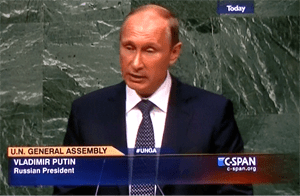
Russia’s Putin says no one but Assad’s forces and Kurds are fighting Islamic State

September 29, 2015 By administrator

Russian President, Putin at UNGA

Russian President, Putin at UNGA

UNITED NATIONS,— Speaking after his meeting with U.S. president Barack Obama on Monday, Russian president Vladimir Putin told reporters Russia was pondering what more it could do to support Syrian government and Kurdish forces against Islamic State militants.

“We should finally acknowledge that no one but President Assad’s armed forces and (Kurdish) militia are truly fighting the Islamic State and other terrorist organizations in Syria,” Putin said.

“We are mulling over what we would really do extra in order to support those who are in the battlefield, resisting and fighting with terrorists, ISIS (Islamic State) first of all,” Putin said, ruling out deploying Russian ground troops.

“There is (an) opportunity to work on joint problems together,” Putin said of his talks with Obama, which a U.S. official described as “businesslike.”

A senior U.S. official, speaking on condition of anonymity, told reporters after the meeting: “The Russians certainly understood the importance of there being a political resolution to the conflict in Syria, and there being a process that pursues a political resolution.”

Russia and the United States agreed on Monday to look for a diplomatic end to the Syrian civil war but clashed over the central question of whether Syrian President Bashar al-Assad should retain power.

During a 90-minute meeting, Obama and Putin agreed that their armed forces should hold talks to avoid coming into conflict in Syria after a Russian military buildup there over the last several weeks.

Filed Under: News Tagged With: islamic state, Kurd, Russia, UNGA

Turkey: thirty arrests of Kurdish language media

September 29, 2015 By administrator

The Turkish police arrested Monday night in Diyarbakir (south-east) thirty people during a series of raids on the headquarters of several Kurdish-language media, reported the Doğan news agency.

This has particularly targeted the Dicle News Agency (DIHA) and Azidiye Welat newspaper, said DHA.

In a statement released on social networks, the agency Dicle said that 32 journalists and other media employees of these had been taken into custody by anti-terrorist police.

Violent clashes resumed two months ago between Turkish security forces and rebels of the Kurdistan Workers’ Party (PKK). They shattered the peace talks initiated between the government and the Kurds in late 2012 to try to end a conflict that has already killed 40,000 since 1984.

For several weeks, several media are the target of police raids or criminal investigations for “terrorist propaganda” for the PKK.

The powerful Dogan Group, owner of the daily Hurriyet and CNN Turk channel information, is thus accused of publishing uncensored pictures of Turkish soldiers killed by the PKK and for airing an interview with a young rookie rebellion.

The publishing director of the magazine Nokta for his part was briefly placed in custody after the publication on the front page of its latest issue of a photomontage showing the Islamic-conservative President Recep Tayyip Erdogan taking a “selfie” before the coffin of a soldier.

Less than two months early parliamentary elections of November 1, the head of state is accused by his critics of wanting to silence any criticism against his regime.

Turkey is regularly singled out by NGOs in defense of press freedom, who accuse his government’s recurrent pressure on journalists.


Filed Under: Articles Tagged With: arrests, Kurd, media, Turkey

A new generation of Kurdish militants takes fight to Turkey’s cities

September 27, 2015 By administrator

Kurdish youth fighting Turkish security forces in Sirnak province in Turkish Kurdistan, August 2015. Photo: Twitter

Kurdish youth fighting Turkish security forces in Sirnak province in Turkish Kurdistan, August 2015. Photo: Twitter

DIYARBAKIR-AMED, Turkey’s Kurdish region,— Young, urban-based fighters, many of them still teenagers, have taken centre-stage in the conflict between Kurdish militants and Turkish security forces that has flared anew in southeast Turkey since a two-year ceasefire fell apart in July.

The intensity of the violence recalls for some the 1990s, when the insurgency waged by the Kurdistan Workers Party (PKK) was at its peak and thousands were being killed annually, though the death toll remains for now well below those levels.

The fighters from the PKK’s youth wing, known as the ‘Patriotic Revolutionary Youth Movement’ (YDG-H), attack security forces in cities and towns with heavy weapons, dig trenches and erect barricades down side streets.

The police retaliate by imposing curfews and launching dragnet security operations, most controversially this month in the Kurdish town of Cizre near Turkey’s borders with Iraq and Syria where at least 20 people were killed.

More than 150 Turkish police officers and soldiers have died in the violence since July, many of them in cities and towns, government officials say, marking a departure from the PKK’s traditional focus on more rural areas.

“We are facing an effort to bring the war of armed groups in rural areas into the cities,” Turkish Prime Minister Ahmet Davutoglu told A Haber television in an interview this month.

The escalating bloodshed in Turkish Kurdistan, the mainly Kurdish southeast region, has exacerbated already sky-high political tensions in Turkey ahead of a snap Nov. 1 parliamentary election, with President Tayyip Erdogan and the ruling AK Party accusing pro-Kurdish lawmakers of being in cahoots with the PKK.

It also complicates international efforts to combat Islamic State fighters across the border in Syria: Turkey says there are links between the PKK and Kurdish groups in Syria who work with a U.S.-led alliance bombing Islamic State.

The PKK is considered as ‘terrorist’ organization by Ankara and U.S. The PKK continues to be on the blacklist list in EU despite court ruling which overturned a decision to place the Kurdish rebel group PKK and its political wing on the European Union’s terror list.

The Turkish military has resumed its attacks on PKK camps in Iraqi Kurdistan while also joining the U.S.-led campaign of air strikes against Islamic State, the hardline Islamists who have seized territory across the Turkish border in Syria and Iraq.

Inside Turkey, the YDG-H militants, largely untrained but determined to fight what they see as an oppressive Turkish state, say they have strong support from local people in a region long blighted by violence and poverty.

“There is a large mass of people who have huge sympathy and support for us. They are not armed but they do help us,” said 19-year-old Nuda, who said she had abandoned her education after high school to become a full-time insurgent.

Turkish government officials say the renewed violence in the southeast, where residents had cherished two years of calm as Erdogan’s government conducted peace talks with the PKK, has actually dented local support for the militants.

TRENCHES AND BARRICADES

Since it was established in 1984 the PKK has been fighting the Turkish state, which still denies the constitutional existence of Kurds, with the aim of creating an independent Kurdish state.

In the 1990s, the PKK limited its demands to establish an autonomous Kurdish region and more cultural rights for ethnic Kurds,who make up around 22.5 million of the country’s 75-million population but have long been denied basic political and cultural rights, its goal to political autonomy. A large Turkey’s Kurdish community openly sympathise with PKK rebels.

Turkey’s jailed PKK leader Abdullah Ocalan was jailed in 1999 but still has considerable influence in the PKK, whose senior commanders are based in the Qandil mountains of Iraqi Kurdistan.

The YDG-H, many of whose members were born in the traumatic 1990s, was only founded in 2006. The precise nature of its relationship with the PKK leadership is unclear, though there can be no doubting its dedication to the separatist cause.

“Police and soldiers come to your neighbourhood to detain you or intimidate you. We aim to prevent them from doing that by digging trenches and barricades,” said YDG-H fighter Mawa, speaking hurriedly while his comrades nervously stood guard, looking out for security patrols.

“We have units in every street, every neighbourhood across Kurdistan,” he said, his face concealed by a scarf.

Mawa, who said he had left university after a year to join the YDG-H, joked that, at 26, he was one of the oldest members of the group.

He was standing behind a community building in the Sur district of Diyarbakir, the biggest city of southeast Turkey, where authorities imposed a brief curfew this month after YDG-H militants killed two police officers.

YDG-H members say their group has grown rapidly but refuse to give a number. Mawa and other members described it as “semi-independent” of the PKK leadership, though Ankara refutes this.

“We act in line with the rules of the (PKK) leadership and its perspective against the destructive policies of the state,” said 23-year-old Sorxin, another young militant in Diyarbakir.

A Turkish foreign ministry official, however, insisted the YDG-H took its orders directly from senior PKK commanders.

“They are not flash mobs, they do not tweet each other and meet up,” said the official. “It is a structure and that structure is being directed from Qandil.”

One PKK fighter deployed to a base near the Iraqi city of Kirkuk told Reuters the reality was more ambivalent.

“They (the YDG-H) don’t have a direct relationship with the leadership because then they would be found out,” said the militant, who gave his name as “Kani Kobani”, sitting in a room with machine guns propped against the wall.

“The leadership gives general directions via TV. All the comrades watch TV. We know how to interpret the message.”

CURFEWS

Turkey’s Anadolu Agency, citing security officials, said this month the PKK had kidnapped more than 2,000 people below the age of 18 in the past two years to be used in its attacks.

Officials say as many as 70 YDG-H militants were involved in this month’s clashes in Cizre, where police imposed a round-the-clock curfew for more than a week.

Lawmakers from the pro-Kurdish Peoples’ Democratic Party (HDP) say 21 civilians were killed in Cizre and that people went hungry for days and could not bury their dead.

Turkey’s interior minister said only one civilian and 32 militants had been killed in the Cizre clashes.

The HDP, whose success in Turkey’s inconclusive June election deprived the AKP of its single-party majority in parliament, accuses the authorities of imposing curfews in areas that support the pro-Kurdish party in order to “punish” voters and intimidate them into not participating in the Nov. 1 poll.

The government denies such suggestions, saying the curfews are aimed at facilitating its operations against the YDG-H militants holed up in urban areas.

Officials are also very aware that a heavy security crackdown could prove counterproductive by further radicalising Kurds in the countdown to the Nov. 1 election and they acknowledge that having to fight teenagers complicates the aim of defeating the PKK.

“What do you do when a 15-year-old shoots at you? You shoot back,” the foreign ministry official said. “The police have to justify their actions and it’s very controversial.”

Suleyman Ozeren, a security analyst for the Ankara-based think-tank Global Policy and Strategy, said he expected no swift resolution of the conflict.

“There’s a very thin line between the terrorists and the (local) population … Turkey can degrade the PKK but it will take time, especially in the cities,” he said.

Source: eKurd

Filed Under: Articles Tagged With: Kurd, Kurdish, militants, new generation, Turkey

Attacks by Turkish state forces left four people dead and four others wounded in Beytüşşebap

September 25, 2015 By administrator

turkish attack-on kurdBy ŞIRNAK – ANF,

In addition to the bombardment by Turkish jets, troops at Gendarmerie Command conducted artillery fire in Beytüşşebap district of Şırnak since last night. The attacks by Turkish forces left some 10 houses and one mosque unusable.

After entering the district in armored vehicles, state forces rained bullets on all the workplaces at district center, as a result of which around 20 workplaces were damaged and 4 others became unusable. While two yet-unidentified people were wounded in the attacks, armed forces also opened fire on the buildings of the HDP and DBP.

THREE KILLED IN MORTAR ATTACKS

Troops at District Gendarmerie Command launched mortar attacks on the nearby villages of Setkar, Tilbes, Faraşîn, Meydan, Germav (Ilıca), Gernex and Tivor.

A mortar shell fired by soldiers hit a house in Setkar village, which left three civilians dead and two others heavily wounded.

Civilians Ahmet Temel, his son Behçet Temel and their relative Alya Temel have lost their lives, while Fevzi Temel and Ahmet Temel’s son Hasan Temel were heavily wounded in the fire. The bodies of the murdered civilians were taken to Uludere State Hospital, and the wounded to Beytüşşebap and Şırnak State Hospital.

The casualties left by the attack are reported to be relatives of former district co-mayor Yusuf Temel.

AMBULANCE DRIVER WAS ALSO SHOT DEAD

On the other hand, police also killed an ambulance driver Şehmuz Dursun as he entered the district to take the wounded policemen upon a call by the district governor early in the morning.

Eyewitnesses told that fire opened by police forces on the ambulance left the driver dead, while two other health workers fled the scene to save their lives.

As tension remains quite high, Turkish forces keep bombing the mountains surrounding the district.

In the meantime, HDP Şırnak deputies Faysal Sarıyıldız, Ferhat Encü and Aycan İrmez have arrived the district to examine the incidents at scene.

Filed Under: Articles Tagged With: attack, Beytüşşebap, Kurd, Turkish

The revival of Turkey’s ‘lynching’ culture “must read to Understand atrocity in Turkey”

September 22, 2015 By administrator

Members of Turkish police special forces search a suspicious car during a security patrol in the Kurdish-dominated southeastern city of Diyarbakir, Turkey, Sept. 8, 2015. (photo by REUTERS/Sertac Kayar)

Members of Turkish police special forces search a suspicious car during a security patrol in the Kurdish-dominated southeastern city of Diyarbakir, Turkey, Sept. 8, 2015. (photo by REUTERS/Sertac Kayar)

By Fehim Taştekin,

Turkey’s collective memory is heavily burdened with state-provoked, politically motivated mob violence attempts against minority groups, colloquially described as “lynching.” In recent weeks, hundreds of violent incidents have heralded the resurgence of the mob violence culture as the country’s climate grows more toxic by the day, with political actors fanning hatred and normalizing violence.

In Turkey’s near history, mobs targeted mainly Armenians, Syriacs, Jews, Greeks, Alevis and Kurds. As Tanil Bora, author of the book “Turkey’s Lynching Regime,” puts it, “When it comes to Alevis and Kurds, this has always been a ‘free shot’ area. The ‘lynching’ of leftists has always been permissible. Police and ‘sensitive citizens’ act on the basis of this knowledge.”

The latest target of the mobs are the Kurds again. As of Sept. 16, a Google search with the key words “lynching attempt” in Turkish produced some 78,800 results for the period since July 24, when Ankara resumed military operations against the Kurdistan Workers Party (PKK), shattering the settlement process with the armed, outlawed group.

The pro-Kurdish Peoples’ Democratic Party (HDP) — vilified by the Justice and Development Party (AKP) since the run-up to the June 7 polls and always deemed an enemy by the Nationalist Action Party — has seen its offices vandalized, ransacked or torched. According to figures provided by the HDP media department, 128 party offices were attacked in the Sept. 6-11 period alone. Ordinary Kurds have not been spared either. Kurdish workers and bus passengers, Kurds speaking Kurdish in the street, and even tanned people mistaken for Kurds have been attacked and Kurdish-owned businesses vandalized.

Turkey’s past century has seen a series of pogroms and mob violence in which the state apparatus directly took part, acted as an instigator or conductor, or simply looked the other way. The 1915 Armenian genocide, the 1914-15 massacres that wiped Syriacs off this geographic area, the 1937-38 massacres of 13,000 Alevi Zazas in Dersim and the deportation of 12,000 others could be seen as planned actions of the state. But the 1934 pogroms in Thrace, which prompted the exodus of up to 15,000 Jews; the Sept. 6-7, 1955, Istanbul pogroms, which saw Greek, Jewish and Armenian properties ransacked; the 1978-80 massacres of Alevis in Maras, Sivas and Corum; and the 1993 torching of a hotel in Sivas in which 37 Alevi intellectuals perished are engraved in memory as the terrible deeds of frenzied mobs.

One can hardly argue that democratic values have now advanced and this is all left in the past. The phenomenon is recurring.

The first harbinger came with the 2013 Gezi Park protests as stick-wielding shopkeepers took to the streets, terrorizing the demonstrators who were challenging the government. Legitimizing the sticks, President Recep Tayyip Erdogan would later famously say, “When need be, shopkeepers are police, soldiers, combatants or guardians of the neighborhood.” He went further last month, calling neighborhood mukhtars (elected district headmen) to duty as informers: “I know my mukhtars [are aware] what kind of people live in which house. They [need to] go to their governors or police chiefs and report this to them.” This rhetoric has sanctioned another form of unlawfulness that opens the door to a new form of mob attacks at the hands of informers.

As military operations against the PKK resumed, the PKK stepped up its own attacks, and funerals of policemen and soldiers became a daily routine. Easily agitated “sensitive citizens” and long-established nationalist groups such as the Idealist Hearths went on the rampage against Kurds, joined by a hitherto little-known group, the AKP-linked Ottoman Hearths. Here are several examples of the mob violence that has simmered since late July:

  • On Sept. 8, nationalists in the Mediterranean town of Fethiye launched a manhunt for Ibrahim Cay, a Kurd who had shared a picture of himself clad in traditional Kurdish attire on Facebook. Cay received a call from the local paramilitary police commander, who told him to stay at home and that he was coming to pick him up. Soon, not the commander but two cars and four motorcycles arrived outside his home. Cay saw what was coming and ran away. A mob of about 70 people soon got hold of Cay, beat him up in the town square and forced him to kiss the Ataturk statue there. It was only then that the paramilitary police arrived to rescue the battered man. In the hospital, doctors refused to treat him, while a mob of some 300 frenzied people gathered outside, waiting to lynch him. The security forces, who did nothing to the assailants, took Cay to the police station for questioning. The paramilitary commander then attempted to send Cay out on his own, though the mob was now waiting outside the police station. Cay managed to safely leave the station and then the town thanks to relatives who came to pick him up. The five assailants he had named in his testimony walked free after questioning, while the prosecution launched a criminal investigation against Cay on charges of “praising crime and criminals” by posting a picture of himself in “peshmerga attire.”
  • On Sept. 14, a group of men taunted Kurdish construction workers in Mudurnu, northwestern Turkey, for “looking disrespectfully” at a Turkish flag and followed them to the site where they were building a school. Soon, rumors spread that Kurds had burned a Turkish flag, drawing hundreds of people to the construction site. The mob set the building ablaze as the eight workers holed themselves up on the roof. They were barely rescued after several hours. Again, not the assailants but the victims were questioned. It turned out four of them hailed from families serving as “village guards,” which are government-armed Kurdish militia that back the army against the PKK.
  • On July 29, rumors spread in Askale, eastern Turkey, that a Kurdish construction worker wore a ring “symbolizing the PKK.” This alone was enough for 2,000 people to flock to the construction site and attack the some 50 Kurds working there.
  • On Sept. 8, the makeshift homes of seasonal Kurdish workers in Beypazari, near Ankara, were burned down and their families battered.
  • On Sept. 9, a man with a dark complexion was beaten up in the Mediterranean city of Antalya as the assailants wrongly assumed he was a Kurd. He was let go only after producing an ID card that showed he was born in western Turkey.

The attempts at physical attacks go together with political attacks and character assassinations. The Dogan Media Group, to which the mass-circulation daily Hurriyet and the CNN Turk news channel belong, has become one of the main targets of character assassinations. In addition to two mob attacks on the offices of Hurriyet, which, by the way, has an anti-PKK line and features the slogan “Turkey belongs to the Turks,” prosecutors have launched a probe against the Dogan Media Group on charges of supporting terrorism.

A striking example of political attacks came from the AKP mayor of Antalya’s Gundogmus district, who, heeding Erdogan’s portrayal of the HDP as a terror-linked party, hung a billboard that proclaimed HDP voters enemies: “Kurds who pray in the mosque and then vote for the HDP can’t be my brothers. Brotherhood is a sublime rank. Dastards can’t make for brothers. Those who vote unwillingly for the HDP are cowards and those who do voluntarily are dastards.”

In sum, nationalist and religious fervors have resurrected the tradition of physical and political “lynching.” While seemingly issuing calls for restraint, Erdogan has not hesitated to tickle the fascist mind, programmed to kill and destroy. Last week, for instance, he spoke of “fists raised up in rage looking for a place to come down.”

In what remains an unchanging trait of the state, the perpetrators of violence enjoy the favor of the security forces, who are more interested in grilling the victims than the assailants. Despite hundreds of mob violence attempts, the security forces have detained only a handful of people, only to release them after questioning. And almost always, they have found a reason to investigate the victims. To use Bora’s words, so-called “lynching” — used as a “governing technique and a means to mold public opinion” — is back in play in Turkey with a new format and new actors.

Fehim Taştekin is a columnist and chief editor of foreign news at the Turkish newspaper Radikal, based in Istanbul. He is the host of a fortnightly program called “Dogu Divanı” on IMC TV. He is an analyst specializing in Turkish foreign policy and Caucasus, Middle East and EU affairs. He contributes to Al-Monitor’s Turkey Pulse as a columnist. He was founding editor of Agency Caucasus.

Filed Under: Articles Tagged With: Armenian, Kurd, lynching, Turkey

Turkey: Over 80 Kurdish HDP, DBP members detained in Turkey’s southeast

September 20, 2015 By administrator

DHA Photo

DHA Photo

BATMAN – Doğan News Agency

As many as 85 officials from the Peoples’ Democratic Party (HDP) and the Democratic Unity Party (DBP), including the mayor of the southeastern province of Batman and his deputy, have been detained after they attempted to enter a military security zone in Batman’s Sason district.

Batman Mayor Sabri Özdemir, deputy mayor Gülistan Akel and HDP Batman provincial head Rojda Sürücü along with others were detained by gendarmerie forces on Sept. 19 after they attempted to enter a military security zone where an outlawed Kurdistan Workers’ Party (PKK) militant was killed in Sason’s Kelhasan village on Sept. 19.

Among the 85 detained were Beşiri district Mayor Mustafa Öztürk, Gercüş district Mayor Abdulkerim Kaya, İki Köprü town Mayor Osman Karabulut, Batman Municipality Assembly President Salih Altun and DBP Batman provincial head Mehmet Candemir.

Behçet Kara, a resident of Kelhasan, where a military-imposed curfew is in effect, said residents of the village wanted the curfew to be lifted and they hoped for to return to normalcy.

“We wish for peace and democracy,” Kara added.

Some of the people detained were on a minibus heading to Sason when it was stopped at a checkpoint placed by the Yanıkkaya Gendarmerie Command to deny entry to the district.

Soldiers gave chairs to the women who got off the minibus when the weather became hot.

Turkey has seen a rise in violence with a spate of terrorist acts in recent months that have left scores dead and injured.

The Turkish military has declared a large number of areas in the country’s eastern and southeastern provinces as “military security zones” in a preemptive action against violent attacks.

Source: hurriyetdailynews.com

September/20/2015

Filed Under: Articles Tagged With: dbo, detained, HDP, Kurd, Turkey

  • « Previous Page
  • 1
  • …
  • 23
  • 24
  • 25
  • 26
  • 27
  • …
  • 46
  • Next Page »

Support Gagrule.net

Subscribe Free News & Update

Search

GagruleLive with Harut Sassounian

Can activist run a Government?

Wally Sarkeesian Interview Onnik Dinkjian and son

https://youtu.be/BiI8_TJzHEM

Khachic Moradian

https://youtu.be/-NkIYpCAIII
https://youtu.be/9_Xi7FA3tGQ
https://youtu.be/Arg8gAhcIb0
https://youtu.be/zzh-WpjGltY


gagrulenet Twitter-Timeline

Tweets by @gagrulenet

Archives

Books

Recent Posts

  • Pashinyan Government Pays U.S. Public Relations Firm To Attack the Armenian Apostolic Church
  • Breaking News: Armenian Former Defense Minister Arshak Karapetyan Pashinyan is agent
  • November 9: The Black Day of Armenia — How Artsakh Was Signed Away
  • @MorenoOcampo1, former Chief Prosecutor of the International Criminal Court, issued a Call to Action for Armenians worldwide.
  • Medieval Software. Modern Hardware. Our Politics Is Stuck in the Past.

Recent Comments

  • Baron Kisheranotz on Pashinyan’s Betrayal Dressed as Peace
  • Baron Kisheranotz on Trusting Turks or Azerbaijanis is itself a betrayal of the Armenian nation.
  • Stepan on A Nation in Peril: Anything Armenian pashinyan Dismantling
  • Stepan on Draft Letter to Armenian Legal Scholars / Armenian Bar Association
  • administrator on Turkish Agent Pashinyan will not attend the meeting of the CIS Council of Heads of State

Copyright © 2025 · News Pro Theme on Genesis Framework · WordPress · Log in