Gagrule.net

Gagrule.net News, Views, Interviews worldwide

  • Home
  • About
  • Contact
  • GagruleLive
  • Armenia profile

There is no statute of limitations for Armenians to forgive the Genocide. Jacob Kedmi

April 24, 2023 By administrator

Armenia is currently restoring economic ties with Turkey, and according to an unspoken precondition set by the Turkish authorities, the Armenian side removed from its agenda the issue of recognizing the Armenian Genocide carried out by the Ottoman Empire in 1915.

In a conversation with RUSARMINFO, Russian political scientist Jacob Kedmi stated that no kind of political conjuncture can replace the national self-awareness and memory of the people. “Whatever the politicians do, the Armenian people will never turn that page throughout their history,” said Kedmi. He also said that such national tragedies have no statute of limitations and there is no forgiveness for those who actively or passively participated in the genocide.

Filed Under: Articles, Genocide

US President Joe Biden: We renew our pledge to never forget the #ArmenianGenocide

April 24, 2023 By administrator

Today, we pause to remember the lives lost during the Meds Yeghern—the Armenian genocide—and renew our pledge to never forget. US President Joe Biden noted this in a statement released Monday on the occasion of Armenian Genocide remembrance day. The statement continues as follows:

“On April 24, 1915, Ottoman authorities arrested Armenian intellectuals and community leaders in Constantinople—the start of a systematic campaign of violence against the Armenian community. In the years that followed, one and a half million Armenians were deported, massacred, or marched to their deaths—a tragedy that forever affected generations of Armenian families.

“As we join nations around the world in remembering this painful history, we also reflect on the resilience and resolve of the Armenian people. So many of those who survived were forced to begin new lives in new lands—including the United States. Here and around the world, the Armenian people have met the evil of hate with hope. They rebuilt their communities. They nurtured their families and preserved their culture. They strengthened our nation. They also told their stories—and those of their ancestors—to remember and to ensure that genocide like the one that happened 108 years ago is never again repeated. 

“Today, let us renew this pledge. Let us recommit to speaking out against hate, standing up for human rights, and preventing atrocities. And together, let us redouble our efforts to forge a better future—one where all people can live with dignity, security, and respect.”

Filed Under: Genocide, News

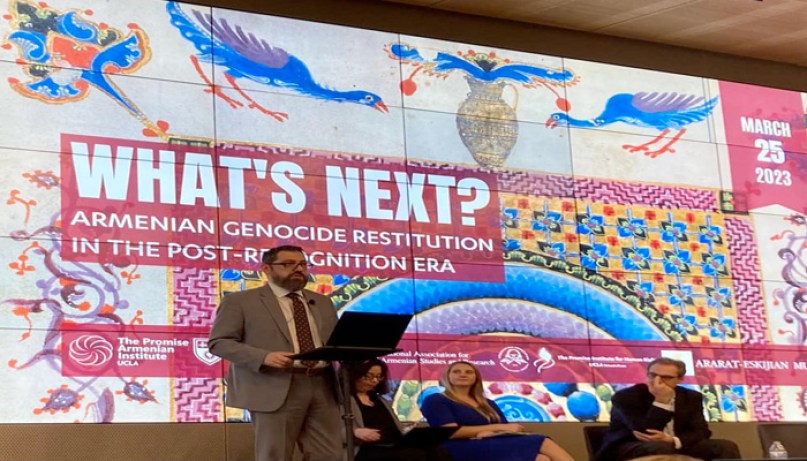
Karnig kerkonian UCLA. We are nowhere near these dark woods, but a path to restitution and reparation must be sought, even in darkness.

April 23, 2023 By administrator

UCLA. We are nowhere near out of these dark woods, but a path to restitution and reparation must be sought, even in darkness. Karing Kerkonian writes on his Facebook Page.

I spoke on cultural appropriation at #UCLA a few weeks ago. The subject is yet another painful fold in the book of genocide trauma that continues, almost unabated—and, today, displays in full color to those who care to see. New wounds, sliced and cut upon still open wounds.

I stressed the power of attribution as a legal tool, and its pressing relevance right now in #Artsakh. Azerbaijan’s path to erase our people from native land is paved with narratives seeking to justify unimaginable acts of inhumanity. The playbook, we know all too well.

We must confront these narratives now, I explained, and we must do so with powerful resolve, unrelenting force, and with a sense of duty. To be left commemorating genocide unfinished is simply unspeakable torment upon still unspeakable torment.

I spoke from historical example and, painfully, a myriad of present ones, illustrating how Azerbaijan’s narratives are specifically engineered not only to render Armenians foreigners on their own land, but to clear disgusting pathways to ethnic cleansing, to annihilation and to genocide—to make the undeniably inhumane somehow palatable to humanity.

Narratives of alienation and dehumanization always preview a slaughter by the sword. They try to justify it. They are the red flags. We, more than any others, should smell it in the air. And we must combat these narratives at every turn, always and everywhere. Human lives continue to hang in the balance where words are allowed to waft in the unattended stench of hatred—just as they did a century ago, half a century ago, two years ago … and just as they will tomorrow, if we allow it.

Thank you to Professor Taner Akcam for the invitation to present at UCLA at this critical juncture; indebted to Garo Ghazarian, Arman Tatoyan, Saro Kerkonian, and the «Թաթոյան» հիմնադրամ/ “Tatoyan” foundation for their valuable contributions to the arguments and evidence; and gratitude again to Liz Mirza Al-Dajani and Ani Nazaryan for helping refine, reshape, and target the words.

Filed Under: Articles, Events, Genocide

Michael Rubin: Biden Must Go Beyond A Cut-And-Paste Job On Armenian Genocide Recognition

April 23, 2023 By administrator

Genocide happens most easily in darkness. If Biden truly understands the lessons of the Armenian Genocide, on Monday, when the White House releases its annual declaration, he will call out those who would continue the genocide through a deliberate campaign of starvation, harassment, incitement, and murder.

On April 24, Armenians will commemorate the 108th anniversary of the genocide they suffered in the last years of the Ottoman Empire. Turkey still denies the genocide was deliberate; many Turkish nationalists question if it occurred at all.

For too long in Washington, promises to affirm the Armenian Genocide were akin to promises to move the U.S. Embassy in Israel to Jerusalem: Every major candidate made them, but none followed through. Donald Trump disrupted that pattern with regard to Jerusalem. Rather than undermine peace, it catalyzed it. Joe Biden did the same with Armenian Genocide. He not only promised as a candidate but also followed through. On April 24, 2021, he stated clearly, “We remember the lives of all those who died in the Ottoman-era Armenian genocide and recommit ourselves to preventing such an atrocity from ever again occurring.” Today, not only the White House, but also the Senate and House of Representatives, all 50 states, and the District of Columbia officially recognize the Genocide.

Despite Turkey’s bluster, President Recep Tayyip Erdogan did nothing. He showed himself to be a paper tiger. Biden and many other world leaders showed that truth trumped spin and propaganda. Unfortunately, Secretary 

of State Antony Blinken tarnished Biden’s moral clarity. Without forewarning Congress, whom he had briefed just days earlier on the Armenian issue, he quietly decided to waive Section 907, which enforced a weapons embargo on Azerbaijan. That section of the Freedom Support Act ties military assistance to Azerbaijan to its commitment to solve its dispute with Armenia through diplomacy alone. Blinken simply ignored the facts not only that Azerbaijan’s surprise attack had killed thousands, but also that Azerbaijani President Ilham Aliyev openly declared he sought to take his conquests further.

In April 2022, Biden issued another statement about the Armenian Genocide on Armenian Remembrance Day. It was a good declaration and addressed all the key points. “As we reflect on the Armenian genocide, we renew our pledge to remain vigilant against the corrosive influence of hate in all its forms. We recommit ourselves to speaking out and stopping atrocities that leave lasting scars on the world,” he said. Once again, the State Department waived Section 907.

As White House speechwriters craft a statement for Monday, Biden must go further. For five months, Azerbaijani militias have blockaded the only route into Artsakh, the Armenian-governed enclave in Nagorno-Karabakh. Earlier this week, Aliyev called for population transfer of the region’s 115,000 remaining Armenians. He has cut off food, water, and gas. Genocide looms.

Blinken and the State Department meanwhile wring their hands and counsel against holding Aliyev accountable for his crimes. After all, Blinken tells Congressmen privately, the United States needs Azerbaijan’s compliance for anti-Iran operations. What Blinken fails to understand is that keeping Iran in check is an Azerbaijani interest. That Aliyev extorts Blinken for something Azerbaijan would do anyway humiliates Washington. Regardless, a millennia-old Armenian community should not die as a concession to the dictator.

Genocide happens most easily in darkness. If Biden truly understands the lessons of the Armenian Genocide, on Monday, when the White House releases its annual declaration, he will call out those who would continue the genocide through a deliberate campaign of starvation, harassment, incitement and murder. He will not simply cut-and-paste from his previous two declarations. There is nothing cheaper and more morally corrupt than condemning a genocide from a century ago while enabling its continuance today.

Now a 1945 Contributing Editor, Dr. Michael Rubin is a Senior Fellow at the American Enterprise Institute (AEI). Dr. Rubin is the author, coauthor, and coeditor of several books exploring diplomacy, Iranian history, Arab culture, Kurdish studies, and Shi’ite politics, including “Seven Pillars: What Really Causes Instability in the Middle East?” (AEI Press, 2019); “Kurdistan Rising” (AEI Press, 2016); “Dancing with the Devil: The Perils of Engaging Rogue Regimes” (Encounter Books, 2014); and “Eternal Iran: Continuity and Chaos” (Palgrave, 2005).

Filed Under: Articles, Genocide

The longer Pashinyan stays in power the more the Armenian case is weakened, Sweden’s FM wants to cancel Armenian Genocide events to please Turkey’s Erdogan

April 21, 2023 By administrator

Amid stalled NATO accession talks—and in an apparent effort to avoid upsetting Turkey more than it already has—the Swedish Ministry of Foreign Affairs, led by Tobias Billstrom (M), is said to have exerted pressure on the Swedish-Armenian friendship group in the Riksdag—the Swedish parliament, asking senior government officials in private to cancel this year’s annual commemoration of the Armenian Genocide, The European Conservative reported.

Sweden Democrat MP Bjorn Soder, the chairman of the Swedish-Armenian friendship group, says that group leaders from each party in the coalition government—the Moderates, the Sweden Democrats, and the Christian Democrats—were asked by the foreign ministry to consider canceling the commemoration event since it could potentially harm Sweden’s prospects of joining NATO, Samnytt reports.

“We have been asked internally in our parties not to hold a celebration in the Riksdag this year,” Soder told the Stockholm-based newspaper Svenska Dagbladet (SvD). 

Filed Under: Genocide, News

Truth And Accountability League (TAAL) Brings Elected Officials, Experts, and Community Leaders Together to Discuss Anti-Armenian Racist Flyers in Beverly Hills and Glendale

April 20, 2023 By administrator

‘It’s unfathomable that on the heels of the Armenian Genocide anniversary on April 24, Armenians are terrorized by flyers around schools and churches that call for the extermination of Armenians’ — Vic Gerami, Founder, TAAL

Los Angeles — Truth And Accountability League (TAAL), in partnership with the LA County Commission on Human Relations’ LA vs. Hate, will hold an in-person Town Hall, ‘Stand Hall to Hate,’ on Thursday, May 4, from 6:00 p.m. to 8:00 p.m. This free event with RSVP is open to the public and is being held at the Glendale Central Library, 222 East Harvard Street, Glendale, 91205. It will feature an open panel discussion with city officials, experts, and community leaders, including the Executive Director, L.A. County Commission on Human Relations Robin S. Toma, Esq., Glendale Mayor Daniel Brotman, Police Chief Manuel Cid, Chief of Staff Joseph F. Iniguez from the LA County District Attorney’s Office, and State Commissioner Sam Kbushyan. 

Moderated by TAAL’s founder & Chair, Vic Gerami, the goal of the meeting is to bring awareness, educate the public, and discuss solutions to the rising anti-Armenian racism, Armenophobia, and propaganda through questions and discussion with participants.

‘The recent anti-Armenian flyers posted around LA County, home to hundreds of thousands of Armenian-Americans, remind us that we must be vigilant about racism, hate acts, and propaganda. It’s unfathomable that on the heels of the Armenian Genocide anniversary, Armenians are terrorized by flyers around schools and churches that call for the extermination of Armenians,’ said Vic Gerami, founder of TAAL.  

He added, ‘But we mustn’t allow the hate of a few to create division, pin us against each other, and get us stuck in the problem. The Truth And Accountability League is focused on the solution. We want to bring together, not only members of the Armenian community, but everyone to create awareness, educate, and find answers. Our panel of leaders and experts will discuss ways to handle malice that aims to victimize, dehumanize, and diminish us. Hate acts affect everyone, regardless of ethnic background, race, religion, sexual orientation, or gender identity. TAAL’s Town Hall is a forum to empower everyone.’ 

The two-hour event is a part of TAAL’s comprehensive and integrated Community Outreach Campaign to address the rise in anti-Armenian hate crimes the last three years, including the anti-Armenian flyers posted in Glendale on March 31 and similar ones in Beverly Hills in January and that called for the massacre of Armenians. 

‘The Armenian American community is such an essential part of our L.A. County community, but the amount of discrimination and negative stereotyping they’ve experienced is too often understated because it is underreported,’ said Robin S. Toma, Executive Director of the L.A. County Commission on Human Relations. ‘I look forward to sharing the data we collect on acts of hate in our county, and most importantly, what we are doing with LA vs Hate to increase reporting and eradicate hate in all our cities and neighborhoods.’ 

‘Stand TAAL to Hate’ is a Town Hall to benefit every group that has experienced racism, been subject to hate crimes, and defamation, along with LA’s Armenian community, which has been a target of such acts more frequently in recent years. With its nearly 40% Armenian community, Glendale is the perfect crossroad for such an event.

Glendale Mayor Daniel Brotman said, ‘I am proud to be the Mayor of Glendale, a city rich with diversity, including one of the largest Armenian diaspora communities in the world. The Jewel City has zero tolerance for racism, hate acts, and defamation. I strongly condemn the recent anti-Armenian flyers and work with Glendale Police and community leaders to find the perpetrator.’

He continued, ‘I’m honored to be a panelist for the Truth And Accountability League’s Town Hall. I applaud Vic Gerami and his team for launching a community outreach campaign to create awareness, educate, and empower not only the residents of Glendale but all of LA County.’

We’ve also witnessed the former president of the LA City Council, Nury Martinez, make a racist statement about a colleague that was caught on tape. The prevalence of the problem led the Burbank Board of Education to revise its anti-racism statement and update the board policy to stand in solidarity with Armenians. 

‘I look forward to participating in the Truth and Accountability League Town Hall in May. Coming together to discuss hate, accountability, and transparency is a powerful act of solidarity and progress. This will be a great opportunity to educate our community on the efforts law enforcement is making to address these challenges, as well as to learn, share, and work together towards a more equitable future,’ said Manuel Cid, Chief of Police, Glendale Police Department.

The audience will have a chance to submit questions in writing before the start of the town hall. RSVP is required and can be sent through Eventbrite: TAALTownHall.Eventbrite.com

‘As district attorney of Los Angeles County, home to more than 200,000 Armenians, I’m immensely proud to represent the largest Armenian population in the United States and the greatest number outside of Armenia itself,’ District Attorney George Gascón said. “Our Armenian community makes tremendous academic, artistic, altruistic, and many other contributions to our region.’ 

He continued, ‘These hate-filled flyers that incite violence are abhorrent and must be condemned. My office takes hate crimes very seriously, filing 86 percent of the hate crime cases referred to us, far above the statewide average of 54 percent. I commend TAAL for becoming an antidote for the poison that is racism and holding this important Town Hall to promote equality and protect human rights.’

CA State Commissioner Sam Kbushyan, an Armenian-American, believes in tackling the problem head-on. He’s been a long-time community organizer and member of Mayor Karen Bass’ Transition Team.

‘It’s been shocking to see anti-Armenian flyers advocating Genocide against Armenians in Glendale and across LA County. We must all condemn this bigotry in the strongest terms. While our families and loved ones in Armenia and Artsakh are under assault by Azerbaijan, LA County’s Armenian community is being terrorized by hate, defamation, and propaganda,’ said State Commissioner Sam Kbushyan.

He added, ‘Vic Gerami and his team at the Truth And Accountability League have taken a proactive step in organizing a Town Hall in Glendale to create a safe place for the community to address this ongoing matter. I look forward to being on the panel and serving the greater LA community.’

Elected officials who would like to attend and have special requests and members of the media interested in interviews should contact Vic Gerami at 310.880.8563 (or) vic@thebluntpost.com. For additional information, visit TAAL’s website, TruthAndAccountabilityLeague.org.

Please click here for photos and see the attached invitation. 

About TAAL

TAAL is a 501©3 non-profit advocacy organization founded in 2020 due to a significant increase in anti-Armenian racism, defamation, hate crimes, and Armenophobia. We monitor and confront bias, disinformation, propaganda, and slander of the Armenian people and culture at the media level, including social media, academics, intelligentsia, and public policy.

Our Mission

To protect human rights, promote equality, combat racism where it appears and exists, stop the defamation and threats of violence against people of Armenian ethnicity, educate the community about racism, bias, and discrimination, achieve worldwide recognition of the Armenian Genocide, and end the crime of Genocide for all people across the world.

About the LA County Commission on Human Relations

The Los Angeles County Commission on Human Relations is dedicated to promoting positive human relations in our richly diverse, multicultural county. The Commission works to develop programs that proactively address racism, homophobia, religious prejudice, linguistic bias, anti-immigrant sentiment, and other divisive attitudes that can lead to intercultural tension, hate crimes, and related violence. Partnering with law enforcement, schools, cities, community-based organizations, youth, academics, policy makers, businesses, and other leaders, the Commission brings key players together to resolve immediate intercultural conflicts and to work toward the longer term aim of eradicating bias and prejudice.

LA County’s Human Relations Commission has a legacy that dates back more than 75 years to shortly after the so-called “Zoot Suit Riots” displayed serious, long-standing human relations concerns. This incident, during which large numbers of mostly White young men in the military clashed with local young men of color for three days in the streets of LA, served as a wake-up call to county residents. In January, 1944, the County Board of Supervisors established a Committee for Interracial Progress. Two years later it was renamed the Committee for Human Relations. Following national recognition for its effective work to improve intergroup relations, the Committee became an official agency of County government in 1958 and was renamed the Los Angeles County Commission on Human Relations. The Commission is among the oldest and largest of its kind in the U.S.

Each County Supervisor appoints three Commissioners who serve multi-year terms. The 15-member Commission meets each month. A staff of professional and support personnel in the County’s Department of Workforce Development, Aging, and Community Services executes the Commission’s programmatic work. The Commission’s signature projects include the annual Hate Crime Report and the annual John Anson Ford Human Relations Awards which recognize exemplary practices and exceptional leadership in human relations work.

About Vic Gerami

Vic Gerami is an award-winning journalist and the editor + publisher of The Blunt Post. Gerami is also the host and co-producer of the national headline news + politics program, THE BLUNT POST with VIC on KPFK 90.7 FM (Pacifica Network). 

Most recently, Gerami wrote, directed, and produce the journalistic documentary feature film, ‘Motherland,’ about Azerbaijan’s, Turkey’s unprovoked genocidal attack on Artsakh (Nagorno-Karabakh) in 2020 and the massacre of 5,000+ people, and the two nations’ ongoing campaign of hate, violence, and disinformation against the indigenous Armenians. Here is a sneak peek at the film’s 5-minute sizzle.

Today reaching national and international audiences, Gerami first built a foundation of knowledge and skills by learning the media industry during his years at Frontiers Magazine, followed by positions at LA Weekly and Voice Media Group. 

Gerami’s radio program, TBPV, covers national, regional, and local headline news, politics, and current events, and Gerami offers analysis and commentary. He also interviews a high-profile member of Congress or other high-profile public figures on each show. His recent guests include Congressman Adam Schiff, Senator Bob Menendez, Congresswoman Jackie Speier, Governor Howard Dean, Congresswoman Katie Porter, Congressman Brad Sherman, Congressman Mike Levin, Congresswoman Maxine Waters, Congresswoman Judy Chu, LA District Attorney George Gascon, among many others. You can listen to all the interviews here. 

Gerami is also a contributor to some of the most prominent publications in the nation, including Windy City Times, Bay Area Reporter, Armenian Mirror-Spectator, The Advocate, The Immigrant Magazine, GoWeHo, Destination Luxury, OUT Traveler, The Fight, and among others.

The Wall Street Journal featured Gerami as a “leading gay activist” in its landmark 2008 coverage of opposition to Proposition 8, the ballot measure that for years denied same-sex couples in California the freedom to marry. In addition to his years of volunteer work as a leading advocate for marriage equality, Gerami served as a Planning Committee member for the historic Resist March in 2017. 

In 2015, Gerami was referenced in the landmark Supreme Court civil rights case, Obergefell v. Hodges, in which the Court held in a 5–4 decision that the fundamental right to marry is guaranteed to same-sex couples by both the Due Process and the Equal Protection Clauses of the Fourteenth Amendment to the United States Constitution.

Filed Under: Articles, Genocide

Turkey Bought Poison Gas from Nazi Germany To Kill Kurdish Alevis & Armenians in 1938

April 10, 2023 By administrator

By Harut Sassounian,

Prof. Taner Akcam of UCLA wrote a revealing article in Turkish, in Istanbul’s Armenian Agos newspaper on March 31, 2023, regarding the Turkish government’s brutal massacre of tens of thousands of minorities in Dersim, an Eastern province of Turkey, in 1938. The article was titled: “[President] Mustafa Kemal and [Prime Minister] Ismet Inonu ordered the use of poison gas during the Dersim massacre.”

While this is not the first time this information has been revealed, Prof. Akcam uncovered additional Turkish documents that confirm the details of this horrible massacre ordered by Ataturk and Inonu. The two Turkish leaders issued a secret decree in 1937 for the purchase of 20 tons of poisonous mustard gas and 24 twin-engine airplanes from Germany to exterminate through aerial spraying and the bombing of Kurdish Alevis and Armenians who were living in hiding in the mountainous caves of Dersim. The thousands of Armenian inhabitants of Dersim were survivors of the Armenian Genocide who had fled and converted to Alevism to save their lives.

Many articles and books have been published in recent years, documenting Hitler’s admiration of Ataturk. The cooperation between the Turkish government and Nazi Germany is another indication of the criminal partnership of these two states. Even today, the Turkish military continues to use poisonous gas purchased from Germany in recent years, in violation of the Chemical Weapons Convention, to exterminate Kurds in Turkey and allegedly in Northern Iraq and Syria.

One of the ironic twists of the Dersim massacre is the participation of Sabiha Gokcen, an Armenian girl orphaned during the Genocide of 1915 and subsequently adopted by Ataturk as his daughter. She became the first female pilot in Turkey and participated in the bombing of Dersim, renamed Tunceli. It is not known if she was aware that she was taking part in killing her fellow Armenians who were survivors of the Genocide, just like her. One of the two Istanbul airports is named after her, as a ‘War Hero.’

A Turkish court ruled in March 2011 that the Turkish government’s massacre in Dersim could not be considered genocide according to the law because they were not directed systematically against an ethnic group. However, Rejep Tayyip Erdogan, while Prime Minister in 2011, issued an apology for the 1938 Dersim massacre. Erdogan’s apology was viewed with suspicion as an opportunistic move to win the votes of the large Kurdish population in Turkey from the government’s main opposition political party, CHP, which is a continuation of Ataturk’s Republican Party. Erdogan described the Dersim massacre “as the most tragic event in our recent history.” He added that, while some sought to justify the killings as a legitimate response to events on the ground, it was in reality “an operation which was planned step by step…. It is a disaster that should now be questioned with courage. The party that should confront this incident is not the ruling Justice and Development Party. It is the CHP, which is behind this bloody disaster, who should face up to this incident.” These comments were pointedly directed at opposition leader Kemal Kılıcdaroglu, who in fact is from Tunceli, and Erdogan’s main opponent in the May 2023 presidential election. One wonders if Erdogan would have also apologized for the Armenian Genocide if there were millions of Armenian voters living in Turkey now.

In one of the footnotes of his article, Akcam referenced a document of the German Parliament where several members asked the German government in 2019 for the details of the Turkish purchase of poisonous gas and airplanes from Nazi Germany. German chemical weapons experts were also brought to Turkey in 1938 to train the military in the use of the poisonous gas. In its reply, the German government acknowledged “the suffering of the [Dersim] victims and their descendants” and added: “the federal [German] government is ready if the events of that time are processed by Turkey to examine German participation.”

While these mass killings cannot be justified under any circumstance, the Turkish government was trying in the 1930’s to suppress domestic opposition and impose its rule in the Dersim region. During a speech in parliament on Nov. 1, 1936, Ataturk described Dersim as “Turkey’s most important interior problem.” Pursuing a policy of Turkification of ethnic and religious minorities, the Turkish government adopted in 1936 the “Law on the Administration of the Tunceli Province” which aimed to resettle the local population to other parts of Turkey. Over 50,000 Turkish soldiers were dispatched to Dersim. They captured and hanged the ringleaders of the local rebellion and indiscriminately bombed and killed thousands of its inhabitants. Even though the Turkish government admitted that 13,806 inhabitants of Dersim were killed, some put the casualties much higher at 70,000 or more. Many of the survivors were moved to other parts of the country and Kurdish girls were given to Turkish families for adoption.

Regrettably, Turkey is still in denial about its past mass crimes. The Dersim massacre is just one example of the exterminations of various minorities beginning in the Ottoman Empire and continuing in the Republic of Turkey era.

Filed Under: Articles, Genocide

Hakob Dilachar Armenian Hakob Martayan – the Founder of the Modern Turkish Language

April 5, 2023 By administrator

In Turkey, many prefer not to talk about the role of Armenians in the development of the Turkish state and Turkish culture. However, Turks cannot help talking about one of those Armenians.

This is the founder of the modern Turkish language – Hakob Martayan, or as the Turks prefer to call him- Hakob Dilachar. When Kemal Ataturk decided to implement a reform of the Turkish language and translate the Ottoman-Turkish language (Osmanli) from Arabian into the Latin alphabet, he requested Hakob Martayan to do the job.

The choice of Ataturk appears, was not accidental. An outstanding representative of the Armenian nation, Hakob Martayan was born on May 22, 1895, in Constantinople (Istanbul). He studied at the American School of Istanbul (Robert College). Then he became an English teacher of that college, and later on, its director.

When the First World War began, Martayan was taken to the Syrian front – to fight against the British. As Martayan mastered English, the English prisoners asked him to pass the Turkish officers their request to stop violence against them. In response, the officers took Hakob to the commander as a traitor. Before hearing the order of the commander, he strongly affirmed that violence is characteristic only of Sultan’s regime, rather than the republican system striving for progress. Perhaps this statement interested the commander as they continued the conversation. Since then, the fate of Martayan changed. Some time later Martayan lectured on public policy and about what the republic was to the above-mentioned commander, who later became the first president of the Turkish Republic. That’s was him – Mustafa Kemal who charged Martayan in 1923 to reform the Turkish language – translating Turkish-Ottoman (Osmanli) arabic into the Latin alphabet. With this goal, in 1932, the Turkish Linguistic Society was created. As there were not enough linguists in Turkey, Kemal decided to invite Martayan to the Society. Settling in Ankara, Armenian linguist became an adviser to the president for the Turkish language, cultural and scientific issues.

In the years between 1936-1950, Martayan taught history of linguistics and general linguistics at the University of Ankara. He then had already been given a nickname Dilachar. It should be recalled that in 1934, Kemal signed the law on surnames, first ordering to give surnames to linguists and public figures (before there were no surnames in Turkey). At the same time Turkish linguists developed surname Turk Atasi for Mustafa Kemal, which was then changed by Martayan as Atatürk and till now Kemal is known as Atatürk. Since Martayan did have a surname unlike the others, he was awarded a title of Dilachar by Ataturk, which in Turkish means “linguist”.

Interestingly, Hakob Martayan is not only the founder of the modern Turkish language, but also the chief editor of Turkish encyclopedia. It should be noted that Martayan along with the Armenian and Turkish, mastered other 19 languages, including Greek, English, Spanish, Latin, German, Russian, Bulgarian etc. He is the author of many works, among which “Language, Languages and Linguistics”, which refers to the Armenian, Old Armenian, Middle Armenian and New Armenian languages. It should be noted that until 1932 Martayan worked in Beirut, in Sofia and other cities, where he lectured Armenian studies. He was the director of the first Armenian school in Beirut. In Sofia, he founded the Armenian newspaper “Rahvira” and “Mshakuyt” (“Culture”). He was the editor of the weekly “Luys” in Beirut, hayazg.info reports.

Despite the anti-Armenian policy of the Turkish authorities, Martayan never concealed his origin, as evidenced by an interesting story: once in 1934, Mustafa Kemal Ataturk attended a dinner with dignitaries, during which he suggested that a representative of each nation sang a song in their own language. When it came to Hakob Martayan, some began to whisper that he would not dare to sing in a language other than Turkish. However, Hakob Martayan sang an Armenian famous song dedicated to the Armenian military leader Andranik.The guests at the table, having heard the word “Andranik”, got confused, and Ataturk said: “Under the sounds of this song, many were ready to die for their nation. Listen to this song with respect.” “Armenians are right by remembering their heroes,” Ataturk said, adding though that the Turks this time won.

Hakob Martayan (Dilachar) died on September 12, 1979, in Istanbul, playing a huge role in the development of the Turkish language and linguistics.

Source: https://armedia.am/eng/news/29191/armenian-hakob-martayan-the-founder-of-the-modern-turkish-language.html

Filed Under: Genocide, News

Ottoman Parliament and Senate in 1918 Acknowledged ‘the Armenian Massacres’

April 3, 2023 By administrator

By Harut Sassounian,

I wrote an article in January 2016, titled: “Turkey was first country to recognize the Armenian Genocide in 1918.” However, most people are still unaware that ‘the Armenian Massacres’ were discussed and acknowledged by the Ottoman Parliament and Senate in 1918.

More recently, two Armenian members of the Turkish Parliament, Selina Dogan and Garo Paylan, raised the issue of the Armenian Genocide in the Parliament on January 14, 2016. Earlier, in November 2014, Parliament member Sebahat Tuncel submitted a resolution on the Armenian Genocide to the Turkish Parliament, asking Erdogan to issue an apology, declare April 24 as an official Day of Mourning, make public the documents in the Turkish archives about this mass crime, and pay material and moral restitution to the descendants of the victims. The proposed resolution was ignored by the Turkish Parliament.

Since writing my 2016 article, I came across a detailed analysis written by Prof. Ayhan Aktar in the History Workshop Journal, titled: “Debating the Armenian Massacres in the Last Ottoman Parliament, November – December 1918.” That debate took place following the defeat of the Ottoman Empire in WWI and occupation of Constantinople (Istanbul) by the victorious allied countries.

In the last two months of 1918, the Ottoman Parliament discussed over several days the Armenian Genocide, described at the time as massacres. A motion was presented which stated: “A population of 1 million people guilty of nothing except belonging to the Armenian nation were massacred and exterminated, including even women and children.” In response, Interior Minister Ali Fethi Okyar declared: “It is the intention of the government to cure every single injustice done up until now, as far as the means allow, to make possible the return to their homes of those sent into exile, and to compensate for their material loss as far as possible…. Yes, Gentlemen, I also say that our officials butchered many Armenians, including women and children and that their properties were plundered.”

A Parliamentary Investigative Committee was set up to collect all relevant documents showing the actions of those responsible for the ‘Armenian deportations and massacres.’ The evidence was turned over to the Turkish Military Tribunal, and those found guilty were hanged or given lengthy prison sentences.

Here are some excerpts from Aktar’s article: “Discussion of the Armenian massacres in the Ottoman Parliament began with motions calling the Union and Progress governments to account. When on November 4, 1918 the Ottoman Parliament convened in Istanbul the political attempts to find the perpetrators started with the first motion, tabled by Baghdat-Divaniye Deputy Fuat Bey a few days earlier. This demanded that members of the Sait Halim Pasha and Talaat Pasha cabinets be tried by the High Court…. Clause 10 [of the motion] made direct reference to the Armenian deportations and to the Teshkilat-i Mahsusa (the Special Organization), an irregular military force organized by the CUP [Committee of Union and Progress] leadership that had carried out deportations and massacres.”

Some of the parliamentarians who belonged to the old guard of Unionists, which were the majority in the parliament, without denying the Armenian massacres, made excuses similar to today’s Turkish Government, stating that Turks were also killed during this period.

Six Armenian deputies of the parliament submitted a motion demanding that “the deportation decision of May 27, 1915 and the decree of September 27, 1915 concerning expropriation of abandoned properties and real estate should be revoked, and that those deported from their native land be permitted to return. It further asserted that the administrative measures facilitating the sharing out among local notables of properties which had belonged to deported Armenians went absolutely against the spirit of the Ottoman Constitution of 1876.”

In response to accusations that some Armenians on the Eastern front had rebelled against the Ottoman Empire, Armenian Deputy Matyos Nalbandian responded: Even if some Armenians had committed illegal acts, does that justify “the removal and extermination of all Armenians” and “the confiscation and plunder of their properties?” Nalbandian also made a distinction between the Turks killed at the warfront and the innocent Armenian civilians who were massacred.

A similar discussion took place in the Ottoman Senate on Nov. 21, 1918. Ahmet Riza Bey made a motion demanding that “‘the atrocities committed under the name of deportation’ be investigated; that the negative impact throughout the country be determined; and that those involved in these affairs be prosecuted.”

Former Governor and Minister of Interior, Reshit Akif Pasha, stated that his investigation indicated that “these orders of deportation had been given by the well-known Minister of Interior [Talaat Pasha] and officially communicated to [governors in] the provinces.”

On December 9, 1918, Minister of Justice Haydar Molla told the Ottoman Senate that the crimes against Armenians were committed by state officials, politicians and ordinary Turks.

Importantly, none of the deputies, regardless of their party affiliation or background, denied the occurrence of the deportation and massacres of Armenians.

On December 21, 1918, the Ottoman Parliament was dissolved by Mehmed Vahdettin, the last Sultan of the Ottoman Empire. “When the Parliament finally reconvened with the newly-elected deputies on January 12, 1920, it was dominated by supporters of the resistance movement which had developed in Anatolia, under the leadership of Mustafa Kemal Pasha (later Ataturk),” wrote Aktar.

The Turkish Military Tribunals in 1919–20 tried and sentenced to death in absentia the masterminds of the Armenian massacres, Enver, Djemal and Talaat, the Young Turk leaders who had fled the country.

Filed Under: Articles, Genocide

Glendale, ANCA-WR Honors Educators at Sold-Out Armenian Genocide Education Awards Luncheon watch Live Video coverage & Interviews

March 29, 2023 By administrator

Live Video Coverage by Gagrule.net (Wally Sarkeesian)

(Glendale, California) On March 25, 2023, a sold-out crowd of nearly 250 honored guests, dignitaries, and community members gathered for the 6th Annual Armenian National Committee of America Western Region (ANCA Western Region) Education Committee’s Armenian Genocide Education Awards Luncheon at Legacy Ballroom in Glendale, California. Since 2016, the Luncheon has honored dozens of local and national educators who have gone above and beyond in teaching about the Armenian Genocide within their school’s arts, language, social studies, and theater curriculum.

“The work of the ANCA Western Region’s Education Committee is a stellar example of the vital grassroots mission we prioritize every day,” stated ANCA-Western Region Board Chair Nora Hovsepian, Esq. “Our Education Committee members, all educators themselves, fully understand the important role that teachers play in shaping the minds of young generations, teaching them about truth and justice, and learning the lessons of history to avoid tragic outcomes in the future. The Genocide Education Awards Luncheon serves to recognize and highlight teachers who set an example for their peers by finding innovative ways to impart age-appropriate lessons about the Armenian Genocide to their students. As the congressional resolutions in 2019 officially recognizing the Armenian Genocide specifically highlighted, encouraging education and public understanding about this pivotal chapter of history is relevant to preventing modern-day crimes against humanity.”

This year, the event kicked off with the performance of the United States and Armenian national anthems by Granada Hills Charter School student, Tatevik Apoyan. 

ANCA Western Region Education Committee Luncheon Chair, Taline Arsenian, introduced Araksya Karapetyan, Emmy-award winning FOX 11 news anchor, a beloved and influential voice for our community who graciously served as the Master of Ceremonies for the event and kicked off the afternoon with a heartfelt welcome address. “By teaching students the importance of recognizing the consequences of hate, dehumanization, and violence, educators make a difference in the lives of children with the hope that they become warriors of justice to lead enduring change,” said Karapetyan. The welcome address was followed by a recognition of past years’ honorees by ANCA Western Region Education Committee Member Medea Kalognomos.

The event welcomed dignitaries and officials serving Southern California, including Burbank City Mayor Konstantine Anthony, Glendale City Mayor Ardashes Kassakhian, Glendale City Councilmember Dan Brotman, Glendale City Clerk Dr. Suzie Abajian,  Los Angeles City Councilmember for the 13th district Hugo Soto-Martinez, Pasadena City Vice-Mayor Felicia Williams, Burbank Unified School District Board Member Dr. Armond Aghakhanian, Glendale Community College District Board President Dr. Sevan Benlian, Glendale Community College Board Clerk Desiree Portillo-Rabinov, Glendale Community College District Board Members Dr. Armine Hacopian and Yvette Vartanian-Davis,  Glendale Community College Superintendent/President Dr. Ryan Cornner, Los Angeles Community College Chancellor Dr. Francisco C. Rodriguez, Glendale Unified School District Board Member Jennifer Freemon, Los Angeles Unified School District Board of Education Vice President Scott Schmerelson, Burbank Teachers Association President Diana Abasta, Glendale Teachers Association Vice-President Emily Rogers, and representatives of the offices of California State Senator Anthony Portantino, Los Angeles County Supervisors Kathryn Barger and Hilda Solis and Los Angeles Unified School District Board Member Rocio Rivas. Officials from California State University, Northridge, were also in attendance, including Dean of the College of Humanities Dr. Jeffrey Reeder,  Chair of the Department of Modern and Classical Languages and Literature Dr. Adrian Perez-Boluda, Director of Development of the College of Humanities Suren Seropian, Assistant Director of Government and Community Relations Victoria Dochoghlian, and Director of Armenian Studies Dr. Vahram Shemmassian. Prominent professors of higher education in the audience also included Dr. Rubina Peroomian, Dr. Levon Marashlian and Dr. Hasmig Baran. 

In addition, certificates of recognition were issued to each honoree by the offices of State Senator Anthony Portantino, State Assemblymember Laura Friedman, Los Angeles County Supervisor Kathryn Barger, President of the City Council of Los Angeles Paul Krekorian, Glendale City Mayor Ardashes Kassakhian, and Los Angeles Unified School District Board of Education Vice President Scott Shmerelson 

ANCA-Western Region Board Member Anahid Oshagan, Esq., who serves as Board Liaison to the Education Committee, delivered the organizational message for the event, highlighting the importance of understanding that the century-long failure to hold Turkey accountable as perpetrator of the Armenian Genocide has directly led to the continuation of genocidal intent by both Turkey and Azerbaijan against the Armenian People more than a century later. The modern-day aggression by Turkey and Azerbaijan against Armenia and Artsakh and the ongoing inhumane Azeri blockade since December 12, 2022 of the Lachin Corridor whereby 120,000 innocent Armenian civilians in Artsakh have been cut off from the rest of the world, are present manifestations of their intent to annihilate the Armenian Nation and remove Armenians from their ancestral homeland with impunity. “The genocide and attempted annihilation continues, we must and we will soldier on by continuing to educate the world and recognize the outstanding educators who go above their call of duty to ensure the dark chapter of this history is taught and not forgotten, to ensure that justice prevails,” said Oshagan.

To highlight an opportunity for educators to participate in hands-on training for Armenian Genocide education, a video clip was shown from the Armenian Genocide Project’s GenEd Fellowship Program: a two phase program in partnership with the Armenian Genocide Museum-Institute in Yerevan which allows secondary school social studies and English teachers to visit Armenia for workshops and cultural field trips to then develop curriculum and teach and share with other educators what they have learned about the Armenian Genocide and its repercussions. Mr. Manuel Lopez, one of the honorees for the Armenian Genocide Education award was a Teacher Fellow who now teaches about the Armenian Genocide to his students at Alisal High School in Salinas, California, described his experience: “Those ten days in Armenia completely transformed who I am as an educator. Knowing I was in the classroom for 20 years and never doing as much as I could have done to bring this important episode to light embarasses me. I have already seen dividends at my school and community since I have trained several teachers about what I have learned in Armenia,” said Mr. Lopez. 

ANCA Western Regional Education Committee Member Lucy Martirosyan introduced sponsors of the event and thanked them for their contributions, after which Education Committee Members Katia Karageuzian and Arpi Krikorian introduced significant Armenian figures who were arrested, displaced, or murdered by perpetrators of the Armenian Genocide and whose images are featured on the honorees’ certificates as a tribute to their legacy. 

Araksya Karapetyan presented the Armenian Genocide Education Award, awarded to educators teaching in K through 12, who have gone above and beyond to educate their students about the Armenian Genocide. The Armenian Genocide Education Awards were presented to four educators who spoke about their Armenian Genocide teachings in their acceptance speeches. Violet De Luna of Toll Middle School (GUSD) accepted her award by saying, “Having these conversations (in classrooms) about genocide helps the students to have a strength in their voices as they express their views on the crimes of genocide, human rights, and social justice.” Celeste Lau of Valley View Elementary School (GUSD) shared her investment into future generations, “Our students are the future, and we must make every effort to create peace and connection among them. And this is what I teach.” Ana Quintanilla of Mountain View Elementary (LAUSD) talked about her teaching goals saying, “I am so honored to work with such an amazing community, and my goal is going to continue to be to empower my Armenian students and the rest of my students.” Manuel Lopez of Alisal High School (Salinas Union High School District) said, “In the time that I still have as an educator, I will do my very best to work with my colleagues, community, and other people who want to learn about the Armenian Genocide.”

Following the first round of awardees, Karapetyan presented the Zaruhy “Sara” Chitjian Armenian Heritage Award, named after educator Sara Chitjian, who dedicated her life to public school education and spent nearly 40 years teaching for the LAUSD and creating curriculum officially formalizing courses in Armenian history and culture. The Zaruhy “Sara” Chitjian Armenian Heritage Awards were presented to three deserving honorees: Anita Kazaryan of Burbank High School (BUSD), accepted the award saying, “I believe that it’s important to educate future generations about the dangers of hatred and discrimination and the importance of standing up against it so that future atrocities never happen again.” Talar Keoseyan of Sunland Elementary School (LAUSD) shared her responsibility as a teacher saying, “In today’s world of intolerance, an educator must teach compassion and empathy.  We have an obligation and a duty to ensure the Armenian Genocide and atrocities like that never happen again.” Taline Satamian of Benjamin Franklin Elementary School (GUSD) expressed her gratitude for the award and said powerfully, “As an educator, my approach to a violence-free world is celebrating diversity, giving voices to silenced communities, instilling respect and tolerance for difference, and encouraging critical thinking. This kind of education can undercut hatred and racism, which are the drivers for mass violence.”

The Ambassador Henry Morgenthau Sr. Courage Award, presented to individuals who embody strength, courage and determination, was presented by Araksya Karapetyan to her friend and FOX 11 colleague, Christina Pascucci. In September 2022, Pascucci reported on the devastating consequences of war in towns where Armenian men, women, and children had their homes destroyed by shelling from Azerbaijani forces, and delivered those untold stories of devastation to American audiences, providing an educational connection for current day genocidal events. “Courage is what led me to reporting on the blockade that is happening in the Republic of Artsakh that has now passed 100 days, but it wasn’t my courage, it was the courage of the Armenian people … and it was the courage of Dr. Grigorian, my high school Spanish, teacher who was so brave to talk about the Armenian Genocide.” 

Presenting the Richard G. Hovannissian Armenian Genocide Higher Education Award to Dr. Khatchig Mouradian was ANCA-WR Education Committee Secretary Laura Gaboudian. While Dr. Hovannisian, a renowned scholar and premier historian on the Armenian Genocide, was unable to attend the event in person, he sent a heartfelt message which was read to the audience in which he congratulated the organizers and honorees and stressed the importance of Armenian Genocide education. “I am gratified that there are those who refused to lose their purposeful spirit and commitment and have had the willpower to reorganize and go forward. The recognition of educators who have continued to enlighten and advocate during these trying times is most commendable,” wrote Hovannissian. In accepting this prestigious award, Dr. Khatchig Mouradian shared a realization he had while writing his book, The Resistance Network, “As I learned more about that region, as I learned more about the way Armenians organized in that region, those survivors who were in terrible conditions when they were arriving in Syria, the way way they formed this underground resistance network, trying to save as many lives as possible, it essentially transformed this book which I was imagining to be extremely dark into a book that was dark, but also highlighted and emphasized the agency of Armenians, their ability to fight back and push back.” Mouradian emphasized the need to keep pushing and being hopeful saying, “More than a hundred years after the Armenian Genocide, today with the war on Armenia and Artsakh, and its aftermath, and the horrors that are being committed on a daily basis, it is important to think about one critical element … we do not see a path forward but in times like this, I want more than anything else to share that as a historian … knowing so well what the Armenian people went through and pushed against with their resilience and resistance, the best thing we can do to ourselves, our community, and our nation, is to think that if they could do it back then, we can do it today.”

The Armenian Genocide Education Legacy Award was presented by ANCA Western Region Education Committee Vice-Chair Sedda Antekelian to Dr. Stephan Astourian, a prominent historian and educator who recently retired after more than two decades as founder and director of the Armenian Studies Program and Associate Adjunct Professor of History at the University of California, Berkeley. The Award is presented to educators who have dedicated a lifetime of efforts aimed toward educating and providing resources for their students and other educators about the Armenian Genocide and its lasting legacy for humanity. Dr. Astourian highlighted the everlasting effects, or rather unending quality of the Armenian Genocide saying, “All things have a beginning, but do all things have an end? For instance, the Armenian Genocide. I leave you with this question during a time when genocide denial is still flourishing in Turkey and genocidal rhetoric is proliferating in Azerbaijan: a country where criminals and war crimes are extolled, and kids are brainwashed in schools hating Armenians.” 

At the conclusion of the luncheon, ANCA Western Region Education Committee Chair Alice Petrossian gave closing remarks, thanking Araksya Karapetyan for her continued support of the Education Committee and the Armenian Cause and encouraging the honorees to continue their efforts to educate about the Armenian Genocide, highlighting that as the Armenian Nation is once again facing an existential threat in Armenia and Artsakh as Azerbaijan’s aggression and war rhetoric continue, each of us has a role to play to amplify our message and educate others about our plight in order to hold the perpetrators accountable.

Announcing the ANCA Western Region Education Committee’s next great endeavor, Committee Member Zarik Hacopian stated, “Now we are moving forward to lead a most critical program in partnership with Rooted and Rerouted to document the Baku Pogroms in a formal manner. It is critical to further have evidence that the Genocide has never stopped and continues today.  We are passionate about this project and today your support means we can grow this project and help provide our students with first person accounts of the Baku Tragedies. While evil dictators revise history, we will document and preserve history.”

The Armenian National Committee of America- Western Region (ANCA-WR) is a grassroots public affairs organization devoted to advancing issues of concern to the Armenian American community. For nearly a century, the ANCA-WR has served to educate, motivate and activate the Armenian American community in the Western United States on a wide range of issues.— 

Anna Gasparyan
Email / Tel: (818) 745-4555
Armenian National Committee of America – Western Region
104 N. Belmont St. Suite 200, Glendale CA 91206
admin@ancawr.org | ancawr.org/facebook | @anca_wr

Filed Under: Genocide, News, Videos

  • « Previous Page
  • 1
  • …
  • 7
  • 8
  • 9
  • 10
  • 11
  • …
  • 373
  • Next Page »

Support Gagrule.net

Subscribe Free News & Update

Search

GagruleLive with Harut Sassounian

Can activist run a Government?

Wally Sarkeesian Interview Onnik Dinkjian and son

https://youtu.be/BiI8_TJzHEM

Khachic Moradian

https://youtu.be/-NkIYpCAIII
https://youtu.be/9_Xi7FA3tGQ
https://youtu.be/Arg8gAhcIb0
https://youtu.be/zzh-WpjGltY


gagrulenet Twitter-Timeline

Tweets by @gagrulenet

Archives

Books

Recent Posts

  • Pashinyan Government Pays U.S. Public Relations Firm To Attack the Armenian Apostolic Church
  • Breaking News: Armenian Former Defense Minister Arshak Karapetyan Pashinyan is agent
  • November 9: The Black Day of Armenia — How Artsakh Was Signed Away
  • @MorenoOcampo1, former Chief Prosecutor of the International Criminal Court, issued a Call to Action for Armenians worldwide.
  • Medieval Software. Modern Hardware. Our Politics Is Stuck in the Past.

Recent Comments

  • Baron Kisheranotz on Pashinyan’s Betrayal Dressed as Peace
  • Baron Kisheranotz on Trusting Turks or Azerbaijanis is itself a betrayal of the Armenian nation.
  • Stepan on A Nation in Peril: Anything Armenian pashinyan Dismantling
  • Stepan on Draft Letter to Armenian Legal Scholars / Armenian Bar Association
  • administrator on Turkish Agent Pashinyan will not attend the meeting of the CIS Council of Heads of State

Copyright © 2025 · News Pro Theme on Genesis Framework · WordPress · Log in