Gagrule.net

Gagrule.net News, Views, Interviews worldwide

  • Home
  • About
  • Contact
  • GagruleLive
  • Armenia profile

Congress Killed Our Privacy and Empowered the NSA

June 28, 2013 By administrator

The very people in whose hands we have reposed the Constitution for preservation, protection, defense and enforcement have subverted it.

Andrew Napolitano | June 27, 2013

Which is more dangerous to personal liberty in a free society: a renegade who tells an inconvenient truth about government law-breaking, or government officials who lie about what the renegade revealed? That’s the core issue in the great public debate this summer, as Americans come to the realization that their government has concocted a system of laws violative of the natural law, profoundly repugnant to the Constitution and shrouded in secrecy.

The liberty of which I write is the right to privacy: the right to be left alone. The Framers jealously and zealously guarded this right by imposing upon government agents intentionally onerous burdens before letting them invade it. They did so in the Fourth Amendment, using language that permits the government to invade that right only in the narrowest of circumstances.

The linchpin of those circumstances is “probable cause” of evidence of crime in “the place to be searched, and the persons or things to be seized.” If the government cannot tell a judge specifically what evidence of crime it is looking for and precisely from whom, a judge may not issue a search warrant, and privacy — the natural human yearning that comes from within all of us — will remain where it naturally resides, outside the government’s reach.

Congress is the chief culprit here, because it has enacted laws that have lowered the constitutional bar that the feds must meet in order for judges to issue search warrants. And it has commanded that this be done in secret.

And I mean secret.

The judges of the FISA court — the court empowered by Congress to issue search warrants on far less than probable cause, and without describing the places to be searched or the persons or things to be seized — are not permitted to retain any records of their work. They cannot use their own writing materials or carry BlackBerries or iPhones in their own courtrooms, chambers or conference rooms. They cannot retain copies of any documents they’ve signed. Only National Security Agency staffers can keep these records.

Indeed, when Edward Snowden revealed a copy of an order signed by FISA court Judge Roger Vinson — directing Verizon to turn over phone records of all of its 113,000,000 U.S. customers in direct and profound violation of the individualized probable cause commanded by the Constitution — Vinson himself did not have a copy of that order. Truly, this is the only court in the country in which the judges keep no records of their rulings.

At the same time that Vinson signed that order, NSA staffers, in compliance with their statutory obligations, told select members of Congress about it, and they, too, were sworn to secrecy. Oregon Democratic Sen. Ron Wyden was so troubled when he learned this — a terrible truth that he agreed not to reveal — that he mused aloud that the Obama administration had a radical and terrifying interpretation of certain national security statutes.

But he did more than muse about it. He asked Gen. James Clapper, the director of national intelligence, who was under oath and at a public congressional hearing, whether his spies were gathering data on millions of Americans. Clapper said no. The general later acknowledged that his answer was untruthful, but he claimed it was the “least untruthful” reply he could have given. This “least untruthful” nonsense is not a recognized defense to the crime of perjury.

After we learned that the feds are spying on nearly all Americans, that they possess our texts and emails and have access to our phone conversations, Gen. Keith Alexander, who runs the NSA, was asked under oath whether his spies have the ability to read emails and listen to telephone calls. He answered, “No, we don’t have that authority.” Since the questioner — FBI agent turned Congressman Mike Rogers — was in cahoots with the general in keeping Americans in the dark about unconstitutional search warrants, there was no follow-up question. In a serious public interrogation, a committee chair interested in the truth would have directed the general to answer the question that was asked.

Since that deft and misleading act, former NSA staffers have told Fox News that the feds can read any email and listen to any phone call, and Alexander and Rogers know that. So Alexander’s “no,” just like his boss’s “no,” was a lie at worst and seriously misleading at best.

This is not an academic argument. The oath to tell the truth — “the whole truth and nothing but the truth” — also makes those who intentionally mislead Congress subject to prosecution for perjury.

President Obama is smarter than his generals. He smoothly told a friendly interviewer and while not under oath that the feds are not listening to our phone calls or reading our emails. He, of course, could not claim that they lack the ability to do so, because we all now know that he knows they can.

These Snowden revelations continue to cast light on the feds when they prefer darkness. Whatever one thinks of Snowden’s world-traveling odyssey to avoid the inhumane treatment the feds visited upon Bradley Manning, another whistleblower who exposed government treachery, he has awakened a giant. The giant is a public that has had enough of violations of the Constitution and lies to cover them up. The giant is fed up with menial politicians and their media allies demonizing the messenger because his message embarrasses the government by revealing that it is unworthy of caring for the Constitution.

Think about that: The very people in whose hands we have reposed the Constitution for preservation, protection, defense and enforcement have subverted it.

Snowden spoke the truth. Knowing what would likely befall him for his truthful revelations and making them nevertheless was an act of heroism and patriotism. Thomas Paine once reminded the Framers that the highest duty of a patriot is to protect his countrymen from their government. We need patriots to do that now more than ever.

Andrew P. Napolitano, a former judge of the Superior Court of New Jersey, is the senior judicial analyst at Fox News Channel. Judge Napolitano has written seven books on the U.S. Constitution.

Filed Under: Articles Tagged With: Congress Killed Our Privacy and Empowered the NSA

Thomas Massie Introduces Bill Blocking Military Aid Being Sent to Syria

June 28, 2013 By administrator

 Matthew Feeney|Jun. 27, 2013 1:55 pm

Yesterday, Rep. Thomas Massie (R-Ky.) and nine of his Republican colleagues introduced a bill that would block unauthorized U.S. military aid from being sent to rebels in Syria.

From Massie’s press office:

credit-thomas-massiewikimediaWASHINGTON – Today, Representative Massie and nine other House members introduced legislation to block unauthorized U.S. military aid to Syrian rebels.

Article 1, Section 8 of the Constitution gives Congress—not the President—the power to declare war. But the President recently announced his intention to send arms to the rebels in Syria fighting President Bashar al-Assad’s regime. H.R. 2507, the War Powers Protection Act of 2013, prohibits any military assistance to Syrian opposition forces unless Congress issues a formal declaration of war pursuant to Article 1, Section 8 of the Constitution.

“Since our national security interests in Syria are unclear, we risk giving money and military assistance to our enemies,” said Rep. Massie.  “Additionally, all military action must be authorized by Congress. The American people deserve open debate by their elected officials.”

The bill comes a week after Sen. Rand Paul (R-Ky.) and three of his colleagues introduced a similar bill to the Senate.

It is reassuring to see that bills have been introduced in both the Senate and the House of Representatives that would limit our involvement in a conflict where Al Qaeda-linked groups are fighting with rebels.

Reason TV sat down with Massie to discuss turd sandwiches, surveillance, and more earlier this month. The other congressmen who introduced the bill with Massie are Rep. Justin Amash (R-Mich.), Rep. Walter Jones (R-N.C.), Rep. Scott DesJarlais (R-Tenn.), Rep. Louie Gohmert (R-Texas), Rep. Ted Yoho (R-Fl.), Rep. Phil Roe (R-Tenn.), Rep. Joesph Pitts (R-Pa.), Rep. Mark Meadows (R-N.C.), and Rep. Mo Brooks (R-Ala.).

Filed Under: Articles Tagged With: Thomas Massie Introduces Bill Blocking Military Aid Being Sent to Syria

1 killed as security forces fire on protesters in southeastern Turkey

June 28, 2013 By administrator

June 28, 2013 – 19:33 AMT

163947 Turkish security forces killed one person and wounded seven on Friday, June 28 when they fired on a group of people protesting against construction of a new gendarmerie outpost in Kurdish-dominated southeastern Turkey, security sources said.

The incident happened in the village of Kayacik in the Lice district of Diyarbakir province, the sources said. It was not immediately clear why the protesters were opposing the new outpost, according to Reuters.

Filed Under: Articles

The Tale of a Turkish Summer: Is there a link between Occupy Gezi and the IMF? once was part of Istanbul’s Armenian cemetery

June 28, 2013 By administrator

Thursday, 27. June 2013 by Mahdi Darius Nazemroaya

“The Turkish leader now faces an Arab Spring of his own—actually a “Turkish Summer.

Turkish Prime Minister Erdogan’s fall from grace has manifested itself in Istanbul’s Taksim Square. Taksim Square now resembles Egypt’s Tahrir Square. What is interesting to 0626_turkishspringnote is that the timing of the massive protests comes a month after Turkey paid its debts off to the International Monetary Fund (IMF). Taksim Gezi Park (or simply Gezi Park) was once part of Istanbul’s Armenian cemetery. Today, it is essentially the last green space inside Istanbul. The park is situated within Taksim Square, which itself is considered the heart of Istanbul, Turkey’s business centre and largest, most populous city. As a gathering place, Taksim is the equivalent of London’s Trafalgar Square, the Place de la Bastille in Paris, Kiev’s Nezalezhnosti (Independence) Square, Plaza de Mayo in Buenos Aires, and Cairo’s Tahrir Square. It serves a similar function as London’s Hyde Park and New York City’s Central Park for the residents of Istanbul. Aside from its ecological value and aesthetics, it has historically been an important and indispensable spot for political and social rallies and protests of all stripes and colours. Traditionally, Turkey’s largest May Day rallies take place in Taksim and it is an important gathering place for Turkish trade unionists and activists –

There should be little wonder as to why the plans to cut all the trees down in Gezi Park and build a brand new shopping mall for tourists—complete with an Ottoman theme—in its place have been bitterly opposed by many of the inhabitants of Istanbul. One of the last open spaces for public assembly and demonstrations in the city would be taken away with the destruction of Gezi Park. Angry residents of the city have actually been protesting the commercial gentrification and re-development of Istanbul for some time before the protests in Gezi Park erupted. One large protest was against the demolition of the Emek Cinema, a cultural heritage landmark with a mixed baroque and rococo design. The cinema was finally destroyed in 2013 to build another shopping mall. Others protests have been against the destruction of the city’s disappearing green spaces. These events have led to the development of an eclectic urbanite movement united under what can be conceptualized and described as the banner of Henri Lefebvre’s “the right to the city.” Istanbul’s Right to the City Movement is actually part of a global phenomenon where urban dwellers are demanding the right to democratically and collectively control the development and resources in their cities. Yet, there is much more to the protests in Taksim. The demonstrations are no longer about the trees and development contracts, but about Prime Minister Erdogan and the AKP.

Re-development plans have ignored the opinions of local residents in favour of the business interests that the governing Justice and Development Party (AKP) protects. Over the years there have been many evictions of people in poor and working areas. The residents of the working class and lower income neighbourhoods of Istanbul have actually been increasingly marginalized and put under pressure by urban projects.

It should come as no surprise that this type of development is increasingly a site of political contestation in Turkey and around the world. It is worth digressing to refer to the work of the Urban Studies Research Cluster at the University of California in Santa Cruz to put this into context. The Urban Studies Research Cluster points out that “social divisions are experienced increasingly in spatial terms—through gentrified housing markets and polarized job markets; unequal access to green space and unequal exposure to environmental risk; new modes of segregation and policing public space.”

 “Saving Gezi Park” turns into “Saving Turkey from Erdogan”

Occupy Gezi, the protest in Gezi Park, is the spark that ignited a fire across Istanbul and Turkey that has exposed Turkish society’s internal divisions and the growing discontent with Prime Minister Erdogan and his AKP government. It all started with the activists that began camping in Gezi Park to prevent its destruction. The Turkish police tried to use heavy handed methods to disperse the activists. Tear gas canisters were used to disperse the crowd and the situation began to escalate. The methods of the Turkish police, fully supported by Erdogan and Turkey’s AKP government, backfired and unleashed a political tremor. More people began arriving to Gezi Park. Two Turkish Members of Parliament (MPs) also joined the ranks of the activists:Sırrı Süreyya Önder from the Kurdish Peace and Democracy Party and Gülseren Onanç from the Republican People’s Party.  The Turkish Communist Party and other groups would throw their weight behind Occupy Gezi. Even though Erdogan’s AKP government enforced a media blackout and tried to prevent journalist from going to Gezi Park, word about the police siege against the activists began to spread as residents became increasingly upset by the liberal use of tear gas. The police would even resort to burning the tents of the protesters and attacking the activists with tear gas while they were sleeping. Water cannons would later be brought to Gezi Park and other protest sites in Turkey, including Ankara. Ahmet Sık, a Turkish journalist and author, would be hurt and rushed to the hospital with injuries.

As the police became more brutal, the protest attracted more and more people and began to take on a new set of meanings. This transformed Occupy Gezi into a demonstration against Erdogan’s arrogance, authoritarianism, and abuse of Turkish democracy in favour of crony capitalism. Soon more than a dozen other Turkish cities, from Ankara and Adana to Iskenderun (Alexandretta) and Trabzon, were ablaze with protests against the AKP government. Occupy Wall Street activists would stage a rally in New York City in support of Occupy Gezi and demonstrations would appear in front of Turkish embassies across the world. The Confederation of Revolutionary Trade Unions (DISK), one of Turkey’s four major unions, would put its support behind the protests. Another major Turkish union, the Confederation of Public Workers Unions (KESK) would follow suit with strikes. Eventually DISK, KESK, the Turkish Medical Association (TTB), the Union of Chambers of Turkish Engineers and Architects (TMMOB), and the Turkish Dentists Union (TDHB) would all hold strikes.

The Turkish police have systematically fired tear gas canisters at the heads of demonstrators. This has led to many injuries including fractured skulls and the loss of eyes. The Turkish Medical Association, which has condemned Prime Minister Erdogan for the violence, has said that at thousands of Turkish citizens have been injured by the police. The president of the TTB, Dr. Ozbemir Aktan, has also complained that five doctors and three nurses had gone missing because they treated injured protesters.

Two young Turks, Mehmet Ayvalıtaş and Abdullah Cömert, would be killed in the early days of the protest. Ayvalıtaş, a member of the Socialist Solidarity Platform (SODAP), was run down by a car while he was demonstrating in Istanbul.  The group Redhack has implied that his death was the “intentional work of a fascist” supporting the AKP government. In Antakya, which is located near the Syrian border, Abdullah Cömert would die next. Most the Turkish media reported that Cömert died of injuries sustained after being shot by “unidentified” gunmen, though many protesters used social media deny the claim by blaming the police for his death.  An autopsy of Cömert, a member of the youth branch of the opposition Republican People’s Party, revealed that he died when a police tear gas canister hit him. By the start of the summer at least four demonstrators were killed and thousands of more people injured across Turkey. The Turkish police would eventually use rubber bullets at different protest sites and even begin to run out of pepper spray.

Occupy Gezi, the protest in Gezi Park, is a spark that ignited a fire across Istanbul and Turkey that has exposed Turkish society’s internal divisions and the growing discontent with Prime Minister Erdogan and his Justice and Development Party (AKP) government. In Erdogan’s own words, “there are two Turkeys.” As the police became more brutal in their treatment of protesters, Turkey’s entire political spectrum, from left to right and from liberal to conservative, have condemned Erdogan and the AKP. Turkey’s second largest political party and main opposition party by way of parliamentary standing, the Republican People’s Party, has used the opportunity to denounce the AKP, rally its supporters, and to capitalize politically. The Republican People’s Party has used Occupy Gezi to portray the protests as a clash of cultural values, and its supporters have linked the protests to the issue of secularism and the AKP’s fresh restrictions on alcohol sales—which foreign media have picked up on—but this is not the real basis for the divisions in Turkey. The Nationalist Movement Party, Turkey’s third largest political party, has condemned the AKP government. The National Movement’s leader would go as far to say that the AKP was using such large quantities of tear gas—courtesy of the same American crowd-control industry that has been helping dictators around the world—that the AKP had “established gas chambers similar to the Nazis.” The Peace and Democracy Party, Turkish Labour Party, Turkish Communist Party, and Felicity Party all also denounced Erdogan for his reckless policies and autocratic behaviour.

Initially, Prime Minister Erdogan spoke in conspiratorial terms and called the protesters unruly extremists working to create sedition in Turkey. He promised that the project to build the shopping mall would not halt for “some old trees” and even tried to glorify the project by saying it was a tribute to Turkey’s imperial past during the Ottoman era. In thuggish language, the AKP mayor of Ankara on the other hand threatened that the AKP could crush demonstrators. The AKP and Prime Minister Erdogan, however, were forced to back down as the many misgivings of Turkey’s people undeniably surfaced. Turkish Deputy Prime Minister Bulent Arinc was forced to make an apology for the violent police treatment of the protesters and the AKP government began backpedalling while Erdogan went on a tour of North Africa. The Turkish protesters have rejected the AKP government’s apology for using brute force as another insincere gesture by a dishonest government. Moreover, they have refused the appeal by Erdogan’s government to end the demonstrations.

Prime Minister Erdogan is now being equated with a fascist by the demonstrators. Referring to the deaths of two young protesters, one of the main Turkish unions turned Erdogan’s own words—which he used against Bashar Al-Assad—against the Turkish leader, asking him to resign: “A leader who kills his own people has lost his legitimacy.” In Istanbul angry crowds of five thousand people surrounded Erdgoan’s Istanbul office and hurled stones at it. The crowds have demanded that he promptly resign, chanting “Tayyip resign” and “shoulder to shoulder against fascism.” In Taksim Square over 100,000 people have gathered to demand Erdogan resign. A showdown between the demonstrators and tTurkish security forces began, after Erdogan returned from North Africa. He began to call the demonstrators “terrorists” and in a threatening tone promised that they would all be individually targeted as police began to make house arrests throughout Turkey.

A Turkish Democratic Model for the Arabs?!

The tables have turned on Prime Minister Erdogan. The irony of the situation is that he is acting like an autocrat, which is exactly what he portrayed himself as opposing during the Arab Spring. Erdogan himself now resembles President Husni Mubarak, Egypt’s former dictator. He has even insisted that the protests are part of a foreign agenda and include foreign “mercenaries.” None of this has been lost on the Syrians either who have taken the opportunity to give Erdogan a taste of his own medicine. The Syrian government has issued several statements about the domestic situation in Turkey and the Syrian Information Minister Omran al-Zohbi has demanded that Erdogan resign, accusing him of “terrorizing” the Turkish people.

The Iraqi government has also taken the opportunity to make statements about the volatile situation in Turkey. Erdogan and the Turkish government have been officially accused by Baghdad of interfering in Iraqi internal affairs and seeking the division of Iraq, ethnically between Arabs and Kurds, and denominationally between Muslims. Under Erdogan the AKP has been busy trying to carve a sphere of influence in Iraqi Kurdistan and has even played with the internal legal status of Iraq’s Kirkuk by lobbying the local Turkoman population in the disputed city not to oppose the Kurdistan Regional Government’s jurisdiction claims. Refusing to recognize the Iraqi federal government’s sovereignty in Iraqi Kurdistan when it comes to foreign trade agreements and diplomatic relations, Erdogan even made a secretive deal with the Kurdistan Regional Government on oil and gas exports. It is in this context that the Iraqi government has taken the opportunity to tell Erdogan to show restraint against his own citizens. In reality, this is diplomatic tit for tat or payback for Erdogan’s confrontational public cries that have undermined the authority of the Iraqi government and essentially encouraged its toppling.

The flawed state of democracy that exists in Turkey has now come into view too. There have been attempts to enforce a media blackout in Turkey and the internet has been cut off in certain places. The Turkish mainstream media, which is tied to large business interests that support the AKP, has been embarrassingly caught collaborating with the AKP government in this regard. House arrests are being made and thousands of activists have been rounded up. Several people in the city of Izmir, a political stronghold of the Republican People’s Party, were arrested by Turkish police for the tweets they wrote on Tweeter about the protests. In his angry Erdogan has condemned Tweeter and all social media in general, stating: “To me, social media is the worst menace to society.”

The violations of civil liberties and media freedoms in Turkey have actually been ongoing. Turkish anti-war protesters that have been opposing Erdogan’s belligerent Syrian policy and Turkish involvement with NATO’s projects have been harassed and detained in large numbers. In 2012, the AKP moved forward with legislation restricting media freedoms. Turkey is actually the country with the most journalists imprisoned in the world according to the Committee to Protect Journalist. Journalists that have questioned official government narratives have been accused of treason and arrested. Artists that have created political art critical of Turkish officials have been arrested and charged with “insulting the dignity of a state official.” This was the “democratic model” that was being pushed on Arab societies after the so-called Arab Spring began.

Like their phony public gestures of support for the Palestinians, Erdogan and the AKP have never been interested in Arab democracy. They merely supported the toppling of Arab dictators to promote Turkish strategic and economic interests—essentially to fill their own pockets under the system of crony capitalism that dominates Turkey. It is precisely on the basis of these business interests that Erdogan and the AKP have kept silent about the democracy movements and protests against the Saudi and Bahraini regimes, which are close Turkish allies and partners.

An Economic Conspiracy Against Turkey?

Internationally, it ominously seems that a lot of Erdogan’s traditional supporters are turning their back on him, just as they did with Mubarak. The European Union and the US government have criticized Erdogan. The mainstream media in the US and Western Europe have not been reporting in favouir of the AKP. Erdogan has slammed the foreign media of showing a distorted picture of Turkey and criticized the governments of some of Turkey’s allies for having double standards when it comes to Turkey.

The protests started after Turkey made its last loan repayment to the International Monetary Fund (IMF) in May 2013. There could be a link between the Turkish protests and this for those that are conspiratorial minded. Some may even accuse speculators of getting ready to siphon Turkey’s wealth, while others may suggest that soft regime change is being attempted with the intention of replacing the AKP possibly with a government by the equally corrupt Republican People’s Party. The Turkish government itself has mentioned that international banks are involved and Erdogan himself has said that the protests were tied to the planning of foreign circles that served the “interest rate lobby.”

Despite the fact that Erdogan has been praised for turning Turkey into an “economic miracle” and bringing the purchasing power of the average consumer up in Turkey, many families in Turkish society are heavily indebted. Under him crony profiteering has thrived with neoliberal economic policies that have supported corporations. Despite the fact that Turkey no longer has IMF debts, it has extremely high private sector debt, which is headed in an unsustainable direction if things do not change. Critics have accused Erdogan of hiding Turkey’s national debt by transferring it onto the shoulders of the average Turkish citizen. After the US economy, the Turkish one has one of the largest current account deficits. This says a lot, because a current account deficit happens when a country’s total imports of goods, services, and transfers is greater than its total export of goods, services, and transfers. This situation makes Turkey a net debtor.

The above factors and the anti-government protests in Turkey could have disastrous consequences for the Turkish economy. Already the demonstrations have now paralyzed large areas of Istanbul, Ankara, and other major Turkish cities. Erdogan has threatened to bring out the military. Tourism has been crippled and the Turkish economy has taken a dive. Turkish stocks and bonds have depreciated in value. In addition, the exchange rate of the Turkish Lira has dropped.

The country’s economy had already been starting to stagger before the protests due to the economic crisis in the European Union and the crisis in Syria that Erdogan has helped fuel with the US, UK, France, Israel, Saudi Arabia, and Qatar. The Turkish-supported NATO war in Libya also hurt Turkish trade with Libya. Aside from the bad relations with Armenia, Prime Minister Erdogan has managed to alienate Turkey and hurt trade with its three most important neighbours. Trade and ties with Syria, Iraq, and Iran have been affected negatively by his neo-Ottomanism.

The Turkish People Reject AKP Crony Capitalism and Neo-Ottomanism

The recent events in Turkey epitomize everything that Prime Minister Erdogan stands for. The battle over the future of Gezi Park exposes Erdogan’s championing of commercial interests and crony capitalism, which has always come at the expense of the interests of Turkish society. Even Turkey’s “Zero Problems with Neighbours” foreign policy was about supporting crony capitalism by promoting Turkish business and trade regionally.

The fact that a replica Ottoman barrack was going to be incorporated with the shopping mall project in Taksim Square represents the failed neo-Ottoman policy of Erdogan and Foreign Minister Ahmet Davutoglu. Erdogan would ridiculously scold the Turkish protesters and say that they knew nothing about the history of the Ottoman Empire; otherwise the demonstrators would support the destruction of Gezi Park and the construction of the shopping mall. The protests in Taksim Square represents a rejection of Erdogan’s stillborn neo-Ottoman regional policy—which at its core serves the crony business interests that Erdogan and the AKP represent—by the Turkish people.

The anti-government demonstrations have yet again shown how much of a hypocrite Prime Minister Erdogan is in his deeds. He has been exposed acting in the same fashion that he took the personal opportunity to blast and vilify Arab leaders with during the Arab Spring. The Turkish leader now faces an Arab Spring of his own—actually a “Turkish Summer.” Yet, the world will still have to wait and see what direction the protest movement in Turkey takes and what its outcome(s) will be and if Erdogan is right about a foreign conspiracy involving the “interest rate lobby.” Whatever happens, the Middle East is need of a healthy and interactive Turkey that will have good relations with all its neighbours.

# # # #Mahdi Darius Nazemroaya- BFP Contributing Author & Analyst
Mahdi Darius Nazemroaya is a sociologist, award-winning author, and geopolitical analyst. He is a Research Associate at the Centre for Research on Globalization, a Canadian research and media organization based in Montreal, and a member of the Scientific Committee of Geopolitica, an Italian journal of geopolitical science based in Rome. His writing has been published in more than twenty-five languages around the world, including Spanish, Russian, Turkish, German, Arabic, Chinese, Portuguese, and Italian. Among his published works is The Globalization of NATO, one of the most comprehensive and critical books on the military alliance.


Filed Under: Articles

Spy games: Inventor of World Wide Web accuses West of hypocrisy

June 28, 2013 By administrator

Sir Tim Berners-Lee has lashed out at Western governments,

calling them hypocritical for spying on the internet while reproaching other oppressive nations for doing the same; adding that the revelations may change the way people 8use computers.

The British computer scientist, who invented the Web in 1989, accused the West of “insidious” online spying after whistleblower Edward Snowden leaked details of the US National Security Agency’s (NSA) dragnet telephone and internet surveillance programs, implicating US and UK in a wave of international criticism.

“In the Middle East, people have been given access to the internet, but they have been snooped on and then they have been jailed,” Berners-Lee told The Times newspaper in an interview.

“It can be easy for people in the West to say ‘Oh, those nasty governments should not be allowed access to spy.’ But it’s clear that developed nations are seriously spying on the internet,” he added.

Berners-Lee believes that the new revelations about Western government spying could change the way people, especially teenagers, use the internet and their computers.

“Teenagers who are unsure about their sexuality, who need to contact others, or people being abused trying to find helplines… There are things that happen on the net that are very intimate, which people are going to be loath to do if they feel there is somebody looking over their shoulder.”

Another concern that Berners-Lee raises is around the safety of the already collected information.

The web’s inventor spoke out before accepting a US$1.5 million joint engineering prize awarded by Queen Elizabeth to five men, who are considered to be the fathers of the internet, including Robert Kahn, Vint Cerf, Louis Pouzin and Marc Andreessen.

Berners-Lee argues that internet freedom must be safeguarded against companies or governments trying to take over control.

“When you make something universal … it can be used for good things or nasty things … we just have to make sure it’s not undercut by any large companies or governments trying to use it and get total control,” he said at the award ceremony.

One of the award recipients, Google Vice-President Vint Cerf, suggested companies should come up with ways to go around the surveillance, such as developing encrypted web communication.

Snowden blew the whistle on an NSA program called PRISM that collects correspondence and video conversations of foreigners using internet services like Google, Skype, Yahoo and Facebook.

He also provided documents showing the intelligence agency collects data on phone calls handled by the major US telephone companies.

On top of that the whistleblower exposed British spy agency GCHQ’s access to the global network of communications, storing calls, Facebook posts and internet histories, and revealed that it shares this data with the NSA.

Snowden was charged with espionage by US federal prosecutors on Friday and currently remains in an airport limbo in Russia’s transit zone after he flew to Moscow’s Sheremetyevo Airport from Hong Kong.

Snowden’s stopover in the transit zone could be prolonged indefinitely, as his passport, which was annulled by the US on Saturday, leaves him without the necessary documentation with which to travel, a source reportedly connected with Snowden told Interfax.

Filed Under: Articles Tagged With: Sir Tim Berners-Lee has lashed out at Western governments

Boston Marathon bombing Turkish Chechnyan bomber suspect charged with multiple murders, WMD use

June 28, 2013 By administrator

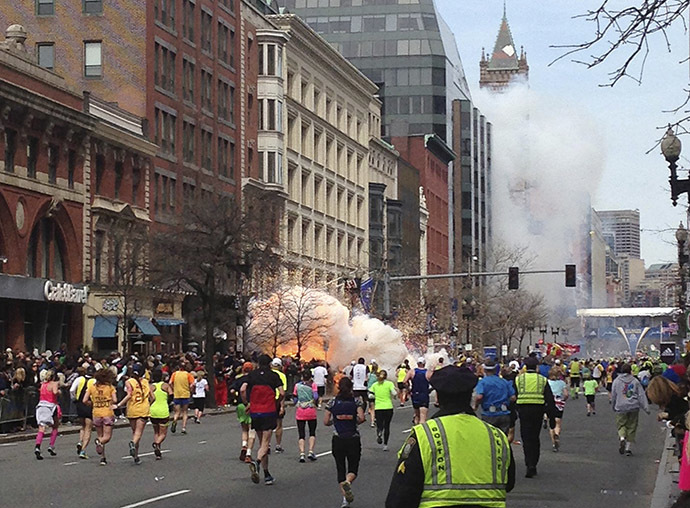
Boston Bombing suspect Dzokhar Tsarnaev has been officially charged with killing four people and using weapons of mass destruction, federal prosecutors announced Thursday. Tsarnaev, 19, faces a potential death sentence over the alleged crimes.

Runners continue to run towards the finish line as an explosion erupts at the finish line of the Boston MarathonAccording to the United States Attorneys’ Office, 17 of the 30 charges levied against the teenager carry a penalty of life in prison or execution.

“The defendant’s alleged conduct forever changed lives,” prosecutors said in a statement.

Officials believe the former UMass Dartmouth student and his older brother Tamerlan planted homemade explosives near the finish line ahead of the April 15 race. The double explosion that went off as runners crossed the line en masse caused three deaths and 264 injuries.

The indictment says the Tsarnaev brothers used pressure cookers stuffed with low-explosive powder, ball bearings, nails, adhesive, electronic components, and other substances to manufacture their devices.

Jahar Tsarni, as prosecutors referred to him, is also charged with carjacking resulting in serious bodily injury. While fleeing the police, the brothers stopped a vehicle and ordered the driver to turn over the car and $800, according to officers.

“I thought it was just a robbery…He took out his gun, pointed it to me,” the carjacking victim told CBS. “He told that, ‘You know I am serious. Don’t be stupid.’”

Four days later, the Tsarnaev brothers allegedly killed a police officer during a firefight. Tamerlan also died in the incident.

A wounded Dzokhar later hid inside a boat in the backyard of a Watertown, Massachusetts residence. He was arrested after a massive manhunt and placed in a medical prison facility where he has stayed ever since.

Prosecutors say Tsarnaev scribbled an anti-government message as he bled from a throat and leg wound, waiting for the police to find him.

“The US Government is killing our innocent civilians. I can’t stand to see such evil go unpunished. We Muslims are one body, you hurt one you hurt us all,” it read, the indictment claims. “Stop killing our innocent people, we will stop.”

One of the passages, the FBI claimed, quoted Anwar al-Awlaki, the American propagandist killed in a 2011 drone strike in Yemen. Previous reports indicated that Tamerlan Tsarnaev watched Awlaki’s speeches on YouTube.

“Today’s indictment is the result of the dedicated and collective efforts of law enforcement and intelligence partners, working with a sense of urgency and purpose to find those responsible for those deadly attacks,” said FBI Director Robert S. Mueller. “These continuing efforts reflect the pursuit of justice for those who lost their lives and the scores of individuals who were injured.”

While the indictment did not speculate on any larger conspiracy behind the attacks, prosecutors did say they found an issue of Inspire magazine – an English language Al-Qaeda publication – downloaded by Dzokhar. The literature, which was dated  summer of 2010, contained “detailed instructions for constructing IEDs using pressure cookers, explosive powder from fireworks, shrapnel, adhesive and other materials,” the indictment read.

“IEDs constructed in this manner are designed to shred flesh, shatter bone, and cause extreme pain and suffering, as well as death.”

Dzokhar was initially unable to talk, but said in a phone call released by his mother earlier this month that he is well-fed and recovering physically.

The Tsarnaev brothers are ethnic Chechens and have roots in Russia’s North Caucasus – a region that has witnessed a massive Islamist insurgency in the past and partly remains a hotbed of extremism.

Filed Under: Articles

Opponents of current President of Azerbaijan ready to get rid of Aliyev’s dynastic rule

June 28, 2013 By administrator

The business news agency Zawya reports.

As the two-term Azeri president Ilham Aliyev prepares to run in the October presidential elections, his opponents are looking to field a credible candidate to rid the country of the Aliyevs’ dynastic rule, the business news agency Zawya reports.

g_image-AliyevThe article reads that Aliyev’s family has had an uncomfortable relationship with democracy. His father Hyder, who was once a senior KGB officer, launched a successful coup against Azerbaijan’s only democratically elected leader Abulfaz Elchibey in 1993 to become president.

It is said that after ruling for 10 years, he stepped aside and nominated his son as his party’s sole candidate in 2003. Ilham Aliyev secured majority votes but opposition groups claimed the process was deeply flawed. Aliyev won a second term in 2008 after the opposition boycotted the elections in Azerbaijan.

The author notes, that there are some concerns among the Azeri political elite whether the president should run a third term.

The material also says that the president is looking to change the status quo because for the first time he may be up against a credible opposing candidate: 74-year-old writer Rustom Ibrahimbeyov, who could be acceptable to a number of opposition groups after they came together under the National Council coalition.

The article reads that, Azerbaijan may have prospered, it has received dismal marks from virtually every human rights institution and NGO in the world. Thus, Human Rights Watch says that since March 2012, the Azeri authorities have arrested or convicted at least 22 political activists, journalists, social media bloggers, human-rights defenders, and others who criticized the government.

However as the author of the article says it is unclear whether Azeris are ready for a major change.

As the article reads, the International Monetary Fund (IMF) says that Azerbaijan has been one of the world’s fastest growing economies in the past decade, yet the country is at a critical juncture given the foreseeable decline in oil production and gas reserves.

Most analysts are predicting oil production to decline within two decades and while natural gas revenues are on the rise, they may not be enough to offset falling oil receipts. The age-old recommendation to diversify away from the hydrocarbon economy has been falling on deaf ears.

The article also says that the focus on natural gas is crucial to maintaining the Azeri economy’s growth trajectory, especially as Aliyev needs a healthy flow of revenues to keep his citizenry content and opposition parties at bay. But the country could face a number of challenges as commodity prices are falling, which is inconvenient for a president fighting for re-election, the author of the material writes.

As the IMF reports, the government’s planned spending program, including in the 2013 budget, is exacerbating oil dependence and increasing risks to a potential fall in global oil prices.

Source: Panorama.am

Filed Under: Articles Tagged With: Opponents of current President of Azerbaijan ready to get rid of Aliyev’s dynastic rule

Germany’s Merkel warns against arming Syria rebels

June 27, 2013 By administrator

June 27, 2013 – 20:14 AMT

163805German chancellor Angela Merkel has warned against shipping weapons to Syrian rebels fighting to overthrow President Bashar Assad, Belfast Telegraph said.

The German leader told parliament she understands why Britain, France and the United States are considering arms deliveries to some rebel groups in Syria, who are facing strong resistance from Syrian government forces and its Hezbollah allies.

But Ms Merkel said that, in her view, “the risks would be incalculable”.

She did not explain why but critics fear Western arms would only prolong the conflict without tipping the scales decisively.

And Western weapons, including anti-aircraft missiles, could fall into the hands of Islamic extremists who might eventually use them against Western interests.

Filed Under: Articles Tagged With: Germany’s Merkel warns against arming Syria rebels

Let’s Go to Greece: Places in Greece You Would Like to Visit This Summer!

June 27, 2013 By administrator

New York.- By Vicki James Yiannias

“Does anyone really need a reason to visit Greece?  The land, the people, the history, the food… you’ll find all these reasons, and more, in travel brochures and posters.  But why you really should visit Greece is to feel alive,” Diane Shugart, editor of Odyssey magazine in Athens, Greece, told the GN, expressing what so many feel to be a go-to-greece1-200x300fundamental truth about that beautiful country.

Addressing the topic of visiting Greece in view of the economic situation, she said, “Greece is still Greece.  And people may be going through a very difficult time, but they haven’t lost their humanity or their zest for life.”

The Peloponnese and Crete hold special fascination for Ms. Shugart.

“I have so many favorite places in Greece, it’s impossible to name one.  But time and time again, I find myself returning to the Peloponnese and Crete.  I’m enchanted with how they shrink the world, bring it closer, but also open it up, thanks to a varied topography that puts 2.5km peaks just minutes away from the sea.”
If she were restricted to just a couple of days in Athens, said Shugart,

“I’d spend the first day visiting the Acropolis and Acropolis Museum before wandering around Plaka and Thisseio, and take in the sunset at Sounio.  I’d spend the second day on a day-cruise to the Saronic islands or independently visit Aegina or Poros.  Maybe I’m biased, but there is a reason I’ve chosen to live on Poros, says Shugart, who is in the enviable position of being able to step out of her house and walk along the sea, “Or maybe combine a trip to Poros with a tour of the Argolid.”

It’s a cliché by now, but undeniable nonetheless, that the clear, ecstatically blue seas of Greece heal the body and calm the soul.  According to the many who say that they can’t do without the health benefits derived from swimming in Greece’s therapeutic sea every year, it’s not just a divine experience but also a necessary one.  It makes sense. 93 out of 100 Greek beaches are rated “excellent” by the European Environmental Agency, and a recent CNN report names 4 Greek beaches, two on Crete, and one each on the islands of Zakynthos and Lefkada, among the top 100 best beaches in the world.  The only thing you need to know about the famous Zakynthos beach “Ναυάγιο” the report says, is that it’s “exquisite”.  You’ll see “dramatic sunsets, and electric blue water” at Lefkada’s “Εγκρεμνοί” beach, and the “pastel colors of the marvelous” Μπάλος beach in Chania, Crete, make it “postcard perfect”, while the “biggest beach party” takes place on the Φαλάσαρνα beach, also in Chania.

Following Gianna Daskalakis-Angelopoulos’s suggestions to support Greece’s agrotourism by visiting small producers of wine and olive oil, while you are Chania take the opportunity to find out how forward-thinking Greece is in its support of organic and sustainable agriculture by visiting the Astrikas Estate, where Biolea olive oil originates.  One of the most serious quality olive oil exporters to the US, Astrikas Estate is only 30 kilometers away from Chania.  Walking though the primordial olive groves you can breathe in the past, then view the future by learning about the importance of sustainability.

For more agrotourism entwined with a culinary experience, you can just make it for a June 24-27 cookbook vacation on renown cookbook author Aglaia Kremezi’s island paradise on Kea, where you have a festival in general, learning to cook with the splendid produce—even some  indigenous varieties of greens that you may never have seen before–that she and her husband Costas cultivate, taste wines and olive oils and feast on your own perfected efforts in the best of Greece’s rural settings.  A second program, a special olive picking and pressing program, here you pick olives and press them in Aglaia and Costa’s own olive press is coming up on September 22-26.)

In the village of Tsangarada on the eastern slopes of Mt. Pelion, one of the most beautiful places in Greece, you can embrace nature in a special kind of foraging agrotourism (a contemporary rage) by staying in the AMANITA Guesthouse, situated between the mountain and the sea, and taking the guesthouse’s gastronomic tour of the mountain, the walking tours among the Forest of the Centaurs’ centuries old trees to collect fruits, nuts, and herbs and gather mushrooms, treks along the mountain’s stone pathways, and the beaches and tiny hidden coves bordering emerald green waters.

These suggestions are just drop in the vast sea of Greece’s summer holiday potential.  This small country holds a universe of things to discover, to invent, and to luxuriate in.  You can pursue whatever pleases you in its sophisticated cosmopolitan centers and gorgeous land and seascapes.

Diane Shugart offers a last, invaluable thought: “As for what else to do when you visit Greece, there’s a lot and there’s nothing–which is something we’ve forgotten how to do.  I’ll go on vacation with a list of books to read or a project I want to work on in peace, but instead I’ll spend those hours just sitting, staring out at the sea or the land.  Greece helps you find balance,” she said, “The thing about coming to Greece is that once isn’t enough.  You always have to come back.  You always want to come back.  Again.  And again.

Your tourist dollars will help get Greece’s economy moving more than any other assistance.  Let’s go to Greece this summer!

Filed Under: Articles Tagged With: Let’s Go to Greece: Places in Greece You Would Like to Visit This Summer!

Turkey: 105 years in prison for nine KCK detainees

June 27, 2013 By administrator

June 27, 2013

DIYARBAKIR, Turkey’s Kurdish region,— Diyarbakir 6th High Criminal Court sentenced nine defendants in the KCK (Kurdish Communities Union) Eruh trial to a total of 105 years and 8 months in prison, as well as 74,880 TL pecuniary penalty. The trial of nine defendants has been going on since 2010.

The court sentenced each of the nine defendants to six years and three months in prison for allegedly “committing a crime on behalf of an illegal organization that they are not members to”, three years for “possessing hazardous material”, two years and six months for “damaging public property”. Each of the defendants was also imposed a pecuniary penalty of 8,320 TL.

On the other hand, of 23 people who have been tried in the scope of the KCK Batman trial, eight were released following the first hearing at Diyarbakir 8th High Criminal Court on Tuesday.

The KCK is a clandestine group suspected of being the political wing of the armed Kurdistan Workers Party (PKK). Turkish authorities accuse the KCK of wanting to promote insurrection in Turkey’s Kurdish region (Northern Kurdistan).

Among the defendants, of whom 19 have been remanded in custody, are also students and members of the Peace and Democracy Party (BDP). Defendants were able to give their testimonies in Kurdish as the court provided Kurdish interpreters.

The next hearing has been set for 10 September.

The KCK-trial began on October 18, 2010 when a Turkish court began the trial of 152 high profile Kurdish politicians and rights defenders, accused of being the urban wing of the outlawed separatist Kurdish PKK rebels.

Over 7748 people were taken into custody and over 3895 persons were arrested in the scope of KCK operations during the past nine months,www.ekurd.net the pro-Kurdish Peace and Democracy Party announced. Dozens of BDP executives and employees are still in prison.

Source Ekurd.net

Filed Under: Articles Tagged With: Turkey: 105 years in prison for nine KCK detainees

  • « Previous Page
  • 1
  • …
  • 1989
  • 1990
  • 1991
  • 1992
  • 1993
  • …
  • 2068
  • Next Page »

Support Gagrule.net

Subscribe Free News & Update

Search

GagruleLive with Harut Sassounian

Can activist run a Government?

Wally Sarkeesian Interview Onnik Dinkjian and son

https://youtu.be/BiI8_TJzHEM

Khachic Moradian

https://youtu.be/-NkIYpCAIII
https://youtu.be/9_Xi7FA3tGQ
https://youtu.be/Arg8gAhcIb0
https://youtu.be/zzh-WpjGltY


gagrulenet Twitter-Timeline

Tweets by @gagrulenet

Archives

Books

Recent Posts

  • Pashinyan Government Pays U.S. Public Relations Firm To Attack the Armenian Apostolic Church
  • Breaking News: Armenian Former Defense Minister Arshak Karapetyan Pashinyan is agent
  • November 9: The Black Day of Armenia — How Artsakh Was Signed Away
  • @MorenoOcampo1, former Chief Prosecutor of the International Criminal Court, issued a Call to Action for Armenians worldwide.
  • Medieval Software. Modern Hardware. Our Politics Is Stuck in the Past.

Recent Comments

  • Baron Kisheranotz on Pashinyan’s Betrayal Dressed as Peace
  • Baron Kisheranotz on Trusting Turks or Azerbaijanis is itself a betrayal of the Armenian nation.
  • Stepan on A Nation in Peril: Anything Armenian pashinyan Dismantling
  • Stepan on Draft Letter to Armenian Legal Scholars / Armenian Bar Association
  • administrator on Turkish Agent Pashinyan will not attend the meeting of the CIS Council of Heads of State

Copyright © 2025 · News Pro Theme on Genesis Framework · WordPress · Log in