Gagrule.net

Gagrule.net News, Views, Interviews worldwide

  • Home
  • About
  • Contact
  • GagruleLive
  • Armenia profile

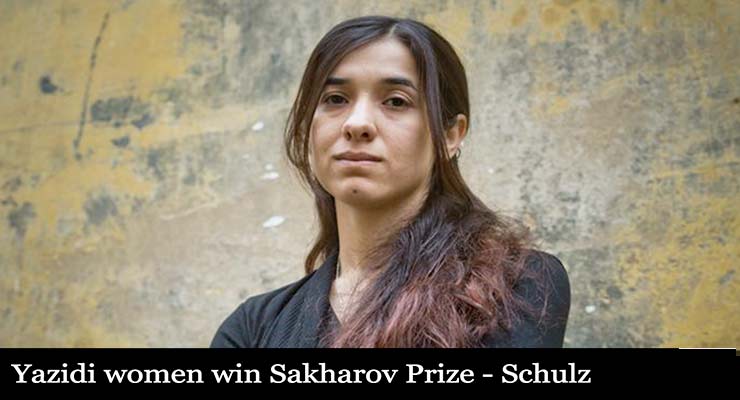
Yazidi women survivors of ‘Islamic State’ win EU’s Sakharov human rights prize

October 27, 2016 By administrator

yazidi-womenA pair of Yazidi women’s advocates have been awarded the European Parliament’s Sakharov Prize for Freedom of Thought. The 50,000-euro prize for human rights has been handed out since 1988.

Iraqis Nadia Murad and Lamiya Aji Bashar, who hail from a Yazidi village in Iraq that was overrun by the self-styled “Islamic State” in 2014, were named Thursday as recipients of the Sakharov Prize. They were nominated by European parliamentary deputies from multiple parties. The laureates’ names were announced at about midday by European Parliament President Martin Schulz, and an award ceremony is slated for December 14.

Thousands of Yazidi girls and women were forced into sex slavery by the extremist group in recent years. The two award winners managed to escape and raise global attention to rampant human rights abuses.

Murad, now aged 23, was held by IS militants in Mosul but escaped in November 2014, reached a refugee camp and eventually
made her way to Europe. She has since become an advocate for the Yazidis, and refugee and women’s rights in general.

Bashar, 18, was captured in the same raid as Murad and also kept as a sex slave by IS. She escaped in March but was badly
disfigured and blinded in one eye when a landmine went off as she fled. Two companions were killed. She has since undergone reconstructive surgery and works as an advocate for members of the Yazidi sect.

Both women reside in Germany.

The Yazidi are a religious sect whose beliefs combine elements of several ancient Middle Eastern religions. Hard-line Islamists consider them pagans or devil worshippers. The United Nations said in a report in June that IS had committed genocide against the Yazidis in Syria and Iraq to destroy the religious community of  400,000 people through killings, sexual slavery and other crimes.

Kurdish forces – with arms and air cover from the US-led military coalition – retook the moutnainous Sinjar region in the end of 2014.

Filed Under: Articles, Genocide Tagged With: EU, sakharov, women, Yazidi

Fallujah: Over 350 Yazidi Women Freed from IS

June 19, 2016 By administrator

yazidi freeThey have been taken into IS captivity after the jihadist group overran Sinjar

FALLUJAH — A Kurdish Yazidi official in Dohuk province revealed that over 350 Yazidi abductees have been freed from the Islamic State (IS) by the Iraqi forces in Fallujah. 

Hadi Dubani, the director of Yazidi Affairs in Dohuk province, told BasNews that they were informed today, June 19, by the Iraqi forces that 354 Yazidi women and girls, previously abducted by the IS militants in Sinjar, have been freed in Fallujah by the Iraqi forces. 

Dubani said “The freed Yazidi women are now in Amirya area in Fallujah under the protection of the Iraqi forces. they are expected to arrive in Kurdistan Region in the near future.

Earlier this month, 4 Yazidi girls were freed by the Iraqi forces soon after the Fallujah offensive was launched; they were later reunited with their families in Erbil. 

The Directorate of Yazidi Abductees Affairs in Dohuk province, which works to locate and free Yazidi captives, previously told BasNews that hundreds of Yazidi girls, who were abducted by the IS militants during the Sinjar massacre, were held in Fallujah with an uncertain future.

IS militants enslaved over 5000 Yazidi girls, women and children after they attacked the Yazidi major town of Sinjar in August, 2014; near 2000 Yazidi abductees have so far been freed from the grip of the IS militants with thousands more still being held by the extremist group.

The rescue of the Yazidi women comes after the Iraqi government forces entered Fallujah last Friday and liberated most of the city from IS.

Filed Under: News Tagged With: freed, Iraq, women, Yazidi

Why Israel and Armenia Should ‘Adopt’ the Yazidis

August 19, 2015 By administrator

By Stefan Ihrig,

Iraqi Yazidi women hold placards during a protest outside the United Nations (UN)

Iraqi Yazidi women hold placards during a protest outside the United Nations (UN)

JERUSALEM — The recent horrifying New York Times exposé on the Islamic State’s sex slavery system targeting Yazidi women was one of the most-read articles on the paper’s website in the last days. And yes, in a doubly perverse sense it feels good to be morally outraged at ISIS for a few minutes. But let us not get all too comfortable with our outrage over what the Times titled “Theology of Rape,” because we like to forget just how easily we forget. The history of mass media and atrocities in the modern world has taught us that the hurdle for us to really care — to the point where something is done about atrocities in progress — is just astoundingly high. The history of the last century provides a seemingly endless list of atrocities that were not stopped, and rarely was this ever for a lack of information about them. We, at least as countries and societies, simply don’t really care. We would like to think we do, but, empirically speaking, we don’t — and the latest case in point is the sheer existence of a system of Yazidi sex slave trade in 2015.

We humans and we modern societies have a tremendous ability to compartmentalize what is going on in the world around us and to assign most of it to such a distance that it simply does not matter. We have an even greater ability not to care or to forget and suppress quickly what we read, hear and see about the tragedies and wars around us. Our ability as societies to ignore, downplay or misunderstand what is going on — in the face of reports, coverage and even discussion in our own media — has a long tradition.

Let me give you just two examples of a dark tradition of not caring too much to illustrate just how easy this is and was: In the 1890s great massacres broke out in the Ottoman Empire; under Abdul Hamid II tens of thousands of Armenians were killed in a span of about three years. Germany was especially close to the Ottoman Empire at the time and was rather well-informed about what happened. From its own sources and from English papers, the German press printed horror stories featuring such explicit depictions of the murder of Armenians by mobs in some localities that even over hundred years later they make for a highly disturbing read. And still they failed to instigate any great response by German society as such.

The papers aligned with the German government downplayed the atrocity reports as British propaganda or outright justified what was happening. Some critical papers were shouted down with the accusation of being obsessed with minority issues because they were Jewish-owned. Others were either silent or sought their own way out of a tragedy that warranted some kind of response, especially because Germany was a quasi-ally of the Ottomans at the time, often either by advancing racial justifications or by stressing that Germany had enough problems at home to care about first. But don’t judge Germany of the 1890s all too quickly, the other Great Powers also did next to nothing to help the Armenians.

ISIS is pretty clear about what it cares for and what it does not. What about us?

By the time the Armenian Genocide occurred, some 20 years later, one German paper, which was the widely acknowledged mouthpiece of political Catholicism, went a step further to justify not caring for the Armenians: it observed laconically that there were either many or not so many Christians in the Ottoman Empire, depending on the perspective. What the paper meant to suggest was that only if one counted the Orthodox Christians — the majority of Armenians were Orthodox — fully, as real Christians would the total number be high. It did not say so explicitly, but what it suggested was clear: because the victims are not really Christians, German Christians were not obliged to bother themselves with this faraway tragedy.

Another example — and a case in point that the size of the humanitarian disaster matters little to our ability to not comprehend, to suppress, downplay and so on — has to be the Holocaust as it was happening. Deborah Lipstadt and others have shown how often and almost casually news about the ongoing Holocaust was pushed to the less important pages of American papers and routinely downplayed in importance. A recent study by Michael Fleming examines how the news about Auschwitz traveled to the Allies and how it was received. He painstakingly documents all the hurdles that needed to be surmounted before this news — about what is today the iconic killing place of the Holocaust — was taken seriously by policymakers and news media at all. Fleming combats the myth about the Allies not having had reliable information about Auschwitz until late in war; well, they did, but it would be just all the more comfortable to believe that they did not.

ISIS’ Sex Slavery

So, now we have more horrifying news about ISIS and we are outraged by ISIS’ sex slave system. And we should be. But then what? By the time you looked up from that Times article to do the next thing you probably already began to put this disturbing piece of information some place away from the things that matter to you. We learn to do so every day. But somebody needs to care. Why? Because it is simply far too easy not to care about the Yazidis (and we had in fact already almost forgotten about last year’s near extinction of tens of thousands of Yazidis, almost miraculously saved by the Kurdish Peshmerga). Not only are they far away, the overwhelming majority of us just don’t have any Yazidis in our circle of friends and neighbors. And finally, and perhaps most importantly, they are neither Christian, Jewish or Muslim and their belief system is just foreign in the most literal sense to us.

Given their history, at the very least the state of Israel and Armenia should, in some form, politically adopt the Yazidis. Like the Armenians and the Jews in the 1890s, during the Armenian Genocide and during the Shoah, the Yazidis, too, have no state of their own, no army and no powerful enough lobby anywhere. And precisely because they don’t and because they are not “one of us,” they matter so much and should matter more than the threatened destruction of the ruins of Palmyra. After we have proven, as a world, that we do not care that much for the Christians, Sunni and Shia Muslims of Syria, or the Kurds and all the other inhabitants in now ISIS-controlled Iraq, the Yazidis should be the last straw. But they probably won’t be. ISIS is pretty clear about what it cares for and what it does not. What about us?

Source: huffingtonpost.com

Stefan IhrigPolonsky Fellow, Van Leer Jerusalem Institute


Filed Under: Genocide, News Tagged With: adopt, Armenia, Israel, Yazidi

Yazidi girl gives account of sex slavery by ISIL

December 22, 2014 By administrator

Yazidi-womanAn Izadi girl has given a blow-by-blow account of the way the ISIL Takfiri group enslaved and abused thousands of women in the Iraqi town of Sinjar.

“They were local Sunni” militants, “some of whom we recognized,” the 19-year-old Izadi girl, who introduced herself as Girl B, told The Times, recalling a day in early August when the Takfiri militants captured Sinjar. reported by Presstv

The militants reportedly killed hundreds of residents, kidnapped and enslaved hundreds of Izadi women and girls, and forced tens of thousands to seek refuge on Mount Sinjar.

Girl B, along with her younger sisters, was among the captured and enslaved people.

“A local mechanic was among them. The Sunni men in our area became Daesh as soon as they got a smell of them approaching. No one even had to ask them to join,” Girl B added.

The Yazidi girl noted that the Takfiri militants took hundreds of Yazidi captives to a building in Sinjar and separated them there.

“The Daesh took our names and ages and noted everything down,” said Girl B, adding, “Then they began dividing us: the men to one side, woman and children to another. Then they selected the young women, both married and unmarried. They told me and my two younger sisters to join that last group. We didn’t know what was happening, but our mother realised, and she began screaming.”

“My mother started screaming and begging for mercy as the Daesh [IS] fighters told my sister and me to join the group of younger women specially selected,” the 19-year-old Izadi girl said, further noting, “But they tore us from her grasp.”

The slaves were then taken to dozens of lorries, pick-ups and dumper trucks in order to be transferred to Mosul where they were sold to the Takfiri group’s senior officials, the girl said.

“I saw other women in the building being dragged out to waiting lorries by their hair,” Girl B said, pointing, “It was organized, and they took us away like cattle.”

In Mosul the slaves were taken to the city’s “Galaxy Hall”, holding centre belonging to the Takfiri group, the Izadi girl said, adding that the enslaved Yazidi women were further subcategorized there and were moved to new centers.

The girl said that the slaves were selected by ISIL commanders the same way as “sheep” and were taken to the house of a prominent ISIL sheikh in the town of Baaj.

“There, the commanders of the Daesh came to look at us again,” Girl B said, explaining, “We were lined up while they came to inspect and buy us. I could see the dinars change hands.”

The girl said her buyer was “Abu Ghuffram”, an ISIS (ISIL) commander in his forties. The girl further noted that Ghuffram was a local Sunni and was reputed for criminal acts before the crisis begins in the area.

The girl along with two other slaves were taken to Ghuffram’s house in the village of Rambussi where they had to serve the ISIL commander and two of his captains.

“Sometimes he would call me by name and talk reasonably,” said Girl B, adding, “At other times the men would insult our Yazidi faith and curse us. If Abu Ghuffram was angry he would strike or kick me. Once he put his hands around my throat and tried to choke me.”

It was also discovered by Izadi health workers that the three girls had been raped numerous times by the three ISIL militants.

Girl B and the two other girls escaped captivity one night in late November, managed to reach the slopes of the Sinjar Mountains, where they met with Izadi fighters and were taken to Dohuk in Iraq’s Kurdistan region by helicopter.

According to Izadi activists, 3,500 women and children are missing as captives and sex slaves. They also say that 2,000 Izadi men are also missing, many of whom feared to have been executed.

“We have raped and pregnant cases; children who have escaped without parents; parents without children. We have cases of women who have been raped by just one Daesh fighter, and cases of women who have been multiply raped and sold several times among ISIS (ISIL) fighters. We have found women sold for dollars 25, for dollars 100, for dollars 1,000. We have it all,” Khider Domle, a Yazidi activist helping escapees in Dohuk said.

On Saturday, Iraqi Kurdish Peshmerga fighters distributed aid on Mount Sinjar after breaking the ISIL terror group’s months-long siege on the area in northwestern Iraq.

The ISIL terrorists control some parts of Syria and Iraq.


Filed Under: News Tagged With: girl, ISIL, sex slavery, Yazidi

Iraq’s Sole Yazidi Lawmaker Says 25,000 Girls Abducted By IS To Be Raped, Sold

November 5, 2014 By administrator

By Freshta Jalalzai and Luke Johnson

513600CE-820A-458E-89B0-2477DF66372A_w640_r1_sIraq’s only ethnic Yazidi member of parliament says that the human rights situation in her country is “deteriorating,” with Islamic State (IS) militants kidnapping, raping, and selling Yazidi women.

“They are still without any shelter. They are sleeping on the streets. The situation is not good and the winter is [advancing], and it’s raining, actually, in Iraq [now]. So the situation is deteriorating,” legislator Vian Dakhil told RFE/RL in an October 8 telephone interview from Iraq’s Kurdish region.

Dakhil, who has been cited by U.S. President Barack Obama, was named the winner of the 2014 Anna Politkovskaya Award on October 6 by the organization Reach All Women in War. The award, named after the murdered Russian journalist, honors women working to help those trapped in conflict.

The lawmaker, who is currently recovering from injuries she suffered in an August 12 helicopter crash on Mount Sinjar in northern Iraq, said that while IS militants have forced Christian women from their homes, Yazidi women often suffer worse fates.

“Only Yazidi women are kidnapped. We don’t know, actually, why exactly the Yazidi women [are targeted],” she said.

Dakhil says that of the more than 500,000 Yazidis in Iraq, some 25,000 Yazidi girls have been abducted by IS militants.

“We don’t know exactly [where all of them are], but some are [kept] at [various] prisons here, still in Iraq, and some have been taken to Syria, and some are in Mosul,” she said. “They are taken to be raped, and they are selling them — $150 for a girl.”

Dakhil called on the international community to step in to help the plight of the Kurdish religious and ethnic minority that has faced religious persecution for centuries and that has been dubbed “devil worshippers” by some Muslims.

“I ask every government — not only here — to take some action to save these people here because the situation is really bad. What is happening here cannot be solved by [the] Iraqi government only,” she said.

Dakhil gained international attention in August after making an impassioned plea to the Iraqi parliament about Yazidis trapped on Mount Sinjar, which was surrounded at the time by IS militants. She called it genocide.

“My family is being butchered, just like all Iraqis are being killed. … And today, the Yazidis are being slaughtered. Brothers, away from all the political disputes, we want humanitarian solidarity. I am speaking here in the name of humanity. Save us! Save us!” she told lawmakers on August 5.

The speaker of parliament interrupted her speech, while others shushed her emotional address, after which she collapsed.

The speech caught the attention of the U.S. president, who referenced her on August 7 when announcing U.S. air strikes against IS militants and a humanitarian aid effort to rescue the Yazidis.

“Earlier this week, one Iraqi in the area cried to the world, ‘There is no one coming to help.’ Well today, America is coming to help,” Obama said.

‘What Would You Feel?’ 

Dakhil broke both legs and several ribs in an August 12 helicopter crash on Mount Sinjar. The pilot of the aircraft, which was carrying about 35 people, was killed in the accident, while “New York Times” reporter Alissa Rubin was injured.

Dakhil said that she plans to return to parliament once she is fully healed.

She also asked Western Muslim women who are supporting IS militants — an estimated 30 of whom have actually traveled to Iraq or Syria — to look at what the group, which is also known as ISIL, is doing to Yazidi women.

“Every girl [in the West] who is supporting ISIL should put herself in any [local] girl’s [shoes] and see what she has gone through. Twelve-year-old girls [are being] raped. Ten-year-old girls [are being] raped. I would like to ask [women supporting ISIL], if she was in their situation, what would she feel? If she was from your family, what would you feel?” Dakhil said.

“This girl could be your daughter, she could be your sister, she could be your neighbor,” she continued. “[Would] you be totally comfortable if someone raped your daughter, or your sister, or your neighbor?”

Interview conducted by Freshta Jalalzai of RFE/RL’s Radio Free Aghanistan in Prague and written by RFE/RL correspondent Luke Johnson in Washington

Filed Under: News Tagged With: abducted, girls, Iraq, Yazidi

UN: Attacks on Iraq’s Yazidis may constitute attempted genocide

October 22, 2014 By administrator

0,,17999015_303,00Iraq’s Yazidi religious minority is facing what may amount to attempted genocide. A week-long visit to the country revealed evidence that “strongly indicates” an effort to wipe out the community.

The campaign against the Yazidis by the “Islamic State” (IS) could constitute attempted genocide, UN Assistant Secretary-General for Human Rights Ivan Simonovic said on Tuesday.

“The evidence strongly indicates an attempt to commit genocide,” Simonovic said after meetings with some 30 people – officials and displaced people in Irbil, Baghdad and Dohuk – during the week-long visit.

Hundreds of Yazidis are believed to have been killed when IS swept across northern and western Iraq in August. Many fled to Kurdish-held parts of northern Iraq, while some 7,000 are believed to have stayed behind and converted to the harsh interpretation of Islam promoted by IS.

Simonovic said it appeared that IS militants – who claim the Yazidis are “devil worshippers” – had the intent of destroying a religious group.

‘Bought and sold’

In a recent issue of its Dabiq magazine, IS reportedly boasted that it was selling Yazidi women and children as slaves, saying members of the group were singled out because of their unique customs.

Earlier this month, the Human Rights Watch group released a report saying abducted woman were subject to sexual assault and were being bought and sold by IS fighters.

According to the 1948 UN Convention on the Prevention and Punishment of the Crime of Genocide, the term genocide represents an intent to destroy – either in whole or in part – a national, ethical, racial or religious group.

The means of doing so, according to the convention, include the killing of members of the group, causing serious bodily or mental harm to members, and deliberately inflicting conditions that would bring about the destruction of the group.

They also include preventing births within a given community or the forcible transfer of children from the group to another group.

During the IS onslaught, thousands of Yazidis were trapped on a mountain near to their main hub, the town of Sinjar, for days in August. They were subsequently helped to safety in Kurdish-held areas with the aid of the Kurdish People’s Protection Units (YPG).

rc/lw (AFP, AP, Reuters)

Filed Under: Articles, Genocide Tagged With: Genocide, UN, Yazidi

Jihadists control all exits from Mount Shingal (Yazidi), says Peshmerga official

October 14, 2014 By administrator

Islamic State fight72535Image1ers.

By Nasir Ali

SHINGAL MOUNTAIN— Militants of the Islamic State (ISIS) are now in control of virtually all the roads leading to the Shingal Mountain where thousands of Yazidi refugees are still encircled, a Peshmerga commander told Rudaw.

“The IS overran three Syrian Kurdish villages last week which were functioning as the only exit routes from the Shingal Mountain into Syrian Kurdistan,” General Ashti Kochar of the Peshmerga forces told Rudaw in a phone interview from the besieged mountain.

“The only way in and out of here is from the air,” the general said, explaining that they had asked the Iraqi air force to drop humanitarian aid on the mountain from now on.

The Kurdish general said nearly 10,000 people were still on the mountain and as the winter approaches they were “in desperate need of blankets and tents.”

An official with the Kurdistan Regional Government (KRG) told Rudaw that his team had prepared more than 10,000 blankets and mattresses to be shipped to the encircled refugees on the mountain.

“We have so far continually delivered aid to the refugees on the mountain, but with all the roads blocked by the Da’esh [ISIS] now, we have to hope that the air transport will go smoothly,” said Nouri Usman, who leads the KRG’s special team established to assist Yazidi refugees.

Rudaw has learned that apart from the Yazidi refugees on the mountain, Syrian Kurdish fighters from the People’s Protection Units (YPG) and guerillas from the Kurdistan Workers Party (PKK), are alongside the KRG’s Peshmerga forces on the beleaguered mountain, which was the focus of an international humanitarian effort in early days of August.

Local Yazidi farmers who have lived with their livestock on the Shingal Mountain have refused to abandon their villages and move to safer areas despite warnings by Kurdish officials.

“This is where we have lived for ages and we would rather die here in dignity than flee,” said Hatte Mito, a 60 year-old Yazidi woman referring to her village of Kochare located on the foothill of the mountain where major battles took place in August as Yazidi and Kurdish fighters successfully repelled Islamic State’s repeated onslaughts.

“We are doing our best to help our Yazidi defenders,” said Hawla Piso, 35, wearing a traditional Yazidi outfit. Piso said she made between 150 and 200 pieces of bread which were then sent to the Yazidi fighters in the frontlines.

General Kochar told Rudaw that the KRG had prepared nearly 100 tons of food, tents and other necessities which he promised would be delivered to the refugees despite the blockade.

“On the direct orders of Prime Minister [Nechirvan] Barzani, we will also airlift anyone who needs acute medical help to Dohuk,” the general said.

Filed Under: Articles Tagged With: Kurdistan, Shingal, Yazidi

France: The wrath of the Eastern Christians, Kurds and Yezidis in the National Assembly

October 9, 2014 By administrator

DSC07465Before the dramatic events that have marred the Armenians, Assyrians and Chaldeans, Syriacs, Yezidis and Kurds, for several years now, Syria and more recently in Iraq, the Armenian community of France gathered Tuesday, October 7th in the National Assembly for scream outrage at the call of the Coordination Council of Armenian Organizations of France (CCAF), soon joined by the Kurdish Democratic Council of France which resulted in its wake hundreds of Kurdish Yezidi and Assyrian-Chaldean, welcomed the applause of Armenians say stop to the barbarity of the Islamic State and denounce “the inaction of the international community” face of the dramatic situation in Kobanê.

Of numerous personalities from the political class and the voluntary sector have thus succeeded in the gallery of the Edouard Herriot up to about a little over 1,600 people determined, demanding weapons to the PKK and humanitarian support for survivors of Kobanê. The attitude of Turkey, accomplice of IE by its negligence and inaction to assist Kurdish fighters, has been widely criticized and booed by the protesters.

Among those present who were not raised at the forum, we could recognize François Bayrou (Modem), Henri Jibrayel (PS) -d’origine chaldéene- Assyrian-François Pupponi (PS) and François Rochebloine (UDI).

100 years after the 1915 genocide that has hit hard the Armenians, Assyrians and Chaldeans, Syriacs and Greeks (1916-1923), as saying all Christians in Turkey, history is repeating itself in Iraq and Syria under the hordes bloody Sunni Islamic state.

After Mosul, Aleppo, Kessab Kobanê, and the destruction of the Holy Martyrs memorial at Deir-ez-Zor, Supreme Criminal stage of the Armenian Genocide, the madness of the IU raises worldwide anger and indignation. That’s what came to tell the elect of the Republic of France diasporic communities expressing their anger, while at the same time the Turkish police charged the Kurdish community in Diyarbakir killing 18, while Erdogan said he was supposedly supports the creation of a buffer zone between Syria and Turkey during a telephone conversation with President Holland.

After a preliminary presentation of the expected speakers Harout Mardirossian (CDCA) left the floor to co-president Mourad Papazian CFC. In his opening speech of the rally, the latter heavily denounced “barbaric jihadists who both Iraq and Syria aim to spread terror among the population in the slaying. The horror of the Islamic state is unbearable and it is in the union of the Armenians, Kurds, Assyrian-Chaldeans, Yezidis and Christians of the East, we must condemn the court of public opinion and states. “Has he said. Then hammering “the goal is to install the jihadists in Iraq and Syria ultra-Islamist and fascist regimes. And in this context, the Turkish government pretended to want to fight, but the reality is quite different. Ankara is home to jihadists, drives the jihadists, finance jihadists. The goal of Turkey is to take advantage of the situation, not to fight the Islamic state, but to weaken the Kurdish and get rid of Armenians and Christians. Ankara is using the conflict and subcontracts jihadists elimination of Armenians and Armenian any traces in Syria. We have seen in making Kessab and blasting the Church and the memorial at Deir-ez-Zor, a symbol of the Armenian Genocide. Deir Zor is the Auschwitz of the Armenians!. “Continuing his remarks, Mourad Papazian insisted:” Turkey is not a reliable ally. , We know that it is not possible to trust him! While the Turks might intervene militarily to prevent jihadists seize Kobanê, we find that they promote their advanced preventing Kurds from Turkey to strengthen the ranks of the resistance Daesh. “ Finally, to conclude, Mourad Papazian called for the intensification of the anti-Jihad fight, calling the coalition to organize a ground intervention, the only way to push back the forces of evil and occupation. “

For Valerie Boyer (UMP) ‘if genocide was to take place today, it will be because the Armenian genocide was not prevented or punished those responsible! “. She also outraged over the destruction of the Church of Deir ez-Zor, “the Auschwitz of the Armenians,” said she said, pointing to the double game of Turkey.

The representative of CRIF, Gil Taieb, for his part, speaking on behalf of the Jewish people and exclaimed: “Today you should know that you are not alone,” he “will have to continue, talking, screaming. We’ll have around us to explain that no one can rest easy, knowing that somewhere in this world there are men and women who weep, who are massacred, abducted and murdered! “


Filed Under: News Tagged With: Armenian, France, Kurd, Yazidi

Iraq ‘IS’ militants abduct thousands of Yazidi women and girls

October 6, 2014 By administrator

0,,17979233_303,00In attacks on the Yazidi religious minority in northern Iraq, “Islamic State” militants are said to have abducted up to 5,000 women and girls. Five survivors tell DW what they endured in 23 days of captivity. DW report

The five girls sit with their heads bowed, veils pulled down over their faces, fingers clutched firmly together. They come from Kocho, a village in the Sinjar Mountains. Ceylan, the smallest, is 10, while the oldest, Zehra, is 20. For three weeks, they were held by the militants of the terrorist group “Islamic State” (“IS”).

“In early August, the jihadists invaded our village,” says Zehra. “They gave residents a choice: You have two days to become Muslim, otherwise you will be killed. But people did not want to convert to Islam. And so they drove us all into a school, separating the men from the women, into groups. My father was in the last group. We never saw him again.”

Up to 400,000 Yazidis have been expelled from their villages and towns in northern Iraq. Hundreds were killed and – as it has now emerged – about 5,000 women were abducted and sent to Mosul, a figure that has been confirmed by aid organizations and Western diplomats.

The “IS” terrorists conducted a veritable manhunt on the Yazidis, killing men and women and capturing women like Zehra and her four sisters. Those who could escape crossed the mountain desert of Sinjar and made ​t​heir way to Lalish, in the autonomous Kurdish region.

‘The worst pogrom of all’

Lalish is the center of the Yazidi faith, a secluded valley in the rugged Kurdish mountains. Many displaced people have found refuge here in recent weeks – and a little comfort. They have sheltered in the shade of the old, sacred trees, in the steep alleys of the temple district, in niches and doorways. Campfires and tents are everywhere.

“Where shall we go when winter comes?” asks a woman. “We should go to Germany,” replies her husband. “We can no longer go back to our villages – the ‘Islamic State’ is there now.”

Baba Sheikh, the minority’s religious leader, says that his people have already endured 73 pogroms. “But this is the worst of all.” The old man looks tired and struggles to somehow place the current disaster in the Yazidi story of suffering.

Women abducted in groups

The religious community, with roots that date back to pre-Christian times, has repeatedly been the target of radical Muslim hatred. The Yazidis worship the archangel Tausi Melek as God’s supreme creation; for Islamists, he is considered to be the devil, Satan or Iblis. They view Yazidi theology as being too complex, too rich in myths and hymns, a belief system that contradicts the more straightforward Islam.

“In the first night, we may have slept two hours,” recalls Zehra. “At 4 a.m., they came to take us to Mosul. One asked my younger sister to take off her veil. My mother was angry, and she wanted to know why they were asking this of her daughter. He repeated himself, saying that my sister should remove the veil or she would be killed. My mother began to cry. Then, he beat her and took her away. ”

In the first days of her abduction, Zehra counted how many people were abducted and disappeared on the way to Mosul: 65 elderly women, 165 unmarried girls and 400 men. “We did not know what had become of the men. Once, at night, we heard shots outside, gunfire. I asked one of the ‘IS’ men what it was. He told me it was nothing, just shots fired at an unfamiliar car. Later, they told us that they had killed the men.”

The next morning, the women were taken in groups and transferred to Mosul, the center of the self-declared caliphate of the “Islamic State.” Iraq’s second-largest city was taken over by “IS” militants in June. According to several witnesses, a kind of women’s market has been set up in the city center, a large building where the men can come and browse.

Fearing the stigma

“There was also an office there, where men could look at pictures of the women and ask about prices,” says Suzan Aref, a prominent human rights activist in Iraq. “Christians are more expensive than Yazidis. We know of women who were held for a time by the ‘IS’ and then came back. For the most part, the women were raped immediately after the abduction. They jihadists first share among themselves. When they have had enough, they then sell the women in Mosul and pick up a new group.”

Of the 5,000 abducted women, about 43 have returned. How, in what way and by which route, is unclear. It’s thought that Sunni tribal sheikhs in Mosul and Fallujah had a hand in their release – with cash. This may the only hope for the abducted.

It may be that the five sisters were ransomed in this way; they don’t say. Instead, they think of the future and fear rejection by the traditional Yazidi society, which may stigmatize them as defiled women. And so they sit here, clutching their hands together and looking at the ground.

“Now, I have to replace my parents,” says Zehra. “What is to become of us?”

Filed Under: Articles Tagged With: islamic state, woman, Yazidi

Armenia transfers $100,000 in aid to Iraqi Yazidis

September 3, 2014 By administrator

Armenian Foreign Minister Edward Nalbandian together with Bradley Busetto, the UN Resident Coordinator in Armenia, Aziz Tamoyan, President of the National Union of armenian-aid-to-YazidiYazidis, Shaikh Bro Hasanyan, the religious leader of the Yazidis of Armenia handed Wednesday, Sept 2, a note to Christoph Bierwirth, the Representative of the UN High Commissioner for Refugees (UNHCR) on transferring $100,000 to the account of the UNHCR Geneva Headquarters for providing support to the Iraqi Yazidis who have become targets of the Islamic State militants because of their religious belief.

Addressing the guests of the event Foreign Minister Nalbandian said that during the past weeks the attention of the international community is focused on Iraq, where religious minorities have been subjected to brutal campaigns of religious violence, the Public Radio of Armenia reported.

Armenia was the co-author of a resolution, which calls for immediate action to tackle the issue, adopted Monday by the UN Human Rights Council.

“The people and government of Armenia share the indignation and concern of Yazidi citizens of Armenia regarding the ongoing atrocities,” Minister Nalbandian said.

“As you know the Armenian government has decided to offer $100,000 as assistance to the displaced Yazidis in Iraq and today we hand the note about transferring that amount to the Representative of the UN High Commissioner for Refugees (UNHCR) in Armenia,” he added.

Mr. Busetto, the UN Resident Coordinator in Armenia in his speech welcomed the decision, saying that Armenia’s participation in the UN’s humanitarian activities shows the important role of the country as a member of international humanitarian society.

Mr. Bierwirth, the Representative of the UN High Commissioner for Refugees (UNHCR) in Armenia, hailed Armenia’s contribution as an important move to support the displaced people.

Source: Public Radio of Armenia. Armenia provides $100 000 in aid to Iraqi Yazidis

Filed Under: Articles Tagged With: aid, Armenia, Yazidi

  • « Previous Page
  • 1
  • 2
  • 3
  • 4
  • Next Page »

Support Gagrule.net

Subscribe Free News & Update

Search

GagruleLive with Harut Sassounian

Can activist run a Government?

Wally Sarkeesian Interview Onnik Dinkjian and son

https://youtu.be/BiI8_TJzHEM

Khachic Moradian

https://youtu.be/-NkIYpCAIII
https://youtu.be/9_Xi7FA3tGQ
https://youtu.be/Arg8gAhcIb0
https://youtu.be/zzh-WpjGltY


gagrulenet Twitter-Timeline

Tweets by @gagrulenet

Archives

Books

Recent Posts

  • Pashinyan Government Pays U.S. Public Relations Firm To Attack the Armenian Apostolic Church
  • Breaking News: Armenian Former Defense Minister Arshak Karapetyan Pashinyan is agent
  • November 9: The Black Day of Armenia — How Artsakh Was Signed Away
  • @MorenoOcampo1, former Chief Prosecutor of the International Criminal Court, issued a Call to Action for Armenians worldwide.
  • Medieval Software. Modern Hardware. Our Politics Is Stuck in the Past.

Recent Comments

  • Baron Kisheranotz on Pashinyan’s Betrayal Dressed as Peace
  • Baron Kisheranotz on Trusting Turks or Azerbaijanis is itself a betrayal of the Armenian nation.
  • Stepan on A Nation in Peril: Anything Armenian pashinyan Dismantling
  • Stepan on Draft Letter to Armenian Legal Scholars / Armenian Bar Association
  • administrator on Turkish Agent Pashinyan will not attend the meeting of the CIS Council of Heads of State

Copyright © 2025 · News Pro Theme on Genesis Framework · WordPress · Log in