Gagrule.net

Gagrule.net News, Views, Interviews worldwide

  • Home
  • About
  • Contact
  • GagruleLive
  • Armenia profile

Turkey’s media now have a single owner, Türkiye’nin medyasının artık tek bir sahibi var

March 24, 2018 By administrator

Turkey’s media now have a single owner

Turkey’s media now have a single owner, Türkiye’nin medyasının artık tek bir sahibi var

It is more than just a change of company ownership. With the sale of Aydin Dogan’s media unit to the Demiroren Group, media diversity in Turkey is dead, writes Rainer Hermann of Frankfurter Allgemeine Zeitung.

From now on, when you go to a newsagent in Turkey, you don’t need to worry about which paper to buy — you only need to buy one. Then you will know what’s in all the other papers. There are, perhaps, different pictures, but often you’ll find the same phrases, word for word. Because when Aydin Dogan, Turkey’s former “media tsar,” cedes his newspapers and television stations to the Demiroren Group, there will no longer be an independent media group in Turkey.

The few small left-wing newspapers, which can barely stay afloat because hardly anyone dares to advertise in them, or because their most important journalists are in prison, are of no consequence.

Goal achieved

It concludes what Turkish President Tayyip Erdogan has been single-mindedly pursuing for the last decade: At his request, businessmen close to him are buying up media outlets. It is a good deal for both sides as Erdogan gives government contracts to loyal entrepreneurs who, in turn, use part of their new wealth to buy up various media and eliminate critical voices.

Having said this, the media’s owners initially have to be worn down, and Aydin Doganwas one of the first to find himself in Erdogan’s line of fire. In 2009, a “retrospective tax payment” of around of $3.3 billion (€2.7 billion) was supposed to bring him to his knees. In 2011, he had to cede the first newspapers, Milliyet and Vatan, to the Demiroren family.

Read more: Turkish court orders release of two Cumhuriyet journalists

These days, Milliyet – once a respected newspaper – is meaningless. The same Demiroren family is now taking over Hurriyet, Turkey’s most influential newspaper; Posta, the most important tabloid and CNN Turk, the last reputable television station.

Within the next year, local and presidential elections will be held in Turkey. In terms of the media, the takeover of the Dogan Holding’s newspapers and television stations means they are no longer a threat. The main opposition party, the Republican People’s Party (CHP), calls it a new, large monopoly. Erdogan’s monopoly commission is unlikely to confirm this, if it is even presented with the case.

The president is in control

Hurriyet has long since stopped publishing any direct criticism of Erdogan. However, the newspaper still offered some room for dissenting opinions. Its sale marks the end of an era. For the first time, a president is now in control of the media, and almost four decades after Aydin Dogan bought his first newspaper, Milliyet, his holding company can concentrate again on its core business, which may well mean it is spared from “paying back taxes.”

Filed Under: Articles Tagged With: media, single owner, Turkey's

The consolidation Daily newspaper “Hurriyet” CNN Turk. now under Erdogan control

March 22, 2018 By administrator

Reporters Without Borders: ‘A dark day for press freedom’ in Turkey
A company with close ties to Turkish President Recep Tayyip Erdogan has bought the daily newspaper “Hurriyet” and TV station CNN Turk. The consolidation is “a deep cut,” says Reporters Without Borders’ Christian Mihr.

DW: What does the sale of the Dogan Group mean for freedom of the press in Turkey?

Christian Mihr: It is a turning point for Turkey’s media landscape. The Dogan Group, which counted Turkey’s largest daily newspaper Hurriyet and the television channel CNN Turk among its holdings, stood for independent journalism.

Of course journalists at those outlets were constantly confronted with censorship and also self-censorship that stopped them before they crossed any red lines. Nevertheless, we saw the Dogan Group as an independent commercial media conglomerate.

The sale represents a deep cut, above all, because the last remaining independent newspapers, like Cumhuriyet, Evrensel and BirGun have a pathetically low combined circulation of about 45,000 in daily sales — the Dogan Group had far greater reach.

More than anything, I fear the worst because the Dogan Group was not bought by just any company but rather by the Demiroren Group, which has close ties to the government.

Does that spell the end for freedom of the press?

I hesitate to declare freedom of the press dead in Turkey simply because there are a lot of colleagues there who stand up for it and try to live and work by its principles each and every day.

When I say that, I am thinking of our colleagues at Cumhuriyet, Evrensel and BirGun, as well as those at independent online sites like Diken and Bianet. We have to encourage them all, nevertheless, it is still a dark day for freedom of the press.

Let’s talk about the group that bought Dogan. What do you expect from the Demiroren Holding?

I’m always open to surprises, but I actually expect reporting will be much like it is at other media outlets with close ties to the Turkish government. That means it will be very uncritical when covering current events in Turkey, as well as being wholly uncritical in reports about the government and its policies. That includes stories like Turkey’s current incursion into Afrin, and the dramatic human rights situation and mass incarcerations happening at home.

On Reporters Without Borders’ current World Press Freedom Index Turkey is ranked 155 out of 180 countries. What will happen now?

That is indeed a pretty low ranking. We will publish our new Press Freedom Index in late April, and I fear the takeover will not do much to improve the situation. Two years ago we published a Media Ownership Monitor report on Turkey in which we took a very close look at media ownership structures there. Even then we saw clear evidence of very problematic connections between economic interests and media policies in the country.

Christian Mihr is the executive director of Reporters Without Borders Germany.

Filed Under: Articles Tagged With: media, Turkey

Investigative journalist Jan Kuciak killed in Slovakia, “Media freedom under threat”

February 26, 2018 By administrator

Media freedom under threat

Slovak reporter Jan Kuciak and his partner have been shot dead in an attack “likely” tied to his reporting, officials say. Kuciak went to the police last year after receiving threats, but the case was reportedly ignored.

Investigative journalist Jan Kuciak and his girlfriend were shot to death in their home east of the Slovak capital Bratislava, authorities said on Monday.

“The evidence indicates that the murder was planned and did not result from a spontaneous confrontation,” police president Tibor Gaspar said.

Gaspar added that the killings “likely have something to do with his investigative activities” but did not elaborate further.

The 27-year-old’s investigative work at the news portal Aktuality.sk focused primarily on tax evasion.

Police went to check on the home on Sunday after the girlfriend’s mother said she hadn’t heard from her daughter since Thursday. Both victims sustained multiple gunshot wounds.

Slovakia’s Prime Minister Robert Fico said that if Kuciak’s murder was tied to his work, the case would be “an unprecedented attack on freedom of the press and democracy in Slovakia.”

President Andrej Kiska urged a quick investigation into the murders, saying in a statement: “We have to find those who did it as soon as possible and ensure the safety of all journalists.”

Uncovering tax evasion

Kuciak’s work at Aktuality.sk primarily involved suspected tax fraud involving high-ranking officials and businesspeople.

In his last story for the site, Kuciak reported on suspected tax fraud connected with a luxury apartment complex in Bratislava.

Last year, Kuciak filed a complaint with police after businessman Marian Kocner threatened him. Kocner is known for real estate deals as well as for insulting reporters and threatening to publish private information on journalists, according to the Slovak newspaper SME.

Kuciak said police never acted on the case.

The editors-in-chief of major media outlets in Slovakia called on the government to take steps to find out who committed the crime and “also to create conditions for the safe work of journalists.”

rs/tj  (AP, AFP, dpa, Reuters)

Filed Under: Articles Tagged With: freedom, media, under threat

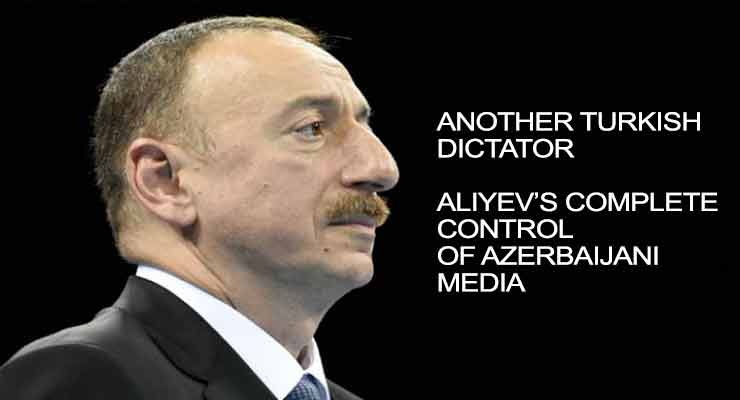
Reporters Without Borders, Online censorship rounds off Aliyev’s control of Azerbaijani media

May 4, 2017 By administrator

Reporters Without Borders famous organization has slammed the Azerbaijani authorities regarding the blocking of independent news websites in the country.

The source notes that the Azerbaijani authorities have blocked five leading independent news websites in the country for the past five weeks – newspaper Azadlig, Meydan TV and Turan TV, the programme Azerbaycan Saati and Radio Azadlig.

Recent legislative amendments gave the government the power to block any website “posing a danger to the state or society.” Ordered by the Ministry of Transport, Communications and High Technology, this “preventive” blocking requires subsequent approval by a court – a formality in a country where the justice system acts as the executive’s armed wing.

“By blocking five leading news websites, President Ilham Aliyev’s government is demolishing all the remaining vestiges of media freedom in Azerbaijan,” said Johann Bihr, the head of RSF’s Eastern Europe and Central Asia desk.

“The persecution of the government’s critics continues to intensify online, offline and even among exiles. The international community must finally end the government’s impunity and hold it to account for its systematic violations of the European Convention on Human Rights and the International Covenant on Civil and Political Rights,” the representative of the Reporters Without Borders notes.

Azadlig newspaper was forced to stop producing a print edition under pressure from the authorities in September 2016. The newspaper’s financial director, Faiq Amirov, has for the past eight months been in prison.

Several members of Azadlig’s staff , have been forced to flee the country in recent months to escape a similar fate.

Reporters Without Borders reminds that Azerbaijan is ranked 162nd out of 180 countries in RSF’s 2017 World Press Freedom Index and Aliyev, whose powers were reinforced by a referendum last September, is on RSF’s list of press freedom predators.

Filed Under: Articles Tagged With: Aliyev, Azerbaijan, control, media

People who use social media a lot are isolated, study says

March 6, 2017 By administrator

By Rachel Hosie

The longer you spend on social networks, the lonelier you’re likely to be.

You might think that social media allows us to be connected to our loved ones 24/7, but a new study has discovered that it’s actually making us feel lonelier.

The report suggests that if you spend over two hours a day on social networks, your chances of feeling socially isolated are twice as high.

The study was carried out by the University of Pittsburgh and saw researchers questioning 1,787 adults aged between 19 and 32 about their use of the 11 most popular social media sites – Facebook, YouTube, Twitter, Google Plus, Instagram, Snapchat, Reddit, Tumblr, Pinterest, Vine and LinkedIn – at the time the research was conducted in 2014.

They found that people who visit social networks over 58 times a week are three times more likely to feel lonely than those who use the sites under nine times.

It has long been suggested that social media is contributing to the rise in FOMO (fear of missing out), but this study suggests the problem may be more serious.

However it’s not clear whether social media causes loneliness, or whether it’s just that already lonely people are more likely to spend longer on social networks.

“We do not yet know which came first – the social media use or the perceived social isolation,” co-author Elizabeth Miller, professor of paediatrics at the University of Pittsburgh, said.

“It’s possible that young adults who initially felt socially isolated turned to social media. Or it could be that their increased use of social media somehow led to feeling isolated from the real world.”

The scientists allowed for demographic differences and maintained that there’s a link between social media usage and loneliness.

However as well as FOMO from events you didn’t attend, the study suggests that the longer someone spends on social media, the less time they have for real life social interactions.

As suicides and mental health issues amongst students and young adults are on the rise, the role of social media is being increasingly scrutinised.

“We are inherently social creatures, but modern life tends to compartmentalise us instead of bringing us together,” Professor Brian Primack, from the University of Pittsburgh School of Medicine, said.

“While it may seem that social media presents opportunities to fill that social void, I think this study suggests that it may not be the solution people were hoping for.”

Source: http://www.independent.co.uk/life-style/social-media-high-usage-more-isolated-lonely-people-study-university-pittsburgh-a7614226.html

Filed Under: Articles Tagged With: lonelier, media, social

Armenians from the Greater NY-NJ area Celebrating Keghart and Independent Media

February 7, 2017 By administrator

Armenians from the Greater NY-NJ area gathered at a luncheon program in January 2017 to celebrate independent Armenian media and honor the Armenian opinion and analysis website Keghart.com

Armenians from the Greater NY-NJ area gathered at a luncheon program in January 2017 to celebrate independent Armenian media and honor the Armenian opinion and analysis website Keghart.com and its principals, Publisher Dr. Dikran Abrahamian and English Language Editor Jirair Tutunjian.

Sponsored by Friends of Keghart, the program featured a Kinetson, or book dedication with wine, of Keghart: Vol. III – a compendium of editorials penned in 2015 and 2016 by the Keghart Collective.

Nearly 30 guests invited by Friends of Keghart learned about the history of Keghart and independent Armenian Diaspora media from Abrahamian and about the objectives and achievements of Keghart from Tutunjian. Keynote speaker David Boyajian, an independent journalist based in Boston, discussed a number of contemporary American and Armenian issues and how these issues shape the public’s understanding of current events. Mistress of Ceremonies Lucine Kasbarian, independent journalist and political cartoonist, introduced speakers Abrahamian, Tutunjian and Boyajian.

The overall intention of the gathering was to generate interest in ensuring the future survival of Keghart. Citing circumstances such as mounting expenses personally taken on by Publisher Abrahamian, Keghart suspended operations in September 2016.  A group of concerned individuals called Friends of Keghart stepped forward in an effort to sustain the online opinion and analysis magazine.

Keghart – the Armenian word for spear or lance, referring to that which pierced Christ – was founded in 2007 by Dr. Abrahamian.

The assassination of Hrant Dink in January of 2007 was a major motivation in starting Keghart.com. Its initial mission was to inform and educate non-Armenian audiences about Canadian and international political and human rights issues, as well as issues crucial for the global Armenian nation. However, because of the March 2008 government killings of protesters in Armenia, Keghart decided to focus primarily on Armenian issues.

In some years, Keghart.com has reached close to one million unique visitor hits. Global readers hailed from more than 80 countries, predominantly the USA, Canada, Europe, Armenia, Russia, Australia, Latin America, the Middle East, India, in that order, and occasionally from China and Japan.

In his Introduction to Keghart: Volume III, veteran journalist Douglas Kalajian pointed out, “Keghart has become a unique voice in the Armenian media because it is independent of political parties and related interests, so its writers aren’t pressured to bend the truth or to avoid offense. There is no hidden agenda. As a result, these editorials are unusually forthright and thoughtful. Reading them can be a bracing experience because none of Armenia’s problems are ever sugar-coated by the Keghart team: corruption in government, corruption in the church, the underhandedness of Armenia’s enemies, the treachery of Armenia’s supposed allies.”

The Ontario-based Abrahamian explained to the luncheon attendees the history of independent media in the Armenian Diaspora leading up to the establishment of Keghart.  Abrahamian defined “independent” media as “not being beholden to any political organization, having the luxury of providing equal opportunity to various opinions, and reporting events as they occur without bending them to fit a certain political or other agenda(s).”  Abrahamian used the term “Armenian Diaspora” to refer primarily to the foreign nations to which Armenians were dispersed after the 1915-23 genocide.

He spoke of the legacy and necessity of independent Armenian media, citing among them predecessors such as Antranig Zaroukian’s Nayiri, Simon Simonian’s Spurk (Diaspora), Yeridasart Hay (Young Armenian), the early editions of AIM and others.

Abrahamian’s capstone message urged Armenians and others to utilize Keghart as a free marketplace of ideas in the Armenian struggle to spread truth in a media world tainted with propaganda and falsehood.

The Toronto-based Tutunjian, an award-winning newspaper and magazine journalist, spoke of his experiences with and contributions to Keghart. Upon joining Keghart, he surveyed editorials that had appeared in a dozen or so Diaspora Armenian publications. Tutunjian found that many of their articles were overly partisan as the publications were owned by political parties.

(L-R) David Boyajian, Jirair Tutunjian, Dikran Abrahamian & Mcee Lucine Kasbarian

The pieces lacked punch and there were often not enough “calls to action.”  Abrahamian and Tutunjian decided that Keghart editorials would stand out by being hard-hitting and addressing topics that most Diaspora papers hadn’t touched. They wanted Keghart’s editorials to emphasize independent thought and non-partisan approaches.

Tutunjian said that Keghart editorials had another aim: to provide readers the English words, phrases, memes and facts which readers could use to present the Armenian Case to non-Armenians to rebut Turkish propaganda.

While Tutunjian could not be certain of the demographics of Keghart readers, he followed his gut feeling about what readers might respond to. His guess turned out to be accurate. Keghart soon began to receive many letters. Many agreed with the stands taken in Keghart editorials. Those who didn’t were the trigger for stimulating exchanges among readers. Keghart discovered a “virtual political party” of Armenians… from such places as Sydney, Beirut, London, Switzerland, Honduras and Chile.

They comprised readers who were unhappy with the Armenian status quo and welcomed Keghart’s independence with open arms.  Keghart became an open market for constructive ideas about the Armenian world. Issue after issue, readers could see that Keghart provided a forum that aired ideas with which Keghart didn’t necessarily agree.  If a letter or article were coherent, made interesting points and wasn’t abusive, Keghart would publish it, uncensored.

David Boyajian talked about several popular topics that the American media had discussed in the previous months, such as: “fake news,” media bias and conspiracy theories.

Boyajian also assessed the performance of journalists of Armenian descent who reported on Armenian topics in non-Armenian mainstream media. He said that they were generally a disappointment but that their editors and supervisors were probably responsible because the latter were usually uninterested in, or unfriendly towards, Armenian topics.

Boyajian cited his favorite Keghart editorials in categories from the practical to the historical, the political and the humorous.  He also talked about “Heroes & Villains” –  among his favorite recurring features in Keghart –  which annually singles out commendable and condemnable newsmakers in the global and Armenian worlds.

Boyajian also praised Keghart for taking up activist causes, hosting panel discussions and organizing public polls.  In describing Keghart’s unique position in the Armenian media universe, Boyajian said: “Keghart has a point of view: it’s frankly Armenian.  It vigorously defends Armenian interests.  It does not hesitate to critique – but in a fair way –  the Armenian community, its leaders, the church, Armenia, and Artsakh  –  ­but also seeks to improve Armenian life, not beat it down. I truly cannot think of any other Armenian website that has editorials with such erudition, imagination, and wit.”

Emcee Kasbarian praised Keghart for a series of articles that contained practical suggestions and guidelines to Armenian article and letter writers who wished to reach non-Armenians about the topic of the 2015 Genocide Centennial. Keghart sent these to every Armenian church and organization for which Keghart possessed email addresses with a request that they republish them in their newsletters.

Kasbarian also cited a memorable instance of media analysis and criticism in which Tutunjian excoriated Western media outlets for their dishonest coverage of the April 2016 Azeri attacks on Artsakh.

In his editorial titled “The First Casualty,” reprised on p. 177 of Keghart: Vol. III, Tutunjian recited, chapter and verse, the typical falsehoods carted out by mainstream media.  A modified version of his editorial was sent to – and appeared in –  15 non-Armenian independent and alternative media outlets.

Kasbarian concluded, “We cannot afford to lose Keghart.”

Friends of Keghart took up the mission to continue Keghart’s successful publication and expand its reach with professional editors and technical personnel at the helm.  In October 2016, an online appeal issued by Dr. Berge Minassian raised over $22,000 in donation pledges. In connection with this Kinetson, donation pledges of more than $4,000 have been collected to date.  When a new Keghart gets off the ground, a new guard of non-partisan individuals intend to approach those who pledged to fulfill their intentions to donate and discuss ways and means to remain self-sustaining.

Before ceremoniously pouring wine onto an open Keghart Vol. III, writer C.K. Garabed performed the Kinetson saying, “I dedicate this publication, in friendship, to all those free and independent spirits who refuse to be coerced into believing that they see the Emperor’s New Clothes when their eyes clearly tell them otherwise.”

The guest speakers were presented with gifts as thanks for their dedication and service.

To ensure the future survival of Keghart, Kinetson attendees suggested starting an online crowd-funding campaign through KickStarter.com or similar websites, establishing non-profit status, and engaging auditing firms to handle budgetary issues.

Friends of Keghart invites further suggestions and ideas from supporters and readers as it moves forward with garnering support for this unique and beloved online analysis and opinion magazine.

Additional donation pledges (not checks at this time) may be sent to Dr. Berge Minassian at: berge.minassian@sickkids.ca or Lucine Kasbarian at: editor@lucinekasbarian.com.

Keghart: Volumes I, II and III are downloadable on Keghart.com.

Publisher’s Note

Dr. Minas Kojayan could not attend the kinetson. As the Armenian language primary editor of Keghart.com, he has been one of the pillars of the website. A veteran editor and teacher, Armenologist Dr. Kojayan has taken the pulse of the Armenian Diaspora through his well-informed and brilliantly-penned articles providing practical solutions to the challenges the Diaspora faces.

Filed Under: Articles, Events Tagged With: Armenian, independent, Keghart, media

HRW accuses Turkey of ‘silencing’ 140 media outlets and 29 publishing houses had been shut down

December 15, 2016 By administrator

Human Rights Watch (HRW) has accused the Turkish government of silencing independent media in an attempt to block scrutiny or criticism of Ankara’s large-scale crackdown on dissidents following an abortive July 15 military coup.

The New York-based rights group said in a report on Thursday that Turkey’s “assault” on critical journalism had accelerated after the putsch and that journalists had described the atmosphere in which they work as “stifling.”

The watchdog said some 140 media outlets and 29 publishing houses had been shut down since mid-July under post-coup emergency decrees, leaving over 2,500 journalists and media workers without jobs.

Accusing Ankara of using the criminal justice system as a tool against the media, the HRW also said the government in Turkey interfered with editorial independence and forced outlets to dismiss critical journalists.

“Keeping 148 journalists and media workers in jail and closing down 169 media and publishing outlets under the state of emergency shows how Turkey is deliberately flouting basic principles of human rights and rule of law central to democracy,” said Hugh Williamson, the Europe and Central Asia director at the HRW.

The Thursday report was based on interviews with 61 journalists, editors, lawyers, and press freedom activists as well as on reviews of court documents. It came after another report by the non-governmental media rights group Reporters Without Borders (RSF) earlier this week, which said Turkey had become the “world’s biggest prison for the media profession.”

Filed Under: Articles Tagged With: hrw, media, silencing, Turkey

Terrorist State of Turkey has closed down 15 more media outlets and dismissed over 10,000 civil servants

October 30, 2016 By administrator

media-closer

Turkey shuts down Kurdish media, fires civil servants

Turkey has closed down 15 media outlets and dismissed over 10,000 civil servants as the Ankara government widens its crackdown on opposition following the abortive July 15 military coup.

The closures and dismissals were ordered in two new decrees issued under a state of emergency on Saturday, Turkish media reported on Saturday.

Academics, teachers and health workers were among those removed over their suspected links with US-based opposition cleric Fethullah Gulen, blamed by Ankara for orchestrating the failed putsch. Gulen denies the accusation.

This is while almost all of the 15 media outlets, which were shut down, reported from Turkey’s largely Kurdish southeast.

Additionally, the decrees ordered restrictions on lawyers’ ability to privately meet with their clients. They further stipulate restructuring the appointment of university rectors through abolishing elections and allowing Turkish President Recep Tayyip Erdogan to directly appoint the rectors from the candidates nominated by the Council of Higher Education.

The coup began when a faction of the Turkish military declared it was in control of the country and the government of Erdogan was no more in charge.

Tanks, helicopters, and soldiers clashed with police and people on the streets of Ankara and Istanbul. Over 240 people were killed on all sides in the attempted coup d’état.

The state of emergency was first imposed a few days after the putsch bid. It was extended for another 12 weeks earlier this month.

The government in Ankara has launched a suppression campaign on those believed to have played a role in the failed coup, in a move that has sparked criticisms from human rights groups.

It has shut down over 160 media outlets, formally arrested more than 37,000 people and sacked or suspended 100,000 civil servants, judges, prosecutors, police and others.

Filed Under: Articles Tagged With: Kurdish, media, shuts down, Turkey

Erdogan Terrorism on Media Turkey’s post-coup crackdown sparks democracy fears

October 9, 2016 By administrator

erdogan-terrorismA dozen police officers, joined by officials from Turkey‘s treasury and the county’s broadcasting watchdog, marched into the pro-Kurdish IMC-TV television station, sealed off its control rooms and forced the channel off the air during a live program on democracy, the Associated Press reports.

The station had anticipated the raid ever since the government, using powers it acquired by declaring a state of emergency in the wake of the July 15 coup attempt, last week ordered IMC-TV and 22 other broadcasters to shut down.

The bold act of censorship nonetheless stunned staff members Tuesday in the channel’s studio.

“Long live hell for the oppressors!” IMC-TV coordinating editor Eyup Burc shouted during the live broadcast. “We stand against coups and we stand against those who use coups to carry out their own coup.”

As Turkey prepares to extend by another three months the state of emergency it imposed after July’s failed military coup, critics fear President Recep Tayyip Erdogan is using the uprising as an excuse to silence his detractors.

The government says it needs more time to eradicate a network linked to U.S.-based Muslim cleric Fethullah Gulen, which the government accuses of orchestrating the attempted coup. But Turkey already has used the emergency powers to carry out an unprecedented purge of people suspected of links to the cleric and has extended the crackdown to go after Kurdish and left-leaning media outlets.

Comments Erdogan made this month suggesting the state of emergency could last as long as a year have reinforced concerns about the president’s aims. Kemal Kilicdaroglu, the leader of the main opposition Republican People’s Party, has accused the government of leading a “counter-coup.”

The state of emergency allows the government to rule by decree with limited parliamentary involvement. Some 32,000 people allegedly connected to the coup have been arrested, while tens of thousands of teachers, soldiers, police officers, judges and prosecutors have been dismissed or suspended from government jobs for suspected links to Gulen, who denies any involvement in the coup attempt.

Hundreds of schools and foundations run by the movement, which the government has listed as a terror organization, have been shut down or taken over. Media outlets once owned by Gulen have been closed down while prominent journalists they employed have been arrested.

Authorities more recently have moved against pro-Kurdish and leftist groups, using a government decree to dismiss 11,000 left-leaning teachers and to force off the air television and radio stations accused of acting as mouthpieces for the Kurdistan Workers’ Party, or PKK.

Among them was a children’s television station broadcasting cartoons in the Kurdish language.

“Fears that the government would make opportunistic use of the state of emergency to silence critics who have nothing to do with the July 15 coup attempt have come true,” said Emma Sinclair-Webb, the Turkey director for Human Rights Watch.

More than 100 journalists have been arrested since the state of emergency was declared and thousands lost their jobs or had press credentials canceled by the government, according to the Journalists’ Association of Turkey. Human Rights Watch said the clamp down on broadcasters “effectively ends critical television news reporting in Turkey.”

The suppression of critical voices has not been limited to news organizations.

Novelist Asli Erdogan, who wrote for the Ozgur Gundem daily newspaper, was arrested on charges of membership in an armed terror organization. Also rounded up was singer Atilla Tas, who had acquired a large social media following for his humorous criticisms of Erdogan and the government.

“What the uniformed coup plotters could not achieve on July 15, (the government) has achieved by extending the state of emergency,” Republican People’s Party legislator and spokeswoman Selin Sayek Boke said. “They usurped the parliament’s most basic powers of enacting laws on behalf of the people.”

IMC-TV, which promotes Kurdish and other minority issues, also was ordered shut down for alleged links to the PKK. Like the Gulen movement, the Kurdistan Workers’ Party is outlawed as a terrorist organization by the Turkish government.

The station, which rejects the accusation, already was removed earlier this year from Turkey’s largest satellite platform for allegedly engaging in “terrorist propaganda.” It was operating through another satellite and via the internet before this week’s raid.

“The state of emergency allows them to make these accusations without any proof and without taking any one to court,” IMC-TV News Director Hamza Aktan, who was in the station’s control room at the time of the raid, told The Associated Press. “Channels they do not like and who do not follow their line are easily being disposed of.”

Nebi Mis, the political research director at the pro-government Foundation for Political, Economic and Social Research think tank in Ankara, defended the purges.

“Those who carried out the July 15 coup not only infringed on human rights, but also on the people’s right to life. A policy of full purification is necessary,” Mis said.

Silencing Kurdish media outlets also was appropriate since the state of emergency encompasses other outlawed organizations, he said. Yet authorities may have “gone overboard” in some cases by going after media outlets that criticize the government, Mis said.

Erdogan and other officials acknowledge that some innocent people have been caught up in the upheaval. The government has promised to set up centers to process claims of unfair dismissals.

Related links:

AP. Turkish post-coup crackdown sparks democracy fears

Filed Under: Articles Tagged With: Erdogan, media, terrorism

Putin take on western Media Warns Journalists of War: ‘I Don’t Know How to Get Through to You People’ (Video)

July 6, 2016 By administrator

putin take on West‘How do you not understand that the world is being pulled in an irreversible direction?’

Vladimir Putin has finally taken the kid gloves off.

The Russian president was meeting with foreign journalists at the conclusion of the Saint Petersburg International Economic Forum on June 17th, when he left no one in any doubt that the world is headed down a course which could lead to nuclear war.

Putin railed against the journalists for their “tall tales” in blindly repeating lies and misinformation provided to them by the United States on its anti-ballistic missile systems being constructed in Eastern Europe. He pointed out that since the Iran nuclear deal, the claim the system is to protect against Iranian missiles has been exposed as a lie. 

The journalists were informed that within a few years, Russia predicted the US would be able to extend the range of the system to 1000 km. At that point, Russia’s nuclear potential, and thus the nuclear balance between the US and Russia, would be placed in jeopardy. 

Putin completely lost patience with the journalists, berating them for lazily helping to accelerate a nuclear confrontation by repeating US propaganda. He virtually pleaded with the western media, for the sake of the world, to change their line:

We know year by year what’s going to happen, and they know that we know. It’s only you that they tell tall tales to, and you buy it, and spread it to the citizens of your countries. You people in turn do not feel a sense of the impending danger – this is what worries me. How do you not understand that the world is being pulled in an irreversible direction? While they pretend that nothing is going on. I don’t know how to get through to you anymore.

Does anyone in the reeking garbage heap that is mainstream western media have a conscience? Do they even have enough intellect to get what Putin is saying – that they are helping to push the planet towards World War III? 

https://youtu.be/8PgSX-WD96Q

Filed Under: Articles Tagged With: media, Putin, western

  • 1
  • 2
  • 3
  • Next Page »

Support Gagrule.net

Subscribe Free News & Update

Search

GagruleLive with Harut Sassounian

Can activist run a Government?

Wally Sarkeesian Interview Onnik Dinkjian and son

https://youtu.be/BiI8_TJzHEM

Khachic Moradian

https://youtu.be/-NkIYpCAIII
https://youtu.be/9_Xi7FA3tGQ
https://youtu.be/Arg8gAhcIb0
https://youtu.be/zzh-WpjGltY


gagrulenet Twitter-Timeline

Tweets by @gagrulenet

Archives

Books

Recent Posts

  • Pashinyan Government Pays U.S. Public Relations Firm To Attack the Armenian Apostolic Church
  • Breaking News: Armenian Former Defense Minister Arshak Karapetyan Pashinyan is agent
  • November 9: The Black Day of Armenia — How Artsakh Was Signed Away
  • @MorenoOcampo1, former Chief Prosecutor of the International Criminal Court, issued a Call to Action for Armenians worldwide.
  • Medieval Software. Modern Hardware. Our Politics Is Stuck in the Past.

Recent Comments

  • Baron Kisheranotz on Pashinyan’s Betrayal Dressed as Peace
  • Baron Kisheranotz on Trusting Turks or Azerbaijanis is itself a betrayal of the Armenian nation.
  • Stepan on A Nation in Peril: Anything Armenian pashinyan Dismantling
  • Stepan on Draft Letter to Armenian Legal Scholars / Armenian Bar Association
  • administrator on Turkish Agent Pashinyan will not attend the meeting of the CIS Council of Heads of State

Copyright © 2025 · News Pro Theme on Genesis Framework · WordPress · Log in