Gagrule.net

Gagrule.net News, Views, Interviews worldwide

  • Home
  • About
  • Contact
  • GagruleLive
  • Armenia profile

Kurdish People rise up against the government in Barzani Kurdistan

December 18, 2017 By administrator

People are taking to the streets in Southern Kurdistan and calling on the government to resign. KDP forces are opening fire on protesters.

Everywhere has turned into a scene of protest in Southern Kurdistan as people have taken to the streets in masses in Sulaymaniyah, Halabja, Seyidsadiq, Ranya, Qeladiz, Sengeser, Derbendîxan, Kelar, Teqteq and Chamchamal. People are calling on the government to resign due to ongoing problems such as non-provision of service to the people, non-payment of salaries and corruption.

HEWLÊR

Asayish forces of the Kurdistan Democratic Party (KDP) attacked the demonstrators with rifle butts and sticks in Hewlêr’s Rewandiz district. Several people were detained or injured as a result of the crackdown.

SULAYMANIYAH

Demonstrators set the KDP office on fire in the town of Piremegrun in Sulaymaniyah’s Dukan district. Calling for the government’s resignation, people were attacked by the attacks of asayish (public security) forces in several areas. Thousands chant slogans in English, Kurdish and Arabic calling for “an end to 26-year reign”.


Large numbers of teachers, workers and citizens have gathered in Sera, Sulaymaniyah and marched to the KDP office on Salım Avenue in protest at the practices of the government.

Asayish forces blocked the demonstrators on Mewlewi Avenue and attacked them with tear gas and opened fire into the air in an effort to disperse the mass.

People gathered in front of the KDP office are calling on the KRG to resign, highlighting electricity, water and salary issues.

KDP OFFICES STONED

In Sulaymaniyah’s Seyiqsadiq district, demonstrations continue since early morning hours. Protestors stoned the KDP offices in the district, after which party members left offices and security units opened fire on the people, forming a line of guard around offices. Some citizens have been injured during the ensuing turmoil.

“OUR PROTESTS WILL CONTINUE”

In Sulaymaniyah’s Chamchamal district, people state that their protests against the government will continue until their demands are met. District Governor Remk Remezan called for common sense against acts of violence.

GERMIYAN

In Germiyan’s Kelar district, demonstrators led by teachers and public servants gathered at Leyla Qasim Park, stressing that the government is no more legitimate.

Arî Ezedîn said the following on behalf of the teachers; “As all segments of the society, we do no more accept these conditions Southern Kurdistan is under. This situation cannot be defended anymore, for which reason we decided to stage mass protests. We are here to end this reign which has no legitimacy left. We will defend the power of the people. People must make their decisions themselves.”

CRACKDOWN ON PEOPLE

As demonstrations continue, security forces are reportedly opening fire on protestors. Some people were reportedly injured as a result of KDP asayish’s attack in Rewandiz.

Filed Under: Articles Tagged With: Barzani, Kurd, uprise

KRSC Representation in the United States report Alarming Iraqi military buildup near Makhmour

December 18, 2017 By administrator

The Kurdistan Region Security Council (KRSC) is alarmed by significant Iraqi military buildup in the vicinity of Makhmour, south west of Erbil, in preparation for an attack on nearby Peshmerga positions.

Intelligence from the last five days indicates that Iraqi Army, PMU, Federal Police and ERD deployments plan to attack the Gwer-Dibege-Dibis road connecting Mosul to Kirkuk.

Peshmerga forces withdrew from Makhmour in October to the current position to avoid military clashes with Iraqi forces. The KRG calls on the Iraqi Government to stop its provocative advances.

Filed Under: Articles Tagged With: buildup, Iraq, Kurd, military

Erdogan: Syrian Kurds will be cleansed from Turkey’s border

December 18, 2017 By administrator

Turkish President Recep Tayyip Erdogan said he will eliminate Kurdish “terrorists” from the Turkey-Syria border referring to the US-backed People’s Protection Units (YPG) in northern Syria

“We will clean Afrin of terrorists, we will clean Manbij of terrorists. We will clean Tel Abyad, Ras al-Ayn and Qamishli of terrorists,” Erdogan said at a meeting with the ruling Justice and Development Party (AKP) on Sunday in the central province of Karaman, state media Anadolu Agency reported.

The YPG claimed on Wednesday that they killed two Turkish soldiers and wounded others trying to cross the border near Kobane.

The Syrian Kurdish force said the Turkish forces tried to “transgress” the border near the village of Ashme, west of Kobane, in the early hours on Wednesday.

The YPG and the female YPJ responded in force that resulted in blowing up a military vehicle “full of ammunition that caused the death of two Turkish soldiers” and wounded an unspecified number of other soldiers, a YPG statement read.

Turkey did not immediately confirm the incident or the casualties.

Turkey has constructed a wall along its border with Rojava, Syrian Kurdistan mainly to prevent movements of the YPG forces across the border.

It considers the YPG and its umbrella organization, the US-backed Syrian Democratic Forces (SDF), as an extension to the Kurdistan Workers’ Party (PKK), a named terrorist organization by Turkey, the US and the EU.

The YPG and SDF deny any connection to the PKK.

Erdogan declared in late November after an exchange of fire between Turkish military and the YPG across the Afrin-Idlib border that they will “cleanse Afrin of the structure there called the YPG terrorist organization.”

The YPG have regularly reported exchanges of fire with Turkish forces in the Afrin area, accusing the Turks and their allied Syrian militias of daily attacks.

“They are not going to be able to seize a tiny part of our land,” the YPG stated last month, vowing to defend Afrin.

Turkey began military operations in Idlib province in October in order to monitor a ceasefire and establish a de-escalation zone under agreements reached in Astana by Turkey, Russia, and Iran.

Turkey is also using the mission to observe the Kurdish canton of Afrin, north of Idlib. Kurdish forces say the Turks have frequently fired at their positions and civilian locations in Afrin.

The YPG is the dominant force within the US-backed SDF battling ISIS in northern Syria and were successful in liberating Raqqa in June from the militant group.

Source: http://www.rudaw.net/english/middleeast/turkey/18122017

Filed Under: Articles Tagged With: cleansing, Kurd, Turkey

Kurds claim Turkish airstrike targeted refugee camp in Iraq

December 8, 2017 By administrator

Amberin Zaman

A mysterious explosion near a refugee camp harboring thousands of displaced Turkish Kurds has killed five members of a Kurdish militia and injured three others amid claims that Turkey was responsible for the alleged attack.

The administrative council for the Makhmour camp, southwest of Erbil, claimed late Wednesday’s blast was caused by an airstrike carried out by Turkey. The council, which is believed to have close ties to the outlawed Kurdistan Workers Party (PKK), said, “It is significant that a camp under the protection of the United Nations, located in the middle of Iraqi territory was attacked. The Federal Iraqi State, the Kurdistan Regional Government and the UN will be clearly implicated until they issue convincing explanations on the matter.” But the statement failed to specify by what means Turkey had conducted the alleged aerial attack.

Kurdistan 24, an Iraqi Kurdish media outlet, claimed the camp had been struck by a rocket but also did not explain how it may have been launched. Earlier reports suggested the explosion was caused by a car bomb.

Turkey and Iraq have not responded to any of the accusations so far. The United Nations High Commissioner for Refugees, which provides assistance to the camp, has not commented either.

Leyla Arzu Ilhan, a former co-chair of the Makhmour Council, backed the claims of an airstrike. She told Al-Monitor, “Residents saw a flash in the sky then heard a loud explosion, so this points to an aerially launched device.” Ilhan said a structure housing local self-defense forces that were established after Islamic State militants attacked Makhmour as they swept across Iraq in the summer of 2014 had been targeted.

“Much of the building collapsed and we have been clearing debris to rescue two of our friends who were stuck under the rubble,” Ilhan said. “Now that we have buried our dead we will undertake a further exhaustive search of the debris for evidence.”

Ilhan acknowledged that an initial search around the site of the blast had yielded no material evidence that could help determine its source. She agreed that IS may have been responsible.

IS militants have used armed drones to attack Iraqi forces and the Kurds, be they in Iraq, Syria or Turkey, are among their archfoes. But Ilhan insisted that Turkey was the more likely culprit. She speculated that the alleged Turkish attack was meant to pressure the PKK into freeing two Turkish intelligence operatives who were netted in a sensational sting operation in September as they met with their moles near the town of Dukhan in Iraqi Kurdistan. “We can’t be sure but it’s a distinct possibility,” she told Al-Monitor. The men remain in PKK captivity despite protracted efforts on the part of MIT chief Hakan Fidan to secure their release.

A Kurdish-Turkish politician living in self-imposed exile in Europe took a different view. He argued that the attack was part of a broader pattern of emerging cooperation between Turkey, Iraq and Iran against the Kurds. The politician, who spoke on condition of strict anonymity, told Al-Monitor, “Ever since the referendum [on Kurdish independence] we have seen signs of these three countries reverting to their old ways of ganging up against the Kurds.” The politician predicted that “it is only a matter of time before Turkey and Syria reconcile and do the same,” pointing to last month’s wave of Turkish airstrikes against Asos Mountain on the Iraq-Iran border.

Turkey periodically rains bombs on PKK bases in the Qandil Mountains but the attack against Asos was a first. The pro-PKK Firat news agency claimed the strikes occurred after Iranian drones scouted the area and then passed on target coordinates to Turkey.

Makhmour has long been a Turkish bugbear because of PKK entrenchment there and every so often rumors surface of an imminent Turkish attack against the camp.

Many of Makhmour’s residents began fleeing military brutality in Turkey in the early 1990s, when the blood-soaked PKK-led Kurdish insurgency was at its peak. The militants have a firm grip over the camp, where giant images of imprisoned PKK leader Abdullah Ocalan are commonplace.

Some Western aid workers caustically refer to the place as a rest and recreation center for PKK fighters pausing from their ongoing battle against Turkish forces for self-rule inside Turkey. With its sand-colored cinderblock dwellings, multiple schools and convenience stores, the dusty settlement looks more like a small town than a camp.

Repatriating an estimated 14,000 Turkish Kurds who live in the desolate desert outpost was envisaged under now stalled peace talks between the Turkish government and the PKK. With few prospects of them resuming, it seems they will be stuck there for the foreseeable future.

Found in:


Filed Under: Articles Tagged With: airstrike, Kurd, refugees, Turkish

Pentagon ‘taking a look’ at halting weapons for Syrian Kurds as Turkey presses ban

November 28, 2017 By administrator

By Ellen Mitchell

The Defense Department on Monday said it is reviewing the process it uses to provide equipment and weapons to Kurdish fighters with the Syrian Democratic Forces (SDF) but has not halted sending weapons.

Pentagon spokesman Col. Robert Manning told reporters that the department is “reviewing pending adjustments to the military support provided to our Kurdish partners in as much as the military requirements of our defeat-[Islamic State in Iraq and Syria] and stabilization efforts will allow us to prevent ISIS from returning.”

Turkey’s foreign minister said Friday that President Trump committed to Turkish President Recep Tayyip Erdogan that the United States would no longer supply arms to Syrian Kurdish fighters.

Turkey considers the SDF Kurds, known as the YPG, to be an extension of outlawed Kurdish insurgents within its country, the Kurdistan Workers Party.

“Mr. Trump clearly stated that he had given clear instructions and that the YPG won’t be given arms, and that this nonsense should have ended a long time ago,” Turkish Foreign Minister Mevlut Cavusoglu said in a news conference last week.

The White House later released a statement that confirmed the topic was touched on but would not commit to a full-on ban.

Filed Under: Articles Tagged With: Erdogan, Kurd, tyrump, weapons

Iraq’s Christians ponder future in wake of Kurdish independence vote

October 25, 2017 By administrator

Omar Sattar,

BAGHDAD — The Chaldean Catholic Patriarch Louis Rafael Sako, in an Oct. 16 press interview, expressed his concern that the Kurdish crisis would put at risk the Christians’ presence in Iraq. He said the current conflict in the disputed areas between Baghdad and Erbil would impede the Christians’ return to their areas, and prompt Christians to rush to leave their country for good.

Sako appealed to Christians to unite their ranks and engage in dialogue to preserve the Christian component in Iraq. Nevertheless, the church’s calls for a dialogue that would have Iraq’s Christians discuss the future of “the Christian component” may not gain much traction because of the great divide among this religious grouping, particularly following the referendum on independence for the Kurdistan region that took place Sept. 25.

There are three main political stances among Christians. Ryan Chaldean, the leader of the Popular Mobilization Units’ (PMUs) Babylon Brigade, represents Christians close to the Shiites and federal authority. They are committed to Iraq’s unity and oppose the secession of Kurdistan, where the largest part of the Christian minority in Iraq lives.

Furthermore, there are those Christians who favor secession and becoming part of a Kurdish state. They are made up of a large number of Assyrian and Syriac parties, most notably the Chaldean Syriac Assyrian Popular Council.

The third stance is expressed by those who say there is a need for Christians to have an internationally sponsored special status within a federal Iraq. Sako is one of them.

There are an estimated 450,000 Christians in Iraq, mainly in Dahuk and Erbil provinces in the Kurdistan region and in Alqosh and Bartella in the Ninevah Plains in Ninevah province. There are also are some Christians in Baghdad and other Arab-majority provinces.

People in Christian areas were subject to captivity and forced displacement after the Islamic State (IS) seized parts of northern and western Iraq in 2014, particularly Mosul. This caused a majority of Christians to move to the Kurdistan region in the past three years. Earlier, other Christians had fled to the Kurdistan region as sectarian violence erupted in Baghdad. Presently, they hold an important card in the Iraqi-Kurdish equation, and many Christians voted in the referendum on Kurdish independence.

Halan Hermez, a member of the Chaldean Syriac Assyrian Popular Council, told Al-Monitor, “Christians are an important component in the Kurdistan region. They are even the indigenous people of this territory. Based on that, taking part in the referendum on the Kurdistan independence was imperative.”

Hermez, who is also a member of the Supreme Council for the Kurdistan Region Referendum, said, “The vast majority of this Christian component is in favor of the independence, as they were subjected to killings and displacements in the rest of the Iraqi areas. This is while they have found security and stability in Kurdistan.”

Commenting on the Chaldean Syriac Assyrian Popular Council’s perception of Christians’ future, Hermez said, “An independent region within the Kurdish state is what we seek. In case independence does not succeed, we seek to have a province that includes the Ninevah Plains established, provided that this province be within the Kurdistan region.”

Of note, Christians do not form a majority in all areas where they have a strong presence, particularly outside the Kurdistan region. For instance, Christians make up about 15% of the Ninevah Plains population, while the Yazidis consist of nearly 40%. The Shabak people represent 25% and Arabs 20%. In addition, there are 65,000 Christian citizens in Qaraqosh, also known as Hamdaniya, alongside 175,000 Shabak and Kurdish people in the Ninevah province.

There are about 25,000 Christian citizens out of 175,000 people in Tel Keppe district, while there are 7,000 Christians out of 37,000 people in the Shekhan district. Both are in Ninevah.

Based on that, Joseph Saliwa, a Christian member of the Iraqi parliament for the al-Warka bloc, said, “It is not to the Christians’ advantage to have a region established at present or to support the Kurdistan region’s secession from Iraq.” He told Al-Monitor, “The referendum has ignited many crises within the country and problems with neighbors and the rest of the world’s countries. It is not in the advantage of a minority, such as the Christian minority, to be involved in that.”

Saliwa said, “The establishment of a new province affiliated with the Baghdad central government is the most suitable solution for Christians — a province that would include the Ninevah Plains, and all of its neighboring areas inside and outside the region. It would also accommodate the area’s other components, such as the Shabak people and Yazidis, under the umbrella of the international community. It would be a province that would become a model of development in Iraq.”

He said, “The Iraqi Cabinet had previously decided to turn the Ninevah Plains into a province. We will be seeking to activate such a decision in parliament.”

He said, “Significant pressure placed on Christians by parties in control of their areas is behind the differing Christian stances.”

The Babylon Brigades’ Ryan Chaldean opposed the referendum and Christians’ secession from Iraq. He also rejected the idea that they should be given special status. He argued in Oct. 13 statement that Kurdish authorities are “further entrenching the Kurdish character” in the Kurdish areas, adding that the independence issue is like “a fire” ignited in Iraq.

Iraqi Christians’ pursuit of living in security and having their civil rights safeguarded exceeds their search for a political and administrative independence. This is due to the harassment they have suffered at the hands of armed groups and militias, as well as their political exploitation by various Iraqi parties that view the minority card to be of a major importance in acquiring land and obtaining international support and sympathy.

In order for minorities, particularly the Christian minority, to have a special status or have their social and security problems resolved, they are required to take part in a “historic” political settlement that may require that amendments be added to the Iraqi constitution, that ensures security, guarantees political stability and puts a halt to the demands that independence be achieved and a region be established.

Filed Under: Articles Tagged With: Christian, Iraq, Kurd

Report: Iraqi forces have captured oil fields and a military base held by Kurdish forces Kirkuk

October 16, 2017 By administrator

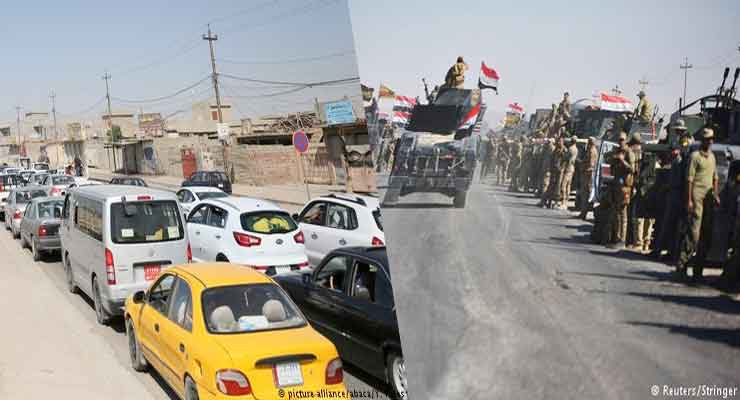
Iraqi forces have captured oil fields and a military base held by Kurdish forces near the oil-rich city of Kirkuk. The US, which backs both sides, urged their allies to deescalate the explosive situation.

raqi security forces and allied Shiite militia clashed with Kurdish peshmerga forces Monday around Kirkuk, an oil-rich area at the heart of disputes between the two sides.

Tensions between the two sides have escalated since the the Iraqi Kurds overwhelmingly voted last month for an independent state in a non-binding referendum, which controversially included disputed territories such as Kirkuk.

Iraqi government and Iran-backed Shiite militia, known as Popular Mobilization Units (PMU), advanced to take control of oil fields, the airport and the strategically-important K1 military base in and around Kirkuk city, Iraq’s Joint Operations Command said.

Iraqi state TV reported that Iraqi forces had taken control of “vast areas” outside of Kirkuk city.

Kurdish peshmerga forces reportedly retreated back from positions outside the city, but were setting up defenses in the city as thousands of civilians fled in cars north to Erbil and Sulaymaniyah.

Prime Minister Haider al-Abadi ordered security forces “to impose security in Kirkuk in cooperation with the population of the city and the peshmerga.” He said that instructions were given for forces to stay out of the city.

The Kurdistan Region Security Council claimed peshmerga had destroyed several US-supplied Humvees belonging to the PMU.

Hemin Hawrami, an adviser to Kurdish President Masoud Barzani, quoted the peshmerga command as saying Abadi’s government would “pay a heavy price” for the assult on Kirkuk.

The US Defense Department, which has supplied and trained both the peshmerga and Iraqi army, urged its two allies in the war against the “Islamic State” (IS) “to avoid additional escalatory actions.” It added that it opposed destabilising actions that distract from the battle against IS militants.

The Iraqi troops and the Kurdish peshmerga fighters have been engaged in a standoff since Saturday, when they took positions on opposite banks of a river on the southern outskirts of the city of Kirkuk.

The Kurdish forces were given a deadline of 2 a.m. local time Sunday (2300 UTC Saturday) to surrender their positions and return to their pre-June 2014 positions.

Filed Under: Articles Tagged With: Iraq, kirkuk, Kurd

The Accidental Martyr Book by Hamma Mirwaisi with Douglas M Brown

October 11, 2017 By administrator

The Accidental Martyr

The Accidental Martyr

How and Why Sakine Cansiz Survived Torture, Led Women in Combat and Was Murdered for Kurdish Freedom

Authored by Hamma Mirwaisi, with Douglas M Brown


The life of Sakine Cansiz mirrors the history of the Kurdish People. To become known as an active champion of human rights, democracy and feminism, she had to be tortured, to receive more wounds as an active soldier in a vicious guerrilla war, ad to become an assassin’s target. For the Kurds to get any attention, they’ve had to be gassed by Saddam Hussein or invaded by ISIS. Now the world can see them as the only effective fighters against ISIS, and see their success in establishing truly democratic communities in a region that knows only oppressive rulers. Who are they? What do they want? Why can’t they have a country?


“Kurdish-American writer Hamma Mirwaisi uses the 2013 execution-style murder of Kurdish feminist activist Sakine Cansiz in Paris as a launching point to explain Kurdish history, Kurdish aspirations, and the Kurds’ insurgency against Turkey – a conflict measured not in decades but in centuries. Whatever one;s perspective, one thing is clear: neither the Kurds nor the PKK can be ignored any longer. The Accidental Martyr may infuriate Turkish nationalists and frustrate diplomats, but it is a must-read to understand where the PKK has been and where Syria and Turkey’s Kurds may be going”.
(Michael Rubin, Resident Scholar, American Enterprise Institute).

Publication Date: Sep 23 2017
ISBN/EAN13: 1976050146 / 9781976050145
Page Count: 204
Binding Type: US Trade Paper
Trim Size:7″ x 10″
Language:English
Color:Black and White
Related Categories: History / Middle East / Turkey & Ottoman Empire
About the author:
Hamma Mirwaisi joined the Iraqi pershmerga as a teenager after Saddam Hussein closed the Kurds’ schools. He later emigrated to the US, earned a Master’s degree in Electrical Engineering and spent his career working on US Air Force projects. He returned to Iraq as a US Army interpreter. Today he lives in Florida, where he writes about the history of the Kurds and why they want to be free.


Filed Under: Articles, Books Tagged With: Hamma Mirwaisi, Kurd, The Accidental Martyr

Erdogan says Israel’s Mossad spy agency has played a role in the recent Kurdish independence referendum

October 1, 2017 By administrator

Turkish President Recep Tayyip Erdogan speaks at a meeting in Istanbul on September 25, 2017. (Photo by the Turkish Presidential Press Service)

Turkish President Recep Tayyip Erdogan says Israel’s Mossad spy agency has played a role in the recent Kurdish independence referendum in northern Iraq.

During a televised speech in the eastern Turkish city of Erzurum on Saturday, Erdogan expressed sorrow that Iraqi Kurds had acclaimed the recent independence referendum with Israeli flags.

“This shows one thing, that this administration (in northern Iraq) has a history with Mossad, they are hand-in-hand together,” Erdogan said.

“Are you aware of what you are doing? Only Israel supports you,” he added.

The Kurdistan Regional Government (KRG) held a non-binding referendum on secession from Iraq in defiance of Baghdad’s stiff opposition on September 25. Kurdish officials said over 90 percent of voters said ‘Yes’ to separation from Iraq.

While much of the international community, including the UN, the European Union and Iraq’s neighbors, has opposed the referendum, Israel has been the only entity to openly support an independent Kurdish state, with Prime Minister Benjamin Netanyahu backing “the legitimate efforts of the Kurdish people to attain a state” of their own.

Erdogan vowed that Iraq’s Kurdistan “will pay a price” for the “unacceptable” independence referendum.

“An independent state is not being founded in northern Iraq, but on the contrary a continuously bleeding wound is being opened,” he said.

“To ignore this reality benefits neither us, nor our Kurdish brothers in Iraq,” Erdogan said, urging Iraqi Kurds to “wake up from this dream” of independence.

Ankara has threatened a series of punitive measures against Iraqi Kurds, including shutting the land border between Turkey and the region and stopping the transit of oil from Iraqi Kurdistan to the southern Turkish port of Ceyhan.

Turkish carriers Turkish Airlines, Atlas and Pegasus suspended their flights to Iraqi Kurdistan for an unspecified period of time on Friday.

Before the Kurdish referendum, Ankara was boosting its trade ties with Iraq’s Kurdistan region, with Iraqi Kurdish leader Massoud Barzani becoming a frequent visitor to Turkey.

In 2016, the business boom with Iraqi Kurds made Iraq, including the Kurdish region, the second-largest market for Turkish exports after Germany.

However, economists have warned that closure of Habur border gate between Turkey and Iraq’s Kurdistan could undermine the $7billion trade between Ankara and Erbil, the capital of the Kurdistan region.

After the Monday referendum, the Baghdad government ordered the KRG to hand over its international airports in Erbil, and the city of Sulaymaniyah, as well as its border crossings.

It also asked the KRG to either cancel the result of the plebiscite or face potential sanctions, international isolation, and military intervention.

A ban on international flights into and out of the Iraqi Kurdish region also took effect on Friday.

The KRG has refused to either hand over the airports and land terminals or annul the outcome of the vote.

Filed Under: Articles Tagged With: Erdogan, Israel, Kurd, mossad, referendum

Karabakh welcomes Kurdistan’s independence vote

September 27, 2017 By administrator

Nagorno Karabakh (Artsakh) welcomes the referendum on independence of Iraqi Kurdistan “as an act of realization of the right of peoples to self-determination and independently choosing their own path of development enshrined in the UN Charter and in a number of fundamental international documents.”

In a statement on Wednesday, September 27, the foreign ministry expressed hope that the situation following the referendum will be settled peacefully, taking into account the need to maintain stability and security in the region.

Preliminary data revealed on Tuesday that 93% of Kurds have voted for independence from Iraq.

Filed Under: Articles Tagged With: Karabakh, Kurd, Vote, wellcome

  • « Previous Page
  • 1
  • 2
  • 3
  • 4
  • …
  • 46
  • Next Page »

Support Gagrule.net

Subscribe Free News & Update

Search

GagruleLive with Harut Sassounian

Can activist run a Government?

Wally Sarkeesian Interview Onnik Dinkjian and son

https://youtu.be/BiI8_TJzHEM

Khachic Moradian

https://youtu.be/-NkIYpCAIII
https://youtu.be/9_Xi7FA3tGQ
https://youtu.be/Arg8gAhcIb0
https://youtu.be/zzh-WpjGltY


gagrulenet Twitter-Timeline

Tweets by @gagrulenet

Archives

Books

Recent Posts

  • Pashinyan Government Pays U.S. Public Relations Firm To Attack the Armenian Apostolic Church
  • Breaking News: Armenian Former Defense Minister Arshak Karapetyan Pashinyan is agent
  • November 9: The Black Day of Armenia — How Artsakh Was Signed Away
  • @MorenoOcampo1, former Chief Prosecutor of the International Criminal Court, issued a Call to Action for Armenians worldwide.
  • Medieval Software. Modern Hardware. Our Politics Is Stuck in the Past.

Recent Comments

  • Baron Kisheranotz on Pashinyan’s Betrayal Dressed as Peace
  • Baron Kisheranotz on Trusting Turks or Azerbaijanis is itself a betrayal of the Armenian nation.
  • Stepan on A Nation in Peril: Anything Armenian pashinyan Dismantling
  • Stepan on Draft Letter to Armenian Legal Scholars / Armenian Bar Association
  • administrator on Turkish Agent Pashinyan will not attend the meeting of the CIS Council of Heads of State

Copyright © 2025 · News Pro Theme on Genesis Framework · WordPress · Log in