Gagrule.net

Gagrule.net News, Views, Interviews worldwide

  • Home
  • About
  • Contact
  • GagruleLive
  • Armenia profile

British MP Steven Pound: Azerbaijan is a failed state

August 29, 2014 By administrator

Interview by Nvard Chalikyan

On the question of the recognition of the Armenian Genocide by the United Kingdom as well as on the recent aggression of Azerbaijani against Nagorno Karabakh and RA British mpPanorama.am has spoken to British Member of Parliament for Ealing North, member of British-Armenian inter-parliamentary group Stephen Pound.

– Mr. Pound, you are a member of British-Armenian inter-parliamentary group and you have been an advocate of closer relations between Armenia and Britain. I wonder how you as a British person became interested in Armenia and in Armenian issues in the first place.

– I have been interested in Armenia long before I became a member of the British-Armenian parliamentary friendship group. One has to look at the map of the world to see the strategic significance of Armenia as a beacon of stability in the South Caucasus. Also, my first interest in Armenia comes from rather more historical reasons, partly because Armenia in 301 AD was the first country in the world that declared itself a Christian country and secondly, because the literature and the theology of Armenia is some of the oldest and most respected in the world. This is an extraordinary country – even when Armenia was subsumed in other empires it still managed to maintain its original and unique qualities. Armenia is not like anywhere on earth. Everything is different in Armenia, usually better. Also, as a human being, particularly as we approach the 100th anniversary of Genocide in April 2015, how can anyone look at Armenia without feeling kinship and friendship and a tear in the eyes?

– You have actually raised the question of recognition of the Armenian Genocide by the UK in the British Parliament and have been advocating for this cause for a long time. What are the main challenges in this process at present?

– I have raised the question in the UK Parliament two or three times and I will continue to do that. I had a recent debate in the Parliament on the Nagorno Karabakh issue, but it also touched the issue of Genocide. First time we had a debate it was pointed out that the word Genocide wasn’t coined until 1946, but that argument to me is an absurdity. I use the word Genocide because it was a systematic attempt by the Ottoman Empire to destroy all Armenian people and it destroyed virtually all of the Western Armenia – the entire Western Armenian culture was destroyed. We know that and we know that the reverberations of that have been felt to this day. So the fact that there wasn’t a particular word at a particular time is completely tendentious. Genocide means slaughter of a people, it means to kill an entire race and what happened in 1915 was probably the third Armenian Genocide, at least the third. In the late 19th century there were two specific attempts by the Ottoman Empire, mostly because of the fact that Armenians were very successful. If you look at places like Van, you will find that all the doctors by 1890s were Armenian; also most of the successful businessmen, traders, book sellers and publishers were Armenian.

– Apart from the argument that has to do with the coining of the term Genocide as such, what are the main political obstacles preventing Britain from recognizing the Armenian Genocide?

– In UK there is opposition towards recognition also because UK and Turkey are a part of NATO and Turkey is becoming even more significant, taking into account what’s happening in Iraq now. Another reason for the reluctance to admit the Armenian Genocide took place is that England will then have to admit for example the Irish genocide which took place in 1854 and also other genocides of the world. However, recognition is important because to kill a people is cruel enough but to deny that you’ve done it is a double cruelty and I see this pain with many Armenian friends.

But there is some hope. Certainly in Ealing, my constituency in West London, we commemorate the Genocide day every year – we have a service, we have a garden of remembrance, we have an apricot tree. Every time I go to the Genocide museum in Yerevan I see another series of letters from the US, from cities of the United Kingdom, from countries like France, commemorating and recognizing the Genocide. My work will not be over until the United Kingdom recognizes what was the first genocide of the 20th century, a genocide, which allowed other genocides to happen.

– Mr. Pound, recently there has been a marked escalation of tensions in the Nagorno Karabakh conflict zone (involving human losses) as Azerbaijan has intensified ceasefire breaches shelling not only the borders of Nagorno Karabakh but also the bordering regions of the Republic of Armenia. Could you comment on these developments and particularly on the stance of Azerbaijan that they supposedly have the right to take back lands by military means?

– We have to establish one point here. I have been to Artsakh for two or three times; anyone who sets foot on that part of the world, anyone who goes from Shushi to Stepanakert and gets to know the area will see that the very air is Armenian air, the soil, the churches, the cross-stones are all Armenian and they have been there for thousands and thousands years. Trying to claim that this is actually a suburb of Baku is ludicrous.

However, there is a problem of sniping across the border and the hostilities on the border are getting worse, partly because of the interesting tactic by Azerbaijan to demonstrate that the conflict is ongoing. If you go to Stepanakert you will see brand new houses and villages being built all around the city – all the displaced people have been provided an accommodation. If you go to Azerbaijan you will see that there are still tents and refugee camps and it almost makes you think thay actually want to keep that sense of grievance. To be completely honest, Azerbaijan is a failed state, which is a byword for corruption; Azerbaijan has completely no political legitimacy whatsoever and is utterly corrupt at every level. In these circumstances anything which destructs attention from Aliyev administration and his family, such as unrest on the border, can almost be seen as an advantage – this is the tactic of pointing the blame outside.

But we have to do our best to solve this conflict. When we look at nightmare situations happening in Palestine, Gaza, Israel, Northern Iraq and all over the world, how can we not resolve this problem which is one of the last relics of Stalinism? We know that Stalin was drawing lines on the map back in 1920s and 1930s. We can put this right just as other boundaries have been changed, and this has to be recognized. It is not just about Nagorno Karabakh; there are other parts of Armenia which are still claimed by Azerbaijan. We have to resolve this once and for all. It has to be done through the Minsk process because nobody wants to go to war.

– Azerbaijan’s actions prior to war, during the war and after the war (Safarov case, anti-Armenianism, bellicose rhetoric, blockade, etc.) come to prove that Azerbaijan is up today posing an existential threat to the people of Nagorno Karabakh. How do you think this question should be resolved even if a peace deal is signed?

– Let’s get one thing absolutely clear and put it on the record once and forth. If the Armenian army had wanted to, it could have occupied Baku at the end of the war. There was nothing standing in the way of the army. So there is no threat from Armenia to Azerbaijan. It is interesting actually to take a look at the success of what was originally very poorly provided army fighting a country which had, I think, two armoured divisions of Russian equipment that had been left behind, they managed to win in a short time, but they did not move forward to Baku when they did have the chance… If Armenia had territorial ambitions the Armenians would have been in Baku today. So there is no threat from Armenia to Azerbaijan. However, there is an existential threat to Nagorno Karabakh from Azerbaijan. Stepanakert airport would be opened tomorrow and the whole area would be opened up for development if it wasn’t for the threat of the missiles. I have been to Stepanakert and I have seen missiles sticking out of the walls. I have seen the monasteries in Artsakh and I saw that the rockets fired from Azerbaijan were still there.

This is one of the most beautiful countries on earth. Yet if you want to go from Yerevan to Stepanakert it takes you the best part of the day to travel. We’d prefer to fly to Stepanakert and even have a railroad built up to Shushi, but that can’t happen at the moment because of Azerbaijan’s threat. The economic development has thus been prevented in this way. As we know economic warfare is another aspect of warfare and we have to halt this urgently!

– We know that Azerbaijan blacklists those foreigners who travel to Nagorno Karabakh through Armenia, and you have been blacklisted as well. What is your opinion about this?

– Yes, I have been blacklisted twice. Actually I have never been more honoured to be on any other list. For me being on that black list is like getting a Nobel Prize. I have no overpowering ambition to visit Baku and the fact that I will not be allowed to is something I will have to live with. I am quite happy to go to Gyumri, to Stepanakert and to Yerevan.

– Speaking about Gyumri, as far as I know you are also interested in establishing ties between Lord Byron School in Gyumri and schools in Ealing, London. Can you say a couple of words about this?

– In Gyumri after the dreadful earthquake the Lord Byron School was opened in 1990 and we have actually been raising quite a bit of money locally because we have a lot of Armenian teachers here. I am still trying to set up an exchange where people from Lord Byron School could come to UK and teachers from UK could go there. That is in the working process. That’s something I will not allow myself to retire until I have achieved.

– Mr. Pound, thank you very much for the interview and for all your support to Armenian causes.

Interview by Nvard Chalikyan

Source: Panorama.am

Filed Under: Interviews, News Tagged With: Azerbaijan, British mp, failed state

West has to deliver more aid’ to Iraq’s Mount Sinjar (Video)

August 15, 2014 By administrator

European Parliamentarian Michel Reimon, of the Austrian Green Party, accompanied an Iraqi military mission to deliver aid to Yazidi refugees on Mount Sinjar. He captured the 0,,17854482_303,00scale of the crisis on film.

DW: There are still many Yazidi refugees who fled Islamic State (IS) militants on Mount Sinjar. You travelled to the region, how would you describe the situation?

Michel Reimon: Imagine thousands of people sitting on desert mountain in temperatures of 45 degrees Celsius (113 degrees F). They have no source of water, no shade and are dying of thirst. Helicopters fly over, drop water and when they then briefly land, hundreds if not thousands of people run towards them.

They clamor to get on board and to be flown to safety. Soldiers do their best to help women and children inside, and to prevent the men from tipping the helicopters over. You can see it in the video I filmed there. It really is a dramatic situation. People are terrified they will die of thirst on the mountain, and they see the helicopters as their only chance of rescue.

The helicopters can only land for a few seconds. Soldiers stand in the doorway and do what they can to control the situation. I, along with two other people, was in the second row and tried to pull children on board, but before you know it, you’re taking off again. People are half in and half out, and you try to pull then inside, and then off you go. A couple of days ago a helicopter was so overloaded that it crashed. The pilot died on Tuesday and the soldiers on board were all seriously injured.

The United States had announced a major evacuation operation, but the Pentagon has since back tracked on the grounds that the situation is not as bad as first thought. Having been there, how do you view that assessment?

If you watch my video, you can assess the situation for yourself. There is no point in using figures to argue the case is. Kurdish fighters are managing to rescue people at night, so the number of refugees is going down, and that is good news, but there are still thousands of people there and that would absolutely justify a rescue mission. Apart from that, they need more helicopters to take water to the mountain. That would help people up there survive for a few more days.

In the West, there is hot debate about whether to provide the Kurds in northern Iraq with arms. Having been there, would you say that is what is most needed in the region?

The most urgent need is humanitarian aid for the refugees. As a politician from a neutral country like Austria, I am not convinced about supplying weapons. We have an arms export ban, and if we are not authorized to arm them, it would be hard for us to advise other countries to do so. All I can say is that the local population is afraid and wants to defend itself against the fundamentalists. The call for arms is fairly unanimous.

Is the West doing enough to provide humanitarian aid?

If you consider the catastrophic scale of the situation, it is almost certainly not enough. Even before this new situation developed, there were 400,000 refugees in need of shelter across the region. I have seen aid organizations’ internal documents, which depending on the conflict situation of the hour, report having to accommodate between 12,000 and 60,000 new refugees each day. That illustrates how the problem is getting worse by the day, so, yes, the West has to deliver more aid.

Michel Reimon has been an MEP for the Austrian Green Party since July 2014. He is a member of the delegation for relations with Iraq. He blogs about his experiences as a European politician and about his travels at www.reimon.net.

Source: DW.com

Filed Under: Articles, Interviews Tagged With: ISIL, mount sinjar

Turkey CHP deputy: PM trying to stifle Hrant Dink case

July 30, 2014 By administrator

Hrant-Dink-newsdetailTurkish author and human rights activist Adalet Ağaoğlu (L) places carnations outside the Agos newspaper building during a ceremony to mark the sixth anniversary of the killing of Turkish-Armenian journalist Hrant Dink in İstanbul in this 2012 file photo. (Photo: Reuters)

Main opposition Republican People’s Party (CHP) Deputy Chairman Sezgin Tanrıkulu slammed Prime Minister Recep Tayyip Erdoğan on Wednesday for his recent remarks on the case involving the murder of Turkish-Armenian journalist Hrant Dink, claiming that the government is trying to stifle the case. reported TODAY’S ZAMAN / ISTANBUL

In a written statement released on Wednesday, Tanrıkulu said Erdoğan is explicitly protecting the suspects in the case of Hrant Dink, who was assassinated outside the office of his Agos newspaper in broad daylight on Jan. 17, 2007, by not admitting that Dink was murdered because of his thoughts and writings. “The assassination of Hrant Dink was one of the most barbaric and shocking events in the world. It is now obvious that there are many different people who are involved in this assassination. Yet the Justice and Development Party [AK Party] is explicitly protecting and rewarding them,” Tanrıkulu stated.

Tanrıkulu also accused Erdoğan of not taking any concrete steps in order to capture the real players behind the scenes in the Dink assassination. “Dink’s assassination was not a result of personal enmity. It was purely an organized crime. Although Prime Minister Erdoğan knows of every single person involved in this murder, the real players still got away with what they did. Only the gunman was sentenced to a prison term,” Tanrıkulu said in his written statement.

Dink was shot dead by an ultra-nationalist teenager in broad daylight five years ago. The hitman, Ogün Samast, and 18 others were brought to trial. During the process, the lawyers for the Dink family and the co-plaintiffs in the case presented evidence indicating that Samast was not acting alone. Another suspect, Yasin Hayal, was given life in prison for inciting Samast to murder. However, Erhan Tuncel, who worked as an informant for the Trabzon Police Department, was found not guilty of the murder.

Stating that he had no doubt that justice will be done sooner or later in Turkey, Tanrıkulu said those behind this murder and those who try to stifle the case will be brought to justice one way or another. “We believe justice will return to this country some day. We are extremely curious as to why the prime minister made a statement regarding the Dink case amid an operation against more than 100 police officers, including former senior police chiefs, who were detained throughout the last week?” he stated.

Prime Minister Erdoğan made a statement last week to the Vatan daily on his way back from an election rally in Diyarbakır, saying: “The Hrant Dink case is personal. It is not possible to compare that with the parallel state [referring to Hizmet movement]. This parallel state is a security issue. They [the Hizmet movement] intend to take over government institutions. It would be a mistake to compare the Dink issue with the issue of the parallel state.”

Erdoğan’s open hostility toward the Hizmet movement has increased since Dec. 17, 2013, when prosecutors made public a massive graft investigation targeting the government, which led to the resignation of three Cabinet ministers and the removal of another. Erdoğan has accused the Hizmet movement of being behind the corruption probe that he claims is a coup attempt, although the prime minister has not produced any evidence to justify his claims.

Filed Under: Interviews, News Tagged With: CHP deputy, Erdogan, Hrant dink

Ambassador of France: Armenia is a deeply European state (France marks Bastille Day)

July 14, 2014 By administrator

July 14, 2014 | 08:12

By Mariam Levina

French AmbassadorFrance marks Bastille Day, the French national holiday, on July 14. Armenian News-NEWS.am presents an interview with France’s Ambassador to Armenia Henri Reynaud.

July 14 is celebrated not only in France, but all over the world. What do you think the French Revolution gave the world?

The French Revolution helped the world to enter a new era, forming background of new social and political order. It came to replace autocracy, and was dictated by the people demanding the separation of powers, establishment of law as asole means of control. The new order brought equal political rights to the citizens,  eliminated discrimination by birth or wealth.

In addition to seizing Bastille, which put an end to voluntarism, the Revolution of 1789 was also marked by two events – August 4 refusal of privileges and the August 26 declaration of human and civil rights. It is this document that was predecessor to the UN Declaration of Human Rights of 1948.

In addition, the revolutions contributed to unification of Europe, through the dissemination of  Civil Code, united society coordinating laws and principles. On September 20, 1792 with the sound of the Marseillaise great German writer Goethe said today the world entered a new era.

What do you think to what extent modern Europe is carrying out the principles of liberty, equality and fraternity?

The revolution of 1989 in Europe was a consequence of the French Revolution. The principles preserved their values and are the background of the European order even if nowadays they are speaking more about tolerance than fraternity. “Tolerance” united the principle of equality and contributed to the principle of freedom. It was in the name of the principles of freedom and equality that France recently adopted the principle of “marriage for all”. Principle of tolerance is present in all processes of social policy development. The European Court of Human Rights is designed to monitor their implementation, as an increasing number of Europeans are turning to the courts to protect their rights.

In contrast to the doctrine of Karl Marx and Communists, the so-called principles of the bourgeois revolution have not become obsolete. On the contrary, they have been rooted in all continents. The story, which, no doubt, is not over.

Is Europe taking sufficient efforts to promote humanity within Europe and outside?

Protection of human rights and the values ​​of the republic is a priority of the European Union, which are being developed in relationship with  partners. All agreements with the EU partners have considerable sections concerning this area. As an example, I want to note the agreements concluded within the framework of the Eastern Partnership.

What do you think Armenia has achieved on the way to European values?

In its history, culture and desire for rapprochement with Europe, Armenia is a deeply European state. In addition, Armenia has been a member of the Council of Europe for over 10 years, and this aims to protect the European system of values ​​and human rights. Last year Armenia chaired the Committee of Ministers of the Council of Europe. For its part, the international structures register significant achievements of Armenia in this area.

Can France play a significant role to help improve the state of human rights in Armenia?

In this context, France is in a regular contact with Armenia with the help of Eastern Partnership policy. Human rights are one of the key directions of cooperation mentioned in the statement adopted by Armenia and EU during the summit in Vilnius. In order to deepen this dialogue, France calls to find a formula that will allow Armenia to have political association with the EU. In terms of bilateral relations, France constantly invites Armenia to participate in initiatives in this area, for example, a seminar on women’s rights held in Paris last year.

Do you think the parties to Nagorno-Karabakh conflict are ready for finding a civilized solution?

More than 20 years passed since signing of ceasefire in 1994. It is necessary to establish a longstanding peace on the basis of the Madrid Principles proposed by co-chairs of the OSCE Minsk Group. The presidents of the OSCE Minsk Group co-chairing states have repeatedly made similar appeal to the  parties. There is no alternative to peaceful resolution of the conflict. France calls on the parties to establish an atmosphere of trust and take the opportunity of advancing talks  to find a peaceful solution.

A personal question. Do you have a favorite place in Yerevan?

I do have a lot of favorite places in Yerevan. I really love the park opposite the municipality where I walk at any time of the year. I think many people recognize me, and I am pleased to talk to passers-by, especially to park employees. I think this is a special part of my day.


Filed Under: Interviews, News Tagged With: Bastille Day, French Revolution

Berkley Professor Discusses Genocide Centennial

June 24, 2014 By administrator

YEREVAN—Panorama.am interviewed Dr. Stephan Astourian, professor of history and director of the Armenian studies program at astourianthe University of California, Berkeley. Dr. Astourian commented on a number of issues related to the Armenian Genocide centennial in 2015. The full interview, by Nvard Chalikian, is below.

* * *

NVARD CHALIKIAN: Dr. Astourian, how do you assess the current policy of Armenian leaders towards Turkey as well as the overall program for the Genocide centennial in 2015?

DR. STEPHAN ASTOURIAN: Armenia’s current policy toward Turkey fits with, and prolongs, the Armenian-Turkish Protocols signed in Zurich in October 2009. These protocols, which encompassed massive concessions on the part of Armenia in exchange for the tentative opening of the border by Turkey, were “dead on arrival.” They remain so until now.

It is difficult to answer your question about the “overall program of the Genocide Centennial” because I am unaware of any such program, assuming it exists. Even though the State Committee dealing with this matter has met three times, it has not made public any program. All that we have at this point is a logo and a somewhat vague motto. Being well aware of the activities of the San Francisco-Bay Area Armenian Centennial Organizing Committee, I can state that nothing could be organized on time for the Centennial in our region if our community leaders had not started planning for it as early as the end of 2013.

N.C.: What is your view regarding the fact that the President of Armenia has invited the President of Turkey to Armenia to commemorate the Genocide centennial? What do you think will be the result of this?

S.A.: Inviting Turkey’s President in April 2015 is at best a minor tactical move which serves public relations goals. Turkish policy is coherent and it will not be altered because of this invitation. Turkey is not going to undermine its very strong strategic ties with Azerbaijan in order to recognize the Armenian Genocide. In addition, it is unlikely that the latest aggression on Nakhichevan’s border, which caused Armenian casualties, could have taken place without prior Turkish knowledge of, or assent to, it. In this context and in the best scenario, Turkey might make at best some ambiguous, vague gesture or declaration in 2015.

N.C.: What issue do you think should be a priority item on the agenda of the Diaspora after 2015? Don’t you think that we need to raise the Nagorno-Karabakh recognition issue to the same level of importance in Diaspora as the issue of Genocide?

S.A.: The “Diaspora” is a very complex phenomenon, made up of extremely diverse communities with no less diverse levels of organization. Thus, using the word “Diaspora” can be misleading. It is my sense that diasporic communities should ensure their survival and help Armenia in various ways. From a purely economic perspective, however, the disappointing experiences of diaspora investors in the past twenty years suggest that there will be no significant economic investments in Armenia as long as the rule of law and the independence of the judiciary are not ensured.

The recognition of Nagorno-Karabakh has been on the agenda of a number of Armenian communities, in particular in the United States, for many years. The real question is this: why would foreign powers recognize the independence of Nagorno-Karabakh when Armenia itself has not done so? To sum up, the issue of recognition belongs first and foremost to Armenia and Nagorno-Karabakh, for it is their future—not Armenian diaspora’s—that will be affected by it.

N.C.: Dr. Astourian, you recently gave a lecture on the Armenian-Tatar war (1905-1906) at the American University of Armenia. What is the significance of these historical events for explaining the current Armenian-Azeri conflict?

S.A.: These events marked the beginning of the antagonism between the Caucasian Armenians and the then “Tatars,” or South Caucasian Muslims. This antagonism, and other conflicts during the period of the independent Caucasian republics, played a crucial role in shaping the subsequent Azerbaijani sense of identity that developed in Soviet times. By the way, the region of Mountainous Karabakh was already central to the Armenian-Tatar War.

Filed Under: Articles, Interviews Tagged With: armenian genocide

France Marine Le Pen: EU robbed us of all liberties, we should fight to get them back (Interview)

June 9, 2014 By administrator

By Sophie Shevardnadze RT

Elections to the European Parliament have brought groundbreaking changes in the structure of EU’s most powerful body: right wing parties along with Eurosceptics, an Marine-Le-Penoutsiders just a few years ago, have now taken the political scene. Front Nacional party in France gets the majority – signifying that people want change; the same with other nations. But what now? Is the European change of course inevitable? What will happen to the Union itself? Today, we meet again with our special guest, the leader of the Front Nacional party. Marine Le Pen is on Sophie&Co today.

Sophie Shevardnadze: Last time we talked you predicted in the EU elections you’d become the number one party in France – and here we are. What’s the very first thing you want to do?

Marine Le Pen: The first thing that I will do is constitute a group in the European parliament to be able to prevent any new advances towards European federalism, which I consider to be profoundly anti-democratic. I believe that it goes against the sovereignty of the people and the economic, social, and international interests of France. So, along with our allies, we will now be able to provide a new voice, different from the one which dominates in the European union.

SS: When you look at the bigger picture, the eurosceptics are in the minority in the chamber and they aren’t even forming a bloc yet, there was no “global victory”. So why all this talk of a political earthquake?

MP: Believe me, we saw the faces of the people here in Brussels who saw us come pouring in, I think they believe that our presence will decidedly change the appearance of the European parliament and, evidently, of the debates that will take place in the parliament.

SS: How big is the problem of these “eurocommissioners” you want to get rid of? Has the sovereignty issue gotten so serious?

MP: Sovereignty is the foundation of democracy. Without sovereignty, there is no democracy, because having the freedom to cast a ballot in a ballot box is one thing, but if the people you elected with your ballot have no power because the actual power was transferred to a supranational body, then we are no longer in a democratic process. And this is exactly what we are currently going through. I think it was in 1957, in the National Assembly, Mendès France said that there are two ways to establish totalitarianism – either all of the powers are united together, or we transfer all the power to a supranational body. Well, that’s exactly what they did by building the European Union – they transferred the sovereignty of the people to a supranational body that is not elected, that has no legitimacy and that imposes its will on the people. This is true for our territorial sovereignty – we are no longer in control of our immigration policy, since with Schengen all of our borders are open; this is true for our monetary sovereignty, since we are no longer in control of our currency; our budgetary sovereignty – it has just been transferred to the European Union, but also our legislative sovereignty, since currently 80% of the laws which are voted in the French National Assembly are actually a transcription of European directives. Well, I consider that France is a free country and that it should stay that way. And since we were robbed of all of our liberties, we should fight to get them back from the hands of those that stole them without our knowledge and against our will.

SS: A little while back there was talk about the new rising superpower – the European Union. These elections showed that the bloc is far from being a universally approved, superstate. Will Europe never unite now?

MP: Europe is not at stake; it is the European Union that is at stake. Europe exists, and it consists of nations whose wealth lies in their uniqueness, their sovereignty, their freedom, their democracy. So, I am for a Europe of nations – I wish that tomorrow we can constitute a Europe that could expand, but to countries that have preserved their sovereignty and that would work together on cooperative projects. This is what works, and this is what I want to implement, but in order to do this, we have to deconstruct this European Union.

SS: I had a member of An Alternative for Germany group here the other day – he wants to divide the Eurozone into North and South. Do you think this is a solution?

MP: No, I think that this is utopian. I think that we are trying to stick plasters on a structure that was faulty from the beginning. As far as the Euro, since it is really about the Euro, they want to make a Northern Euro-zone and a Southern Euro-zone. But, in this case, what is the advantage for Southern countries to continue to have the euro imposed on them? It would be better if they re-establish their national currency, and adapt the level of their national currency to their economy to boost growth, employment, and exports. Now, if Germany wants to keep a Euro-mark zone around their territory- that is their responsibility. If they see their interests there, they are free to do it. But we have no interest in integrating a ‘sub-Euro’ structure.

SS:You’ve said you want to defend French interests in the EU against Germany – what are those French interests that German policy is infringing upon?

MP: Let things be clear- I am not a Germanophobe. This wouldn’t make any sense. I cannot be mad at Germany for defending its interests. I simply find that their interests are divergent from ours. It is that simple. I criticize the French leaders for not defending France’s interests and for defending Germany’s interests. For example, in the case of the Euro – we can see that the Euro was created for and by Germany. The Euro is custom tailored, but in a way that fits only Germany and not any other country of the European Union. I want something tailored for me, and for this I want a national currency. Especially since currency is a part of sovereignty. There: one currency, one country. This is the way that 95% of the countries in the world function, by the way. If tomorrow we go back to our national currencies, German marks would be overvalued compared with the Euro. Our new francs would be devalued compared with the Euro. We would therefore benefit, and Germany would be at a loss. Currently, Germany is profiting from the Euro, since they have a currency which is structurally devalued, which gives them a considerable competitive advantage. So, this European Union has fallen under the domination of Germany since Germany has managed to impose its views on all of the other countries, and we end up martyrs. From the point of view of the economy, of employment, of society, we have suffered a considerable loss in the last few years, and I will not continue to accept the suffering of the French people to placate Madame Merkel.

SS: Obviously you are not a big fan of the austerity policies that are in you view ruining Europe. But what else needs to be done to combat the debt crises?

MP: Surely not to do this, in any case. Because the austerity policies that have been implemented have shown not only their injustice but their futility, their inefficiency. The laboratory of these austerity policies is Greece. Just look at Greece : we sent the Greeks back to the Middle Ages, their youth unemployment rate is at 60%, 30% for the rest of the workforce, a drop in unemployment compensation, a drop in salaries, a drop in civil servant bonuses. They no longer have access to appropriate health care, suicide rates have doubled, and there’s been a 50% increase in the infant mortality rate.. Is this progress? Is this what we were promised? This is a disgrace, it is scandalous! And moreover, it doesn’t reduce deficit or debt. Greece’s deficit and its debts are still increasing. This is why I say that the austerity policies are both inefficient in attaining their objectives, which is reducing deficit, but they are also profoundly unjust and almost inhumane when we look at the fact that in some hospitals in Greece, when women come to give birth, they given their baby only in exchange for a bill to pay for their delivery.

SS: Who would you rather see as head of the European Commission?

MP: I completely don’t care, they are all interchangeable. This is a legend for yuppies and for Europhiles. We tell them: “Look, Juncker!” etc., while in reality they are all the same, completely the same! The president of the commission is the warden of the prison, that’s it. But he is there to enforce the application of the rules. So whoever the warden is, he will apply the rules inside the prison. This is exactly what the head of the commission does. What counts is who will best apply the ultra-liberal policy, the transfer of sovereignty, the expansions they want to impose on various European populations, the signature of the Trans-Atlantic treaty with the United States, which we formally contest and which we will fight tooth and nail.

SS: On events in Ukraine – you’ve called the EU an “antidemocratic monster”, which has made things worse with its offers of partnership to Kiev. How exactly?

MP: Listen, obviously when the European Union made this partnership proposal to Ukraine, this basically meant a rupture of their relationship with Russia, it was a kind of blackmail that could only fuel the divisions of Ukraine, since we know that within the country, there are citizens in the East which look towards Russia and some in the West which look towards the European Union. We were well aware of this. And fuelling these divisions was obviously putting in place conditions for a danger of civil war. So the European Union started the initial fire and since then has only aggravated the situation via threats, blackmail and sanctions, which we can clearly see do not contribute to bringing everyone to the table to find a peaceful and reasonable resolution to this conflict.

SS: You’ve said the EU is responsible for the situation in Ukraine – did it ever know what it was getting into?

MP: By definition, it is not up to me to defend the competency of these bodies. To not know this would be tragic – such geopolitical ignorance seems astounding to me. Nevertheless, the result is there – the European Union did not play the role that it could have played, and it contributed to aggravating the situation. What is really a shame is that countries like France no longer have a diplomatic voice – because here is a conflict in which France, if it had kept a strong political voice, a balancing voice like the one I want it to recover, it could totally manage to overcome these difficulties. The diplomacy of the European Union is a catastrophe, and not only in Ukraine – each time the European Union participates on the global stage, it is usually either to create a problem or to aggravate it.

SS: Is imposing sanctions on Russia a sign that the EU’s foreign policy is subordinated to the U.S.? How far will the EU go with those?

MP: I don’t know, maybe eventually the European Union will have to face reality and come to the conclusion that it is not to its advantage to bend to America’s will. In any case, that is what I hope, because these sanctions have contributed to strengthening everyone’s opposing positions, which makes no sense. We were completely aware of the fact that Russia, faced with these sanctions, wouldn’t say: “Oh, well if it’s going to be like that, no problem, do what you want”. That doesn’t make any sense. The sanctions that were imposed, including those imposed on Russian deputies and even the president of the Duma, which are even more problematic, are a rupture in historical traditions on a diplomatic level. Generally, we do not sanction deputies because they are the expression of the people. So I am under the impression that there are no more rules, except maybe the ones imposed by the United States, which once again defend their own interests, but their interests are not ours.

SS: Can Ukraine ever become an EU member? Do you think it should?

MP: Obviously not, obviously not! Once again – here, when the European Union promised to let Ukraine become part of it, it clearly contributed to the exacerbation of tensions within Ukraine. Ukraine will not become part of the European Union. We won’t tell tales – Ukraine absolutely doesn’t have the economic level to become part of the EU. And, once again, it is a long way down the list. I am opposed to any new expansion, so I say this with no judgement whatsoever. I feel friendship towards the Ukrainians, so I wouldn’t invite my friends to the table of nightmares. I want to leave the European Union, so I can’t invite them to join.

SS: The G7 condemned Russia for the situation in Ukraine, vowed more sanctions…Why are Western leaders calling on Russia and President Putin to end the violence, and not the government in Kiev, the newly-elected president they’ve been meeting with?

MP: That’s a good question. Because we are at the culmination of a Cold War that has been fought against Russia by the United States, to which the European capitals have completely submitted on an international level. It’s as simple as that, and a shame as well. And I would like to seize this opportunity to express my compassion and my sadness and my disgust to see these civil victims in the East of Ukraine, who are dying surrounded by the general indifference of the European political world and media. It is a real scandal which is happening on our doorstep, and you are right to say that from the moment Ukraine has a legitimate government, it is the government which must take responsibility. But for this, we would need to demand that the Ukrainian government dismantle and disarm the reigning militia, which would most likely embarrass a number of people.

SS: The elections in Ukraine were quick to be accepted by the major powers in the West – despite the civil war that’s going on in the country and the fact that there was no vote in the country’s rebellious East. At the same time, the elections in Syria, were branded illegitimate even before they were held. Why?

MP: Yes, but this has been happening for years! I mean, such and such decides who is on the good side and who is on the bad side. And this can change at any moment. The good guys of today will be the bad guys of tomorrow, and maybe the bad guys of today will become good tomorrow, if Washington decides that it is to their advantage to make them good. It is a shame, since there is a substantial amount of mistakes that have been made at an international level under Washington’s influence, especially in Syria. We were the only ones among the French political parties to oppose intervention in Syria, the first and only ones who, from the beginning, said that we were arming Islamic fundamentalists, who would, if they did win, implement a reign of terror like they did in Libya. This was, once again, because of us. We helped them come to power. This is the American method, the international American method: they defend their interests, or they think that they are defending them, since sometimes they make serious mistakes. What is terrible is that European countries no longer have a say in things. There are no more sovereign nations in Europe that can be the voice of reason for peaceful settlement of conflicts, the voice of balance between different interests of different nations.

SS: Obama said the security of America’s European allies is sacrosanct, promising to boost U.S. military deployments and exercises around Europe. Does Europe need this kind of support?

MP: To defend ourselves against whom? […] To defend ourselves against whom? Well, you know that we are for leaving NATO, for France leaving NATO, we have a Gaullian vision of what international politics must be like, we are for developing our relations with Russia, without breaking ties with the United States. We believe that France must maintain its relations with all of the world’s great nations, and we do not want to be imposed with a way of seeing things by anybody. We aspire to have the freedom to determine the quality and the level of our international relations. But… to defend ourselves against whom? When we asked this question to a French politician, his answer was “China”. It almost makes you laugh. We can clearly see that, as a matter of fact, this is an opportunity for the United States to carry out military integration, and maybe tomorrow, economic integration, to extend the scope of its influence. The free-trade agreement that the United States want to sign at any price is really just another way to tie the European Union, in a quasi-definitive way, to the United States. This is, once again, a loss of independence, not to mention the catastrophic consequences that this free-trade agreement would have for us in terms of agriculture, industry, defence, etc. So this is much more a geopolitical treaty than a purely commercial or economic treaty.

SS: After your success – what now? Running for President in 2017?

MP: Listen, if the followers of my movement put their trust in me, since we have an upcoming congress in November, where I will run to be re-elected as the head of the Front National. If I am re-elected as the head of the FN, then I will obviously be a candidate for the future presidential elections, which may take place earlier than we expected, either the presidential or the legislative elections, given the extremely low level of support for the President of the Republic, François Hollande.

SS: So you believe elections may take place earlier than scheduled?

MP: That is what François Hollande’s friends say, who have raised the question to figure out how they can hold on for another three years while sustaining such heavy losses in all of the elections organised in the meantime, and having just a 16% popularity rating among the French population. I strongly believe in an early dissolution of the National Assembly. If the results of this early legislative election give the same results as the European election, where the political party of the President of the Republic, which has all the power, the State, the National Assembly, the Senate, the regions, thousands of municipalities, gathered less than 14% of voices, then I don’t see how the President of the Republic can continue like this. In any case, the question arises.

Filed Under: Articles, Interviews Tagged With: EU, Marine Le Pen, robbed

Khatchik Der Ghougassian: We must move from Genocide Recognition policy towards struggle for Reparation

June 5, 2014 By administrator

Interview by Nvard Chalikyan

Parorama.am has talked to Professor of International Relations at the University of San Andrés in Buenos Aires, Argentina, Dr. Khatchik Der Ghougassian on the issues Khatchik Ghougassianbetween Armenia and Turkey on the eve of the Armenian Genocide centennial. Dr. Der Ghougassian says that Armenia should double its diplomatic efforts to ensure the presence of international leaders in Armenia in 2015 given the fact that Turkey is going to divert the attention of the international community away from it. He also says that a shift should be made from the policy of the international recognition of Genocide towards the struggle for the reparation.

– Dr. Der Ghougassian, how do you assess the policies pursued by the Armenian leadership towards Turkey on the one hand and the policies pursued by the Turkish leadership towards Armenia on the other hand in the context of the Genocide centennial?

– Willingly or not, the Armenian and Turkish governments have gotten engaged in a diplomatic race the “outcome” of which will be seen next year on April 24. As it is known, the Turkish government announced that it will mark the 100th anniversary of the Gallipoli battle on April 24, 2015 and had started inviting heads of states for the public ceremonies. Its aim, of course, is to overshadow the global remembrance of the Genocide at its centenary. Yerevan has no other choice but to double the diplomatic efforts to assure a high level of presence and participation of international leaders on the same day. Consciously or not, this is yet another chapter of the power struggle between denial and truth. Yet, more important is the question whether the centenary would mark the beginning of a new phase in what we might conceptualize as the Armenian Cause. In other words, would we move on from the struggle for the international recognition of the Genocide to the struggle for the reparation in a very broad understanding? If serious, this shift that engages both the Armenian state and Diaspora could be the best preemption to any Turkish denialist novel initiative in the logic of the “common sorrow” that both people share.

– What is your view regarding the fact that the President of Armenia has invited the President of Turkey to Armenia to commemorate the Genocide centennial? What do you think will be the result of this?

– It was definitely a political move, much in the style so proper to Serge Sarkisian to make surprise announcements, answering and challenging Erdogan’s public declaration on April 24. This is the second time Sarkisian invites his Turkish counterpart to Armenia. He made the first one on June 2008 in Moscow, it was the first step to what would later become the so-called “football diplomacy.” In that first invitation, Sarkisian gave a dangerous sign of concession to the Turkish thesis almost accepting the proposal for a “commission of historians.” This time, however, there was no concession at all; quite the opposite, much in Kocharian’s line when he sent a letter to Gul in 2005 and rejected the offer to form a mixed commission of historians Sarkisian clearly stated that for Armenia such a commission is out of question. Hopefully this would become a state policy. There is no room for any kind of concession when it comes to Genocide.

Interview by Nvard Chalikyan

Filed Under: Articles, Interviews Tagged With: Genocide Recognition, struggle

Russia-China ties at highest level in history – Putin

May 18, 2014 By administrator

RT Russia-China cooperation has reached its highest level ever, Russian President Vladimir Putin has said in an interview with Chinese media on the eve of his visit to Shanghai, where a record package of documents is expected to be signed by the two nations.

Below is the full transcript of the Russian president’s interview with Chinese Central Television, Xinhua news agency, China News Service, The People’s Daily, China Radio International, and Phoenix Television.

Question: What are your expectations concerning the upcoming visit to China? What results do you expect from the Summit of the Conference on Interaction and Confidence Building Measures in Asia in Shanghai?

2ni_7960_copy.siVladimir Putin: I am always happy to visit hospitable China. It is a pleasure to see how our neighbour is transforming right before our eyes. Shanghai is a vivid illustration of this.

Establishing closer ties with the People’s Republic of China – our trusted friend – is Russia’s unconditional foreign policy priority.

Now Russia-China cooperation is advancing to a new stage of comprehensive partnership and strategic interaction. It would not be wrong to say that it has reached the highest level in all its centuries-long history.

I am looking forward to a new meeting with President of China Xi Jinping, with whom I have good working and personal relations. We will discuss how previous agreements are being implemented and outline new objectives for the future. I am sure that the upcoming talks will give a powerful impetus to further strengthening of bilateral cooperation in all areas and deeper coordination in the international arena. The summit’s results and future plans will be reflected in the Joint Statement by the Heads of State and a strong package of documents expected to be signed during the visit.

Russia and China have actively advocated establishing a new security and sustainable development architecture in the Asia-Pacific. It should be based on the principles of equality, respect for international law, indivisibility of security, non-use of force or threat of force. Today this task is becoming increasingly important. The forthcoming Summit of the Conference on Interaction and Confidence Building Measures in Asia (CICA) serves to contribute to addressing this task.

CICA is a well-established cooperation mechanism. It has been successfully working in such spheres as security, new challenges and threats, economy, environmental protection and humanitarian issues, all of which are important for the region.

Russia has taken an active part in CICA’s activities. In mid-April 2014, members of the Conference approved the Statute of the CICA Business Council sponsored by Russia. I am confident that the launch of the Council will enhance practical ties between business communities of the Asian countries.

At the upcoming summit, the Secretariats of CICA and SCO are expected to sign a Memorandum of Understanding. That would serve as another step towards shaping a framework of partnerships between this region’s organisations and forums.

Q: China is consistently making progress towards the “Chinese dream”, i.e. a great national rebirth. Russia has also set a goal of restoring a powerful state. How, in your opinion, could our countries interact and help each other in fulfilling these tasks? What areas can be prioritised in this regard?

VP: Promotion of friendly and good-neighbourly partnership relations is fully consistent with the interests of both Russia and China. We do not have any political issues left which could impede the enhancement of our comprehensive cooperation.

Through joint efforts, we have established a truly exemplary collaboration, which should become a model for major world powers.

It is based on respect for the fundamental interests of each other and efficient work for the benefit of the peoples of our two countries.

Russia and China successfully cooperate in the international arena and closely coordinate their steps to address international challenges and crises. Our positions on the main global and regional issues are similar or even identical.

It is encouraging that both sides are willing to further deepen their cooperation. Both Moscow and Beijing are well aware that our countries have not exhausted their potentials. We have a way to go. The priority areas of collaboration at the current stage include the expansion of economic ties and cooperation in science and high-technology sector. Such pooling of capacities is very helpful in fulfilling the tasks of domestic development of our countries.

Q: Cooperation between China and Russia has been steadily increasing, but uncertainties in global economy persist. The emerging markets are faced with new challenges and slowdown of economic growth. How can our two countries help each other to counter these challenges? How can we ensure steady increase of mutual trade and reciprocal investments?

VP: In the context of turbulent global economy, the strengthening of mutually beneficial trade and economic ties, as well as the increase of investment flows between Russia and China are of paramount importance. This is not just a crucial element of socioeconomic development of our countries, but a contribution to the efforts aimed at stabilising the entire global market.

Today, Russia firmly places China at the top of its foreign trade partners.

In 2013, the volume of bilateral trade was close to $90 billion, which is far from being the limit. We will try to increase trade turnover to $100 billion by 2015 and up to $200 billion by 2020.

Our countries successfully cooperate in the energy sector. We steadily move towards the establishment of a strategic energy alliance. A large‑scale project worth over $60 billion is underway to supply China with crude oil via the Skovorodino-Mohe pipeline.

The arrangements on export of Russian natural gas to China have been nearly finalised. Their implementation will help Russia to diversify pipeline routes for natural gas supply, and our Chinese partners to alleviate the concerns related to energy deficit and environmental security through the use of “clean” fuel.

At the same time, we are working actively to reduce dependence of bilateral trade on external market conditions. Therefore, in order to develop trade and economic cooperation we pay particular attention to the breakthrough areas such as higher energy efficiency, environmental protection, production of drugs and medical equipment, developing new information technologies, as well as nuclear energy and outer space.

We implement a list of joint projects in 40 priority areas with total investments of about $20 billion.

These areas include civil aircraft industry. An agreement has been reached on joint design of a wide-body long-range aircraft. In the future we will develop a heavy helicopter. I am sure that our companies can manufacture and supply competitive products to the world markets.

We also intend to actively develop investment cooperation, the scope of which obviously does not meet real capacities and needs of our countries yet. We have examples of successful projects. I would like to note the participation of Chinese capital in the reconstruction of an airport in the Kaluga Region and building of plants for production of automotive parts and construction materials in that Russian constituent entity.

To our mind, there are many other promising areas for investments. We can point to different branches of machine engineering, processing of agricultural products, mining operations, and development of transport and energy infrastructure.

We must also strengthen financial cooperation and protect ourselves from exchange-rate fluctuations among the world’s major currencies. Therefore, we are now considering how to increase mutual settlements in national currencies.

Q: Russia has recently announced the creation of a special economic zone in Vladivostok. What could, in your view, be the role of China in its creation and in the development of the Russian Far East as a whole?

VP: Accelerated socioeconomic development of Siberia and the Far East is one of Russia’s key national priorities for the 21st century. We are now implementing a whole package of programmes to modernise and upgrade transport, energy and social infrastructure in these regions.

We are aiming at the creation of special areas of advanced economic development with an investment-friendly environment.

Competitive conditions for launching export-oriented enterprises in non-primary sectors have been created.

In the areas of advanced development, new companies will enjoy some substantial benefits. These are tax holidays with respect to a number of taxes and reduced insurance premium rates; liberalisation of the customs regime, including free customs zones; special rules for access to land and for connecting to infrastructure facilities.

Today, the relevant federal law is being finalised. Development institutions are being created and promising centres are being selected. One of them will probably be established in Vladivostok on Russky Island where the APEC 2012 Summit took place.

Obviously, we are interested in Chinese businessmen making use of these opportunities and becoming one of the leaders here, since both Russia and China will benefit from an accelerated development of the Russian Far East.

It is important not to limit our relations to trade. It is essential to establish strong technological and industrial alliances; attract investments to the infrastructure and energy sectors; to jointly promote scientific research and humanitarian contacts; lay a solid foundation for a sustainable long-term development of our trade and economic relations. And the Russian Far East can and must become a natural venue for the said efforts.

Q: How would you rate the present level of cooperation between our countries in the humanitarian sphere and its prospects? Which projects within the framework of reciprocal theme years (national, language, tourism, youth exchanges) have impressed you most?

VP: The humanitarian contacts between Russia and China are in keeping with the steady development of the whole complex of strategic partnership relations between our countries. At the moment, their level is as high as never before. The major projects of national, language and tourism theme years in which millions of our citizens participated, have played a significant role in that.

It is noteworthy that a number of events are now being carried out on a regular basis. These are festivals of culture, film weeks, youth sports games, student festivals, camps for schoolchildren and students, fora for university principals, exhibitions of educational services and many other events.

An intergovernmental project of the Russia-China Youth Friendly Exchanges Years planned for 2014–2015 was launched this March. The performance of the recently created Russian-Chinese philharmonic youth orchestra, headed by the artistic director and principal conductor of the Mariinsky Theatre Valery Gergiev, has become a highlight of the theme years’ launch in St Petersburg.

Of course, we are not going to settle down. The mutual interest of youth in history, culture and traditions of the peoples of China and Russia is increasing. It is an objective process, and we are committed to fully supporting it in the future.

Q: In 2015, our countries will celebrate the 70th anniversary of Victory over fascism. What is the impact of joint Russian-Chinese efforts to oppose the attempts aimed at challenging the results of World War II?

VP: It is true that the attempts to rewrite and distort history are becoming more frequent.

Four years ago Russia and China adopted a Joint Statement on the 65th Anniversary of Victory in the Second World War.

We share an idea that it is unacceptable to revise the results of the war, as the consequences will be extremely grave.

It is clearly evident from the tragic events currently unfolding in Ukraine, where violent neo-Nazis are waging a real campaign of terror against civilians.

I would like to express my gratitude to our Chinese friends for cherishing the memory of thousands of our compatriots, who sacrificed their lives to liberate Northeast China from invaders.

Next year we will hold a range of joint events to mark the 70th anniversary of Victory both in the bilateral and the SCO format. During these events, youth will be in the focus of our work.

We will certainly continue to oppose attempts to falsify history, heroize fascists and their accomplices, blacken the memory and reputation of heroic liberators.

Filed Under: Articles, Interviews Tagged With: China, Russia

Interview with a Diasporan Armenian Writer C.K. Garabed

May 2, 2014 By administrator

infowelat.com

C.K. Garabed (a.k.a. Charles Garabed Kasbarian) has been active in Diasporan Armenian community organizations all his life. As a writer and editor, he has been a keen observer of, and outspoken commentator on, political and social matters feature2-624x360affecting Armenians.

For more than 40 years, his writings have appeared in the Armenian press in the Diaspora. The year 2014 marks the 25th anniversary that Garabed has been a regular contributor to “The Armenian
Weekly.” There, he produces a weekly column called “Uncle Garabed’s Notebook,” in which hepresents an assortment of tales, anecdotes, proverbs, poems, riddles, and trivia. For the past 10 years, each column has contained a deconstruction of an Armenian surname whose language origins may be Armenian, Persian, Kurdish, Turkish, or Arabic.

Earlier this year, his “Dikranagerd Vernacular Handbook” was published. A sort of dictionary, it contains hundreds of words and expressions from the Armenian dialect of today’s Diyarbakir.

In the following interview with INFOWELAT, Garabed discusses his ancestral history
in and culture of the Diyarbakir region, the preservation of the Armenian identity in exile, and prospects for developing Kurdish-Armenian relations.

INFOWELAT: You first came to our attention with the online publication of your Dikranagerdtsi Vernacular Handbook. Before we discuss the Handbook, we’d like to ask you about your background. Your parents were originally from Diyarbakir, which you call Dikranagerd. What can you tell us about your family history?

Kasbarian: My father’s mother, Mariam, was an Alipounarian. The Alipounarian clan took its name from the village of Alipounar, which lies west of the city of Diarbekr, within walking distance. I understand the name of the village comes from Ali Pounar or Ali’s Spring. Dikran (Spear) Mgunt, in his book Echoes of Amida (Amidayi Artsakankner) published in America in 1950, states that in the 19th century, the village was comprised of 40-50 families of three races, Armenians, Chaldeans, and Turks, living in separate enclaves.

My father’s father, Der Kasbar, was the village priest of Alipounar, his church’s name being Sourp Asdvadzadzin, Holy Mother of God. My father told me that it was a big church with rooms to accommodate pilgrims who stayed overnight. In his book, Mgunt states that swallows had built a nest in the church, and would sing along whenever the Divine Liturgy was performed.

Der Kasbar was killed, along with his eldest son, Garabed, whose name I bear, in the Hamidian massacres of 1895. He left five other children, which included my father, Hagop, who later migrated to America.

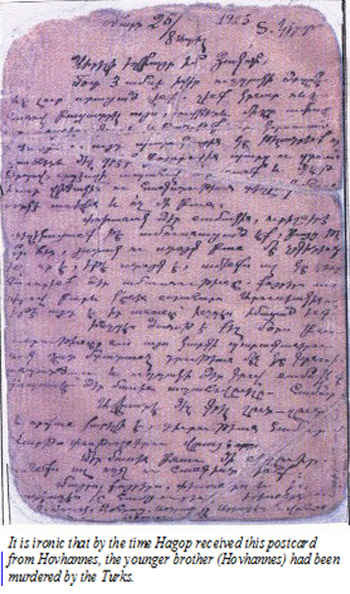
The other members of his family, who remained behind, were caught up in the Armenian-Assyrian-Hellenic Genocide of 1915. As was the custom of the genocidists, able-bodied male giavours (infidels) were murdered, and this included the husbands of Hagop’s two sisters, as well as Hagop’s brother, Hovhannes.

dibistan_amed5-copy1See photograph of postcard below, with English translation, sent by Hovhannes Der Kasbarian to his older brother, Hagop,in America.

“March 25/8 April 1915 D.Gerd (Dikranagerd)

My dear brother Hagop,

We have not received any direct news from you for close to three months. We cannot explain this because your letters always arrived within a month. We can guess that they got lost on the way. In that case we suggest that from now on you write to us in a very concise, simple way so we can receive it securely and thus learn of your situation and well-being. Nothing more than that.

Instead of a letter from you, we heard from others that you have gotten married. But to whom? We do not know anything clearly and for sure. Anyway, if it is true, we all congratulate your wedding. My sisters also send their love and greeting to the new bride, Arousiag, if that is her name as we had heard. As our mother’s character is known to you, she is in a state of anxiety when in similar situations. She absolutely awaits to receive a letter directly from you with your handwriting to hear that you are safe and sound. Try to write to us more often and as much as you can on post cards to make it easy. Do not worry about us. We are all well and alive.

Our mother, sisters, brothers-in-law and I warmly embrace you and kiss your cheeks. Greetings also from your nephews Kevork, Arshag, Zohrab, Antranig, Ardashes and Vahan.

Hovhannes.”

nameMy mother, Lousia, was from the city, and was exiled in 1915 along with her mother, Touma, and two infant children. Lousia’s father and her husband were victims of the Genocide, and her two children perished in the murderous march through the Syrian Desert. Ironically, my mother succeeded in preserving the deeds to properties in Dikranagerd that belonged to her husband and his family who were all liquidated in the Genocide. She also made a point of preserving as much of the culture she was forced to abandon, including the traditions, cuisine and dialect of Dikranagerd.

INFOWELAT: What an amazing coincidence! Our editor’s family roots also go back to “Elpinar,” as we say it. In fact, his two uncles still reside there. Our editor visited the area last week with photographers who took pictures of the village, and the church you mention, which is shown elsewhere in this interview.

How have Armenians been able to continue their identity and culture despite living in their Diaspora for the past one hundred years? Considering the pressures of the “American way of life” which is based on individual values rather than the collective ones, and the level of integration of Armenian-Americans into English speaking mainstream society, what do you think about the chances that Armenian-Americans can continue their group identity?

Kasbarian: Any time a people are separated from their indigenous lands, we will also regrettably see a departure from the native culture. It is difficult to authentically replicate that culture without environmental reinforcement, and it requires formidable effort to resist the influences of a new dominant culture that might not always be preferable or superior to the old one.

My parents succeeded in passing on to their children the language and customs of the Armenians at the cost of a great sacrifice of their ability to succeed materially in the New World. By making Armenian the language of the home, they saddled themselves with broken English for the remainder of their lives, and we were the beneficiaries of that sacrifice. The same can be said of my wife’s family.

To get an idea of our children’s involvement in Armenian matters, visit the web sites with which they are affiliated:

http://www.tufenkianfoundation.org/ and http://www.lucinekasbarian.com

To a degree, I fault our clergy for not discharging their responsibilities as leaders of the Armenian community, which has led to the precarious condition of our culture in exile. Whenever officiating at weddings of our young couples, had they given them advice, when blessed with children, to make Armenian the language of the home, and have their advice taken, we would be in much better shape today as Armenians.

For those of your readers who are interested in a comprehensive treatment of the subject, there is a lecture I delivered some years ago about the future of Armenian culture in America, the transcript of which is available here:

http://www.armeniapedia.org/wiki/Armenian_Culture_in_America:_Dead_or_Alive%3F

Although it has a pessimistic tone to it, I am including it here in the hope that the “hidden Armenians” among you will come forward to declare their Armenian identity, and perhaps form a nucleus around which Armenians in the Diaspora can rally.

hagop2INFOWELAT: Regarding your Dialect Handbook, when and how did you begin to compile words, expressions, phrases and other useful information? What are the difficulties of preparing a dictionary in your Diaspora?

Kasbarian: Sometime about 1970, I began recording whatever I knew from speaking to my parents and members of the Armenian community at large. After all, the Dikranagerdtsi dialect is my native language. I made entries in a notebook in my spare time. It started out mainly for self-amusement. As the years went by, I realized that a written record of our dialect was an important undertaking, and therefore took my task more seriously. With the advent of personal computers, I transcribed whatever I had recorded, until it grew to a size that was feasible to pass on to the public. “Dikranagerdi Parparuh,” a textbook on the Dikranagerdtsi dialect, had been published in Armenia back in 1978 and which I’m sure was useful to many persons who were interested in becoming knowledgeable of the dialect. However, I found it lacking in that it’s vocabulary did not include many Turkish, Kurdish, and Arabic words. Without those borrowings it was not a realistic portrayal of the way our forebears spoke on a daily basis.

Producing this Handbook was not a difficult undertaking for me personally because I merely recorded what I knew. Whenever I was not sure of the meaning of a term, or even its pronunciation, I would seek help from my friends and relatives. As far as the difficulty of publishing a book that is so specialized, and of limited interest among non-Armenians, I avoided that difficulty by choosing to publish only online in order to make it accessible beyond our borders, and at no charge.

INFOWELAT: Is the dialect still spoken by Armenian-Americans who are originally from the Dikranagerd region, that is now called Amed (Diyarbakir) by Kurds?

Kasbarian: Yes, there are some Armenian-Americans of my generation that converse in the dialect whenever they get together, which is less frequent as time passes. Not many of the younger generation make use of it, although they may fully understand. It has become a vehicle for humorous banter more than anything else.

You’ll notice that I spell Diyarbakir as Diarbekr. There’s a reason for that. My understanding is that the ancient name of the city, Amid, is of Assyrian origin, and that when the Romans colonized the city they called it Amida. Following the Romans, the Persians came to power and were succeeded by the Muslim Arabs. It was the leader of the Arab Bekr tribe, who renamed the city Diar Bekr, meaning – the country of Bekr. Much later Mustafa Kemal gave the city its current name Diyarbakir, which was derived from the copper ore that exists there. Diarbekr is the spelling that appears on many old maps, and is used by writers on the subject, such as Gertrude Bell, as well as H.F.B. Lynch*, who surveyed all of Armenia, east and west, and drew a map that showed all the cities, towns and villages with their old names, before they were changed. You can see the villages surrounding Dikranagerd where my relatives lived, such as Alipounar, Hazro, and Haini.

malbat3-copyINFOWELAT: What are the exact borders of the historical Dikranagerd region? Considering the vast geography where Armenians lived, what are the other dialects Armenians have spoken? Did any dialect become extinct after the Armenian scattered around the world?

Kasbarian: I don’t know if I can answer the first part of your question; however, your readers can inform themselves of the history of Dikranagerd, and Diarbekr, whose ancient name is Amida, as we say it, by viewing a video that contains a slide lecture by Dr. Herand Markarian. It can be accessed at the following URL, documenting a cultural evening celebrating the Dikranagerd Armenian heritage: (Advance to the 31 minute mark of the video)

As far as dialects go, every city with its surrounding villages had its individual way of speaking. Kharpert (Elazig), Sepastia (Sivas), Moush, Palou, Yerzinga (Erzincan), Erzerum, etc. all differed to some degree. Some did not depart radically from the standard Armenian language; some did. Dikranagerdtsi is difficult for other Armenians to understand because of the heavy borrowings from neighboring languages. Dikranagerdtsis have two ways of pronouncing the letter (a). There is the standard pronunciation as in the English word bar. Then there is the flat (a) that is borrowed from Arabic, Persian and Kurdish, such as in the English word hat.

I’m not able to say which dialects have become extinct, if any. I’m sure some are on the border of extinction.

INFOWELAT: Was there a standard Armenian language spoken in the region you call Western Armenia and used by Armenian political, educational and other organizations?

Kasbarian: Definitely. Those Armenians who are partial to the Eastern version of the Armenian language sometimes refer to Western Armenian as a dialect of the original language. This would be like saying that French, Italian and Spanish are dialects of Latin. However, they are viable and distinct languages, and so is Western Armenian. A vast body of literature has been composed in Western Armenian, which is the version used by most Armenians outside of the Republic of Armenia and Iran. The texts of many folk songs from the villages of Western Armenia include many terms intrinsic to Western Armenian and reflect the influence of Turkish and Kurdish.

INFOWELAT: Do you have any information regarding the language influences of Armenian on Kurdish and Kurdish on Armenian? Can you give some examples?

Kasbarian: I don’t know about the influence of Armenian on Kurdish, but I can give you an idea of the influence of Kurdish on the Dikranagerdtsi Armenian dialect.  There are scores of words from Kurdish that we still use, For example:

Adǎt: custom

Akhur: end, outcome

Alav: flame

Azab: bachelor

Bǎg: feudal lord, ace in card-playing

Betǎr: worse

Chamour: mud

Dǎrǎjǎ: staircase

Dǎvǎ: camel

Furchǎ: brush

Hǎrs: anger

Jǎgh: fence

Kǎchǎl: bald

Mala mineh: All my home and family have disappeared. (Used to describe a child’s idea of disaster.)

Peshgir: towel

Shor: salty

Shorba: soup

Tǎshkǎlǎ: tumult

Toutkal: glue

Zad: meal, stew

The well known and beloved Armenian folk song Dle Yaman is a case where Armenian has been influenced by Kurdish. Dil means heart in Kurdish, and dle means my heart. Yaman, in my opinion, is a mispronunciation of aman, which means grief or sorrow. Thus, dle aman can mean my grieving heart, or my sorrowful heart, which matches the lamenting nature of the song.

INFOWELAT: The Turkish rulers created barriers between Armenians and Kurds who were native inhabitants of the same country and they succeeded with this project by using Kurdish people in the Armenian Genocide. We know the rest of the story of Armenian-Kurdish relations, which has continued to be marked by a lack of contact. As an Armenian intellectual, what do you suggest to start mutual relations in this regard and what kind of responsibilities could both players have? The remains of Sourp Asdvadzadzin Church in Alipounar photographed under the guidance of our editor could perhaps be a starting point. Do you think Diasporan Armenians would like to see it restored? If so, would they be willing to contribute to the funding of the cost of renovation?

Kasbarian: First of all, when you refer to me as an intellectual, I must inform you that I do not approve the use of that word as a noun. It is pretentious sounding. As an adjective it is perfectly fine. One can have intellectual pursuits or curiosity. Now, to try to answer your question, I am not a member of any political party, nor do I occupy a position of authority within Armenian community organizations. I merely offer my views as a writer on matters that affect the Armenian community at large. The best I can do is to appeal to my fellow Armenians to make their views known to our leaders, and hope that these leaders possess the wisdom to pursue a policy that has popular support. But first, our rank and file Armenians must be alert as to what our future is likely to be without a recovered homeland.

From informal polls, today, we know that now, more than in decades past, Armenians are traveling to Eastern Turkey to visit their ancestral lands. The successful undertaking by the global Armenian community to renovate Sourp Giragos Church in Dikranagerd is a good indication of the strong ties that many Armenians still feel for their homeland. We also know that many Armenians claim they would develop ties with their ancestral lands if they felt they could safely do so. This could include but not be limited to Armenian refugees from the war in Syria, whose ancestral homeland is in modern Turkey. But other Armenians claim they would not return, even to visit, because they do not wish to feed a Turkish economy that has already inherited and benefited from the theft of Armenian wealth and property. Perhaps generating and publicizing a census regarding individual intentions of Armenians with regard to their ancestral lands will clarify the issue. Such a census should include a reference to Sourp Asdvadzadzin Church in Alipounar to determine if the Armenians living abroad would be interested in helping to restore the church.

As far as historical Kurdish-Armenian relations are concerned, we Armenians, from our perspective, are aware of the injustices we have suffered at the hands of the Kurdish Begs, as exemplified in the well-known novel, Khentuh (The Fool), written by Raffi (Hagop Melik Hagopian) in 1881. It is available in Armenian and English translation, but has yet to be translated into Kurdish and Turkish. One English translation of The Fool by Jane Wingate in 1950 is now in the public domain and freely available online here: http://www.cilicia.com/armoz.html

And now, if I may, I invite your Kurdish colleagues to ask themselves the following questions on Kurdish-Armenian relations.

Have any of your Kurdish colleagues touched on this subject? What is the thinking among rank and file Kurds, especially in the Dikranagerd region? It’s all well and good for Abdullah Demirbaş, mayor of Sur in the province of Diyarbakir, to invite Armenians back. But does that reflect the thinking of those Kurds who are currently occupying property of the ancestors of those very same Armenians? Would your Kurdish colleagues like to see the forming of dialogues and alliances with Armenians of the Diaspora? If so, to what extent?

——————-

Note:
Lynch’s two volume work “Armenia: Travels and Studies” was published in London in 1901, and remains the definitive account in English of Armenia before the 1915 massacres. An Armenian translation of the book was published in London in 1902, and another in Constantinople in 1913. In modern Turkey, until at least the late 1990s, the book was on the official list of banned books.

Filed Under: Articles, Interviews Tagged With: Diasporan Armenian, History

Turkish PM’s Armenian statement unimaginable just 20 years ago

April 28, 2014 By administrator

ISTANBUL – Hürriyet Daily News
Barçın Yinançbarcin.yinanc@hurriyet.com.tr

n_65642_1The Turkish government’s message of condolence talking about the “shared pain” stemming from the mass killings of Armenians in 1915 is a watershed development that would have been unimaginable in years past, according to former Envoy Ömer Lütem.

“You could not imagine this, let’s say five years ago … 10 years ago, never; 20 years ago, it was unimaginable. There has been a change in the Turkish official position,” he said.

What is your evaluation of the statement?

It is related to the moral side of the Armenian question. First of all, it did not seem to have something related to politics. The moral side or the sentimental side is very important because Armenians really fell some pain.  It could look bizarre, because these events happened a century ago, but as they were repeated every day to them, there is the impression as if they happened recently. So the moral side is extremely important when you say we present our condolences; that we are sharing your pain.  I think it will have an influence on Armenians, but what will result from the political point, that remains to be seen. The militant ones won’t be influenced.  But the silent majority, the majority of the people who are not vocal, but they will be impressed. 

Does it mean that it is the first time the Turkish government has shown empathy with the pain you are talking about.

That empathy was expressed with strong words; it was never said like that before. The foreign minister said something similar, but the tone was softer

Is it the first time Turkey recognized April 24th as a remembrance day?


That is correct; before there was an effort not to notice it, but it was there. Yet officially … I don’t know. They did not put emphasis on recognizing April 24 as the Remembrance Day.

But is it an official recognition that something terrible happened in the past?

They did not put it that way. What is not emphasized is not what happened, but the pain that exists; they are not the same thing.

But after all pain is a consequence of an event; so that is not defined then?

That’s right. I think they did not say that something has happened on purpose. They tried to underline the human aspect of what happened.

What is the importance of the statement?

It is a very important turning point. Though it concerns the humanitarian aspect, it is first time that there has been a display of real empathy towards the Armenians. I have been dealing with the Armenian question for the past 30 years; I have not seen something similar: it is going directly to the people, to their pain, to the people suffering and trying to understand this and presenting condolences; you could not imagine this, let’s say 5 years ago … 10 years ago, never; 20 years ago, it was unimaginable. There is a change in the Turkish official position.

Why do you think it has taken so long?

I think that this government, from the beginning, tried to solve this question. Instead of fighting, arguing with the Armenians, they have been trying to find other ways.  One of the very important elements on the subject was the proposal about the creation of a historical commission.  Before, it was always Armenians saying something, and Turks saying ‘this is not right.’ The government tried another way, but they have not been successful until now.

With the centennial of 1915 approaching, I think the government had the idea to make something that would withdraw the people’s attention, especially the Armenians. I think this is the main cause.

So the Armenians will think their decades-long efforts of recognition are paying off.

Most of them will think that their efforts to convince that what happened is genocide are paying off; but the text of the PM’s message does not give this impression at all.  The message says from the moral point of view, yes we understand your pain, but it did not say anything that can be interpreted as recognition of genocide

But do you think it was a positive step?


Yes, it is, but I don’t know whether it will be well received or not. But this kind of move takes a rather long time to be accepted; you cannot expect a result in a few days’ time. The government of Armenia did not say much. Most probably they are consulting each other and some countries first, like Russia for instance.

How do you think the Turkish public received it?

In general it was well received. The main opposition party was not against; this is important.  The MHP [Nationalist Movement Party] was against it and that is expected.  The Kurdish party opted to support the Armenian view about three years ago anyway and the AK Party represents above half of the population. I can say that there is not much of strong opposition to that message except from the MHP.

Do you think there is an evolution in the Turkish society’s approach to the issue?

In the beginning, Turkish society was not very much against the Armenians.  First of all people, say they don’t know about the 1915 events. They became angry about these kinds of allegations; they took it as a personal offense. In time, they separated allegations and Armenians in the street. ‘I like my Armenian neighbor,’ they say, ‘but Turks would never commit genocide.’ But the message contains nothing controversial.

Do you think that the strong mandate Erdoğan received from the elections made it easier for him to take this step?

Without having such a big majority, no government would dare take this step.

You said previously that Turkish people were not aware of what happened to the Armenians; so do you think there is now awareness due to Armenians’ genocide recognition efforts?

Armenian terrorism is the main reason for the awareness. They began to shoot Turkish diplomats. And Turkish people were shocked and started asking questions.

What should be done as far as the next steps are concerned
?

Turkey has made a great effort; normally, Armenians should respond. And then if there is a positive reaction, then additional steps could come. But if I were in the government, I would rather wait for the reaction from the Armenians, especially in Armenia.

Who is Ömer Lütem ?
Born in Istanbul in 1933, Ömer Lütem graduated from the Faculty of Political Sciences, University of Ankara in 1957 and became carrier diplomat the same year. His most important posts have been:

Turkish Consul General at Cologne, Germany (1975-1979) Director General of Intelligence and Research of the Foreign Ministry (1981-1983), Ambassador of Turkey to Bulgaria (1983-1989), Deputy Undersecretary of the Foreign Ministry (1989-1992), Ambassador of Turkey to the Vatican (1992-1995), Permanent Representative of Turkey to UNESCO (1995-1997). In 1998 he retired.

He was previously Director of the Institute for Armenian Research of the Center for Eurasian Strategic Studies (ASAM), 2000-2008 and 2009-2012 Director of the Center for Eurasian Studies (AVIM). He has been advisor of the center since 2013.

Lütem is the editor of the Review of Armenian Studies, Ermeni Araştırmaları (Armenian Studies) and Uluslararası Suçlar ve Tarih (International Crimes and History).

His works include: Türkiye Bulgaristan İlişkileri, 1983-1989 (Turkish-Bulgarian Relations 1983-1989) (ASAM-Ankara 2000); Balkan Diplomasisi (Balkan Diplomacy) (Co-Editor) (ASAM-Ankara 2001); Ermeni Sorunu El Kitabı (Handbook of the Armenian Question) (co-author) (ASAM- TEİMK, Ankara 2003), Armenian Terror (ASAM- Ankara, 2007), Armenian Question: Basic Knowledge and Documentation (AVIM- Ankara 2009).

Filed Under: Articles, Interviews Tagged With: armenian genocide, intervew, Turkey

  • « Previous Page
  • 1
  • …
  • 14
  • 15
  • 16
  • 17
  • 18
  • …
  • 22
  • Next Page »

Support Gagrule.net

Subscribe Free News & Update

Search

GagruleLive with Harut Sassounian

Can activist run a Government?

Wally Sarkeesian Interview Onnik Dinkjian and son

https://youtu.be/BiI8_TJzHEM

Khachic Moradian

https://youtu.be/-NkIYpCAIII
https://youtu.be/9_Xi7FA3tGQ
https://youtu.be/Arg8gAhcIb0
https://youtu.be/zzh-WpjGltY


gagrulenet Twitter-Timeline

Tweets by @gagrulenet

Archives

Books

Recent Posts

  • Pashinyan Government Pays U.S. Public Relations Firm To Attack the Armenian Apostolic Church
  • Breaking News: Armenian Former Defense Minister Arshak Karapetyan Pashinyan is agent
  • November 9: The Black Day of Armenia — How Artsakh Was Signed Away
  • @MorenoOcampo1, former Chief Prosecutor of the International Criminal Court, issued a Call to Action for Armenians worldwide.
  • Medieval Software. Modern Hardware. Our Politics Is Stuck in the Past.

Recent Comments

  • Baron Kisheranotz on Pashinyan’s Betrayal Dressed as Peace
  • Baron Kisheranotz on Trusting Turks or Azerbaijanis is itself a betrayal of the Armenian nation.
  • Stepan on A Nation in Peril: Anything Armenian pashinyan Dismantling
  • Stepan on Draft Letter to Armenian Legal Scholars / Armenian Bar Association
  • administrator on Turkish Agent Pashinyan will not attend the meeting of the CIS Council of Heads of State

Copyright © 2025 · News Pro Theme on Genesis Framework · WordPress · Log in