Gagrule.net

Gagrule.net News, Views, Interviews worldwide

  • Home
  • About
  • Contact
  • GagruleLive
  • Armenia profile

Another Turkish aggression on neighboring country Syria’s Idlib in progress

October 13, 2017 By administrator

Turkish troops travelling in a convoy of 12 armoured vehicles have entered northern Syria in a new military operation.

Turkish news media reported that the vehicles carrying the troops crossed into Idlib province late on Thursday, Aljazeera reports.

The development came after Turkey said it was sending troops into Syria to enforce a de-escalation zone in Idlib.

The de-escalation zone forms part of an agreement reached between Turkey, which backs forces battling the government of President Bashar al-Assad, and Iran and Russia, which support his government.

Turkish media sources said the convoy included about 80 soldiers.

Local sources told Al Jazeera the troops were headed towards the western part of Aleppo province.

Filed Under: Articles Tagged With: idlib, Syrian, Turkey

Turkey sentences Wall Street Journal reporter to more than two years in prison

October 11, 2017 By administrator

A court in Turkey has sentenced a Wall Street Journal reporter to more than two years in prison on terrorism charges over an article, the newspaper said in a statement Tuesday, in a case that highlighted the Turkish government’s escalating clampdown on press freedoms, The Washington Post reported.

The reporter, Ayla Albayrak, was in New York at the time of the sentencing and planned to appeal the decision, the Journal said.

The charges against Albayrak, a dual citizen of Turkey and Finland, stemmed from an article that she wrote two years ago on Turkey’s ongoing war with Kurdish militants, the Journal statement said.

“The sole purpose of the article was to provide objective and independent reporting on events in Turkey, and it succeeded,” said Gerard Baker, editor in chief of the Journal, according to the statement. “This was an unfounded criminal charge and wildly inappropriate conviction that wrongly singled out a balanced Wall Street Journal report.”

The source reminds that the sentence appeared certain to aggravate the ongoing dispute between Turkey and the United States. The feud burst into public view Sunday, when the U.S. Embassy in Ankara announced that it was suspending the issuing of nonimmigrant visas at its missions in Turkey. The move was taken in response to Turkey’s arrest this month of the consulate employee, Metin Topuz, on espionage charges.

Turkey retaliated by quickly announcing an almost identical visa suspension. Erdogan, speaking in Belgrade, Serbia, weighed in on the dispute Tuesday, saying that “the offender in this problem is the United States of America itself.”


Source Panorama.am

Filed Under: Articles Tagged With: journal, sentences, Turkey, wall-street

Turkey, US keep finding ways to provoke each other

October 10, 2017 By administrator

By Pinar Tremblay,

A diplomatic row between Turkey and the United States continued to escalate Oct. 9, with Turkish authorities seeking a second US Consulate worker on terrorism charges. According to media reports, the suspect was refusing to leave the consulate Monday afternoon, and authorities were questioning his wife and son. Another consulate employee, Metin Topuz, was arrested last week.

Meanwhile, news of the discord between Turkey and the United States sent the Turkish lira plunging more than 6% Oct. 8 against the US dollar, although it regained much of the loss the following day. This followed the US Embassy‘s Oct. 8 announcement that said, “Effective immediately, we have suspended all non-immigrant visa services,” and Turkey’s in-kind response. It is crucial to note that the first sentence of the statement expressed concerns the US government has about Turkey’s commitment to the security of American personnel. This is a strong reprimand that indicates the growing lack of trust among the two longtime NATO allies.

The tit-for-tat exchange began Sept. 25 when Topuz, a Turkish national employed at the US Consulate, was taken into custody and accused of espionage and attempts to destroy Turkish constitutional order and the government. Authorities allege that he is linked to the Gulen movement, which Turkey blames for a coup attempt in July 2016. The United States has denied Turkey’s demands for the extradition of the movement’s leader, Fethullah Gulen, from his home in Pennsylvania.

Topuz was officially charged Oct. 4. On Oct. 5, the US Embassy in Ankara released a statement saying that officials were “deeply disturbed” about the arrest. It said Turkey was “trying the employee in the media rather than in a court of law” and using “leaks from Turkish government sources.” This detailed media coverage made the possibility of a fair trial impossible, the statement said.

The “leaks” began showing up a week before Topuz was even officially charged. For example, on Sept. 28, state-owned Turkish Radio and Television (TRT) news posted a detailed report. His full legal name, his alleged aliases and the specific locations of his alleged meetings with Gulenists — including room numbers — were published along with the dates of his supposed phone conservations with Gulen members. Details of his alleged crimes of spying and trying to destroy constitutional order were published widely.

“We believe these allegations to be wholly without merit,” the US Embassy said, adding that the defendant deserves “due legal process” in accordance with Turkish laws. Turkey and the United States have long had relations that are highly beneficial to both sides, the statement noted, adding, “Baseless, anonymous allegations against our employees undermine and devalue this longstanding partnership.”

The most recent moves came Oct. 9, when authorities issued an arrest warrant for the second consulate worker, whom they declined to name. The Turkish justice minister denied the US ambassador’s request for a meeting, even as Turkey’s Foreign Ministry summoned the US Embassy undersecretary, seeking to pressure the United States to restore visa services.

Topuz, who began working as an employee of the consulate in 1982, supposedly testified Oct. 6. According to news reports, he said that in 1993 he had assumed a position for the US Drug Enforcement Administration in Istanbul. Topuz has not denied making contact with Gulen members who were prominent officials at the time. He said he had to meet with them as part of his job.

Pro-government media outlets and hundreds of social media accounts latched onto his arrest and reported testimony as clear evidence that the July 15 attempted coup was backed by the United States, along with other troubles the government faced: the 2013 corruption probe and the Halkbank investigation. In commentaries, Topuz is frequently labeled in Turkish media as a CIA agent or spy.

Sabah Daily columnist Hilal Kaplan joined the fray, announcing Oct. 6 from her Twitter account that she had been disinvited to US Ambassador John Bass’ press conference because of her newspaper’s headlines about Topuz. In a subsequent tweet, she included an excerpt from the Turkish press in which Bass explained why certain press representatives were absent. He said, “Because I don’t consider them to be [media] outlets any longer, given the extent to which they deal in fiction and do not follow a set of basic journalistic ethics.” Bass emphasized he was disturbed by the Topuz case because some people in the Turkish government are “motivated by vengeance rather than justice.”

In the meantime, pro-government media reported Kaplan’s canceled invitation as press censorship. Kaplan and others kept reiterating the tacit involvement of the US government in the July 15 coup attempt. State-owned TRT World reported the incident with the headline, “US ambassador bans journalist over story she never wrote.”

Public criticism of US Embassy personnel was a recurring theme for politicians long before the coup. For example, in January 2016, Al-Monitor reported that Ankara’s mayor, a member of the ruling Justice and Development Party, asked Bass to leave Turkey or keep quiet. Pro-government Turkish media’s relentless efforts to link the US government to the July 15 coup attempt are also remarkable. Just a week after the coup attempt, Daily Sabah’s twitter account was running polls with loaded questions, asking things like which US institution provided the most support to the Gulenist terror group. The options available were CIA, FBI, Department of State and White House (the CIA received by far the most votes). Hence, when a US Consulate staff member was arrested, the Turkish public was ready to rejoice.

A grass-roots movement took off on social media as citizens demanded that US troops be expelled from Turkey’s Incirlik Air Base. The movement seemed to be gaining ground Monday. There was also talk of holding a protest in front of the US Consulate in Istanbul.

Topuz isn’t the first US Consulate employee to be arrested this year. On March 7, a translator at the consulate in Adana was charged with supporting the Kurdistan Workers Party, which Turkey and the United States consider a terrorist group.

Found in:CIA, TURKISH MEDIA, HALKBANK, ANKARA, VISA, US EMBASSY, GULEN MOVEMENT

Pinar Tremblay is a columnist for Al-Monitor’s Turkey Pulse and a visiting scholar of political science at California State Polytechnic University, Pomona.


Filed Under: Articles Tagged With: provoke, Turkey, US

Turkey Now Targeting Academic Freedom in Europe

October 9, 2017 By administrator

BY UZAY BULUT,

Turkey’s targeting of dissident academics seems to have crossed the borders of the country. Academic freedom in Europe and in the U.S. is being stymied by the Turkish government and nationalist groups.

Most recently, Turkey targeted a conference held September 15 to 18 at the European Academy Berlin entitled “Past in the Present: European Approaches to the Armenian Genocide.” It was part of the “Workshop on Armenian Turkish Scholarship (WATS),” a series founded by the University of Michigan in 2000. It was co-organized by the University of Michigan, the Dornsife Institute of Armenian Studies of the University of Southern California (USC), and Germany’s Lepsiushaus Potsdam.

Before the conference took place, nationalist groups, media outlets, and Turkey’s government-funded Council of Higher Education (YÖK) targeted the organizers and participants in a PR campaign.

This led to academics working in Turkish universities to withdraw.

The head of the ultra-nationalist Homeland Party (Vatan Partisi) and a long-time avid denier of the Armenian genocide, Doğu Perinçek, were prominent leaders of the PR campaign. At a press conference on September 6, Perinçek accused the conference and Sabancı University — one of the organizers of this year’s conference — of engaging in “a betrayal of science, university identity, law, and the homeland.” He added:

This workshop serves the project of “Kurdistan,” or more correctly, “a second Israel” of USA imperialism. Particularly the fifth panel of the workshop discusses the “unity of fate” of Armenians and Kurds against Turkey. This is an imperialistic confession.

Perinçek called on the YÖK to prevent Turkish academics from joining the conference.

Following Perinçek’s denunciation of the workshop, the ultra-nationalist paper Aydınlık attacked Sabancı University with an article headlined: “Hey Sabancı, Stop This Disgrace.”

The pressure on the universities and academics by the YÖK and the media bore fruit. Sabancı University withdrew from the event.

On September 8, Aydınlık proudly reported its “victory” in a headline that read: “No academics for the workshop of lies.” In another report, Aydınlık referred to those who participated in the workshop as “fake academics,” and listed the PR campaign’s “accomplishments” concerning the workshop:

The conference has literally “fallen to pieces” after the head of the Homeland Party, Doğu Perinçek, warned that the conference was a betrayal of science and homeland.

So, there is no longer a Turkish university left in the workshop of betrayal. The beginning date of the workshop has been postponed to the next day; the withdrawn Turkish academics have been replaced with foreigners and the access to the program is now subject to permission. It would be an insufficient explanation if we did not say the persevering and determined attitude of the YÖK has greatly contributed to getting these results.

In reality, the academics who participated in the event are top scholars engaged in vital, critical research, and are highly regarded for their academic endeavors on a global scale.

The Middle East Studies Association (MESA) of North America and its Committee on Academic Freedom has issued a written statement about the pressure placed on the conference and the academics:

As part of his broader campaign against the conference, Perinçek brought the topic and list of participants to the attention of YOK, which subsequently rescinded permission for Turkey-based academics to travel to the conference. In line with this policy, Dr. Murat Cankara, who is on the faculty at the Ankara Social Sciences University, was subjected to a travel ban preventing him from participating in the conference.

In addition, ultra-nationalist Turkish diaspora organizations, in apparent coordination with Perinçek’s party, have mobilized against the conference and are threatening a show of force at the Lepsuishaus, the main organizer of the event in Germany. No doubt, anyone who attends the conference is at risk of being filmed/photographed, blacklisted, and hounded by social media trolls in Turkey.

The smear campaign led by the daily Aydınlık, associated with Perinçek and his party, targets the private Koç and Sabancı Universities and accuses especially the latter of treason. The atmosphere of intimidation and threats has grown so alarming that the cancellation of the conference is being considered.

We strongly condemn the private and public harassment of academics for their planned participation in this conference and call on YÖK to immediately reverse its policy of preventing academics from traveling from Turkey to attend the conference.

We consider this action to be an assault on the academic freedom of scholars in Turkey.

Despite the pressure and the threats, many academics from Turkey who are currently based outside the country did participate in the event as speakers. However, they were still targeted.

The ultra-nationalist People’s Liberation Party (Halkın Kurtuluş Partisi, HKP) filed a criminal complaint against two participants and the presidents of Koç and Sabancı universities based on article 301 of Turkish criminal law, which punishes those who “insult Turkishness.”

Yektan Türkyilmaz, a prominent Armenian genocide scholar from Turkey who attended the conference as a speaker, and who is now based in Germany, said:

Source: https://pjmedia.com/homeland-security/2017/10/09/turkey-now-targeting-academic-freedom-europe/

Filed Under: Articles Tagged With: academic, targeting, Turkey

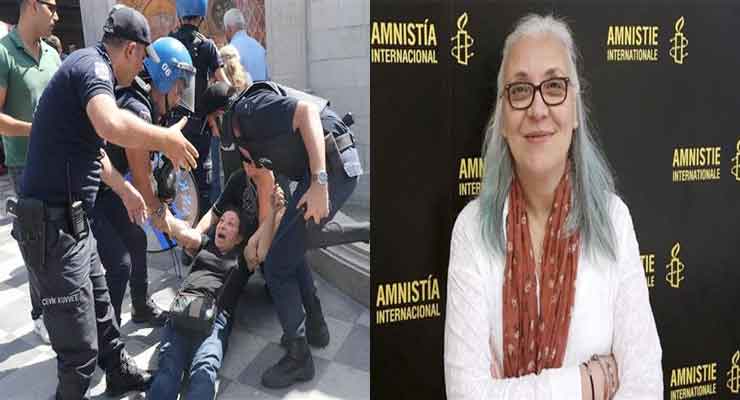
Turkish prosecutors seek prison terms for Amnesty Turkey chief, 10 other activists

October 9, 2017 By administrator

Nearly a dozen prominent rights activists in Turkey, including two foreign nationals, are facing up to 15 years in prison over charges of membership in terror groups and aiding them some three months after they were detained in Istanbul.

Turkey’s state-run Anadolu news agency reported on Sunday that Public Prosecutor’s Office in Istanbul had completed its investigation into nine Turkish activists, including Taner Kilic, Amnesty International’s Turkey chief, and German Peter Steudtner along with Swede Ali Gharavi.

The suspects were detained at a workshop, organized by Amnesty, on digital security at a hotel in Buyukada of Istanbul’s Princes’ Islands on July 5 on charges of taking “membership in an armed terrorist organization” and “aiding an armed terrorist organization” in the meeting.

In a 17-page indictment, which was approved by Istanbul Chief Prosecutor Irfan Fidan, prosecutors sought prison terms from seven-and-a-half to 15 years. The indictment was later sent to the Istanbul Heavy Penal Court.

The indictment charged Kilic with armed terror group membership, whereas the rest of the suspects were charged with aiding an armed terror group.

According to the indictment, the suspects allegedly tried to incite violent and chaotic mass public protest rallies when Kemal Kilicdaroglu, the chairman of the main opposition Republican People’s Party, held “Justice” march between June 15 and July 15.

Kilicdaroglu and his fellow party members marched from the capital Ankara to Istanbul, calling for justice for people jailed for their purported connections to a number of terror groups, particularly the Fethullah Terrorist Organization (FETO), led by US-based cleric Fethullah Gulen.

Ankara accuses Gulen of being the mastermind of last year’s mid-July failed coup in the country. The 76-year-old cleric has since strongly rejected the government’s allegations, but Ankara labeled his movement as FETO and designated it as a terrorist organization.

Amnesty, while denouncing the detention of the activists, describes Gharavi as an IT strategy consultant and Steudtner as a “non-violence and well-being trainer.”

The jailing of the 11 activists, including Amnesty’s director in Turkey, Idil Eser, has already sounded international alarm and amplified fears of waning freedom of speech under President Recep Tayyip Erdogan.

Prosecutors charged Kilic with FETO membership, whereas the rest were accused of helping an armed terror group, including FETO.

Since the botched putsch, Ankara has unleashed a massive crackdown across the country, suspending or dismissing more than 150,000 judges, policemen, teachers, and civil servants and arresting nearly 50,000 others.

Many rights groups, including Amnesty and Human Rights Watch, have slammed Ankara’s heavy clampdown on perceived putschists.

Filed Under: Articles Tagged With: amnesty, chief, Turkey

United State -Turkey escalates tit-for-tat travel and visa restrictions

October 9, 2017 By administrator

US restrictions appear to be linked to arrest of consulate employee in Istanbul over alleged links to Gülen movement

The US and Turkey have imposed travel restrictions on each other’s citizens in an escalating diplomatic spat that highlights worsening relations between Ankara and its western allies.

Washington said late on Sunday it was suspending the processing of all non-immigrant visas in Turkey due to “recent events” that “have forced the United States government to reassess the commitment of the government of Turkey to the security of US mission facilities and personnel”.

Ankara responded in the early hours of Monday with an identical statement, imposing tit-for-tat measures and suspending the processing of visas in its embassy and consulate in the US. It also shut down its online visa system for US citizens.

The Turkish move effectively closed its borders to American visitors residing in the US or elsewhere, unless they can obtain visas from diplomatic missions outside their home country.

A rift between Turkey and the west has broadened in the aftermath of last year’s coup attempt, divergence over the war in Syria, and a crackdown against alleged putsch collaborators.

The US government’s restrictions appeared to be linked to the arrest last week of a local consulate employee in Istanbul over alleged links to the movement of Fethullah Gülen. Gülen, an exiled preacher based in Pennsylvania, is widely believed in Turkey to have orchestrated last year’s coup attempt. Ankara has long demanded the cleric’s extradition.

The US embassy said it was “deeply disturbed” by the arrest, and said the allegations were “wholly without merit”.

Later on Monday, in another escalation, the Turkish foreign ministry said it had summoned the American charges d’affaires, and the Istanbul prosecutor’s office said it had ordered the questioning of another US consulate official as a suspect in an unidentified case.

Filed Under: News Tagged With: Turkey, US, visa restrictions

Turkey, Iran to use national currencies in bilateral trade

October 5, 2017 By administrator

Turkey and Iran have agreed to use national currencies in trade in a bid to ease the parity risks over their bilateral trade, the leaders of both countries announced on October 4.

At a joint news conference in Tehran with his Iranian counterpart Hassan Rouhani, Turkish President Recep Tayyip Erdoğan said the goal of raising Turkish-Iranian trade volume to $30 billion from $10 billion remains on the agenda, adding that some decisions were made to reach this target.

“Iran and Turkey agreed on the use of national currency in bilateral trade to ease foreign currency risks on the road to increasing trade volume,” he said, according to Hurriyet Daily News.

He also added that the officials from both countries’ central banks would next meet to finalize the steps to be taken in this key field, while also adding Turkey was interested in opening Turkish banks in Iran.

Rouhani said three customs gates between Turkey and Iran would work for 24 hours.

“Two customs gates will work 24 hours a day by tomorrow. As soon as technical and construction issues are resolved in the third gate, it will also start to work 24 hours a day,” he noted.

Filed Under: Articles Tagged With: currencies, Iran, Turkey

Turkey: Erdogan issues another warrants for 254 Istanbul municipality and staffers over coup

October 3, 2017 By administrator

Turkish authorities have issued detention warrants for 254 Istanbul municipality and staffers of ministries on suspicion of links to the alleged mastermind of last year’s coup attempt.

Prosecutors in Istanbul ordered the detention of 112 current and former staffers of municipalities in the city on Tuesday, Turkey’s official news agency Anadolu reported.

At least 67 of these suspects have so far been detained since the issuance of the arrest warrants, the news agency added.

In Ankara, prosecutors issued arrest warrants for 142 staffers of the education and sport ministries, most of whom had already been fired from their jobs over their alleged links to the US-based opposition figure Fethullah Gulen, whom the Turkish government accuses of having orchestrated the attempted military coup.

According to the agency, the suspects were accused of being users of the ByLock mobile application, which the Turkish government claims to be the top communication tool among members of the Gulen movement.

The latest warrants mark a fresh escalation against the Gulen movement. On Monday, the Interior Ministry said about 1,000 people had been arrested over the previous week on allegations of links to what authorities described as the “Gulenist Terror Group.”

Turkey witnessed a coup attempt on July 15, 2016, when a faction of the Turkish military declared that the government of President Recep Tayyip Erdogan was no more in charge of the country.

However, over the course of some two days, the putsch was suppressed. Almost 250 people were killed and nearly 2,200 others wounded in the abortive coup.

Gulen has denied the charges of having masterminded the coup.

In a post-coup crackdown, Turkey has suspended or dismissed more than 150,000 judges, policemen, teachers, and civil servants and has arrested nearly 50,000 others.

Many rights groups, including Amnesty International and Human Rights Watch, have denounced Ankara’s heavy clampdown on perceived putschists.

Filed Under: Articles Tagged With: coup, Turkey, warrants

FourTurkish security personnel killed & eight guards injured in operation against Kurdish PKK in Turkey’s east

September 30, 2017 By administrator

Two Turkish military personnel and two security guards were killed early Saturday during an operation against the Kurdistan Workers’ Party (PKK)  (outlawed in Turkey) in the eastern province of Agri, province’s governorship told Anadolu Agency.

The governor Suleyman Elban added that eight security guards were also injured in the same operation in the province’s Dogubeyazit district.

The operation reportedly came after PKK militants killed three migrants Monday and injured seven others.

Filed Under: Articles Tagged With: PKK, Turkey, war

What kind of ‘end-user certificate’ exists between Russia and Turkey

September 27, 2017 By administrator

Author Anahit Voskanyan

The Russian “Pravda” newspaper published analysis days ago over the Karabakh issue and Turkey’s acquisition of Russia’s most advanced S-400 missile defense system.

In the author’s conviction and as he claimed in the piece when Turkey reached an agreement with Russia over the purchase of the S-400 systems in April, FEW could suppose that could affect the balance of power between Armenia and Azerbaijan.

In an interesting way, they ‘came to that conclusion’ only after the comments by Azerbaijani lawmaker Rasim Musabekov, suggesting “Russian interference into the Karabakh conflict on the side of Armenia would inevitably lead to Turkey’s taking the Azerbaijani side.”

The time coincided with reports by Turkish sources, saying the country plans to deploy the newly obtained missile systems at the border with Armenia. Let us put aside the long-persisted Azerbaijani practice of intimidating us with its “big brother” Turkey, as do the fact why Russia acted so ‘naively’ to sell weapons in a region where it positions itself as a mediator. Similarly, it would be best to leave out the Russians’ ‘surprise’ over reports of Turkey’s initiative to deploy the missile systems at the border with Armenia, likewise Russian cynical justifications of arm sale to Azerbaijan for solely ‘business considerations.’

Let us only accept the fact that Russia sells weapons to Turkey with follow-up new questions, surfacing whether Russia plans to sell new arms to Turkey, what kind of weapons, if so, and whether Turkey can resell those arms to Azerbaijan. Does the Armenian diplomacy track those possible developments? We addressed the question about the possibility to resell arms to Armenian ministries of foreign affairs and defense.

In its official clarification, the foreign ministry referred to the Russian legislation mandating the required document of the so-called ‘end-user certificate’ for military devices and equipment which is a document used in international transfers, including sales and export of the arms to certify those will be used only for the stated purposes, that the buyer is the final recipient of the materials, and not planning on transferring or re-exporting of the materials to third parties without the agreement of the original supplier of the arms.

Thus, it remains to see what kind of ‘end-user certificate’ exits between Russia and Turkey!

Filed Under: Articles Tagged With: Armenia, Russia, S-400, Turkey

  • « Previous Page
  • 1
  • …
  • 20
  • 21
  • 22
  • 23
  • 24
  • …
  • 271
  • Next Page »

Support Gagrule.net

Subscribe Free News & Update

Search

GagruleLive with Harut Sassounian

Can activist run a Government?

Wally Sarkeesian Interview Onnik Dinkjian and son

https://youtu.be/BiI8_TJzHEM

Khachic Moradian

https://youtu.be/-NkIYpCAIII
https://youtu.be/9_Xi7FA3tGQ
https://youtu.be/Arg8gAhcIb0
https://youtu.be/zzh-WpjGltY


gagrulenet Twitter-Timeline

Tweets by @gagrulenet

Archives

Books

Recent Posts

  • Pashinyan Government Pays U.S. Public Relations Firm To Attack the Armenian Apostolic Church
  • Breaking News: Armenian Former Defense Minister Arshak Karapetyan Pashinyan is agent
  • November 9: The Black Day of Armenia — How Artsakh Was Signed Away
  • @MorenoOcampo1, former Chief Prosecutor of the International Criminal Court, issued a Call to Action for Armenians worldwide.
  • Medieval Software. Modern Hardware. Our Politics Is Stuck in the Past.

Recent Comments

  • Baron Kisheranotz on Pashinyan’s Betrayal Dressed as Peace
  • Baron Kisheranotz on Trusting Turks or Azerbaijanis is itself a betrayal of the Armenian nation.
  • Stepan on A Nation in Peril: Anything Armenian pashinyan Dismantling
  • Stepan on Draft Letter to Armenian Legal Scholars / Armenian Bar Association
  • administrator on Turkish Agent Pashinyan will not attend the meeting of the CIS Council of Heads of State

Copyright © 2025 · News Pro Theme on Genesis Framework · WordPress · Log in